• F2
  • F3
  • F1
  • F4

Collar decorated with floral broderie anglaise, handmade, c. 1900, the Netherlands (TRC 2007.0755).Collar decorated with floral broderie anglaise, handmade, c. 1900, the Netherlands (TRC 2007.0755).Gillian Vogelsang-Eastwood, 1 June 2024

While working on the various European volumes of the Bloomsbury World Encyclopedia of Embroidery, we often come across  broderie anglaise, otherwise also sometimes known as broderie de Calais, although there are minor differencesThere are various examples of this type of embroidery in the TRC collection.

In the US the term Madeira work is frequently used. As such it is named after the Portuguese island of Madeira, which lies in the Atlantic Ocean, west of Morocco. It was probably introduced on Madeira by Catholic nuns who taught in convent schools.

But what is broderie anglaise?

Basically it is a type of whitework, i.e., embroidery using white threads on a white ground, with the pattern mainly made from eyelets. These are small, round or oval holes deliberately cut into the ground material.

By Shelley Anderson, friend and long-time volunteer at the TRC (27 May 2024)

A recent visit to the Portuguese Synagogue in Amsterdam made me think about velvet, and especially the gorgeous velvet pieces in the TRC collection, and the TRC online exhibition: Velvet!. And please note, there are still some places left for the TRC study day on velvet, on Friday 31st of May. If you are interested, let us know asap.

Portuguese Synagogue, Amsterdam (1675). Photograph by Massimo Catarinella. This file is licensed under the Creative Commons Attribution-Share Alike 3.0 Unported license.Portuguese Synagogue, Amsterdam (1675). Photograph by Massimo Catarinella. This file is licensed under the Creative Commons Attribution-Share Alike 3.0 Unported license.

by Gillian Vogelsang-Eastwood, 23 May 2024

We have just had several groups visiting the TRC to see what the TRC is doing, to look at the current exhibition about Chinese garments and in particular to discuss the role of embroidery, past, present and future. And the reactions were positive, as more and more people are getting interested in embroidery and want to acquire the skills behind this ancient textile form. Not surprisingly, given the extensive nature of the TRC’s embroidery collection, everyone was intrigued, interested and surprised by what is in the archive and collection boxes! There were various request to have this box and that box opened.

Our visitors were also very impressed by the Bloomsbury World Encyclopedia of Embroidery – they had not realised that there are so many different forms of embroidery produced, sometimes for thousands of years, in almost every corner of the world. This is a craft that certainly deserves an eight-volume series.

Given the various reactions we thought we would write an embroidery update. We just finished the final proofs of the fourth volume of the series, which is about embroidery from Scandinavia and Western Europe. It is c. 600 pages in length (the maximum we could have in one volume), with hundreds of colour pictures, black and white illustrations as well as diagrams. Again there are numerous maps and stitch illustrations, drawn by our colleague Dit e-mailadres wordt beveiligd tegen spambots. JavaScript dient ingeschakeld te zijn om het te bekijken.. The volume will be published on the 14th November 2024.

We are now working on the fifth volume, which is about embroidery from Eastern Eiurope and beyond, from the Baltic countries to Macedonia and Greece, not forgetting Russia, Turkey, Armenian, Azerbaijan and Georgia, to name just a few countries. We have had offers of help from various people and groups, including Armenian, Bulgarian, Hungarian, Polish, Romanian and Russian embroiderers and historians.

by Dr Gillian Vogelsang-Eastwood, Director TRC, 22 April 2024

Lace cap made from a very fine net (tulle) with applied embroidered and appliqué motifs of various types and sizes. The Netherlands, 19th century (TRC 2024.1174).Lace cap made from a very fine net (tulle) with applied embroidered and appliqué motifs of various types and sizes. The Netherlands, 19th century (TRC 2024.1174).It has been a funny old week at the TRC! Lots of things happening, even more to think about and some unexpected donations that have led to totally different thoughts!

We have had various meetings over the last few weeks about the future of the TRC, its role in Leiden, about textile studies in general, about the nature of the TRC Collection, how we can improve the TRC website, especially the database, not to mention the question whether we really need to regularly set up small exhibitions.

It has been a confusing, frustrating and at times enlightening time, with the promise of more discussions to come, but in the long run, the TRC will be the stronger for this period of ‘soul searching’.

I would like to thank everyone who has been helping, thinking with us and adding useful and constructive comments.

by Marije Boerma (20-04-2024), who recently completed a Research Master of colonial and global history at Leiden University. The topic of her thesis was the East African kanga.

Black and speckled with red and white designs of hearts, crosses and dots: the kisutu cloth, for wrapping around the body, from the island of Zanzibar along the East African coast may be the oldest type of kanga. The TRC has a large collection of these garments, and hence it seemed appropriate to write a short blog on the subject.

Kisutu from Zanzibar, 2004 (TRC 2004.0162).Kisutu from Zanzibar, 2004 (TRC 2004.0162).

Studyday: What is a thread. TRC, 15 March 2024.Studyday: What is a thread. TRC, 15 March 2024.by Gillian Vogelsang-Eastwood, Director TRC, 17 April 2024

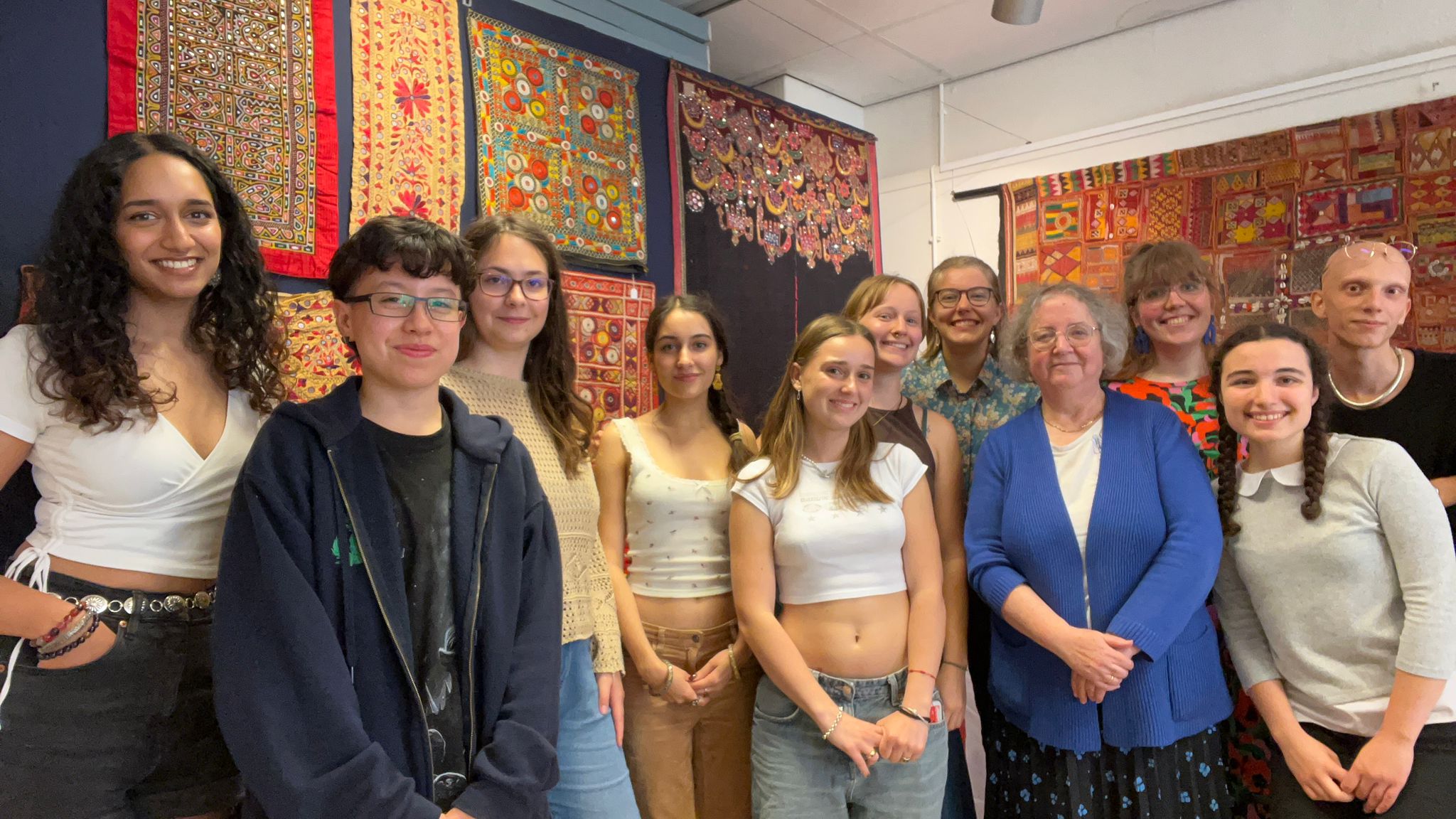
We have recently had three very different groups visiting and working at the TRC Leiden. How enjoyable it was to talk about various forms of textiles and to listen to what people could tell us.

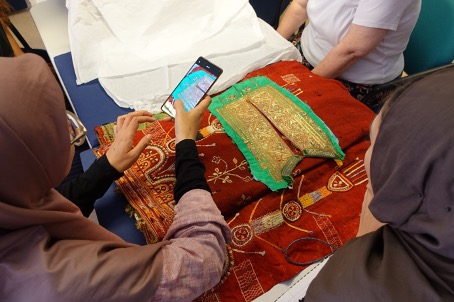
The first group consisted of students from the Royal Academy of Art in The Hague, who are studying a variety of textile-related subjects including design, interior design and textiles in general. The group included students with very diverse cultural and ethnic backgrounds. There were some lively discussions about cultural appropriation, return of artefacts, role of museums, handling of objects, symbolism and textile designs.

What struck me most was the enthusiasm and understanding of the subject by the students with multiple cultural experiences. What all of the participants enjoyed, however, was opening boxes with objects from the TRC collection and physically handle textiles from around the world.

I am looking forward to hearing more from the students and learn what they gained and how they turned the newly acquired information into practice.

The second group was there for the study day ‘What is a thread?’ There were eight people present, some of whom had considerable experience with spinning, others with no experience at all.

The day started with looking at various natural fibres and their properties and then we went on to the theory of fibres (natural, artificial, synthetic, metallic, etc); at the TRC we strongly feel that if you do not understand the initial composition of cotton or wool then you will not understand how and why the fibres react when turned into a thread.

by Olivia Buchan, TRC volunteer from Scotland, and currently MA student in Russian and Eurasian Studies, Leiden University. 12 April 2024

Since joining the bobbin lace classes at the TRC in the autumn of last year and later joining as a volunteer, I have been discovering just how broad the world of lace is. I am currently reorganising the TRC’s reference collection of lace, which contains over 1200 pieces (and more are continually being catalogued, photographed and added to the TRC Collection database).

Sample of chemical lace. The Netherlands (TRC 2007.0593).Sample of chemical lace. The Netherlands (TRC 2007.0593).

By Gillian Vogelsang-Eastwood, 9 April 2024

A few days ago (Saturday 6th April) we had a really interesting, pleasant and intriguing meeting in Leiden with Polish colleagues about medieval Christian wall paintings from Nubia (northern Sudan and southern Egypt), and about the role and the future of the TRC and textile studies in general. Dr. Karel Innemée , a TRC Board member, professional archaeologist and textile/dress specialist working in Egypt and Sudan, and at present an assistant professor at the University of Warsaw, brought the Polish group to see the TRC.

Polish delegation visits the TRC, 6 April 2024Polish delegation visits the TRC, 6 April 2024

Zoek in TRC website

Contact

Boerhaavelaan 6
2334 EN Leiden.
Tel. +31 (0)6 28830428  
office@trcleiden.org

facebook 2015 logo detail


instagram vernieuwt uiterlijk en logo


Bankrekening

NL39 INGB 0002 9823 59, t.a.v. Stichting Textile Research Centre.

Openingstijden

Het TRC is gesloten tot maandag 4 mei vanwege de verhuizing naar de Boerhaavelaan. We blijven bereikbaar via email (office@trcleiden.org) of telefoon: 06-28830428.

Financiële giften

Het TRC is afhankelijk van project-financiering en privé-donaties. Al ons werk wordt verricht door vrijwilligers. Ter ondersteuning van de vele activiteiten van het TRC vragen wij U daarom om financiële steun:

Giften kunt U overmaken op bankrekeningnummer (IBAN) NL39 INGB 000 298 2359, t.n.v. Stichting Textile Research Centre. BIC code is: INGBNL2A

U kunt ook, heel simpel, indien u een iDEAL app heeft, de iDEAL-knop hieronder gebruiken en door een bepaald bedrag in te vullen: 


Omdat het TRC officieel is erkend als een Algemeen Nut Beogende Instelling (ANBI), en daarbij ook nog als een Culturele Instelling, zijn particuliere giften voor 125% aftrekbaar van de belasting, en voor bedrijven zelfs voor 150%. Voor meer informatie, klik hier