• F1
  • F4
  • F2
  • F3

Fig. 1. Ottoman Turkish apron, late nineteenth century (TRC 2003.0199).Fig. 1. Ottoman Turkish apron, late nineteenth century (TRC 2003.0199).My blog of 9 August about an Ottoman-period apron now in the TRC Collection (Fig. 1TRC 2003.0199), certainly ‘opened up a can of worms’, as the saying goes.

We received loads of questions: How was the bib held in place? The ties are too short! Strange shape! It is too flimsy to be useful! Even, what is an apron?

Let’s take the last question first. According to the Shorter Oxford English Dictionary an apron is: ….. (1) An article of dress, orig. of linen, worn in front of the body, to protect the clothes from dirt or injury, or simply as a covering; (2) A similar garment worn officially by bishops, deans, Freemasons, etc., 1704; (3) Anything like an apron in shape or function esp. the leather coverings for the legs in a gig etc., 1875.

Fig. 2. A triangularly shaped apron made from glass beads in various colours, which are used to create simple, geometric patterns. New Guinea, Indonesia, 1930s (TRC 2016.0998).Fig. 2. A triangularly shaped apron made from glass beads in various colours, which are used to create simple, geometric patterns. New Guinea, Indonesia, 1930s (TRC 2016.0998).The modern English word apron derives from the medieval English napron, which comes from the old French word naperon, and eventually from the Latin nappa, meaning a napkin.

Aprons can be made out of any material, from thick leather (such as those worn by blacksmiths) and beading (Fig. 2; TRC 2016.0998), to fine and semi-transparent cloth, in fact they can be made of anything. They can also be decorated with embroidery or printing, or be ornamentally woven.

By Shelley Anderson, 1 September 2024

One of the biggest lessons I’ve learned volunteering at the TRC is how dress is a marker of identity. What we wear says so much about how we see ourselves and how we want others to see us, about our dreams and self-expression. One major identity we show by what we wear is gender.

Amsterdam drag queen Jennifer Hopelezz (l) poses with Amsterdam Mayor Femke Halsema (r) in front of the Stonewall Inn in New York City, in April 2019. Hopelezz’s dress reflects the red and black colours of the Amsterdam (NL) city flag.Amsterdam drag queen Jennifer Hopelezz (l) poses with Amsterdam Mayor Femke Halsema (r) in front of the Stonewall Inn in New York City, in April 2019. Hopelezz’s dress reflects the red and black colours of the Amsterdam (NL) city flag.

In 2019 the TRC put together its digital exhibition Rainbow People: 50 Years of Stonewall.  It was a celebration of the 50th anniversary of the Stonewall Uprising, which kickstarted the modern movement for LGBTQ+ rights. The exhibition includes about 30 objects, from badges and jewellery, to a pink shirt from an Irish LGBT+ choir (TRC 2019.1992) to a hand crocheted rainbow kippa (TRC 2019.1607).

Distressed denim sari by Diksha Khanna. Made in 2018 from scrap denim, it consists of a long denim skirt with an attached lighter denim pallu, and cotton blouse. Photo: Shelley Anderson.Distressed denim sari by Diksha Khanna. Made in 2018 from scrap denim, it consists of a long denim skirt with an attached lighter denim pallu, and cotton blouse. Photo: Shelley Anderson.By Shelley Anderson, TRC volunteer, 20 August 2024

The sari is an iconic women’s garment from India. At its simplest, a sari is a rectangular, unstitched length of cloth anywhere from 4 to 9 yards long, draped around the body as clothing. Some researchers believe its origins lie 5,000 years in the past, in the Indus Valley civilization, where a statue of a bearded man was excavated, a fabric draped around his torso, leaving his right shoulder bare. There are references to draped garments in the sacred Rig Veda, dated circa 1,000 BCE, and in later Jain and Buddhist writings, from circa 450 BCE.

While there are over 30 different regional variations, a modern sari is usually worn wrapped or pleated around the waist (often tucked or pinned into a petticoat), with the end (called pallu)often heavily embellished, thrown over the left shoulder. A short-sleeved blouse, called a choli, is worn underneath. The TRC has almost 200 saris from the late 20th to the early 21st century in its collection. They are from all over the Indian subcontinent, including Assam, West Bengal, Tamil Nadu and Kerala, and are primarily from chiffon, cotton, or silk.

by Marije Boerma, TRC Volunteer and specialist in African textiles and garments, 13 August 2024

Every day at the TRC may lead to something remarkable. All textiles and garments have stories to tell, and at times some of them really demand your attention. This was the case for the Donso hunting tunic that I encountered while checking on the state of the collection boxes.

Bambara Donso's tunic (donsodloki), Mali, late 20th century (TRC 2018.3397).Bambara Donso's tunic (donsodloki), Mali, late 20th century (TRC 2018.3397).

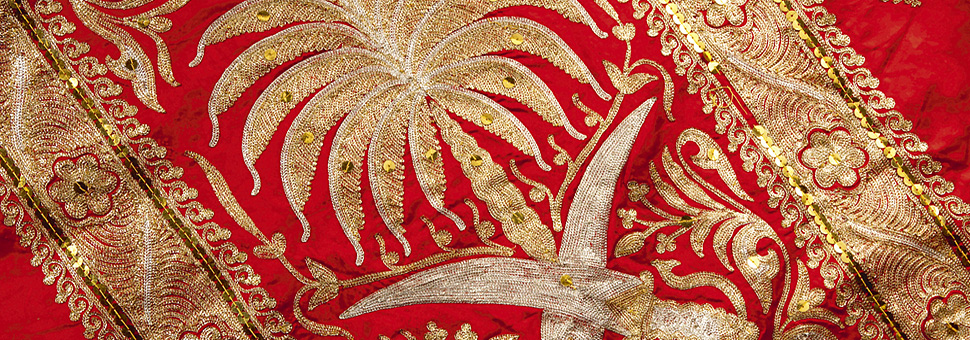
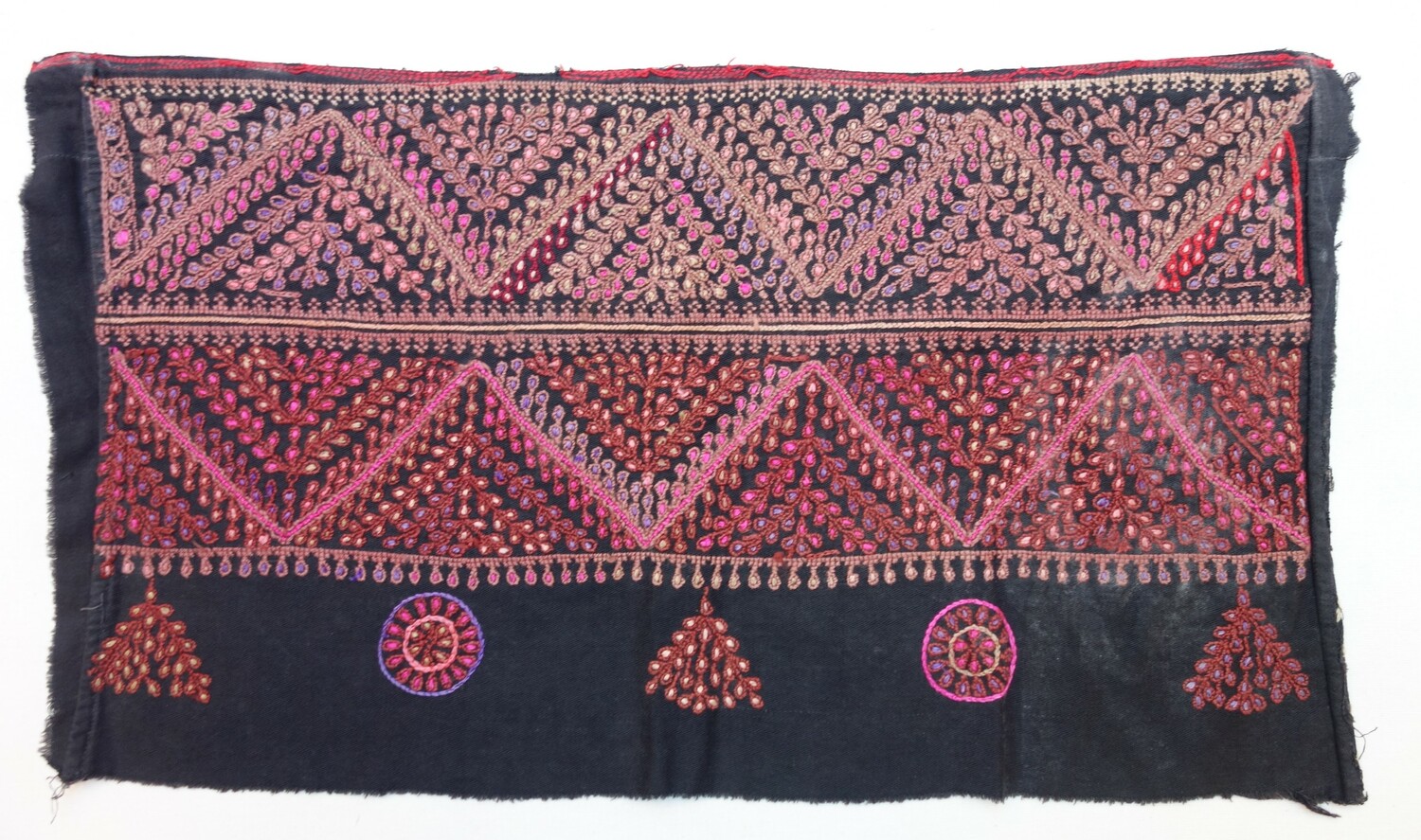
Embroidered panel from Ottoman Turkey, 19th century, probably for the tourist market (TRC 2024.2255).Embroidered panel from Ottoman Turkey, 19th century, probably for the tourist market (TRC 2024.2255).(11 August 2024) In a recent TRC blog about an Ottoman-period embroidered apron (TRC 2003.0199), I mentioned that the garment, which also has embroidered texts in Arabic script, may have been intended for the tourist market.

Recently, the TRC was given two metal-thread embroidered panels, also from Ottoman Turkey, which include images of mosques, crescent moons and stars, as well as some texts (TRC 2024.2255 and TRC 2024.2256).

What do the texts say, and were both of them, as we suspect, intended for the 19th century tourist market?

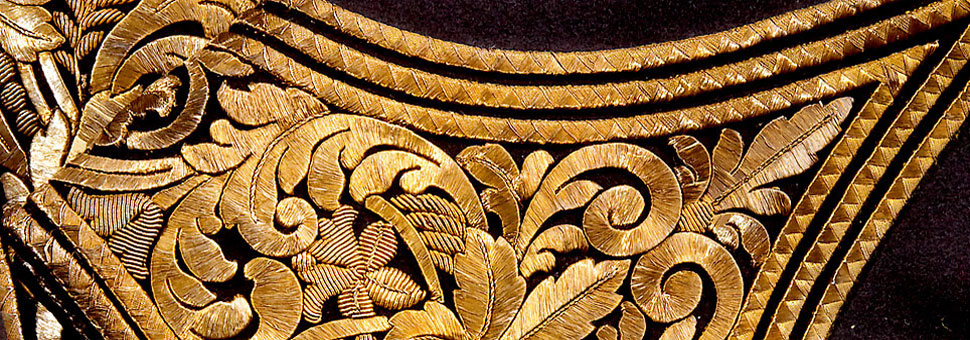
These questions were initiated by the apron discussed previously. Basically, the apron consists of a small bib, a skirt section and waist ties. They were made from a fine cloth, decorated with floral, geometric and paisley (buteh) motifs in white silk and gold-coloured metal thread. There are also texts around the outer edge of the skirt section.

The bib has a signature (tughra) based on the name of a sultan, worked in satin stitch, using white floss silk and silver metal thread (passing). In addition, the waist ties have texts in Arabic script (although one of these texts is worked upside down).

(9 August 2024) I am currently working on the fascinating, but complicated history of Ottoman Turkish embroidery, for the 5th volume of the Bloomsbury World Encyclopaedia of Embroidery. The volume is about central and eastern European embroidery, including Russia, the Balkans, Greece, Turkey, and the Caucasus.

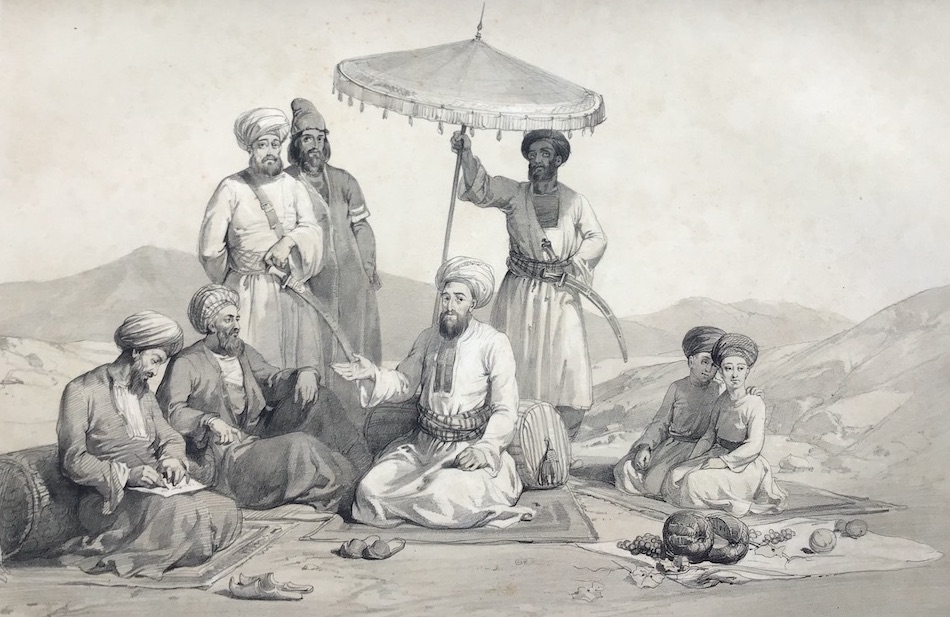
A drawing by an anonymous artist portraying the daily life in the Grand Bazaar in Ottoman times.A drawing by an anonymous artist portraying the daily life in the Grand Bazaar in Ottoman times.As part of the initial research I have been reading Turkish and European travelogues and reports about life in the Ottoman Empire, in order to glean further information about embroidery, its many forms, techniques and influences.

One of the books I have been delving into is by Charles White (1793-1861). White was a former colonel in the British army, who served under Wellington in the Peninsular War between 1807-1814. He later went on to live in Istanbul (which he called Constantinople) between 1841 and 1844. He wrote a three-volume book entitled Three Years in Constantinople: Domestic Manners of the Turks (London, 1845). He died in Brussels in 1861.

Dr Willem Vogelsang, Lt Col. (ret) and former Cultural Advisor to the Dutch armed forces in Afghanistan. 8 August 2024

Wood engraving based on a photograph of the Kandahar citadel where Harry Lumsden and his team stayed in 1857-1858. The Illustrated London News, 14 August 1880, p. 157. Public domain. Inside the citadel was a filature for sericulture.Wood engraving based on a photograph of the Kandahar citadel where Harry Lumsden and his team stayed in 1857-1858. The Illustrated London News, 14 August 1880, p. 157. Public domain. Inside the citadel was a filature for sericulture.

While preparing a manuscript for a book about 19th century foreign perspectives on Afghanistan, I came across an intriguing passage in Major Harry Lumsden’s report of his mission to Kandahar (in southern Afghanistan) in 1857-1858. It reminded me of a series of articles about modern sericulture in Herat, in the west of the country, recently published in the Kabul Times (compare ‘Sericulture turning common in Herat’, 22 July 2019, and ‘Herat’s silk industry offers women opportunity to work outside home’, 16 August 2022).

De afgelopen dagen hadden we een Indiaas tintje op het TRC.

Rechthoekig stukje stof versierd met geometrische en zeer gestileerde mensfiguren in verschillende kleuren, en met kleine glazen spiegeltjes (shisha-werk). India, 2017 (TRC 2017.2653).Rechthoekig stukje stof versierd met geometrische en zeer gestileerde mensfiguren in verschillende kleuren, en met kleine glazen spiegeltjes (shisha-werk). India, 2017 (TRC 2017.2653).

Afgelopen week kregen we bezoek van Lipika Bansal (van de Textielfactorij in Amsterdam), die verschillende groepen Indiase ambachtslieden naar Nederland brengt om speciale workshops te geven. Vroeger omvatten deze lessen blokdrukvormen, maar Lipika breidt nu uit met verschillende Indiase borduurtechnieken.

Ze georganseerd momenteel de overkomst naar Nederland van een Kutch-borduurster, Geetaben Meriya, die in september komt om lessen te geven over shisha-werk, op verschillende locaties in het land. We hebben afgesproken om een ​​van deze masterclasses bij het TRC te houden. Meer specifiek zal de bijeenkomst gaan over Kutch-spiegelwerk (shisha), waarbij glazen spiegeltjes op een stoffen ondergrond worden bevestigd met behulp van verschillende borduurtechnieken.

Zoek in TRC website

Contact

Boerhaavelaan 6
2334 EN Leiden.
Tel. +31 (0)6 28830428  
office@trcleiden.org

facebook 2015 logo detail


instagram vernieuwt uiterlijk en logo


Bankrekening

NL39 INGB 0002 9823 59, t.a.v. Stichting Textile Research Centre.

Openingstijden

Het TRC is gesloten tot maandag 4 mei vanwege de verhuizing naar de Boerhaavelaan. We blijven bereikbaar via email (office@trcleiden.org) of telefoon: 06-28830428.

Financiële giften

Het TRC is afhankelijk van project-financiering en privé-donaties. Al ons werk wordt verricht door vrijwilligers. Ter ondersteuning van de vele activiteiten van het TRC vragen wij U daarom om financiële steun:

Giften kunt U overmaken op bankrekeningnummer (IBAN) NL39 INGB 000 298 2359, t.n.v. Stichting Textile Research Centre. BIC code is: INGBNL2A

U kunt ook, heel simpel, indien u een iDEAL app heeft, de iDEAL-knop hieronder gebruiken en door een bepaald bedrag in te vullen: 


Omdat het TRC officieel is erkend als een Algemeen Nut Beogende Instelling (ANBI), en daarbij ook nog als een Culturele Instelling, zijn particuliere giften voor 125% aftrekbaar van de belasting, en voor bedrijven zelfs voor 150%. Voor meer informatie, klik hier