
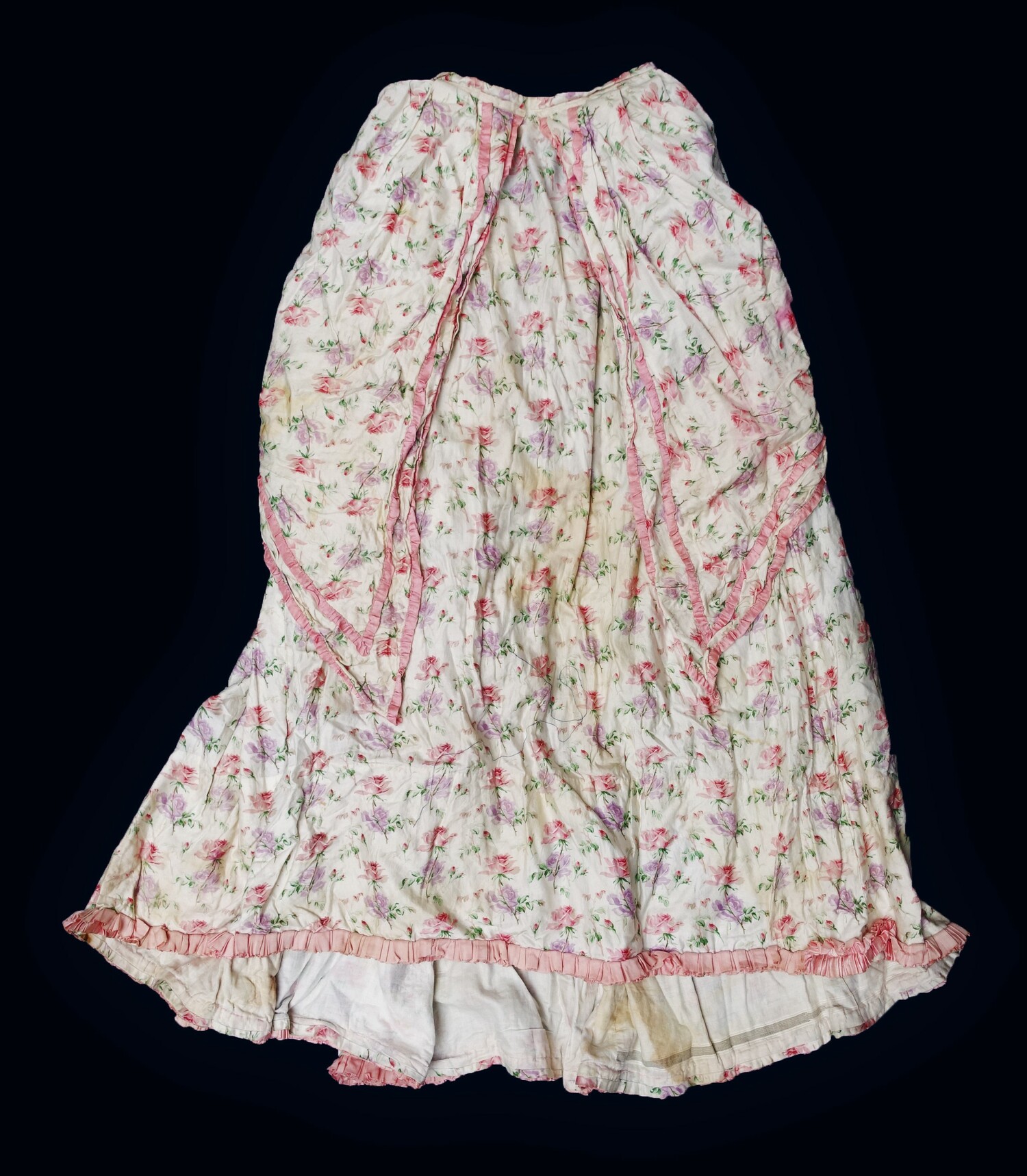
 Full length bustled, cotton and silk skirt in white with printed pink and purple floral motifs (TRC 2022.2726a). The inside pocket contained the embroidered handkerchief TRC 2022.2726b. 19th century, Europe.There have recently been some exciting and unusual donations to the TRC, such as that of an Empire-style period dress, but ‘small’ finds occur on a regular basis as well. Two such examples are the discovery of a forgotten handkerchief and the identification of the girl who made a late 19th century school sampler. Both of these ‘textile tales’ are described below by Nelleke Ganzevoort.
A forgotten handkerchief
Recently, I was at the TRC while three volunteers were at work in the depot. One of the ladies, Renske, was examining a late 19th century skirt (TRC 2022.2726a). It was quite an interesting and complex garment, and we were trying to find out how it was constructed and worn. Then we noticed the skirt had an inside pocket and that there was something inside! Renske got it out. It looked like a wad of used tissues, the sort of thing you would throw into the rubbish bin. But of course it wasn’t, it was an embroidered handkerchief, used and then forgotten for over 125 years (TRC 2022.2726b).
 Handkerchief found in a pocket of 19th century skirt TRC 2022.2726a (TRC 2022.2726b).
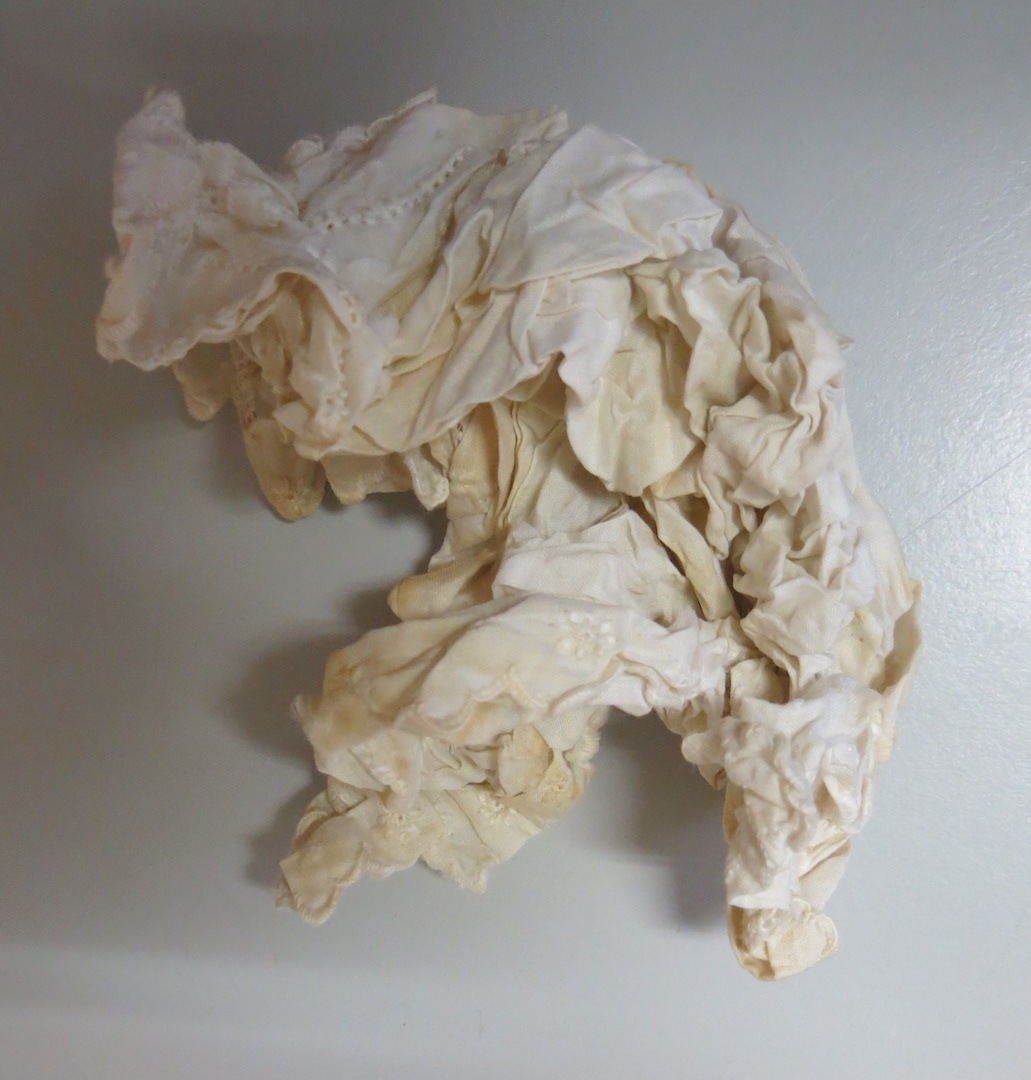 Crumpled embroidered handkerchief (TRC 2022.2726b), found inside a pocket of 19th century skirt TRC 2022.2726a.
I carefully (!) washed and ironed the crumpled piece of cloth, but I didn’t try to get out the stains; just got it clean and flat enough to be studied. It was made of very fine cotton, and about 30 x 30 cm in size.
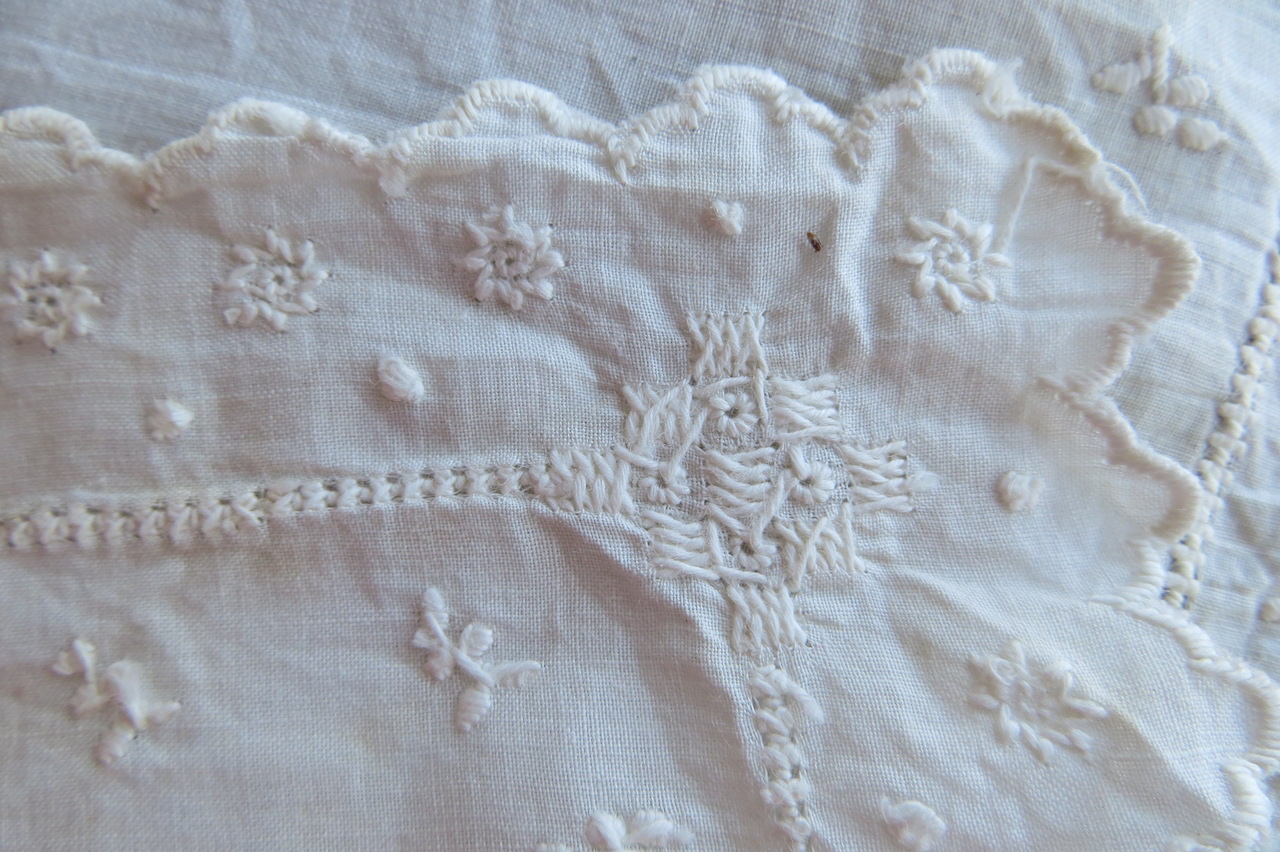 Detail of embroidered handkerchief (TRC 2022.2726b), found inside a pocket in 19th century skirt TRC 2022.2726a.On closer examination it was clear that it had been hand embroidered using a whitework technique, although I needed a magnifying glass to be sure because it was so finely worked. The handkerchief was decorated with a prettily scalloped border, with little flowers in straight stitches and in satin stitch, as well as lines in four-sided stitch with some shadow work on the corners. Just lovely and so delicate!
But of course, it left us all wondering, who had made the handkerchief, was the person who last used it sick with a cold, hence its used state, and why did it remain forgotten for over a century in the pocket of the skirt? Sadly, we will never know the answers to these and other questions, if only the embroidered handkerchief could talk and tell us its story!
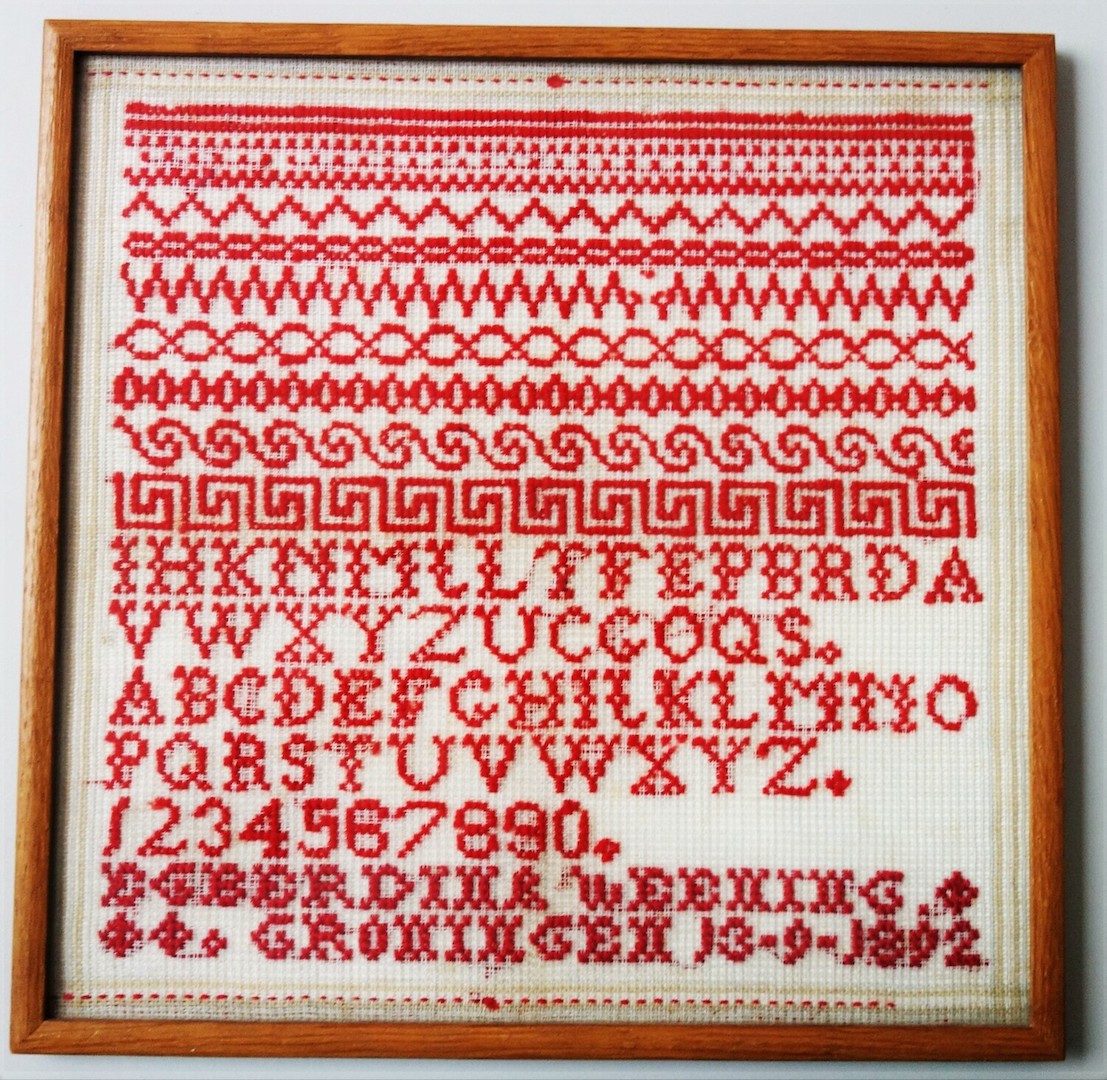 Sampler worked by Egberdina Weening, 1892 (TRC 2022.3203).Egberdina Weening’s sampler
I have just had an email from Gillian saying that the TRC has registered a ‘school’ sampler (TRC 2022.3203), which included the name of Egberdina Weening, the place: Groningen and the date: 13th September 1892. Gillian asked if the TRC’s sampler detective (me!) could find out more about her?
A little work on the internet produced the following results: Egberdina Weening was born in Groningen on 13-09-1892. Her parents were Johannes Pieter Weening, a postman, and Diewerke Mulder. Egberdina had three older siblings: Catharina, born in 1885, Egbert, born (and died) in 1887, and Derkiena, born in 1888. We know that the family moved to Huizum, near Leeuwarden, in 1902, and then onto Amsterdam in 1905.
In 1922, there is a newspaper report that mentions ‘E. Weening’ in a list of people who passed an examination for teaching gymnastics in Groningen. If this is our Egberdina, it means that she had become a gym teacher.
The next record of Egberdina comes in 1938, when she was living on the Frisian island of Terschelling, where she had married a 61-year old widower called Leendert Groendijk who had two grown sons. Egberdina was 46 by this time, so it is unlikely that this marriage produced any children.
Local newspaper reports tell us that Leendert Groendijk died in 1946. After that, I found one later mention of Egberdina: an obituary in a 1959 newspaper of a man called Albert Kok, living in Huis ter Heide (near Utrecht). E. Groendijk-Weening was mentioned as his housemate. After that there would appear to be no further records about Egberdina Weening.
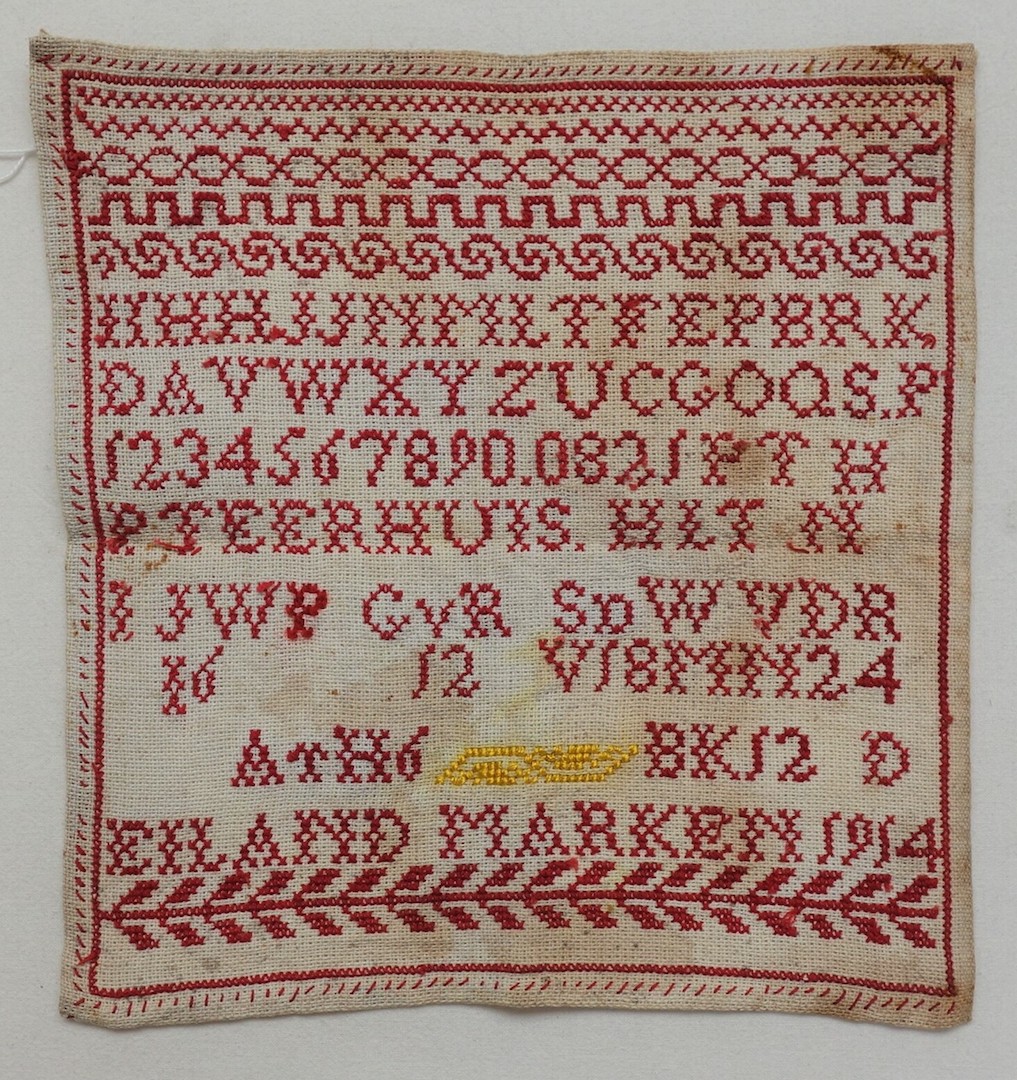 School sampler with rows of simple designs, letters, numbers and various initials. It includes the text: "EILAND MARKEN 1914" (TRC 2018.2382).Going back to the sampler – there is a curious aspect to it, namely that the date on the sampler is her birth date, not the date when she made the sampler. That does not make it a birth sampler as we know it now. By ‘birth sampler’ I mean a sampler, made to commemorate the birth of a baby by a close family member such as a mother, grandmother or aunt, and which was often used as an adornment to the nursery. Birth samplers are a fairly modern phenomenon, and are seldom seen before the Second World War (1939-1945).
Egberdina’s sampler is not a ‘traditional’ birth sampler, but it is a typical school sampler (see for example, TRC 2007.0612 and TRC 2018.2382), which could be found in many parts of Western Europe in the late 19th and early 20th century. They were made in school as a first attempt at needle work, using red cotton thread on a canvas ground and very formal. Every girl in her class would have carried out exactly the same needlework exercises. The samplers were first stitched with simple lines of repeating geometric patterns before going on to slightly more complicated borders. This was often followed by an ABC alphabet and a row of numbers.
As noted above, it is quite unusual to have birth date on a sampler of any period before the Second World War, but it does happen. In this case we may have a clue in the fact that the name, place and date on Egberdina’s sampler are stitched in a slightly different red thread and in smaller letters and numbers.
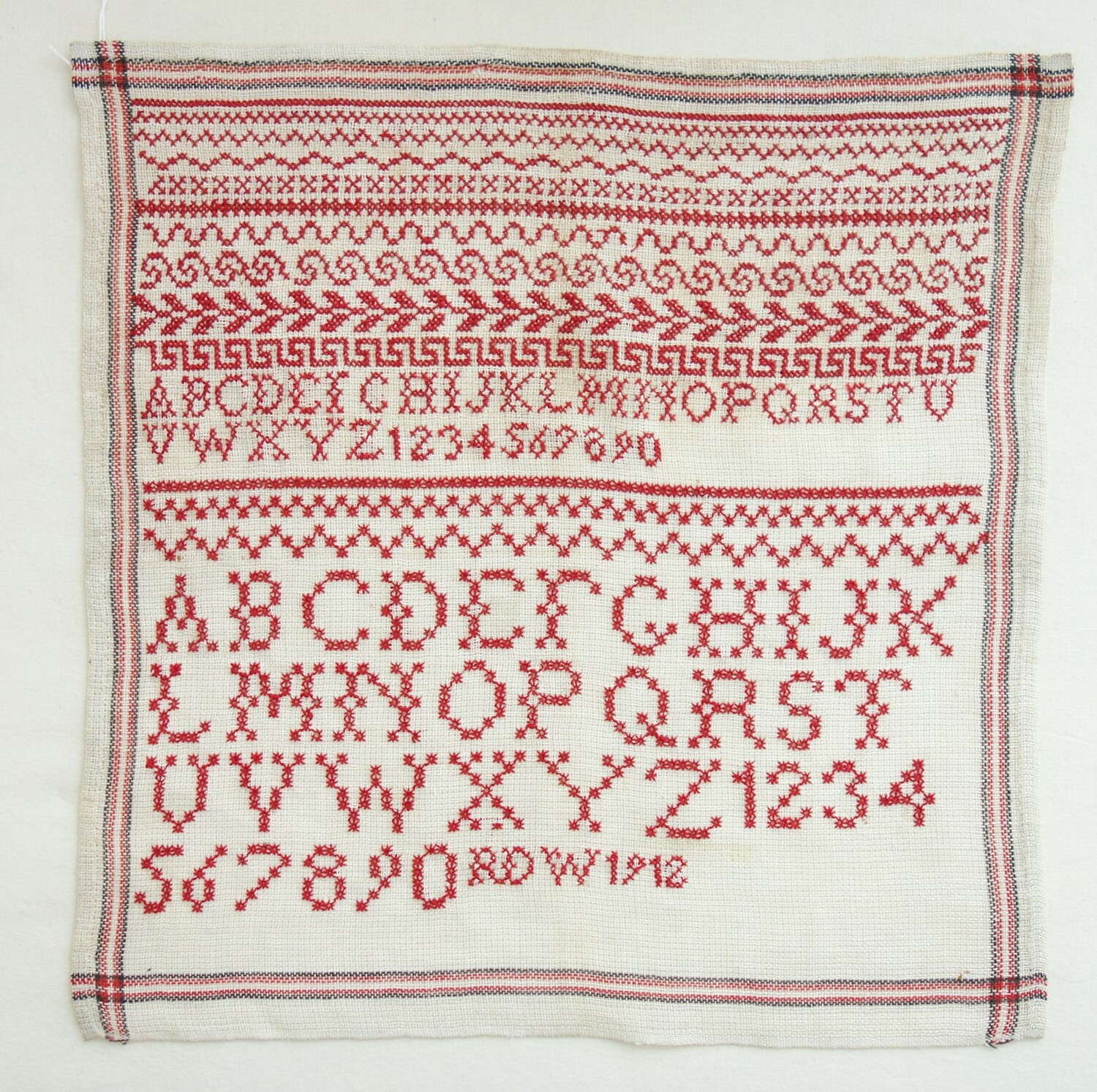 A school sampler worked with cross stitch and eyelet stitch using a red cotton yarn. The Netherlands, 1912 (TRC 2020.1609).Red school samplers were done in school, and at the end of the school year the girls will have taken them home, whether finished or not. In the next school year they would start afresh on a new piece of needlework.
If there was some empty space left on a school sampler, some girls finished it at home (but, of course, most did not! See for example TRC 2020.1594 and TRC 2020.1609). I think Egberdina went on stitching, filling up her sampler with a red thread from her mother’s sewing box. Because she worked on it at home, she was free to put in her date of birth, as something more meaningful to her, rather than the date of working her sampler.
Egberdina will have been about nine years old when she made this sampler. Therefore, it was probably done in Groningen, before the family moved to Huizum. In any case, it can be dated to 1901-1902.
Nelleke Ganzevoort, 4 January 2023