
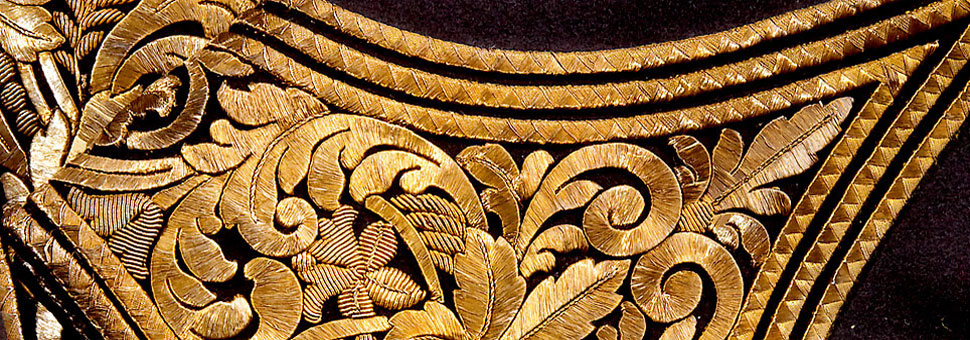
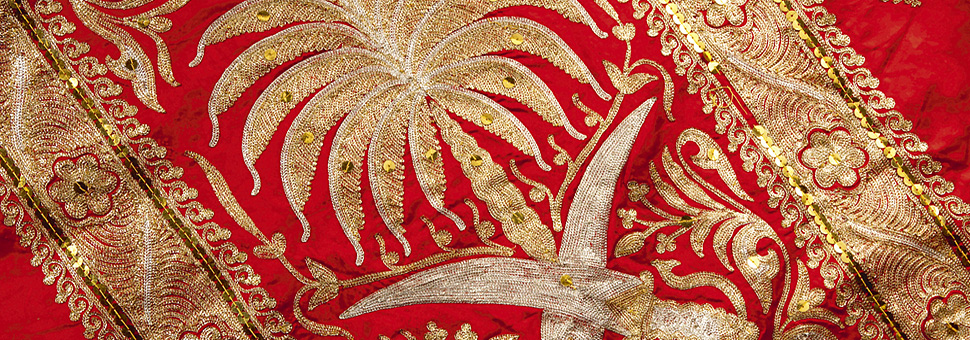
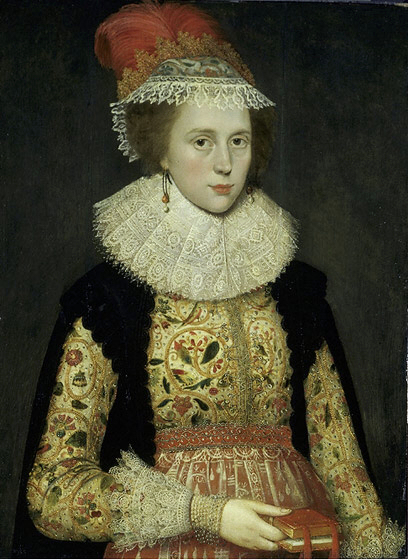
 Oil painting of Margaret Layton with a detailed display of her garments, by Marcus Gheeraerds, c. 1620. Victoria and Albert Museum, London, T.228-1994. Open domain.Willem and I went to a museum recently with lots and lots of paintings, rather than ‘just’ textiles! But what struck me was how the two of us approach looking at a painting in different ways. I must admit that neither of us are really interested in vague comments about how the light falls upon the subject, or whether the abstract lines suggest a deep fear of something or other.
Willem likes looking at when a painting was made, by whom and what buildings, if any, are depicted. He especially likes looking at Dutch paintings to see if a particular building is still there or not, and can he recognize landscapes and other features. We have been going to various towns and places, for example, associated with the Dutch painter, Vincent van Gogh.
And how do I approach a painting? Well, I have a practical nature and I really like late medieval, Renaissance and various schools of 19th century paintings that show lots of details that I can use in books, articles and exhibitions. I am currently working, for example, on the Bloomsbury World Encyclopedia of Embroidery, more specifically vol. 4, which is about Scandinavian and West European embroidery.
So yes, I am looking for examples of embroidery in paintings, how it is used and where. Although in all too many cases it is usually depicted as a blur of small lines!
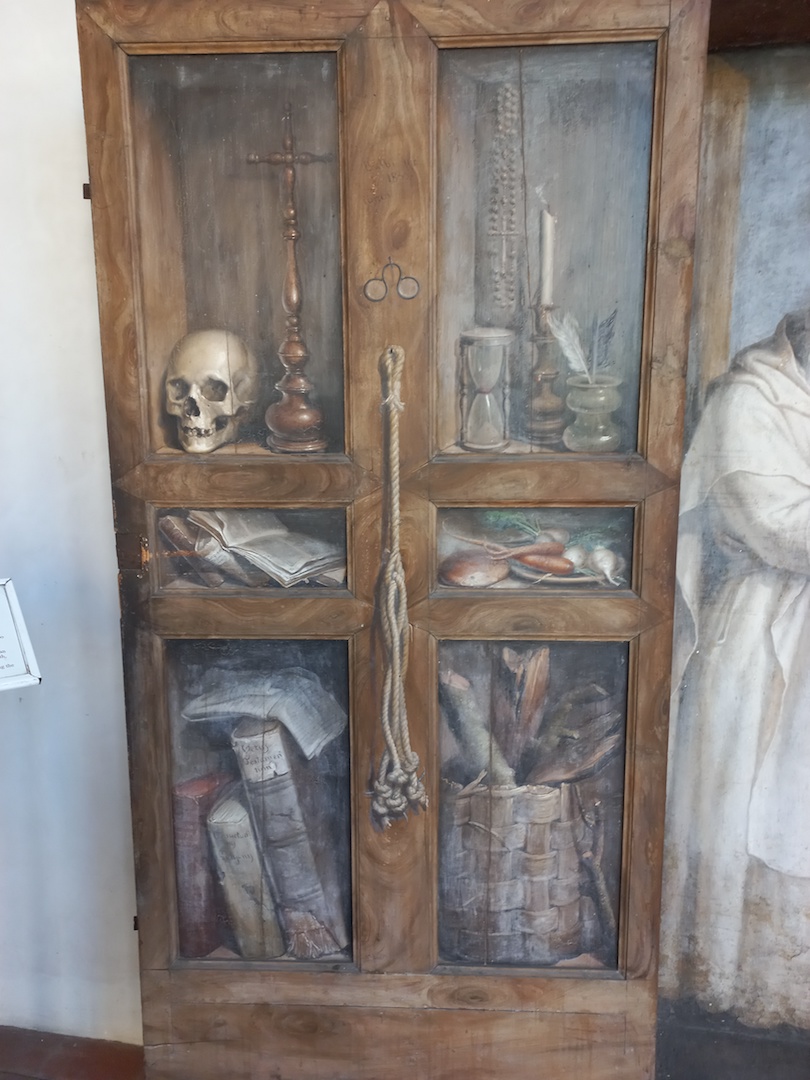 Oil painting, signed and dated 1855 by the author Filippo Balbi. A pair of spectacles is shown in the centre. Museo Nazionale Romana, Rome. Photograph by Gillian Vogelsang.In addition, thanks to the recent donation of a box full of glasses (the type you wear rather than drink from) that apparently date to the 1920s (we have our doubts!) by the Ottow family, we are working on a mini-exhibition about these items, what are the various types and their dates. We are also working with a local optician to get accurate information concerning what they are, the type of lenses, as well as the type of lens prescriptions. More about this subject will shortly be presented in a TRC Blog.
I have only been hunting for depictions of glasses for a few months, and found several pairs displayed in paintings while we were in Rome just after Christmas – we actually found several pairs on 15th and 16th century paintings, but also on a mid-nineteenth century trompe d'oeil painting of a cabinet.
It is also worth noting that in the Lakenhal, Leiden, there is a painting from about 1624 by another famous Dutch painter, Rembrandt (1606-1669, who originally came from Leiden), called the Brillenverkoper (‘Spectacles seller’). The title, it turns out, is an old-fashioned term for someone cheating. Now that is the sort of detail I enjoy.
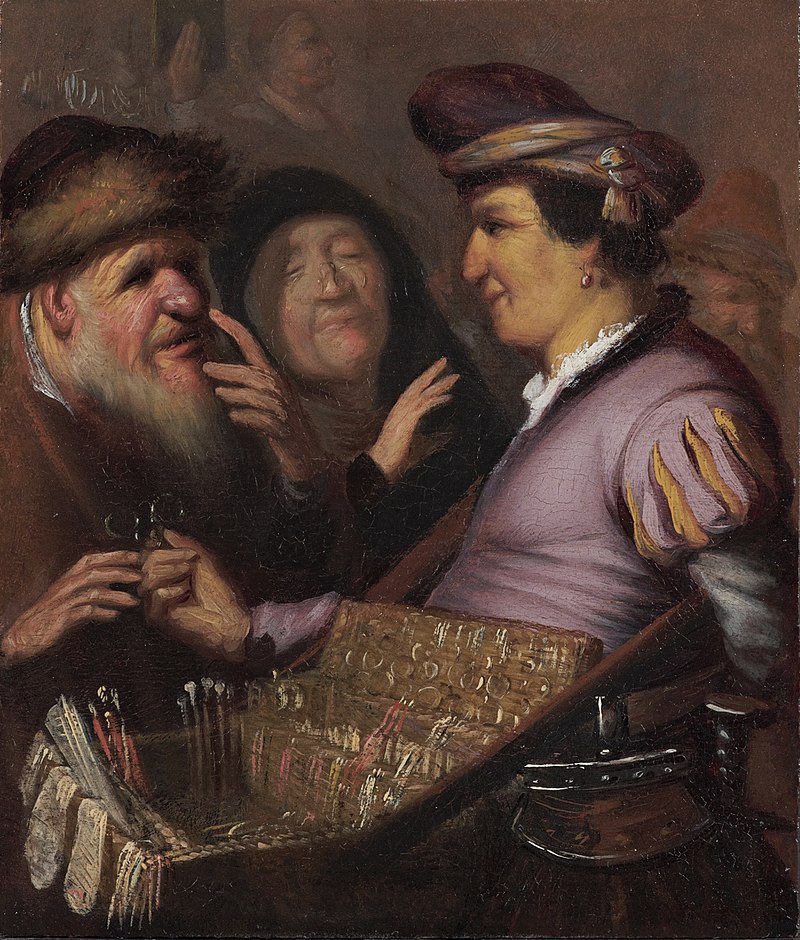 Rembrandt van Rijn, 'De Brillenverkoper,' c. 1624. Museum De Lakenhal, Leiden. Open domain.Basically, I look at paintings for what they contain and depict rather than what I feel. Is this the main difference between an Art Historian and a Design Historian? I use paintings and sculptures to gain a better understanding of material culture in all its many aspects and possibilities.
I suppose the two basic questions are: how do you look at a painting and what do you want out of it?
Gillian Vogelsang-Eastwood, 12 January 2023