
The TRC object of the month for April 2012, selected and described by Kayle Harris (TRC intern from Leiden University) was a coat (khosai) from Uruzgan Province in southern Afghanistan, made from locally produced felt. It is decorated with hand embroidery and includes small geometric motifs in white thread with small dots in blue, yellow, pink, and green. This particular khosai was made in 2009 specifically for Dr. Willem Vogelsang, Leiden, after seeing another example and talking about this type of garment with the district chief.  Old man from Uruzgan, South Afghanistan, wearing a khosai coat. Spring 2009. Photograph: Willem VogelsangIt took about a year for the various elements of the garments to be organised, such as collecting the sheep’s wool, making the felt, adding the detailed embroidery, and so forth.
This type of heavy felt coat, or khosai, was traditionally worn by shepherds in the lowlands of southern Afghanistan and the high mountain pastures in the centre of the country. Such heavy garments were necessary in order to help keep the wearer warm, especially during cold winter nights. Many of these shepherds were Pashtuns who form Afghanistan’s largest ethnic group and live along both sides of the modern Afghanistan-Pakistan border.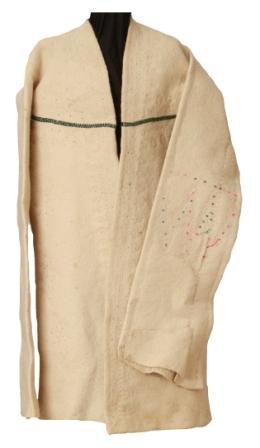 A khosai coat from Uruzgan, South Afghanistan. TRC collection.
These coats are noteworthy for their exceptionally long sleeves that are not meant to be used, instead the garment is draped over the shoulders like a cloak. In this particular case this garment has two small hand pouches at the chest to keep the front sections of the coat closed. Coats with long, false sleeves are worn throughout Central Asia, Afghanistan, and parts of Iran. Such coats that can be made of other types of textiles such as silk, and have a long history going back to the first millennium BC. The ancient Greeks, for example, recount stories about how in the presence of kings the subjects would put their arms in the sleeves as a sign of respect to make sure they could not use their weapons.
- Keywords: Coat
- Local Name: khosai
- Country: Afghanistan
- Region/Group: Pashtun
- Date: 2009
- Materials: Felt; synthetic fibre; silver coloured thread; synthetic velvet
- Techniques: Embroidered; hand-sewn; applied band; felted; couched
- Dimensions: H 122 cm x W 54 cm
- ID Number: 2010.0087
Further Reading:
Vogelsang, Willem, 2005, “Dressing for the future in ancient garb: the use of clothing in Afghan politics,” Khil’a 1.
Vogelsang, Willem, 2007, “What Afghan men used to wear in the early nineteenth century: the Right Honourable Mountstuart Elphinstone and his account of the Kingdom of Kabul,” Khil’a 3.