Object of the Month for June 2012 is a beautiful sewing box from Syria. The box, which is now on display at the TRC, is made from dark purple and natural coloured straw. The lengths of straw were first dyed and then woven into squares and triangles. These were then sewn together to create the base section and the lid of the box. The seams of the sewing box are further decorated with stripes of various types of cotton and synthetic cloth decorated with flower motifs, as well as damask and plain cloth. The corners of the box have small tassels made from short lengths of cloth bundled together. Each tassel is made from one type of cloth rather than a mixture.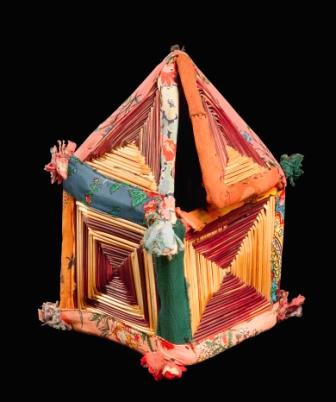 A southern Syrian sewing box. TRC Collection, Acc. No. 2005.0132
These boxes are said to take the form of little houses with the lid acting as the roof of the ‘building.’ Examples of similar sewing boxes from southern Syria also tend to be made with simple tassels on the upper corners of the box and the apex of the lid. In contrast, early to mid-20thcentury examples from Jordan and Israel/Palestine were often elaborately decorated all over with silk tassels attached to the four top corners, and diamond shaped amulets sewn to the four bottom corners of the box. The amulets were made of straw.
The boxes normally have strings attached to the roof apex. The strings are used to hang the sewing box from a hook in the ceiling or from the wall. The boxes are used to store miscellaneous items of sewing equipment (sewing notions), such as spools of sewing thread, needles, floss silks and cotton embroidery threads.
The use of straw to create objects, such as mats and small containers, is still common in the mountainous regions of southern Syria, northern Jordan and parts of north-eastern Israel/Palestine. The items are often made by local women as gifts for family or friends, and for sale in the local suqs.
- Keywords: Sewing, Middle East
- Object type: Sewing box or workbox
- Local name: Quta`
- Country: Jordan, Israel/Palestine and Syria
- Region/group: Southern Syria, as well as villages in the `Abud region of Jordan, and the Jaffa and Ramallah areas of Israel/Palestine.
- Date: Pre-1980
- Materials: Wheat straw, cotton and synthetic fabrics.
- Techniques: Woven in various forms (plaited, tabby, damask); roller printed
- Dimensions: 28 cm (height) x 16 cm (width)
- TRC number: TRC 2005.0132
Further Reading:
(eds) Völger, Gisela, Welck, Karin von, and Hackstein, Katharina, Pracht un Geheimnis: Kleidung und Schmuck aus Palästina und Jordanien, Rautenstrauch-Joest-Museum der Stadt Köln, Cologne, 1987; catalogue item no. 526, p. 411, see also fig. 150, p. 240.
Kalter, Johannes, “Rural life and peasant culture,” in (eds.) Kalter, Johannes; Pavaloi, Margareta and Zerrnickel, Maria, The Arts and Crafts of Syria, Thames and Hudson, London, 1992, pp. 103-118; in particular see fig. 240, p. 108.
See also: