• F1
  • F4
  • F2
  • F3

(21 Sept.) A few weeks ago Gillian and I went to the province of Zeeland, in the southwest of the Netherlands. We spent some time in Middelburg, the province's capital. We visited the Abbey, a complex of buildings in the town's centre that dates back to the Middle Ages and that since 1576 (and the eviction of the previous Catholic occupants) has been the centre of the provincial administration. Right now it also includes the Zeeuws Museum, the provincial museum.

Detail of 'The siege of Veere', May 1572. Two 'rebel' ships attacking a Spanish ship. The tapestry was designed by Hendrik Vroom in 1599, and woven in Middelburg.Detail of 'The siege of Veere', May 1572. Two 'rebel' ships attacking a Spanish ship. The tapestry was designed by Hendrik Vroom in 1599, and woven in Middelburg.

Detachable collar, the Netherlands, 20th century (TRC 2016.0806).Detachable collar, the Netherlands, 20th century (TRC 2016.0806).The story goes that in the 1820s a New York housewife was fed up with the amount of laundry she had to take care of. The laundry basket contained a large pile of men’s shirts, many of which not even dirty, only the collar was greasy from rubbing against her husband’s neck and hair all day.

She took her scissors and cut off the collar from the rest of the shirt. She washed the collar and sewed buttons and buttonholes on both the collar and shirt to re-attach the collar afterwards. The beginning of a new trend.

Detachable collars were indeed first seen in the 1820s. During that time the white collar was a symbol of social affluence. Keeping shirts and their collars clean was costly and time consuming. A detachable collar simply meant less laundry, which attributed to its success.The introduction of the detachable collar also meant that a larger group of men could afford a white collared shirt. 

A recent acquisition of the TRC is a sampler made by a girl called ‘Sanneke’ (TRC 2022.2990). It has a familiar look: I have seen quite a few comparable examples offered for sale on online market places. Sanneke must have seen a chart, or she may even have had a kit of an original. That explains the two dates on the sampler: 1821 and 1978. The original must have been made in 1821; Sanneke's copy was finished in 1978.

Sampler from 1978, based on original from Amsterdam from 1821 (TRC 2021.2990).Sampler from 1978, based on original from Amsterdam from 1821 (TRC 2021.2990).

Willem and I have just spent a few days in Middelburg, the capital of Zeeland, in the southwest of the Netherlands. It's an historic town with medieval and later buildings, including an abbey complex that dates back to the twelfth century. We had come in order to visit the Zeeuws Museum which is housed in part of the complex and has an extensive textile collection. Middelburg has long been an important centre for the import of wool from England, comparable to the nearby town of Veere, about which we reported in an earlier blog.

The Middelburg abbey. The Middelburg abbey.

There were two things we specifically wanted to see, namely (a) a set of large tapestries that date back to the late 16th and early 17th century and depict various sea battles that took place in Zeeland in the early years of the Eighty Years War between the Netherlands and the Spanish empire. My husband had heard about these at school when he was a little younger and had long wanted to see them. He will be writing a blog about these wall-hangings shortly.

6lbs bag of extra fancy patent flour with a printed figure of a cloth doll wearing a purple dress. USA 1937 (TRC 2017.3232).6lbs bag of extra fancy patent flour with a printed figure of a cloth doll wearing a purple dress. USA 1937 (TRC 2017.3232).Sometime ago we published a poem about the use of feedsacks for making clothes, including underwear in 1930s America. The writer obviously had some very vivid and personal recollections. We described the poem without the name of the author, which until a few days ago remained unknown.

Feedsacks were widely used in the USA and beyond to make garments, and animal feed producers often deliberately printed clothes' patterns on their feedsacks for women to make garments. The TRC dedicated a special online exhibition to this phenomenon: For a few sacks more, which also includes the poem (see below).

What a pleasant surprise, when we recently received an email from Rol Morris in Canada, identifying the author of the poem as his great aunt, Ada Marie Shrope, who lived in southern Kansas in the dustbowl days. He told us the following:

"Not much is known about Ada Marie. She was born in Fairview Township, Cowley County, Kansas the first of October 1899. Her parents were James Washington Shrope (1874-1957) and Ora Estelle Onstatt (1877-1951) and she was the youngest of three children. Ada married Roy Fox, a Collector for the McAllister Transfer Company, in Wichita in 1918. They raised a daughter, Ada Mae Fox (1919-1966).

Throughout history people have always tried to interact with the supernatural as a way to maintain harmony in a world full of the unknown. In order to find some sense of security, societies around the world have developed their own ceremonies and rituals. Textiles are often given magical qualities and they play an essential role in these events.

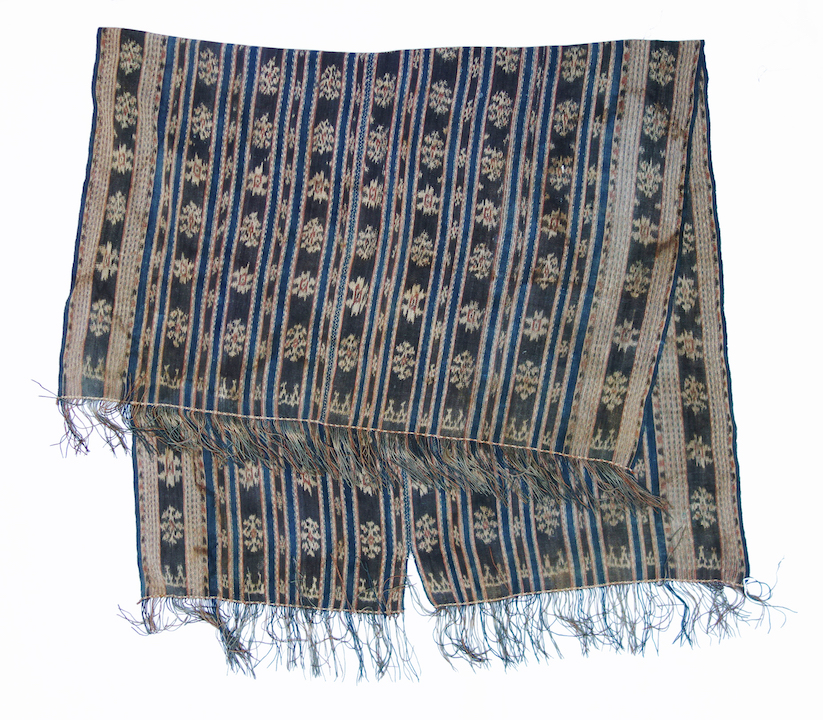
In the Indonesian archipelago, many ikats are used during rituals such as weddings and funerals. Among the Indonesian ikats in the TRC collection, there are two ceremonial cloths that caught my attention. At first glance they may seem ordinary, but they actually give us a glimpse into the afterlife!

Cloth/shroud from West Sumba (TRC 2020.4734).Cloth/shroud from West Sumba (TRC 2020.4734).

(21 Aug.) We are working hard on the next exhibition at the TRC. The theme is Asia-Africa textiles and is being organised as part of an international seminar week organised by the IIAS, Leiden University. The IIAS week is from the 19th to the 23rd September, but the exhibition will be opened on the 12th September and will last until December 2022.

The TRC exhibition looks at various aspects of the Asian-African-European trade in textiles, namely:

Fragment of a block printed textile using a resist technique, 14th century, from India, excavated at Quseir al-Qadim, Red Sea coast, Egypt (TRC 2020.0239).Fragment of a block printed textile using a resist technique, 14th century, from India, excavated at Quseir al-Qadim, Red Sea coast, Egypt (TRC 2020.0239).

Zoek in TRC website

Contact

Boerhaavelaan 6
2334 EN Leiden.
Tel. +31 (0)6 28830428  
office@trcleiden.org

facebook 2015 logo detail


instagram vernieuwt uiterlijk en logo


Bankrekening

NL39 INGB 0002 9823 59, t.a.v. Stichting Textile Research Centre.

Openingstijden

Het TRC is gesloten tot maandag 4 mei vanwege de verhuizing naar de Boerhaavelaan. We blijven bereikbaar via email (office@trcleiden.org) of telefoon: 06-28830428.

Financiële giften

Het TRC is afhankelijk van project-financiering en privé-donaties. Al ons werk wordt verricht door vrijwilligers. Ter ondersteuning van de vele activiteiten van het TRC vragen wij U daarom om financiële steun:

Giften kunt U overmaken op bankrekeningnummer (IBAN) NL39 INGB 000 298 2359, t.n.v. Stichting Textile Research Centre. BIC code is: INGBNL2A

U kunt ook, heel simpel, indien u een iDEAL app heeft, de iDEAL-knop hieronder gebruiken en door een bepaald bedrag in te vullen: 


Omdat het TRC officieel is erkend als een Algemeen Nut Beogende Instelling (ANBI), en daarbij ook nog als een Culturele Instelling, zijn particuliere giften voor 125% aftrekbaar van de belasting, en voor bedrijven zelfs voor 150%. Voor meer informatie, klik hier