
Willem and I have just spent a few days in Middelburg, the capital of Zeeland, in the southwest of the Netherlands. It's an historic town with medieval and later buildings, including an abbey complex that dates back to the twelfth century. We had come in order to visit the Zeeuws Museum which is housed in part of the complex and has an extensive textile collection. Middelburg has long been an important centre for the import of wool from England, comparable to the nearby town of Veere, about which we reported in an earlier blog.
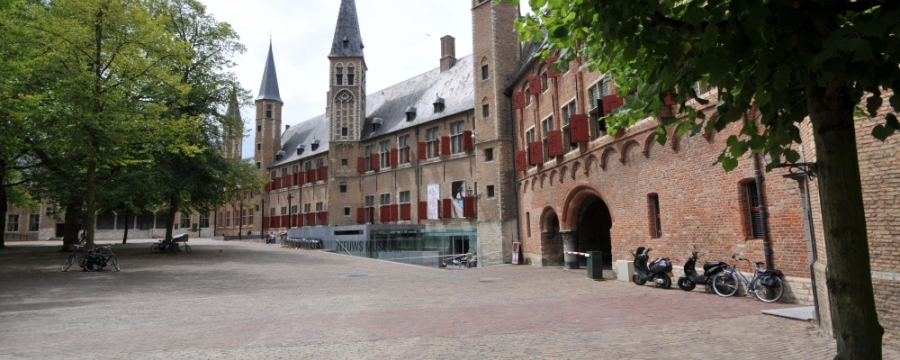 The Middelburg abbey.
There were two things we specifically wanted to see, namely (a) a set of large tapestries that date back to the late 16th and early 17th century and depict various sea battles that took place in Zeeland in the early years of the Eighty Years War between the Netherlands and the Spanish empire. My husband had heard about these at school when he was a little younger and had long wanted to see them. He will be writing a blog about these wall-hangings shortly.
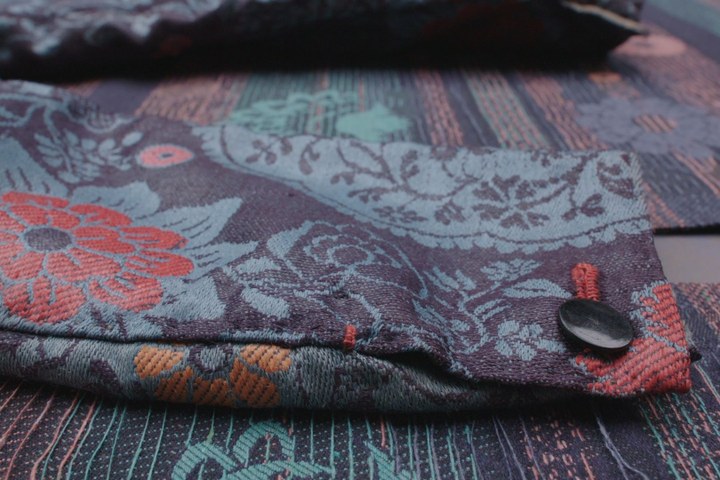 RE_USED RE_SATIN 26 Nov 2021 until 02 April 2023. The origin and future of textilesAnd (b) I wanted to see an exhibition in the museum called Re_Used Re_Satin (26th November 2021 to 2nd April 2023). The exhibition was researched and organised by Remi Veldhoven, a textile researcher and designer, with the aid of various textile historians and specialists from Norwich (such as Michael Nix), as well as from the Netherlands (including Cultureelerfgoed.nl).
The exhibition is about the origins and indeed future of one particular type of cloth, namely a form of brocaded worsted cloth produced in and around Norwich in eastern England and highly prized for men’s regional dress in Zeeland and elsewhere from about 1750 to 1850.
In particular it was used for a close-fitting men's jacket locally called a hemdrok. More specifically seven hemdrok dating from the 18th and 19th century were examined in detail and put on display. They were made out of a type of worsted, brocade-type cloth that was often glazed (these cloths are sometimes called damasks, but they are not technically, woven damask forms) with flowery and lace motifs in various combinations of blue and red, with yellow, green and purple details.
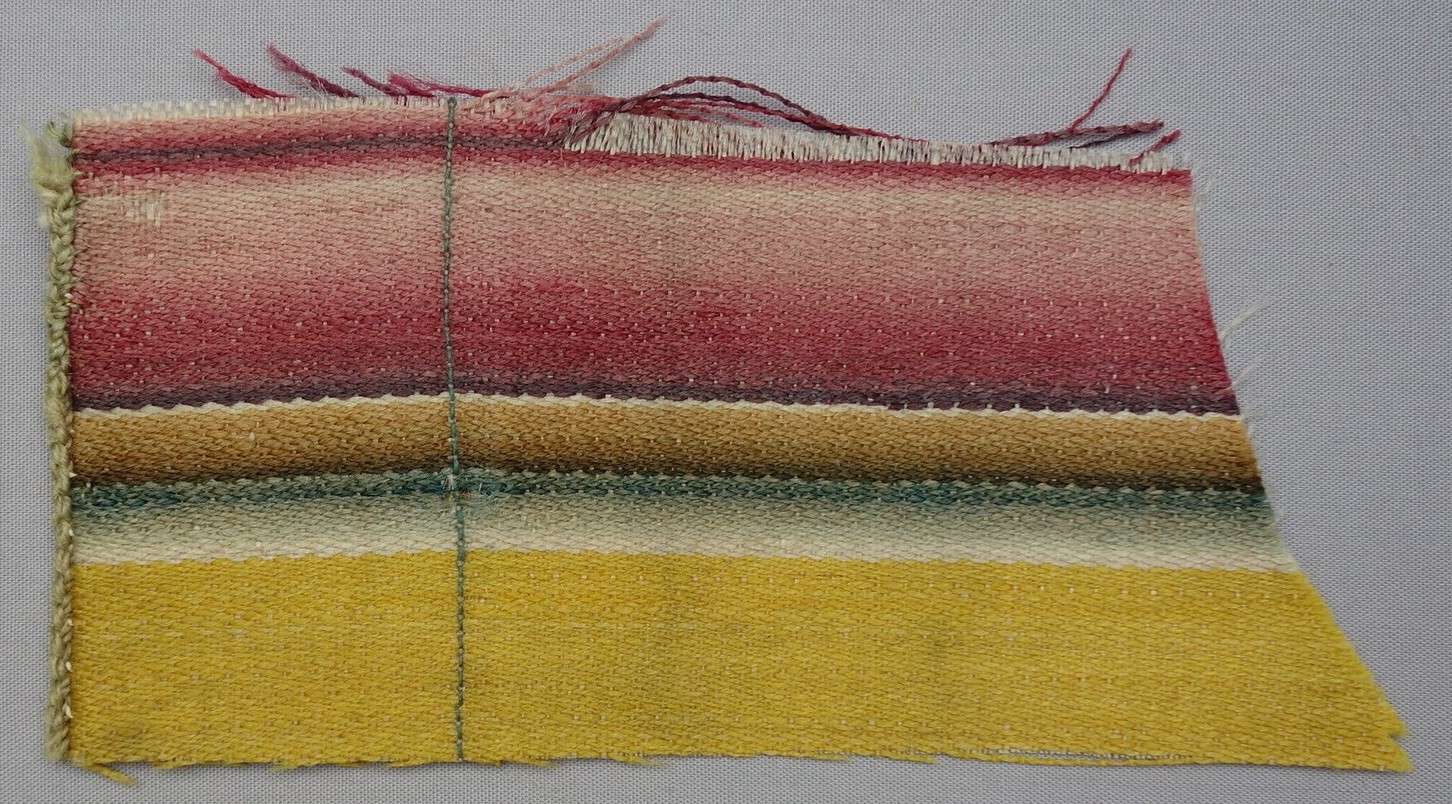 Length of 18th century worsted cloth from Norwich, England (with a 20th century machine stitched hem). This type was used for Dutch regional clothing (TRC 2015.0413).
The exhibition is divided between three rooms. The first room includes the introduction to the exhibition and various garments, the third room is a workshop with wool, weaving equipment and lengths of cloth for visitors to see and touch. It is the second room that is of particular significance. It contains a number of actual and replica garments (hemdrok), lengths of cloth, photographs, video interviews, and text boards with very detailed information, in Dutch and English.
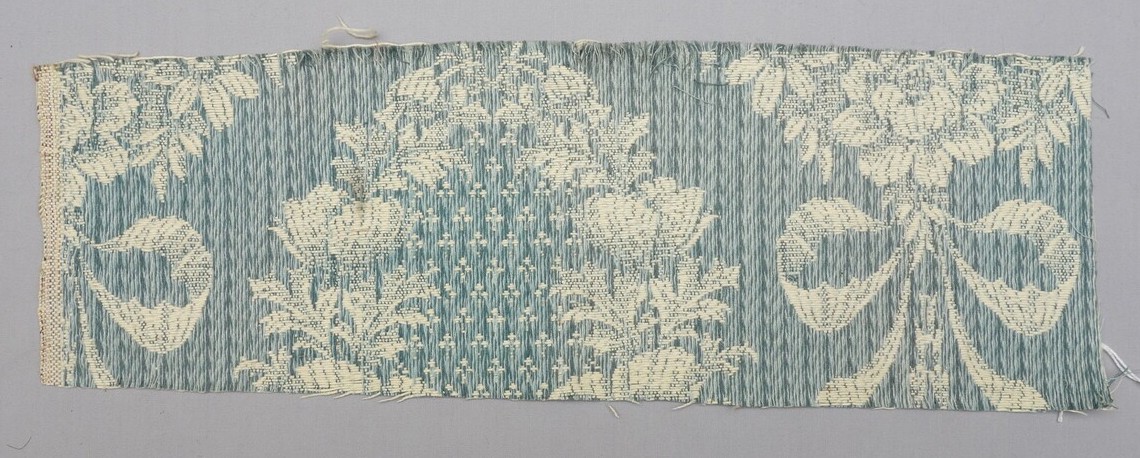 18th century woollen cloth from East Anglia / Norwich (TRC 2011.0390).
Prior to being displayed the garments were examined and explored with respect to fibres, dyes and colours, weaves, glaze and garment construction. The dyes used for the garments include cochineal, indigo, lac, orseille, quercitron and weld, sometimes in combination with each other, such as cochineal with a touch of indigo. All this information can be found on the text boards.
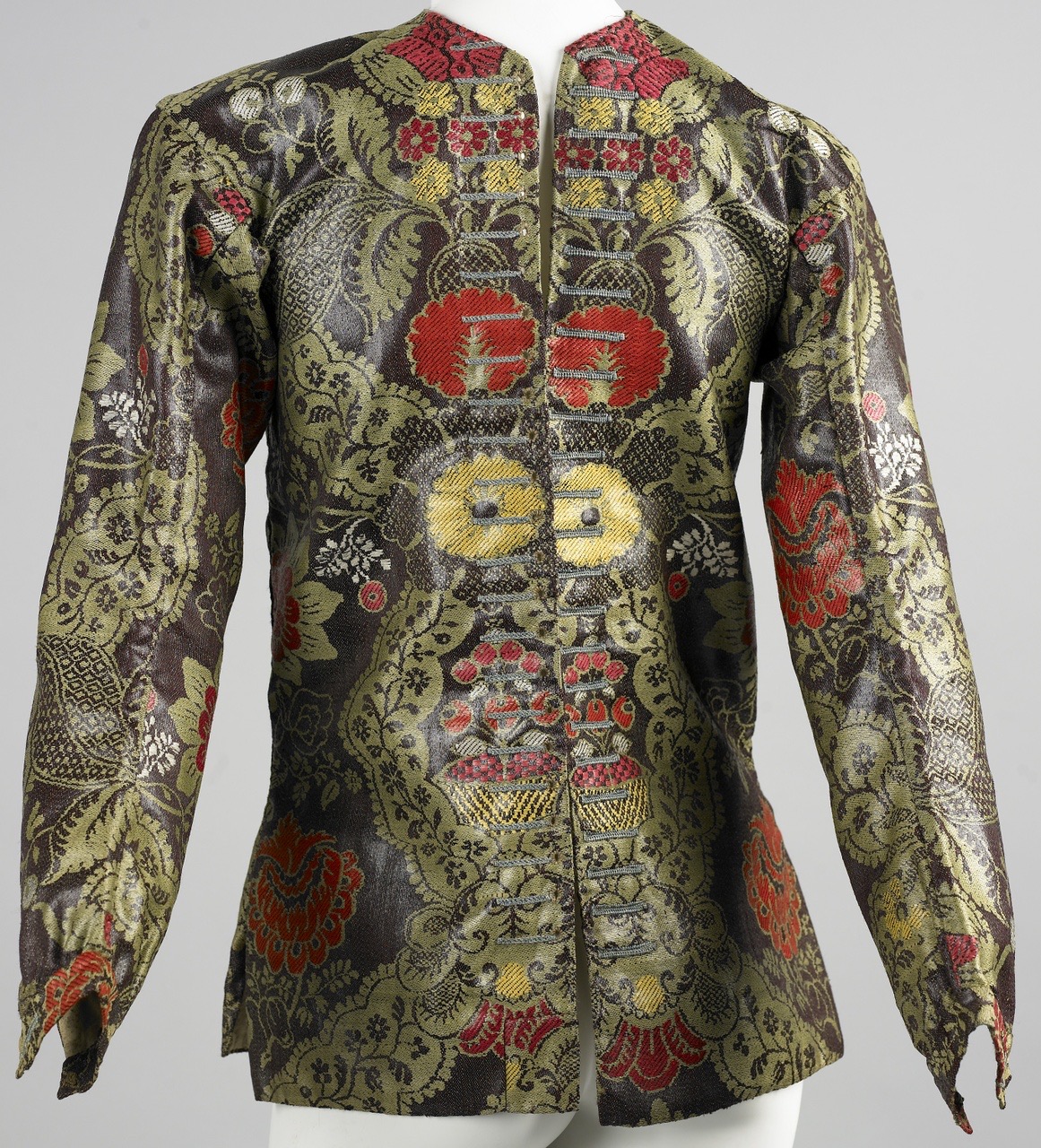 Worsted 'hemdrok' from Walcheren, Zeeland, mid-19th century. Zeeuws Museum, acc. no. M96-029-01.The range of glazes used to make the various hemdrok, including gum Arabic, bees wax, paraffin, lanolin, sandarac (from the Tetraclinis articulata tree that grows in Morocco), and tragacanth (a natural gum obtained from Middle Eastern legumes of the Astragalus genus).
When studying the objects, sample books from the period were also consulted, and so were records of the working methods of Norwich and local agents to provide exactly what was required for local customers in various parts of Europe.
In preparation of the exhibition several Dutch companies were approached to help making replicas using recycled fibres made from clothing that had been thrown away, and being woven again in the fform of brocaded cloth. The recycled yarn – which is a mixture of many different types of fibres - was sourced from Wolkat in Tilburg, the Netherlands, but with a subsidiary in Morocco. The weaving company of E.E. Exclusive (Van Engelen and Evers) was approached to make a modern interpretation of 18h century woven cloth. Then the company of Hul le Kes, Arnhem, was commissioned to make several replica garments.
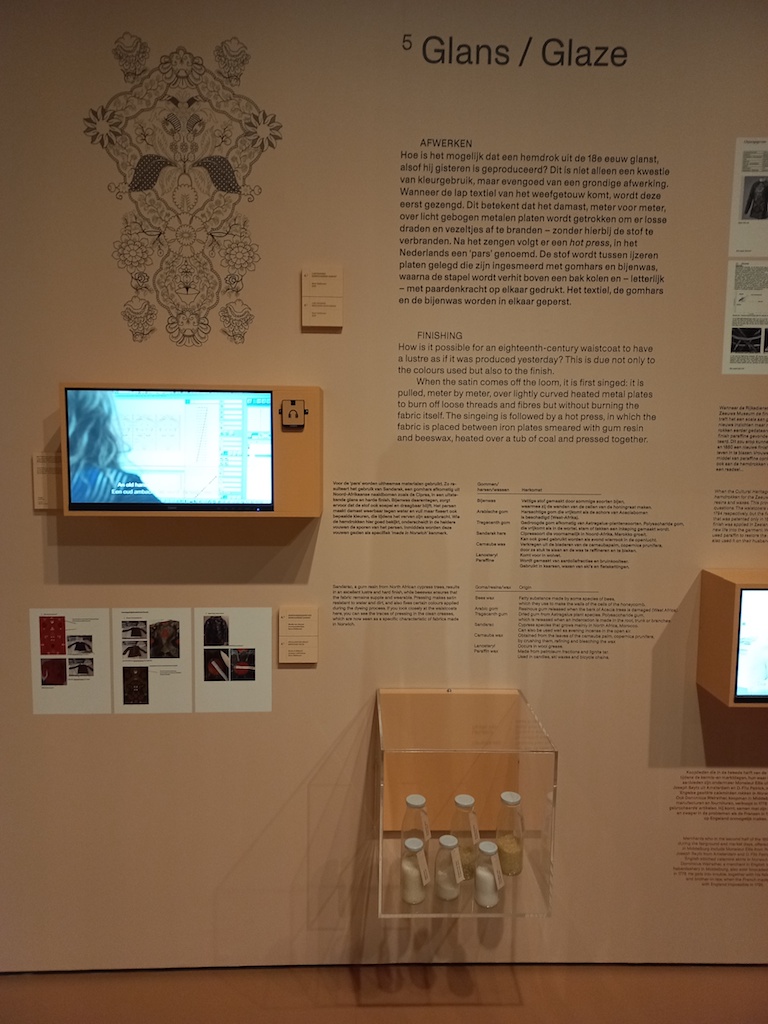 An exhibition with much to see, and with a wealth of informaton. Photograph by the author.Basically, it was wonderful to walk around a textile exhibition that did not dumb-down the information or presume the audience were 10 year olds (with apologies to 10 year olds). It was noticeable that the public in the exhibition when I visited it was made up of both men and women (often as couples) from different age groups and everyone appeared to be enjoying the experience and welcoming the information.
It is unfortunate that there is no catalogue, nor is there extensive information online about the results of the various fibre, dye, weave and glaze analyses, let alone information about how the various cloth lengths were cut in order to make the garments. The text boards however provided a wealth of information.
The exhibition is well worth a visit, and so is the museum, and the fascinating town of Middelburg.
Gillian Vogelsang- Eastwood, 4 September 2022