
 Johanna Elizabeth van NieropIn early November 2022 the TRC was approached by Henk van Nierop about a small group of lace samples (TRC 2022.3134 – TRC 2022.3155) and a lace notebook (TRC 2022.3156) that had been collected by his aunt, Johanna van Nierop.
It turns out his aunt’s lace story was much more complicated and interesting than we initially thought. The following blog is by Henk van Nierop.
****
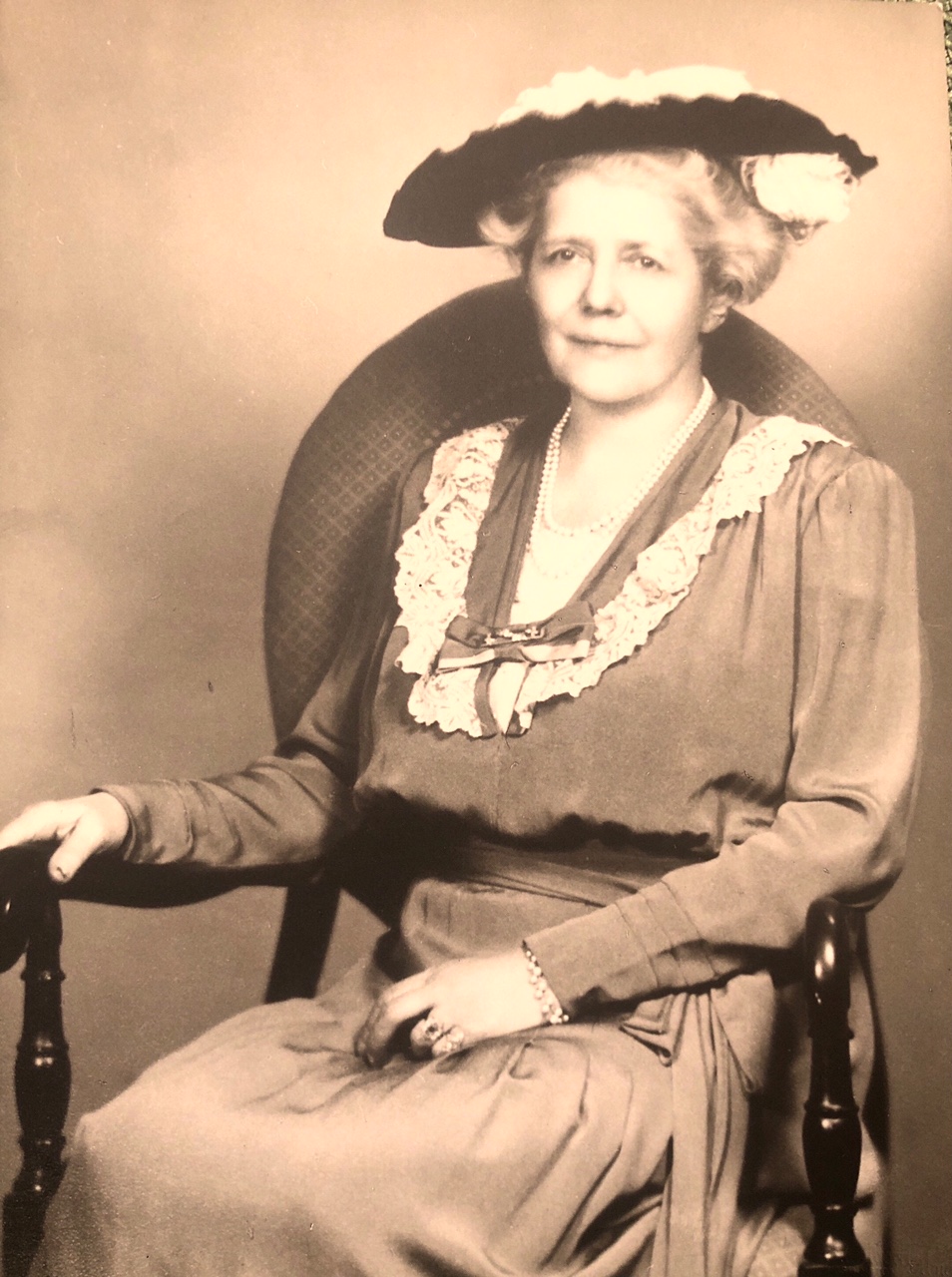
Johanna Elisabeth van Nierop (nicknamed 'Zus' in the family) was born in Amsterdam on November 16, 1882, the youngest of six children. Her father, Frederik Salomon van Nierop, was a wealthy lawyer and banker ¬– he was the founder (in 1871) and director of the Amsterdamsche Bank – as well as a liberal member of the Amsterdam municipal council, the Provincial States of Noord-Holland, and the Upper House (Eerste Kamer) of the Netherlands' Parliament.
 Sarphatistraat in Amsterdam, in 1890. House No. 3 is to the left.Johanna's mother was Emilie Regina Gompertz, a scion of a family of bankers: her father and her brother were partners in the prominent Wertheim & Gompertz Bank.
The family was Jewish, but not very religious, even though Johanna's father was President of both the Executive Committee of the Nederlands-Israelitisch Kerkgenootschap and the Kerkenraad van de Hoofdsynagoge (Consistory of the Principal Synagogue) in Amsterdam. The family lived in an colossal house on 3 Sarphatistraat, Amsterdam.
 Caricature of Johanna van Nierop as a butterfly, by Ina Koch in Amsterdam in 1938 (from the archives of the Rijksmuseum, Amsterdam).Johanna was very close with her elder sister Leonie ('Lie'), who reaped fame as the first woman to read Law and receive a doctoral degree in Political Sciences (Staatswetenschappen) at the University of Amsterdam. Both sisters were to remain unmarried.
Having lived in their parental home until the death of their mother in 1925, they moved to the Hotel des Pays Bas in Nieuwe Doelenstraat (No.11). In 1938 however, due to the dangerous political situation in Europe, they moved to the United States, where they settled in the Sheraton Park Hotel in Washington DC. The sisters were to remain together until Leonie's death in 1960. Johanna died in Washington on January 4, 1970.
Johanna van Nierop's name will be forever connected with the collection and study of lace. In 1925 she was one of the founders as well as the first president of Het Kantsalet ('The Lace Club'), a society of ladies 'with a favourable disposition towards the collection of antique laces in the Rijksmuseum'.
Aiming 'to animate and sustain the interest in lace', the Kantsalet encouraged its members to make donations of lace to the Rijksmuseum collection. They also organised expositions of laces.
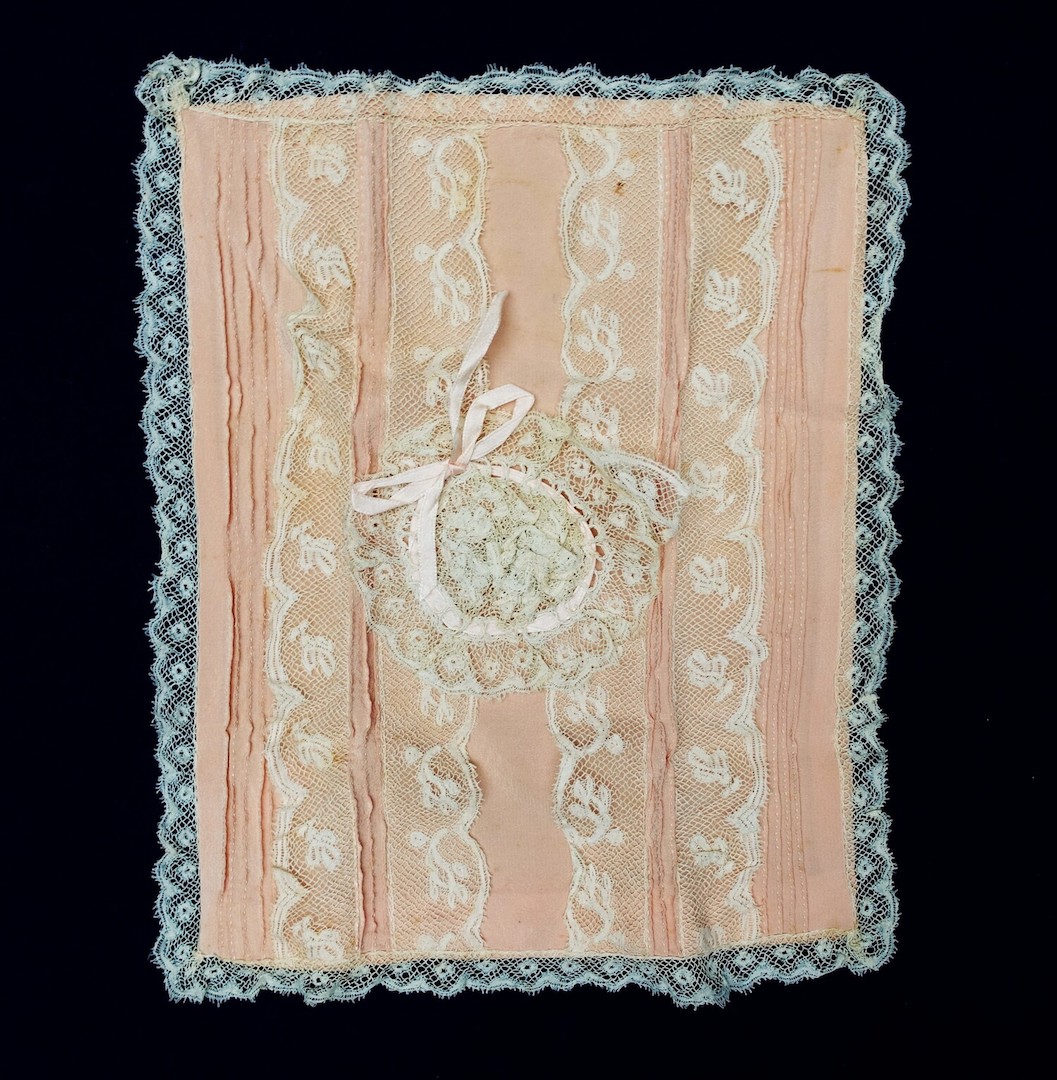 Pink bag decorated with pin tucks, as well as rows of bobbin lace and a rosette made out of lace. Late 19th - early 20th century. From the collection of J. E. van Nierop, now housed at the TRC (TRC 2022.3151).There was yet another way by which Johanna van Nierop promoted the Rijksmuseum lace collection. The 1929 Rijksmuseum annual report states as follows: 'Because of [Johanna van Nierop's] great devotion it was possible that the study-depot of the laces was sorted and that the various specimens of lace were attached to frames with a written elucidation'.
Examples of various kinds of lace were sewed onto fabrics tended on frames that were inserted into a cabinet, along with filing cards providing often abundant information in Johanna's own neat handwriting. She thus made the collection accessible for systematic study. The study collection, which eventually counted 102 frames, was later dismantled, but the laces are still in the museum.
Johanna aimed to make the Rijksmuseum collection as comprehensive as possible. In doing so she enlisted the help of her sister Leonie and other ladies to provide samples of many kinds of lace, especially from the nineteenth and twentieth centuries.
 Parasol with a cover of Chantilly lace, third quarter 19th century. Donated to the Rijksmuseum by Johanna van Nierop (Rijksmuseum, BK 16518).Thanks to her efforts the Rijksmuseum collection boasts samples of Cluny and torchon laces in wool, silk, and wire that in the second half of the nineteenth century had been popular as dress trimmings but had become rare. The online catalogue of the Rijksmuseum lists 425 objects donated by Johanna van Nierop, most of them laces.
Having resigned in 1931 as president of the Kantsalet, Johanna remained active in the Rijksmuseum until her departure to America. Even from there she continued to donate valuable laces to the Rijksmuseum collection.
In 1948 and 1951 she sent two costly Chantilly parasols, one with an ivory stick embossed with the initials of her mother (Rijksmuseum inv. no. BK 16518).
In Washington she remained active as a collector and student of laces, working in, and making donations to, the Smithsonian Institute's National Museum of American History.
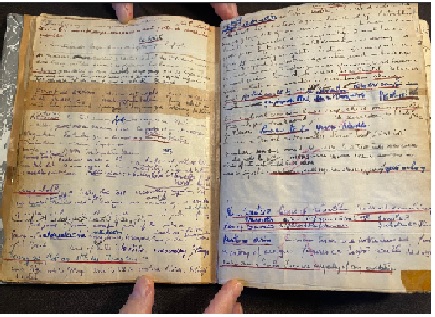 Pages from the notebook of Johanna van Nierop (TRC 2022.3156).Johanna bequeathed the small collection of laces that she had kept for herself, as well as a notebook (TRC 2022.3156) filled with copious facts and dates about the production and history of lace, to her niece and godchild Adrienne Johanna ('Uus') Asser-van Nierop (1911-1998). The son and heir of the latter presented these to the present author, who donated them to the TRC Leiden in 2022.
Henk van Nierop, 31 December 2022
Sources:
- Hell, Maarten, 'Nierop, Leonie van (1879-1960)'.
- Nierop, Margaret A. van, Familiegeschiedenis/ family history Van Nierop 1813-2000: Nieuwe Niedorp, Hoorn, Amsterdam: volgend op een gedeelte van de familiegeschiedenis/ and a part of the family history Ephraim 1646-1813: Buren, Tiel, 's-Gravenhage (Amsterdam, 2000) p. 93.
- Wardle, Patricia, '"As many types of old hand-made Iace as possible": Three Lace Collections Made in the Netherlands in the Twenties and Thirties', Textielhistorische Bijdragen vol. 40 (2000) pp. 75-96, esp. 88-94.
- Wardle, Patricia, '"De belangstelling voor kant wakker te roepen en te onderhouden": de vorming van de kantcollectie van het Rijksmuseum', in: KOSTUUM verzamelingen in beweging: twaalf studies over kostuumverzamelingen in Nederland & inventarisatie van het kostuumbezit in Nederlandse openbare collecties (Nederlandse Kostuumvereniging voor Mode en Streekdracht, 1995), pp. 58-64, esp. 58-59.