
For a small place, the island of Tenerife, part of the Canary Islands, has a fascinating textile history. During a recent visit to Santa Cruz de Tenerife, I tried to track down some Tenerife lace (known as roseta canario or calado canario in Spanish) to add to the TRC’s collection. The TRC already has some examples, such as a beautiful late 19th century Tenerife lace collar (TRC 2020.0462) and two doilies (TRC 2015.0281 and TRC 2015.0282), but those examples are from the UK, reflecting the technique’s widespread popularity in the late 19th and early 20th centuries. The TRC correspondingly also has an early 20th century DMG pattern book with Tenerife lace patterns (TRC 2020.0393).
 Tenerife lace collar (TRC 2020.0462).
Tenerife lace, which originated in drawn thread work, is distinctive. Radial threads are made on small round card frames or cushions, and the remaining circular pattern is woven with a needle. These roundels are then stitched together to make larger pieces. Because of their characteristic round shape, the lace is sometimes called sol lace. Spanish colonists brought the technique to South America, where this type of lace making persists.
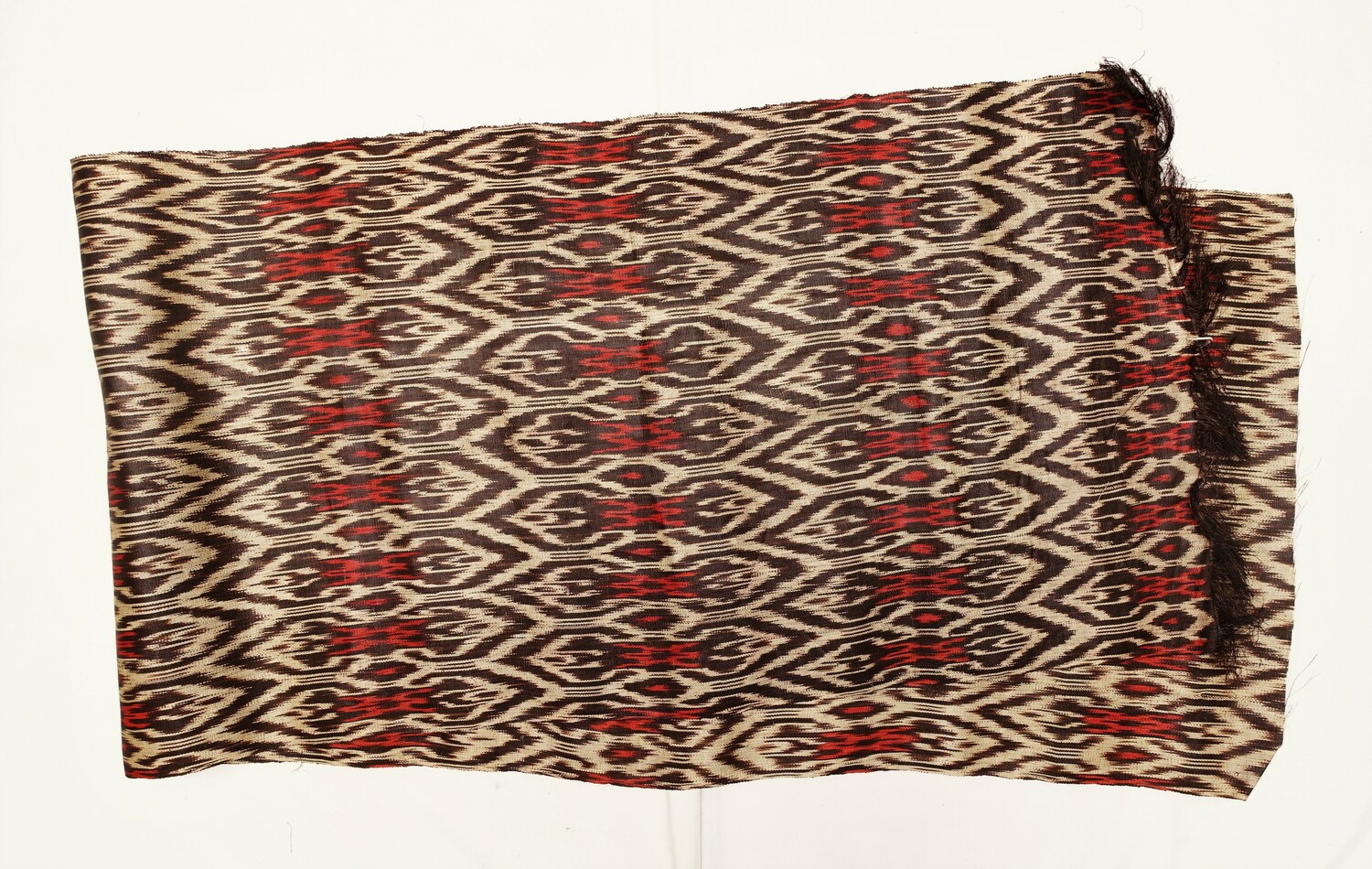 Abaca ikat cloth from the Philiippines, 20th century2022.2909I was also on the lookout for some badana—textiles produced from banana tree fibres, which I had read had been used in the Canary Islands. The TRC has several hand dyed and hand woven examples of abaca (banana fibre) textiles from the Philippines (TRC 2022.2909-2918). Some 18 per cent of Europe’s bananas come from the Canary Islands and there are several projects experimenting with using the waste products. I can testify that the bananas were sweet and delicious. But, alas, I didn’t find any badana. Nor did I discover any lace.
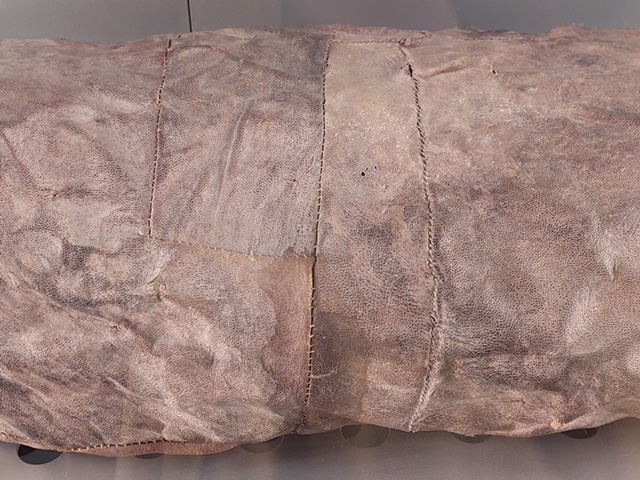 Decorative stitching on goat leather mummy wrapping, Tenerife. Photo by Shelley Anderson.I did, however, discover some older textile history in Santa Cruz’s excellent Museo de Naturaleza y Arqueologi. The Canary Islands were visited by the Phoenicians (rock carvings depicting their ships have been found) and later by Greeks and Romans (a Roman dye workshop was discovered around 2012 on Lobos Island) to procure the sea snail Stramonita haemastoma. This spiny shelled mollusk was a source of the luxury dye for Tyrian purple, beloved colour of Roman emperors. The dye, produced by crushing the shell, then extracting a gland which was fermented for days, was worth its weight in gold. Even today a gramme of this dye can cost anywhere from US$2,800 to $4,000.
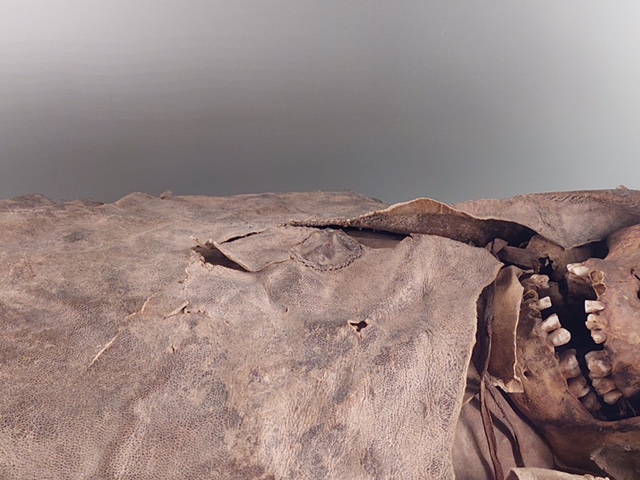 Stitching on Guanche mummy wrapping. Photo by Shelley Anderson.I also saw the Museum’s famous mummies. The indigenous Guanche people of Tenerife practiced mummification. The bodies of men, women and children were cleaned with herbs, dragon tree resin and bark, then left in the sun during the day and smoked by fires at night. The mummy was then wrapped in long rectangle garments of goat leather, which were finely stitched together, I presume with thread made from animal sinew. Some mummies were found in up to twelve such wrappings, perhaps an indicator of status. One leather wrapping I saw seemed to have some more decorative needlework, but it was difficult to see due to the protective glass case. These mummies are thought to be at least 1,000 years old.
For more on Tyrian dye click here.
For more on the Guanche mummies, click here.
Shelley Anderson, 22 November 2022