
 17th century portrait of Adriana van Nesse, a sister of Maria van Nesse, painter unknown. Photograph by Shelley Anderson.By Shelley Anderson, 14 December 2022.
The TRC’s Van Gerwen Collection includes silk velvet samples from the 17th century. I had some of these beautiful velvet patterns in mind when I visited a new exhibition at the Alkmaar Stedelijk Museum (City Museum) in the northern Dutch town of Alkmaar.
“Rich and Independent: Maria van Nesse’s Memory Book” is a small exhibition dedicated to a very unusual 17th century woman. Maria van Nesse (1588-1650), born and raised in Alkmaar, was unusual for several reasons: she was a Roman Catholic in a Protestant town and she was fabulously wealthy. At her death she possessed 78,000 guilders, or 800,000 euros in today’s currency. But most of all, she was an unmarried, independent woman, who spent her money as she wanted.
What Maria wanted, it seems, were fashionable clothes, expensive shoes, and fine paintings. We know this because Maria kept a ‘memory book’, a combination account book/diary in which she recorded the details of every purchase she made between 1623 to 1646.
The book, which covers over 90 pages, was discovered in 2019 in a family archive in Belgium. In it we can see what she paid for a barrel of beer or for gifts to her young nieces and nephews. But we also learn that “I have paid 1 guilder and 2 stivers for a dozen small bows to sew on the front of my velvet jacket.” And that “I have had to pay Adriaan Christiaans 2 guilders and 14 stivers for a pair of slippers and a pair of Spanish leather shoes.”
 Modern interpretation of 17th century woman’s dress (on loan from Stichting Kaeskoppenstad), with the silver chatelaine of Martjen Bootes, 1669-1693 (on loan from the Fries Museum, Leeuwarden). Photograph by Shelley Anderson.The exhibition includes two large oil paintings of two of Maria’s sisters, dressed in the height of 17th century European fashion: elaborate lace collars, black velvet under and overskirts, and bodices with sleeves. The whole family seemed enamoured of prestigious textiles: in one entry, Maria notes that “My sister has given me a white, pleated upstanding collar that belonged to our Catharina, which she didn’t wear anymore because she wears flat collars now.”
Unfortunately, there is no known painting of Maria herself, but there is a lovely replica of a black and gold garment Maria might have worn, complete with a high starched lace collar and cuffs, and a silver chatelaine. We know from her memory book that Maria did wear such a prestigious silver object. A chatelaine was a belt or clasp from which chains dangled. These chains held useful objects like keys, thimbles, note pads, seals and vinaigrettes, as 17th century women’s clothes did not have pockets as such. In the 1620s Maria notes that she sold her silver chatelaine, chain by chain, as these belts had gone out of fashion.
And what about those shoes of Spanish leather? On display is a very rare object, the first of its kind ever discovered in the Netherlands: the remains of an expensive woman’s shoe, dated to between 1625-1650. The calfskin shoe has a floral pattern, made by a punch, and a wooden heel, covered by leather. It’s a size 2 and a half, and was found in a cess pit on the same street in Alkmaar where Maria lived (the same cess pit also yielded the remains of a 17th century fan). But it housed to a famous neighbour of Maria, a poet named Maria Tesselschade Roemersdr Visscher (1594-1649). Tesselschade was an intellectual who befriended and debated some of the Dutch Golden Age’s most renowned thinkers: Vondel, Huygens, Hooft and Baerlaeus and belonged to the so-called Muiderkring cricle.
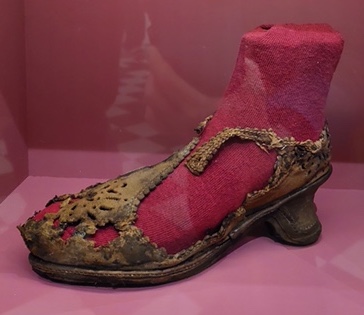 Shoe from the cess pit of the house of Maria Tesselschade Roemersdr Visscher, first half of 17th century, on loan from the Alkmaar Archaeological Centre. Photograph by Shelley Anderson.Maria van Nesse’s memory book offers a unique glimpse into a wealthy 17th century woman’s home, from the personal seamstress she hired (but who also “…has to help with the polishing and washing, and, if I want her to, to help with the dusting and cleaning the house on Fridays and Saturdays.”), to the hundred entries about art works that she commissioned.
The original pages (with Dutch transcriptions) can be seen on the Alkmaar Regional Archives website (click here). The book Het unieke memorieboek van Maria van Nesse (1588-1650): Nieuwe perspectieven op huishoudelijke consumptie, by Judith Noorman and Robbert Jan van der Maal has recently been published by Amsterdam University Press. The exhibit is on display until 19 March 2023.