
Erfgoed Alkmaar ('Heritage Alkmaar') publishes an excellent newsletter about the archaeology and history of this town in the north of the Netherlands. In its most recent issue (No. 59, winter 2020/2021) there was an interesting article on 17th century fans.
 'De Modese Waayer' ('The fashionable fan'). Mid-18th century advertisement from Utrecht, the Netherlands, showing a fan and instruments to make and repair fans. Underneath the print is the text: FRANS BENEVELT Woont op het oude kerkhof Te Utrecht Childert, Maakt, Verstelt, en Verkoopt, alle soort van Waijers Soo Wel Engelse, Fransse als Heel Ivoore, bij het stuk en Doesijn Alles tot een Civiele Prijs. Utrecht: Centraal Museum, acc. no. 2127.
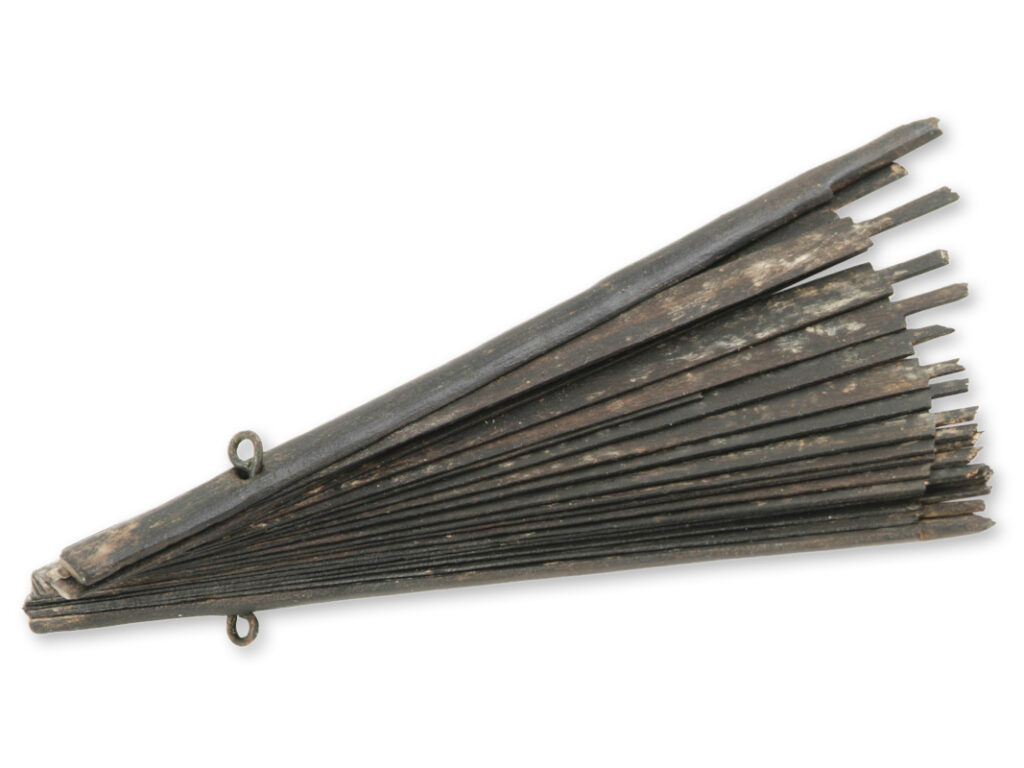 Remains of a 17th century fan, excavated in Alkmaar, the Netherlands (Newsletter 59 Erfgoed Alkmaar).
The remains of several hand fans have been discovered in Alkmaar. Most ribs (those sticks that give a folding fan its structure) in fans of this period were made of bone. But in 1994, during an excavation on Alkmaar’s main shopping street, the ribs of a 17th century folding fan were recovered from an old cesspool. They were made from baleen, or whalebone, which becomes flexible when heated, and was used in corsets, parasols, umbrellas—and fans.
The 21 ribs were approximately 12 cm long, shorter than expected because the top pieces had broken off. At the bottom of the fan were two metal brass eyelets, connected by a small pin. The leaves of the fan, perhaps of paper or cloth, had decomposed.
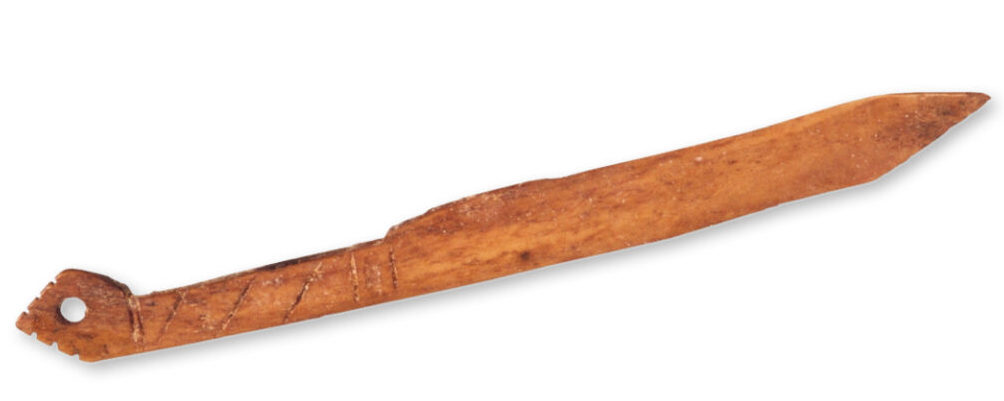 17th century verenkruller ('feather curler') for a fan, excavated in Alkmaar, the Netherlands; Newsletter 59 Erfgoed Alkmaar.Fans were also made of feathers (ostrich feathers in particular). In a different Alkmaar excavation, also dated to the 17th century, a 10 cm long bone verenkruller ('feather curler') was discovered. As its Dutch name implies, this object, often sold with a fan, was used to curl the feathers.
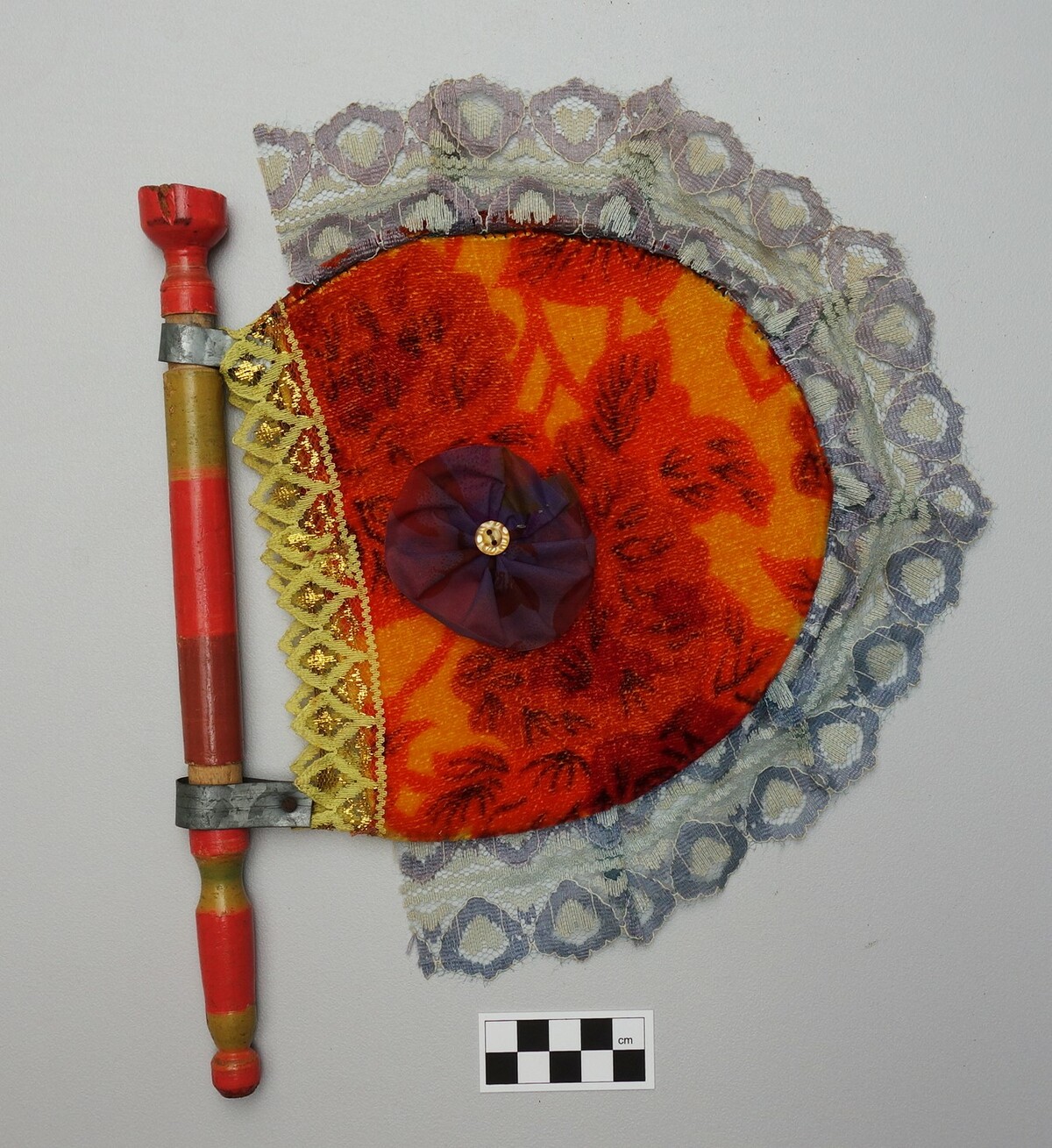 Late 20th century fan from Sri Lanka (TRC 2015.0519).Over the centuries fans have been made of many different materials. TRC has over 100 fans in its collection, from Japan, Gambia, China, the Philippines and elsewhere. The materials range from hand plaited palm to lace. One of my favourites comes from Sri Lanka (TRC 2015.0519). It has a wooden handle, a plastic middle that is decorated with a ribbon rosette and button, and it is trimmed with lace.
Another favourite is a Dutch fan (TRC 2015.0518) made of paper, with gold metallic paint on one side and silver metallic paint on the other. This latter object might reflect the fan’s change from a de rigueur fashion accessory to a free publicity gimmick—on one side is printed “Stoomvaart-Maatschappij ‘Nederland’ (Steamboat Company “the Netherlands”).
 Late 20th century fan from the Netherlands (TRC 2015.0518). It carries the text: Stoomvaart-Maatschappij "Nederland"Fans have an ancient history—the Egyptians, Greeks and Romans used them. Folding fans, like those that became fashionable in 17th century Europe, may have originated in the 7th century in Japan. According to this story, a man got the idea for the folding fan after examining the wing of a dead bat.
The story of the folding fan is still being written—in November 2020, The Worshipful Company of Fan Makers (founded in 1709) made a fan to raise money to help those affected by the COVID-19 pandemic. This fan, made from silk woven in Suffolk, was designed by Stewart Parvin, who designed many of Queen Elizabeth II’s clothes. An elegant way to keep cool, indeed.
Further literature:
- https://journalofantiques.com/features/fans-and-fashion/
- https://fanmakers.com/2020-commemorative-fan-queens-couturier-designs-fan-for-lord-mayors-appeal/
Shelley Anderson, 23 January 2021