
We have just been to Copenhagen for a two-day conference entitled ‘Current Research in Textile Archaeology along the Nile’ (5-6 December 2022). The conference was organised by the Centre for Textile Research (CTR), part of the Saxo Institute, the University of Copenhagen. More specifically, it was organised by Chiara Spinazzi-Lucchesi. I was invited to be the key-note speaker to round off the first day.
 Replica of a beaded tunic with discs, reconstructed with the help of Jolanda Bos. The original was discovered in the tomb of Tutankhamun. Part of TRC-led project on the study of Tutankhamun's wardrobe. Photograph courtesy Textile Museum of Sweden.
The first day was concerned with a more traditional approach, namely a series of 15 papers on a wide variety of subjects related to Nile Valley textiles. It included papers on depictions of royal dress (D. Wollnerova); reconstructing Middle Kingdom textile themes (V. Van Kersen); mummies in the Egyptian Museum, Turin (V. Turina, M. Borla and G. Pallottini); the use of miniature tools (informal apprentice pieces? (H. Hilliker); various Egyptian textiles in the University of Turin collection (M. Borla and E. Fiore Marocchetti), as well as the difference between Egyptian and C-Group textiles from Nubia (E. Yvanez and A. Dickey); the movement (forced and otherwise) of female weavers across the ancient Near East (D. Stefanovic); gender divisions in ancient Egyptian textile production (R. Skumsnes); the organization of the laundry at Deir el-Medineh (K. Gabler); flax processing in ancient Egypt (C. Spinazzi-Lucchesi and A.M. Wallenberg); the production of textiles in Old Dongola, Sudan (M. Wozniak), and details about the range of textiles found at the oasis site of Karanis, Qasr Ibrim (S. Hitchens).
 Paper presented by K. Gabler about laundry lists from Deir el-Medina, 5 Decmber 2022, Copenhagen.My contribution was the last paper of the day and was about the embroidery techniques and designs found on various textiles from the tomb of Tutankhamun. Well, actually, it was a little more than the embroidery as my talk also included appliqué, applied bracteate forms, as well as beaded tunics. As the embroidered and beaded garments are three-dimensional, some of the audience also had the chance to try on some test garments that were originally made to access size, pattern layout, and general ‘feel’ of the various garments.
The papers were presented live to a larger online audience, but unfortunately they were not recorded due to various Copenhagen University regulations.
The second day was something different, with practical sessions about the production of linen threads using various splicing and spinning techniques. The workshop was held by a very patient, Swedish hand spinner and weaver, Marie Wallenberg. It has made me think hard about different types of linen threads in ancient Egypt, and I really want to carry out some more experiments.
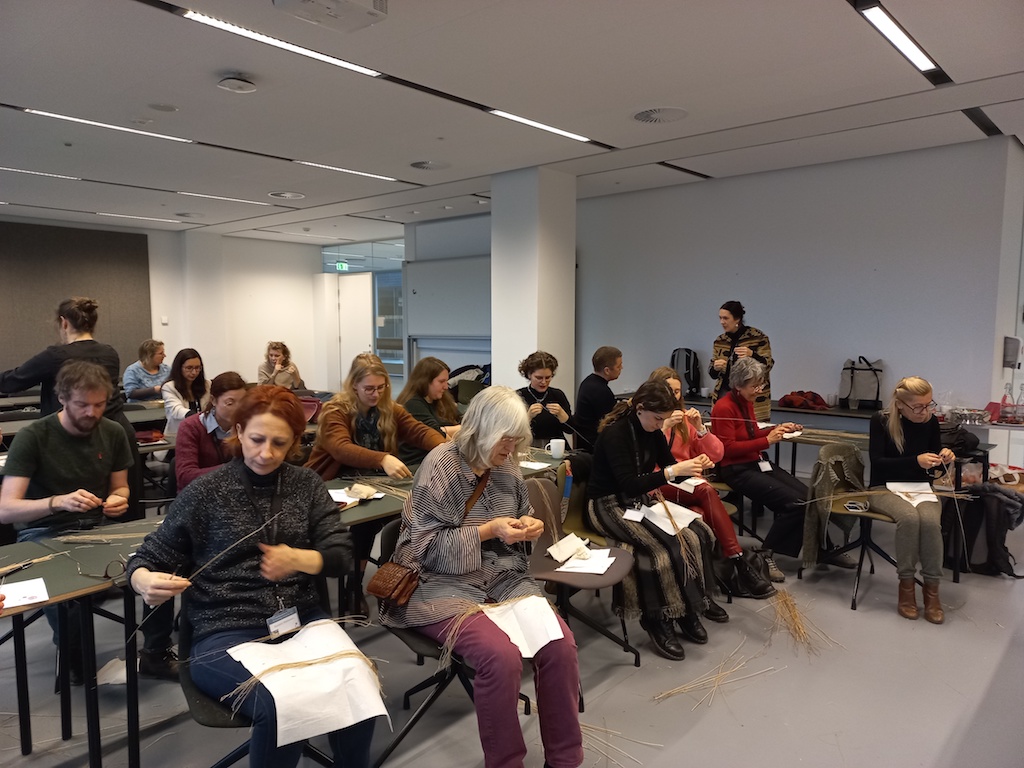 Workshop splicing, 6 December 2022, Copenhagen.
It was lovely to attend an actual conference rather than watching online events, and having the chance to talk with people during the breaks and at lunchtime.
It was decided that the papers will be published, hopefully in 2023. Chiara Spinazzi-Lucchesi will be the main editor, while I have agreed to be co-editor. We will start looking for a publisher shortly!
Thanks to the generosity of Eva Andersson Strand, director of CTR, the TRC was given a wide range of archaeological textiles and dress books published by the centre over the last few decades. They are even posting the books to the TRC, as they were too heavy to take on the plane back to Leiden! More details about these books will be published when they have registered into the TRC Library. But what a wonderful and totally unexpected gift. Thank you CTR!
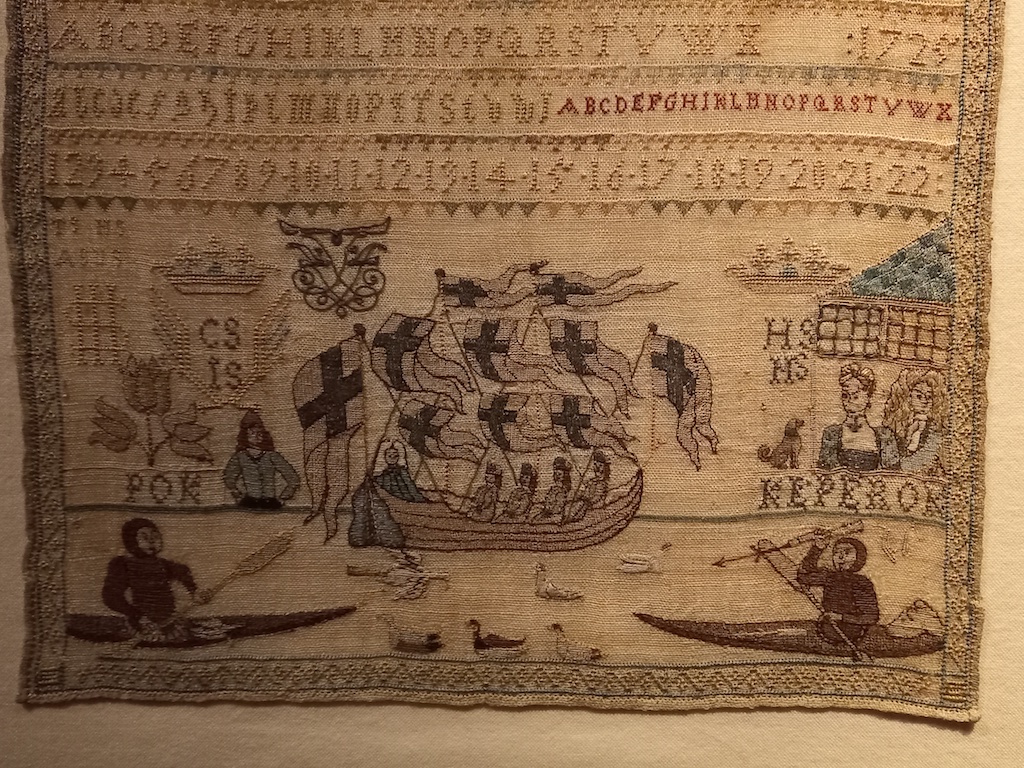 Sampler from 1725, recalling the scene of two men from Greenland (Pooq and Qiperoq) kayakking in Frederiksholm Canal in 1724. National Museum Copenhagen, acc. no. 136915/L18.495.We also had the chance to go to the National Museum, Copenhagen, and were able to see various medieval and renaissance period ecclesiastical embroidery on various chasubles. There were also several Icelandic embroideries. One item that really stuck me was a 1725 Danish sampler that shows two Greenland men in their kayaks on the Frederiksholm Canal in Copenhagen (1724)! It makes a change from stylised buildings that so often feature on Dutch samplers.
And as we left Copenhagen it started to snow! Very festive.
Gillian Vogelsang-Eastwood, 9 December 2022