
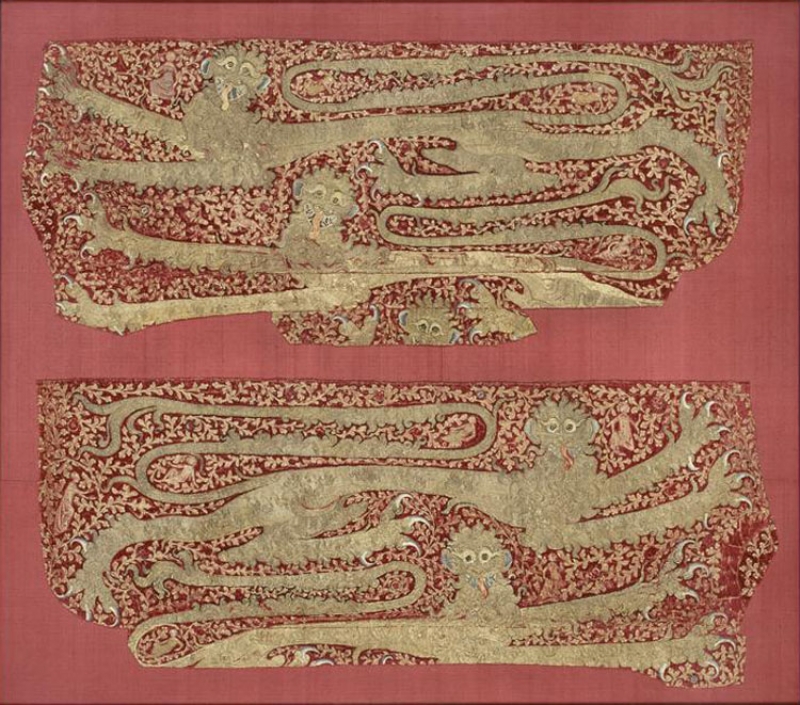
The fragments are made of silk velvet and are decorated, upon a silk interlayer, with silver-gilt and silver thread and coloured silks, worked in surface couching, running stitch and split stitch. There are also applied ornaments. This combination of techniques is different from most of the contemporary opus anglicanum textiles, which are normally worked with underside couching and split stitch. The latter techniques are far more labour intensive, but certainly not less expensive, considering the amount of silk required.
It has been indicated that the lions represent the English monarchy before 1340, in which year King Edward III (1312-1377) claimed the throne of France and added the French royal fleurs-de-lys to the lions on his coat of arms.
Source: BROWNE, Clare, Glyn DAVIES, and M.A. MICHAEL (2016). English Medieval Embroidery: Opus Anglicanum, exhibition catalogue, London, Victoria and Albert Museum. London, Catalogue no. 51 (pp. 211-212).
Musée de Cluny online catalogue (retrieved 12 August 2020). Acc. no. Cl. 20367 a, b
WV