Beyond The Chador Regional Dress From Iran

10. The Zoroastrians
The Zoroastrians are the followers of one of the oldest extant religions that base their beliefs on a written text. Its roots allegedly date back to the teachings of an Iranian prophet called Zarathustra, who became known in ancient Greece as Zoroaster. Reputedly living in the late second millennium BC, somewhere in South Central Asia or eastern Iran, Zarathustra taught a dualistic religion in which the creator-god and Lord Wisdom, Ahura Mazda, fights a cosmic struggle against the God of Evil, Angra Mainyu.
Ahura Mazda’s followers are asked to help him in this struggle, by Good Thoughts, Good Deeds and Good Words. People thus have a choice, between supporting Good or Evil. For the Zoroastrians, the world is the arena for the battle between Truth and Falsehood. In the end, Ahura Mazda will win, and all his rightful followers will join him in paradise on earth.
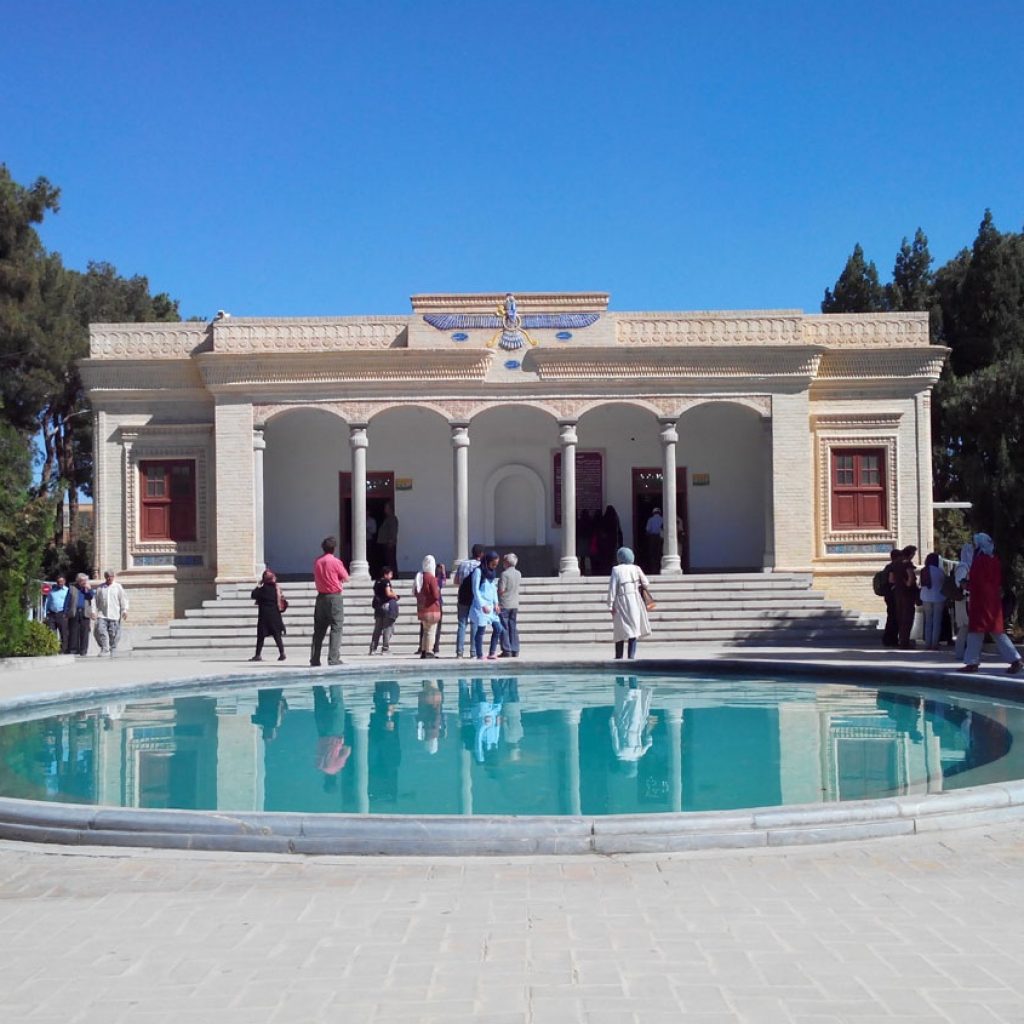 Zoroastrian fire temple in Yazd, Iran (@FriendlyIran).
One of the characteristics of the Zoroastrians is their attempt not to defile the earth. Corpses of the deceased therefore used to be exposed on hill tops or on man-made tower-like structures. Nowadays the dead are often buried in concrete graves. Fire and water are regarded as the two main cleansing agencies. The Zoroastrians are also known for their fire temples, the most important of which is the eternal fire still being worshipped in Yazd.
The Holy Book of the Zoroastrians is generally known as the Avesta, which contains the words of Zarathustra. Zoroastrianism used to be the dominant religion of Iran until the advent of Islam in the seventh century AD. It has had a profound influence on Judaism, Christianity and Islam. Their number of followers in Iran is about 25,000, and their main centre in Iran is the city of Yazd. Over the centuries many Zoroastrians have fled religious persecution in Iran and moved to South Asia, where they settled mainly along the west coast of India and became known as the Parsis. Their number in India is estimated at some 60,000.
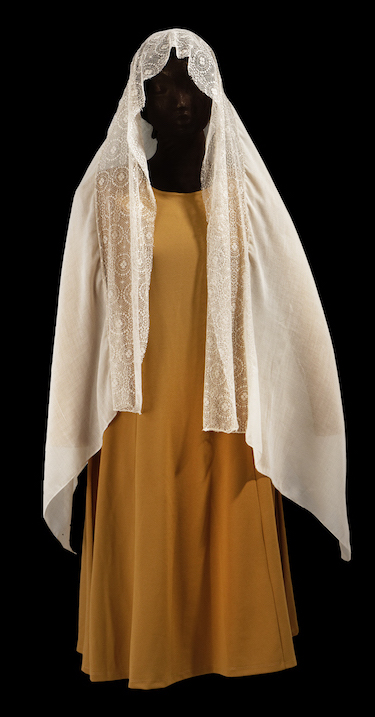
 Outfit of a Zoroastrian woman from Yazd, Iran . TRC 1998.0274 (dress) and TRC 1998.0352 (shawl). Click the illustration for the TRC catalogue entry for the shawl.Secular dress
For the last few hundred years, the garments worn by Zoroastrian men in Iran have not differed from that of their Muslim neighbours. In contrast, the attire of Zoroastrian women was distinct, although in the last forty years or so, their garments have become more comparable with their Muslim counterparts.
Traditional Zoroastrian women’s clothing is made up of four important items, namely a pair of striped trousers (shalwar), a wide dress (pirahan), a triangular cap (latchak) and a large rectangular head covering (batch). The dress consists of a bodice with attached sleeves and a very large, striped skirt. In winter, many women wear a large silk or woollen covering called a chador.
Sacred garments
Traditional Zoroastrians, both men and women, wear a sacred shirt (sudre) and belt (kushti) under their clothing. These garments are given to a Zoroastrian boy or girl during his or her initiation. The shirt is made out of white cotton and should be kept very clean. The belt is worn directly over the shirt and, again, is made of cotton. These garments are worn underneath all other items of attire.

9. The Jews
As an ethno-religious group, Jews are both a people and members of a religious faith. Slightly less than half the world’s Jews live in Israel, while most of the other half reside in the United States. The name ‘Jew’ comes from the ancient kingdom of Judah, while Jews were also known historically as ‘children of Israel’. Over the millennia, Jews were divided into different groups according to origin and practice.
Today, the most common designations refer to rite and visible religiosity. The main current prayer rites are Ashkenazi (from the medieval Jewish name given to Central and Eastern Europe), Sephardi (from the medieval Jewish name given to Spain and Portugal), Yemenite and Ethiopian. In the US, Jews are divided into Orthodox, Conservative and Reform, while in Israel they are Hiloni (secular), Massorti (traditional), Dati (religious) and Haredi (Ultra-Orthodox), without clear dividing lines between them. Haredim are further divided into Misnagdim (opponents) and Hassidim (devotees). The latter are further organized in different ‘royal courts’. There are many languages traditionally associated with the Jewish community, including several types of Hebrew, Yiddish, Ladino and Judeo-Arabic, while Aramaic is used extensively in the liturgy
Jews are required to wear ‘humble’ clothing (tzniut). This has led to many interpretations over the years affected to a great extent by the surrounding non-Jewish communities. Both men and women are expected to wear long clothing and a head covering, especially as adults. For Haredi women this typically entails sleeves to the elbow combined with conservative skirts over the knees and stockings.
Men are further required to wear a garment with tzitzit (special tassels) at their four corners, as ordained in Numbers 15:38 and Deuteronomy 22:12. This is done by wearing an everyday tallit katan and by wearing an additional tallit (gadol) during prayer. The former is a poncho-like garment worn under or over ordinary clothes, while the latter is a large shawl draped over the shoulders or the head. They are often white among Sephardi Jews and white with black or blue stripes among Ashkenazi Jews.
 Jewish skullcap (kippa) with a stylised depiction of Jerusalem. Israel 2016 (TRC 2017.0188). Click illustration for TRC catalogue entry.Headdress
Men wear a small skullcap, called a kippa or yarmulke (probably from the Aramaic phrase ‘fearful of the King’) with an additional hat among Ultra-Orthodox Jews. According to the Talmud, holy words may not be spoken in the presence of a tefakh of hair (a palm’s width). This has led to interpretations ranging from partially covering the hair with a scarf (shavis or tichel), to covering all the hair with a snood, to Hassidic women shaving their hair upon marriage and replacing it with a wig (sheitel), itself sometimes covered by an additional head covering.
 One of a pair of tefillin (phylacteries), Israel, early 21st century (TRC 2017.0228a).During prayer, men wear two types of tefillin (phylacteries), for the head and the arm. The tefillin containers enclose specific verses from the Torah and are made of animal hide. The black leather straps are wrapped seven times around the arm, signifying the Sabbath, and around the hand in the shape of the Hebrew letter signifying the name of God. Hassidic Jews also wear a gartel, a cord belt, during prayer to separate the head from the loins.
Ultra-orthodox men’s clothing
Hassidic men (and some non-Hassidic Haredi Jews) stand out because of their traditional, East European inspired outfits, beards and long sidelocks (peyot). They wear a black suit with a white shirt and a long black coat (rekel). For the Sabbath and other festive occasions, the weekly coat is replaced with a kaftan or bekishe, a silk (or polyester) coat, combined with a fur head cover, typically the wide shtreimel. Some groups from Jerusalem wear a gold-coloured kaftan instead. A white over-robe, called a kittel, is worn by Orthodox Ashkenazi Jews on their wedding, for certain holidays and eventually as a burial shroud.

8. The Samaritans
The Samaritans constitute a separate ethnic and religious group that lives in modern Israel. They claim direct descent from the Israelites and say that their ancestors lived in this part of the world from before the Jewish diaspora.
They specifically identify themselves with the Jewish tribes of Ephraim and Manasseh, and the priestly clan of the Levites. The tribes of Ephraim and Manasseh were traditionally linked to ancient Samaria, which covered much of what is generally called the West Bank. The religion of the Samaritans is closely linked to that of Judaism and is based on the Samaritan Pentateuch.
 Ruins on the summit of Mount Gerizim on the site of the Samaritan temple. Wood engraving after Harry Fenn, 1881-1884.
The Samaritans claim that their religion is that of the ancient Israelites before many of them were exiled to Babylonia in the sixth century BC and is different from that of the Israelites who returned from exile.
One of the main differences is the site of their holiest temple. According to the post-exilic Jews, it is located on the “Mountain of Blessing” in Jerusalem; according to the Samaritans, it is on Mount Gerizim (near Nablus).
Nowadays, there are at least 1500 Samaritans remaining, who live in or near Mount Gerizim and in the town of Holon, close to Tel Aviv.
Secular attire
Most Samaritan men and women wear Western-style clothing in public. However, when attending religious services some women wear long-sleeved garments and a cloth over their heads. Many men will put on a long and dark coloured gown and/or a long white gown (both called jallaba) that has 22 buttons across the front. These represent the 22 letters of the script of the (Samaritan) Pentateuch.
In addition, men will often wear a white skull cap, similar to those worn by Muslim men, or a red tarbush. Sometimes the tarbush is covered with a turban. This head covering is made from a piece of cloth that is decorated with chain stitch embroidery (ghabani) and originally came from Syria. Another popular form of head covering is a black beret, which is associated with Samaritan men from the town of Holon, near Tel Aviv.
Priestly attire Samaritans marking Passover on Mount Gerizim, 2006.
The priestly attire associated with the Samaritans varies depending on their seniority. Much of it is very similar to that worn by secular men. Some of the more senior priests, however, wear a jallaba and on top a brightly coloured gown (gumbaz), which is kept in place with a cummerbund (zunnar) of some kind.
Again, the headgear is based on the tarbush and turban combination, but with a red cloth worn during the week and a white cloth worn during services and on the Sabbath. The priest carrying the Torah will wear a silk prayer shawl called a tzitzit-tallit, which is often fastened to his tarbush. The tzitzit-tallit is very similar to the large prayer shawl (tallit) used by Jewish men.

7. The Palestinians
What exactly should be understood as Palestine is an extremely political question. The southern Levant was known as ‘Palaistine’ by Herodotus, while the Romans called it ‘Syria Palaestina’. One of the most important factors in the making of modern Palestine was the British Mandate of Palestine (1922-1948) and the subsequent designation of three-quarters of this area as the State of Israel. The ensuing Arab-Israeli War resulted in an exodus of Palestinians to surrounding countries such as Jordan, Lebanon and Syria, where many were housed in refugee camps.
Violent clashes have marked the history of Palestine and Israel ever since. Since the Palestinian Declaration of Independence in 1988, the ‘State of Palestine’ has referred to the West Bank and the Gaza strip, although many Palestinians feel this is only a small part of their country
 Palestinian flag dress, produced in Syria by ANAT (TRC 2003.0005a). Click illustration for TRC catalogue entry.Palestinian embroidery
The Palestinians have a rich dress tradition, especially when it comes to women’s clothing. Different regions, like Bethlehem, Ramallah and Bayt Dajan, had different traditions and more generally there was a distinction between urban, village and Bedouin styles.
Although other techniques of decoration were used, embroidery has been the most important since the second half of the nineteenth century. Little girls would learn their skills from their mothers, and embroidery was an important factor in a girl’s eligibility as a bride. The patterns and styles of the decoration on a woman’s dress reflected her background and social status.
After 1948, these traditions largely dissolved, but embroidery remained an important aspect of Palestinian identity. The 1960s saw the development of the six-branch dress. This dress, usually made from sateen or acrylics, was decorated with an embroidered chest panel and six embroidered bands running from the waist to the hem. These dresses were manufactured for the foreign market and tourists, but also became popular locally.
The same goes for the shawal dress of the 1980s, which consisted of pre-embroidered panels that were sewn together to form a dress with a sleeker silhouette than the traditional thob. Workshops set up in refugee camps by aid organizations played an important role in the rise of these new forms of Palestinian dress.
Embroidered dresses such as these have become part of Palestinian folklore and are now worn by older women, and by younger women for  Palestinian flag dress said to have been designed by the wife of Yasser Arafat, the former Palestinian leader (TRC 2003.0007). Click illustration for TRC catalogue entry.special occasions. During the first Intifada in the late 1980s some women incorporated signs of protest into the embroidery of these dresses, including the colours of the flag of Palestine, the Dome of the Rock, the dogtooth-check of the kufiya scarf, or the texts ‘Filastin’ or PLO. These dresses are also referred to as flag or Intifada dresses. They were not a widespread phenomenon, but forms of these are still produced, mainly to sell to members of the Palestinian community and Palestine-sympathizers abroad.
One other form of clothing closely tied up to the Palestinian identity is the kufiya scarf, especially the version with a black and white dog-tooth motif. The kufiya is worn throughout the Middle East, but has become associated with the PLO and the Palestinian cause since the 1960s, partly because Yasser Arafat made a point of always wearing one. It was worn to hide the faces of the stone-throwers of the first Intifada.
The scarf also found its way into Western fashion. First worn by anti-Vietnam protesters in the 1960s and Palestine sympathizers, it became a fashionable anti-establishment accessory in the 1970 and 1980s. It peaked in popularity just after 2007, when it featured on the catwalk as part of the ‘military chic’ trend. Subsequently it was adopted by high-street retailers – most notably (and ironically) by Urban Outfitters as an ‘anti-war scarf’.

6. The Druze
The Druze are a monotheistic, Abrahamic religious group numbering around one million adherents. Most live in Syria and Lebanon, but smaller numbers reside in Israel, Jordan and outside of the Middle East.
The Druze religion developed out of Ismaili Islam in the eleventh century and was heavily influenced by Gnosticism and Greek philosophy. Despite their origins, the Druze consider themselves Unitarians rather than Muslims and see their religion as a continuation of Judaism, Christianity and Islam. Some of the aspects that characterize their religion are their esoteric interpretation of religious teachings and their belief in reincarnation.
Being a religious minority, the Druze sought to protect their faith and community by following the principle of taqiya – adapting one’s appearance and practices to the local environment, while shielding one’s inner faith. Historically, the Druze have blended in very well with local populations and have openly adopted local religious and social customs. At the same time, they are one of the most secretive and cohesive religious groups in the Middle East; their scriptures are secret, marriage outside the faith is not permitted and apostasy is equally forbidden.
 A Druze from the Lebanon, with his tarbush and turban. TRC 2000.0077 for the cloak, and TRC 2000.0065 for the tarbush. Click the illustration for the TRC catalogue entry for the cloak.
The initiated and uninitiated
The Druze community is divided into the initiated (uqqal), who have access to the sacred scriptures, and the ‘ignorants’ or uninitiated (juhhal). The latter form the largest part of the community (about 80%). They are not given access to scriptures and generally do not concern themselves with religious issues.
This differentiation is also visible in the way they dressed. The ‘ignorants’ could wear colours, while the initiated wore black and white. Apart from that, their manner of dress did not stand out colourwise from that of other neighbouring communities – in line with the concept of taqiya. Today, uninitiated men often wear Western-style clothing, while the initiated generally maintain the more traditional style.
Men’s dress
For the largest part of the nineteenth and early twentieth centuries, the male outfit of both the initiated and uninitiated consisted of baggy trousers (sirwal), a waistcoat (jubba or sidriya), a girdle, an overgarment (qumbaz) and a wide cloak (abaya).
Uninitiated men typically wore a skullcap (taqqia) covered with a head cloth (kufiya), kept in place with the aid of a round cord. The initiated shaved their heads and wore a tarbush with a white turban cloth (laffa) wrapped around it. The exact head cover depended on seniority, and special forms of these turbans were worn by the religious leaders.

Women’s dress
The customs related to colour equally apply to women. During the nineteenth century, the main components of female attire were the baggy trousers (shintiyan), a long, fitted shirt (qamis), a skirt (tannura), a robe (qumbaz), an overgarment (sabakana) fastened with a belt (shala) and an apron (mamluk).
Especially eye catching was the headdress, which consisted of a cap (tarbush) with a long metal cone (tantur) placed on top and fastened with ribbons. The ensemble was covered with a white veil (mandil or futa).
The tantur was gradually abandoned over the last part of the nineteenth century in favour of the tarbush (without tantur) and veil. The tarbush continued to be worn during much of the twentieth century, decorated with silver and gold coins along the borders. At present, most Druze women, initiated or not, wear only the white veil.

5. The Copts
The Copts are members of the Coptic Orthodox Church in Egypt, which developed as a separate Church in the sixth century AD, in the wake of the Council of Chalcedon in 451 AD. They are the largest denomination of Christians in Egypt and the largest Christian minority in the Middle East.
The Copts are very proud of their orthodox tradition, which they feel is very close to the original Church. Martyrs play an important role in the Copts’ history and sense of identity. Their calendar even starts with the Anno Martyrum ('In the year of the martyrs'; 284 AD), to commemorate the persecution of Christians under the Roman Emperor Diocletian. They also have their own language and alphabet, Coptic, which is related to both ancient Egyptian and Greek, although it is now only used during the liturgy.
 Headdress for a Coptic woman for when in church, with an illustration of Mary and Child. Bought in Cairo, 2001 (TRC 2001.0245f) ). Click illustration for TRC catalogue entry.
Coptic secular dress
In general, ordinary Coptic men do not dress in a distinctive way, but Coptic women stand out in Egypt because they do not wear a headscarf, commonly worn by Muslim women. In the past both Muslim and Christian women used to wear some type of headscarf, like the colourful sharb or the elegant, sheer black tarkha. From the 1960s these traditional head covers were increasingly thought backward and were abandoned by many women, both Coptic and Muslim. However, from the 1980s the Islamic headscarf started to rise in popularity. Today, most Muslim women outside of Cairo wear some type of headscarf, while Coptic women do not – although some women still wear the traditional scarves. They only cover their heads while praying and in church, often with special prayer scarves that look very different from the Islamic hijab.
In contrast to women, Coptic men are difficult to recognize as they do not dress differently from their Muslim neighbours. There is, however, one thing that distinguishes Coptic men and women alike: the cross tattoo. Most Copts have a small cross tattooed on the inside of their right wrist. These tattoos are often set at a very young age. In the past this was done at home or by local tattooists, using a needle and a paste of crushed green leaves. Today tattoo artists set up small booths in the monasteries during festivals. The tattoos function as an indelible marker of their Christian identity.
 Liturgical dress of a Coptic bishop, worn at Christmas and Easter. TRC 2012.0143 (cope) and TRC 2012.0136 (bishop's headwear). Click the illustration for the TRC catalogue entry for the cope.Coptic religious dress
Priests are important figures within the Coptic community, not only as prelates, but also as representatives. They are recognizable by their distinct outfit, consisting of a black gown, similar to the local gallabiya, a black felt cap (amma), cross necklace and their beard. They wear a more ornate outfit to celebrate the liturgy, including a white overgarment (tonya), special oversocks (talliq), a stole (sadra), a mitre (taylasan) and a special mantle (bornos) for Christmas and Easter. Bishops are recognizable by their more elaborate cap and their staff. Ordinary
Coptic men also participate in the celebration of the liturgy as deacons, for which they put on the white overgarment (tonya), the same as the priest, and a stole (badrushil) wrapped in a manner that indicates their rank.
 Hood for a Coptic nun (qalansuwa) (TRC 2006.0218d). Click illustration for TRC catalogue entry.Monks and nuns also play an important role as spiritual role models. As novices the monks wear a blue and subsequently a white robe, while the nuns wear a grey outfit. They change to wearing black garments after their initiation, in order to show that they are ‘dead to the world’.
Both nuns and monks wear a qalansuwa, a hood embroidered with thirteen crosses that represent the apostles and Christ – although nuns wear it underneath their veil. They are also girded with a leather belt underneath their gown to remind them of their vows. The qalansuwa and the rest of their outfit are said to protect the nuns and monks from attacks by devils.

4. The Bedouin
Bedouin is a term that is commonly used in the Middle East to indicate people who live outside the urban centres and who mainly live a nomadic or semi-nomadic existence, or directly descend from these people. The term is derived from Arabic badiya, which refers to the desert and the term badu, which refers to a person living in the desert. The Bedouin refer to themselves as Arabs and more specifically identify themselves with a particular tribe, many of which originated from what is now Saudi Arabia.
Most of the Bedouin, also those who have adopted a settled life, retain much of their Bedouin culture, which includes traditional music, story telling and poetry, dances and their specific dress. These often show their tribal background. Bedouin can be found from Morocco in the extreme west (the Maghreb) of the Arab world, far to the east to the deserts of Syria, Iraq, and the Arabian Peninsula. Most Bedouin eke out a livelihood, or at least used to, by herding goats and dromedaries. These animals were used for their meat, milk and wool, while dromedaries were also used for transport.
 Photograph of a group of Bedouin men from Kuwait, 1950's (TRC 2017.1683). Click the illustration for the TRC catalogue entry.Men’s dress
As a generalisation, many Bedouin men wear a basic outfit made up of trousers (shalwar, serwal), a long gown (thob, galabiya, dishdasha), a belt, a cloak (aba, bisht), a coat (furwah) or jacket in the colder weather, and a head covering of some kind, often made up of a large headcloth (ghutra, hatta, kufiya, shemagh) and a headrope (aqal). There are, of course, a number of different variations upon this theme. Many Bedouin men wear Western-style clothing, especially when visiting urban centres.
 Bedouin woman's dress from the northern Sinai, Egypt (TRC 2013.0297). Click illustration for TRC catalogue entry.
Women’s dress
A much wider range of attire is worn by Bedouin women than men, and many items are related to specific tribes, or at least they were up to about fifty years ago, when transportation and communication services between various parts of the world started to facilitate long-distance contacts. Basically, women’s attire is based on a chemise (qamis, thob) of some form, a long dress (thob), a sash, coat or jacket (jubba) and a headdress of varying degrees of complexity. The latter is often made up of a cloth (shaal, usaba) and a headband (asba). Within some groups, married women wear a face covering of some kind. Sometimes trousers (libas, serwal, shalwar) are worn, but these were not widespread until comparatively recently.
Often the decoration (generally embroidered) on the main dress and the head covering indicates which tribe a woman belongs to and where she lives. The embroidery on the dress can also indicate whether it is worn by an unmarried girl, a married woman, a widow or, in some cases, a woman looking for a new husband.
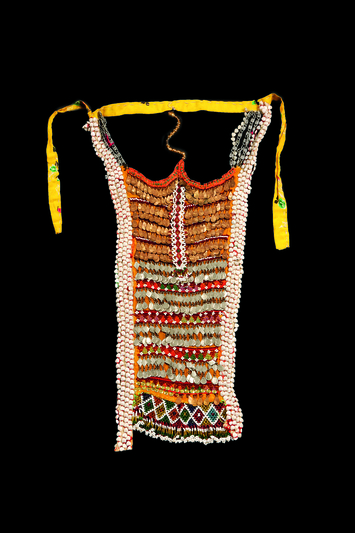 Burqa style face veil from the southern Sinai, Egypt, l1970s (TRC 2015.0584). Click illustration for the TRC catalogue entry.
Face veils
There are various types of face veils associated with the Bedouin living in southern Palestine and the adjoining Sinai peninsula. These types are based on a 'classic' burqa type with a head band and a connected veil section. In the deserts close to Palestinian villages, the traditional veils are short and often decorated with two rows of tightly packed coints.
Bedouin versions from the northern Sinai have much longer veil sections, which are made from red or dark orange cloth. These veils are often covered with embroidery and have attached chains, pendants, beads, etc., down the long sides. The southern Sinai Bedouin face veils are usually yellow or light orange in colour and again have numerous attached chains, pendants and beads.
Each tribe in the Sinai used to have its own type of face veil, but over the years the distinction between one group and another has faded. In addition, more and more married women are wearing plain black veils that show the influence of their Saudi Arabian neighbours.
 Thob ubb from Jordan, mid-20th century, 3 x 2.6 metres (TRC 2005.0248). Click illustration for TRC catalogue entry.Thob ubb
One of the most spectacular of the Bedouin dresses is the thob ubb, which was worn until quite recently in parts of Jordan, Palestine and southern Syria. The version from the Salt region of Jordan is about 3 by 3 metres in size and is worn with a huge pleat in the skirt section and with the sleeves acting as a head covering.
 Group of Bedouin women just outside of Jericho. They are wearing the thob ubb, c. 1910. Library of Congress LC-DIG-matpc-01273.One story associated with the dress is that in the late nineteenth century the Ottoman tax collectors were increasing the amount that the Bedouin had to pay, so women hided small valuables in their garments because the (male) tax collectors would be reluctant to search them. Allegedly the dresses grew in size as the quantity of items carried by the women increased.

3. Fez or tarbush
Followers of the British comedian Tommy Cooper, who died in 1984, will instantly recognise the bright red cap that became his trademark, but what exactly is he wearing? Is it a fez or a tarbush? Does it actually matter, especially as for many people the two words are synonymous?
There are subtle differences between the two forms and these can be seen as reflecting the massive social, cultural, economic and political changes that took place in the Middle East and the West in the nineteenth and early twentieth centuries. It is not simply something worn by a crazy comedian. It has a history. The origins of this bright red headgear, whether a fez or a tarbush, date back to the medieval period in the Levant, and possibly earlier.
It was always regarded as important for men to wear some form of headgear, especially when in public. One of the most widespread forms within the Islamic world was the turban (imama), which was regarded as one of the main symbols or badges of the wearer’s Islamic faith. The turban was wrapped around a cloth or a felt cap.
 Early 20th century postcard showing a Turkish gentleman and his lady in a carriage, both of whom are wearing Western style clothing. The man is also wearing a fez. TRC 2015.0432Fez
In the early nineteenth century the Ottoman sultan, Mahmud II (1785-1839), decided that the wearing of traditional style clothing was to be generally banned, including the turban, but the head should be covered. This decision created the problem of what to wear on the head, especially during prayers, when the forehead should touch the ground. Following various discussions a red, felted cap with no brim and worn without a turban was adopted in 1826 and this became known as the fez. In 1827 a further detail was added, namely the silk tassel,
The new headwear was made out of a base (made from basketry or card). This was covered with a knitted tube (this was often made in Hungary and what would later become Czechoslovakia) and shrunk to the required size and shape and felted to create a smooth, flat surface. An official decree in 1827 ordered the addition of a silk tassel, which was seen as symbolically representing the hair by which a devout Muslim would be raised to Paradise by Allah. It was worn to the right, left or back, but never to the front as associated with Tommy Cooper.
 Woman's fez from Egypt, late 20th century (TRC 1997.0258). Click the illustration for the TRC catalogue entry.
Some wealthy (Turkish) women were also wearing a fez, as for instance in Ottoman Egypt. Their headdress had a decorative metal disc (kurs) on the crown, and a multi-coloured tassel, to differentiate it from the male form.
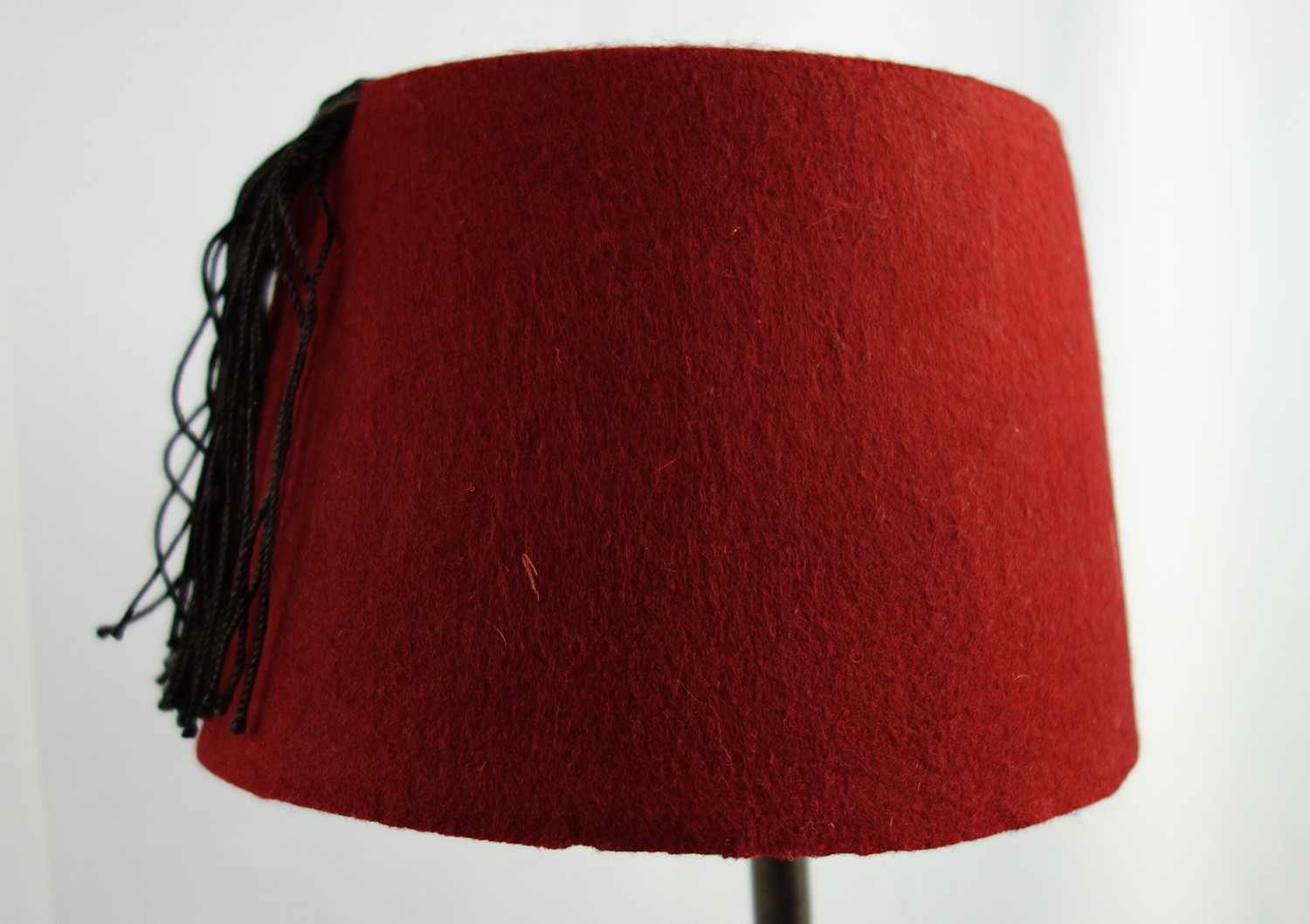 Tarbush from Egypt, bought in 1997 (TRC 1997.0071). Click illustration for TRC catalogue entry.
Tarbush
The idea of wearing the Ottoman fez (without turban) was regarded with distaste by many Arabs in the Ottoman Empire, and many men chose to ignore this regulation and continued to wear a cap and turban combination. In due course, and influenced by the ‘official’ fez, this cap developed into the tarbush. Because tarbushes were worn with a turban they are normally taller and with straighter sides in comparison to the Ottoman fez. The official tassel was black, but religious leaders could wear a blue tassel.
Modern fezz and tarbush
The wearing of the fez (by men) was banned in Turkey in 1925 as part of the so-called ‘Hat Law’ and its use died out among many groups. The wearing of tarbushes in Egypt was officially discontinued in 1956, when Nasser assumed power in Egypt.
Nevertheless, the use of blue tasselled tarbushes by Egyptian religious leaders (sheiks) has continued to the present day, and various groups outside of Egypt still wear fezzes and tarbushes as part of their ‘traditional’ dress, notably the Druze and the Samaritans. Fezzes can also be found among various Kurdish groups in Turkey, for example in Adiyaman, where the women’s headgear is based upon a red fez, which is covered with coins and several scarves.
The modern fez, as worn for instance by waiters in tourist restaurants in Turkey, is relatively short, with slightly sloping sides, with a black tassel. Reports have surfaced recently that with the revival of Ottoman culture and history some men in Turkey are starting to wear a fez again.

2. Global fashion
From the 1970s onward Western-style clothing has become more widely available to all layers of Middle Eastern society. T-shirts and jeans, suits and sweaters are worn next to local-style garments and adapted to fit local tastes. These Western-style garments are produced locally or in the Far East and are part of a global phenomenon. In addition, since the 1980s an international Islamic-style fashion has developed, that combines modesty with modern stylishness.
 An Egyptian lady wearing Western style clothing and a transparent face veil locally known by the Turkish word yashmak. Early 20th century (TRC 2017.1841). Click illustration for TRC catalogue entry.There are many local versions that betray the wearer’s nationality, but also styles that cross borders, such as ‘Islamic chic’. The TRC houses a group of garments created by the Lebanese fashion designer, Elissar W. Hikal. She uses men's kufiyah's, the traditional local headcloth for men, to make women's garments and textile jewellery.
In addition to global fashions, local dress traditions still play an important role, whether worn on a day-to-day basis or as part of folklore. This exhibition shows just a snippet of the great diversity of religious and ethnic groups in the Middle East, and the ways in which they display their identity.

1. A brief history
The Middle East is known to many as the ‘Cradle of Civilizations’, and indeed, agriculture and settled life quickly developed in this part of the world from ca. 9,000 BC onward. The region saw the subsequent rise of towns and cities and the first attestations of the use of a script and written language, sometime in the third millennium BC.
Great civilizations, such as those of the Babylonians, Hittites, Assyrians and, in neighbouring Egypt, that of the Pharaohs developed here, but the region was also coveted by outsiders and at successive times occupied by Greeks, Romans and Turks, and more recently the British and French. Moreover, it functioned as a gateway between East and West, with goods such as silks and precious dyestuffs travelling through its ports and towns.
The history of dress in the Middle East is defined by its cultural, ethnic and religious diversity, and by the outside influences that came with foreign occupiers and international trade. After the Arabs conquered a large part of the region in the seventh century, a Middle Eastern dress tradition developed out of an amalgam of local and external styles. Important new elements that subsequently became popular include the turban and tailored garments.
 Photograph of a street in Port Said, Egypt, late 19th century, showing people wih Arab, Turkish and Western styles of dress. TRC 2017.2287.The rise in power, some thousand years ago, of the Central Asian Turks under the Seljuqs, the Mamluks and finally the Ottomans, who dominated the lands from the early sixteenth to the early twentieth centuries, caused another important shift in dress traditions. Dress was increasingly institutionalized and various garments and outfits were restricted to certain groups. Ottoman Turkish modes of dress included layered shirts and coats, worn open or closed with a row of ties or buttons, as well as wide sleeves and various types of head coverings. Aspects of Ottoman costume, such as the kaftan and the yelek coat, can still be spotted in local dress to the present day.
In the late nineteenth and twentieth centuries, European fashion, in their turn, had a significant impact on what was worn by the Middle Eastern elite. Upper-class women travelled to Paris for the latest fashions, and photographs from the period show men wearing three-piece suits and women in Victorian gowns. Often these were combined with local elements, such as the fez for men and veil for women.
After the dissolution of the Ottoman Empire in 1922, the Middle East came under the control of the French and the British and the influence of European dress forms became more pronounced. Moreover, several independent governments, such as those of Turkey, Egypt and Iran, stimulated and even imposed Western-style (but locally made) garments for government employees, as part of an effort to modernize the newly fledged nations.