Beyond The Chador Regional Dress From Iran
5. Street of the Tentmakers
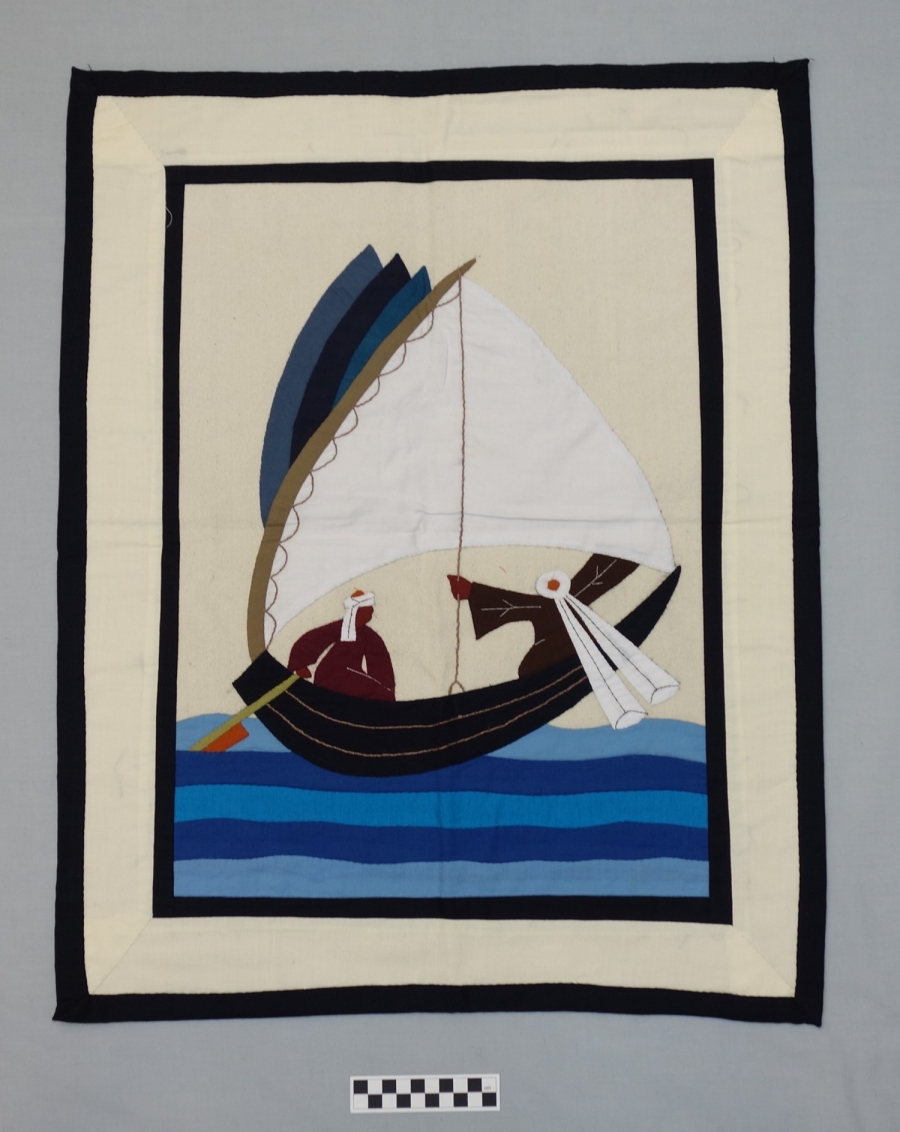
By the twenty-first century the production of tent appliqués can still be found in a small number of Egyptian cities and towns, but the most famous is the Shari’ Khayamiyya (or Suq Al-Khayamiyya). The Shari’ Khayamiyya is situated near the Bab al-Zuwayla, one of the city gates that was erected in AD 1092. The name Khayamiyya comes from the Arabic word khayma, which means ‘tent.’
The Street was established in the mid-17th century by Ridwan Bey al-Faqari (he died in 1656). His work included the organisation of the Egyptian pilgrim caravans going on the annual Hajj to Mecca in what is now Saudi Arabia. The preparations for the pilgrimage included the collection of items transported to Mecca, and just before the departure of the actual caravan there was a procession of the pilgrims themselves. Part of this procession passed very close to the Street of the Tentmakers. The thousands of pilgrims and their guards meant that each year it was necessary to assemble together vast quantities of supplies for the feeding and housing of those involved.
 Man working on an appliqué panel, Street of the Tentmakers, Cairo, Egypt. Photograph: Gillian Vogelsang-Eastwood, December 2014.The Street was part of a large complex that was created to cater for the pilgrims’ religious and secular needs. The complex included a mosque, offices, a palace for Ridwan, as well as a school and bath house. Among the objects needed for the pilgrimage were tents, tent ropes, banners and flags, as well as leather items such as water bags, leather saddles, even leather shoes and sandals. All of these items were made in the Street and surrounding district. From the seventeenth to the mid-twentieth centuries the Street was also famous for the production of appliqué panels traditionally used to make and decorate mainly urban (as opposed to nomadic) tents.
Nowadays, these tents, or more accurately pavilions, are used for family and official gatherings, rather than for living accommodation. Often the outside of the tent is plain and made of an off-white cotton, but on the inside the tents are lined with intricate geometric patterns in many colours. Sometimes, on very special occasions, panels are used to decorate both the inside of the tent and its outside.
These large appliqué panels used to be made in great ‘tent lofts’ above the suq leading to the Bab al-Zuwayla, on terraces or in the local mosque. By the end of the twentieth century, however, few of these huge panels were being made, as most of the festive tents and pavilions used in Cairo are decorated with printed, rather than hand sewn, designs
4. Medieval appliqués
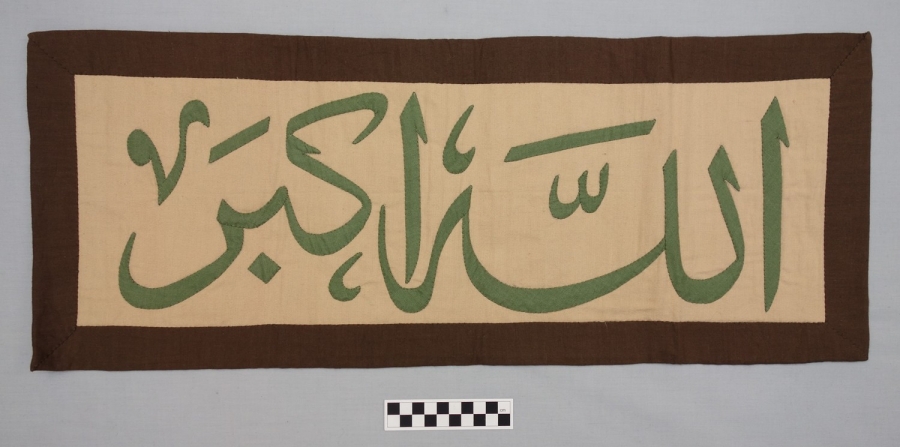
Various examples of 'real' appliqué as well as inlay appliqué (inlay patchwork) survive from the medieval era in Egypt, namely from the Fatimid (969-1171) and Mamluk (1250-1517) periods. Surviving examples of medieval appliqué include banners that are made of linen with appliqué work and needle weaving. These often have designs of circles enclosing diamond shapes applied to the background cloth and small z-shapes and central diamonds. Other popular medieval motifs include chalices and swords. These forms were often made using applied woollen cloth in various colours. Sometimes the ground material was linen, on other occasions it was made of wool.
One of the main uses of khayamiyya panels was for making large, decorative tents that were used at weddings, feasts, as well as by people going on hajj. There are various medieval descriptions of decorative tents and tent panels, which refer to appliqué as well as embroidered forms. In particular, there are references to manufacturers of decorative tents by the Egyptian writer al-Maqrizi, who was born in Cairo in AD 1365. The following description comes from Maqrizi’s so-called Book of Treasures, and it gives a description of ‘The Store of Tentmakers’ in Cairo. Maqrizi was using an earlier unnamed source for part of his study, which suggests that the production of tents and tent panels had been carried out for some time (Maqrizi, Khitat, I, 418ff; quoted by Serjeant 1972:159-160):
……Among the articles brought forth from the treasuries of al-Kasr, was a countless number of packages containing tents (khaima), large tents (midrib), tents with two poles (faza), flat-roofed tents (musattah), military tents (djarkawat), fortress tents, and castle tents, tents with one side only, pavilions and marquees (fustat) manufactured of Dabiki and velvet stuffs, Khusrawani stuffs, royal brocade (dibadj), Armenian stuff, cloth from Bahnasa and Karduwan (in Persia), and the best kind of Halabi (stuff manufactured at Aleppo [Syria]), … of various colors and kinds, as well as of sundus brocade and tamim (gold brocaded stuff) embroidered with designs of elephants, wild beasts, horses, peacocks, birds and other kinds of wild animals, and human beings ….. of all manner of striking and wonderful forms and shapes.

3. Historical examples
Examples of appliqué have been recorded from various archaeological sites throughout Egypt. Most notably, appliqués were found in the tomb of the ancient Egyptian pharaoh Tutankhamun (d. 1323 BC). These pieces include a panel, probably for the front of a tunic (see illustration), the ‘king's wings,’ as well as a small embroidered leopard skin in linen, which was used by the king when he was carrying out his role as a priest.
All of the appliqués from the tomb of Tutankhamun were made from either red or blue linen cloth on either a white or dark red ground. There is no direct evidence to show exactly how all the appliqués were made, but at least two techniques could be identified. The first uses rolls of very fine even weave linen, which were sewn down directly onto the ground material. This technique is seen on a child’s tunic worn by the young king and was used for an elaborate, decorative appliqué collar that was made in imitation of a beaded version.
 Detail of an appliqué textile from the tomb of Tutankhamun, 14th century BC. Photograph by Nino Monastra.A second technique used a piece of material that was cut out and then trimmed, nicked and tucked under in order to create the desired shape. This process is still used by Egyptian appliqué makers in Cairo to the present day. This form was probably used for the child’s leopard skin from the Tutankhamun’s tomb, which has applied linen roundels underneath five-pointed stars (the so-called night stars) and on top of the falcon's feathers. The appliqué falcon and vultures decorating the ‘king’s wings’ and the design on the tunic panel (see illustration) were also made with this technique

2. Appliqué
Appliqué is a technique whereby one or more textiles are sewn onto a ground material, usually of cloth, but leather may also be found. The cloth appliqués are made by drawing out a basic design on the ground material. Separate coloured cloth is cut out to the approximate shape and then, using a needle, its edges are tucked under and sewn down onto the ground.
There are two types of appliqué associated with Egyptian objects. Firstly there is positive, or ‘real’ appliqué, whereby a piece of cloth is sewn down onto another piece of cloth. Usually the edges of the applied cloth are tucked under to create a neat edge. The second form is called inlay appliqué (also known simply as inlay, and inlay patchwork), whereby an identical pattern is cut out in two pieces of differently coloured cloth and the ‘other’ pattern is sewn into the first piece of cloth, so creating a design that appears on both sides of the material. Often a cord was sewn around the pattern to hide the join between the ground material and the inlaid pattern. This particular form of appliqué is no longer widely used, but was especially popular during the medieval period.
In general, the production of this decorative technique was and remains the preserve of male embroiderers, but changes started to occur in the late twentieth century as more women and girls were taking up this profession, but they work from home rather than in public.

1. Introduction
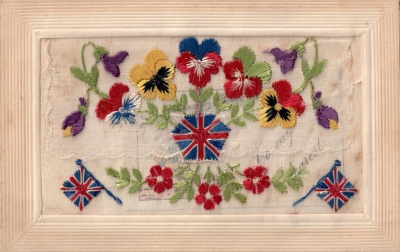
Embroidered postcards were popular in Europe from the early 1900's until the 1950's. Many of these were made in France. The cards were decorated with a wide variety of designs and messages worked in floss silk in various colours. It has been suggested that some ten million embroidered cards were produced.
This digital exhibition focuses on the embroidered postcards that were produced during and just after the First World War. Comparable cards were also produced in printed or woven forms, but the embroidered cards have become the most appealing.
The cards were made with machines that imitated hand embroidery, and they were often provided with embroidered texts with a patriotic, romantic or religious message. They were sent home by the officers and soldiers that lived and fought in the trenches of northern France. They were addressed to parents, brothers, sisters, wives and girl-friends. Texts were embroidered in the diverse languages of the Allied forces, but comparable cards with German texts were also produced, and sent home from the opposite side of the front. Some of the cards in the collection of the TRC still include the names and addresses of the people they were sent to, and sometimes even with a longer hand written text in pencil on the back.
 Embroidered postcard from World War One, with the flags of the Allied forces, from left to right those of Russia, Italy, Britain, France and Belgium (TRC 2015.0448). Click illustration for TRC catalogue entry.
The cards that are discussed in this digital exhibition and that are shown in the picture gallery, are all housed in the collection of the TRC in Leiden. They provide a very different glimpse of life in the trenches, a glimpse that the soldiers perhaps intentionally presented to their loved ones so not to worry them. It was a glimpse that provided a somewhat fanciful and sentimental impression of the war, very different from the harsh circumstances, the cold, the dampness, the dangers and the boredom, of life in the trenches.

2. Embroidered reminders from the dreadful trenches
Embroidered silk postcards were especially favoured during and just after the First World War (1914-1918).
The range of embroidered designs was varied and included obviously military subjects, such as the flags of the Allies (notably Belgium, Britain, Croatia, France, Italy, Portugal, Russia, and the USA), names of regiments, figures of famous generals, and more public subjects, such as Christmas, New Year and birthdays.
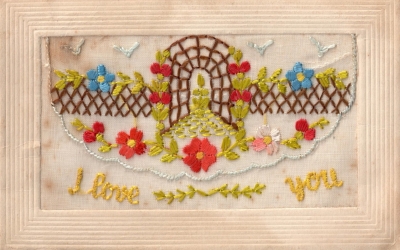
 Embroidered postcard from the First World War, with the flags of the Allies depicted on the feathers of a peacock (TRC 2015.0434). Click illustration for TRC catalogue entry.In addition, many cards carried illustrations of butterflies and flowers, as gentler, more sympathetic images. Many of the cards were embroidered with messages, varying from patriotic slogans to more sentimental expressions, such as illustrated below.
There are also postcards celebrating the end of the war. One postcard, again with the Allied flags, actually refers to the occupation of Cologne and the German Rhineland. The first British troops entered this German city on 3rd December 1918, barely three weeks after the cessation of hostilities on 11th November 1918. The British Army of the Rhine would remain in Germany until 1929, with their headquarters in Cologne.
 Embroidered postcard with the flags of the Allied nations during the First World War, celebrating the occupation of the German city of Cologne, first entered by Allied troops in early December 1919 (TRC 2017.2571). Click illustration for TRC catalogue entry.
5. Making embroidered postcards with a machine
Based on surviving examples, it is clear that strips (in domestic machine production) or very broad sheets (in factory production), both of organza cloth, were being embroidered with series of identical designs. Using hand-embroidery machines it was possible to produce hundreds of images on a sheet in one go.
 Postcard embroidered with a floral motif and the text "To my dear mother", worked with a Schiffli embroidery machine (TRC 2015.0432). Click illustration for TRC catalogue entry.
Once embroidered, the strips/sheets were cut up and the individual images were stuck into an embossed card frame. They were then sold to the public, especially the officers and soldiers, at a relatively high price.
The companies making and selling these cards could well have made a considerable profit. Perhaps this is the real reason behind the stories of poor refugee women working all hours to hand embroider these cards in order to feed their desperate families.
Once it had been established that this form of postcard was very popular, and lucrative for producers and sellers, several companies started producing these cards using truly mechanical embroidery machines, which did not imitate hand embroidery.
In doing so, some companies used a Schiffli embroidery machine, which creates running and satin stitches (this machine uses a lock stitch with two threads, one on the front and one on the back of the ground material) or a Cornely embroidery machine (for chain stitched motifs), but these are not as well made as those produced on the hand-embroidery machine.
3. Who actually made them?
The designs and texts for the cards were worked in series with colourful, free style embroidery on silk gauze panels. The individual embroideries were cut out and stuck to a card frame that was embossed with a decorative edging.
For the embroidery itself, a wide range of stitches were used. These included the back stitch, basket weave stitch, individual cross stitches, herringbone stitch, reverse herringbone stitch (in order to create a shadow work effect), double running stitch (also known as the Holbein stitch), satin stitch, stem stitch, as well as various composite stitches.
 A set of 25 images that were pre-embroidered by machine. The images are ready to be cut out and glued onto a card ground. The main text on the card reads: "Peace 1919" (TRC 2015.0421). Click illustration for TRC catalogue entry.In the past, various questions have been raised about these cards, especially as to how the cards were decorated, and by whom. Several different answers were given, the most popular and persistent (and sentimental) was the one that said that the images were hand embroidered by Belgian and French women who had been afflicted by the war.
But this explanation is not acceptable. Would these women and girls have really been able to hand embroider tens of thousands of cards? An important detail in this respect is that none of the individual postcards so far examined show any indication of a drawn or printed design that would have been essential if the embroideries were being made by hand. In addition, large sheets have been preserved (see the illustration) with series of comparable designs, ready to be glued onto the cardboard cards.
 Detail of postcard TRC 2015.0448, showing various embroidery stitches, including the cross stitch, satin stitch and stem stitch. For more information, click on the illustration.The large sheets and the lack of drawn or printed designs, and the sheer number of embroidered cards, indicates that the cards were machine made, but this brings us to the next question, which type of machine was used?
15. Pastime dress
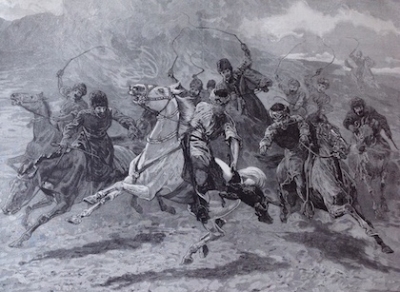
The TRC holds some unique garments from Afghanistan, which were worn on special occasions, such as when playing the game of Buzkashi (literally “goat grabbing”), at the so-called Zur-Khana ('House of Strength'), for the Pashtun Atan dance, and for hunting.
Buzkashi is a traditional Central Asian sport played by men on horseback. In Afghanistan it is especially popular in the north of the country. The aim is for the riders to grab the carcass of a headless goat or calf from the ground while riding a horse. A ‘goal’ is scored when the carcass is slung across a goal line, into a target circle or a vat. Games can last several days. The competition is generally very rough as riders try to make each other’s horses trip in order to thwart scoring attempts. Riders wear heavy padded clothing and head coverings in order to protect themselves from the other players’ whips and boots.
 "Cheif [sic] wrestler at Kabul." Water colour by Godfrey Thomas Vigne 1835-1838. Please note the embroidered pair of trousers.
The Zur-Khana is an ancient tradition that is still very popular in neighbouring Iran, but in the past was also popular among the Tajiks and other Persian speaking groups in Afghanistan. Basically it is a ritualised form of working out, using various tools, such as a club and a bow. Participants wear special clothing, and the TRC is fortunate in having one of the characteristic half-long trousers in its collection.
 Detail of a boy's tunic for the Atan dance, Kandahar, 2010 (TRC 2010.0532b). For more information, click on the illustration.
The Atan dance is performed by Pashtun men and boys; they dance around in a circle, often throwing their heads with their long locks of hair wildly around, and moving faster and faster. The TRC collection includes a boy's outfit from Kandahar for the Atan dance, but also a pair of man's dancing shoes from Kabul.
 Clubs (in Persian called 'mil') used in a modern zurkhaneh in Iran (TRC 2017.3043a b). For more informaation, click on the illustration.The TRC also holds two pieces of cloth that were used to 'hide' the hunter while chasing his prey. Both derive from western Afghanistan. One is in the shape of an animal, the other is decorated with painted representations of wild animals.
And perhaps not to be classed as pastime, riding a bicyle is also a way of expressing one's taste by decorating the bike with textiles. The TRC collection includes a number of saddle cloths from Afghanistan that are made of decorative carpet woven to shape.
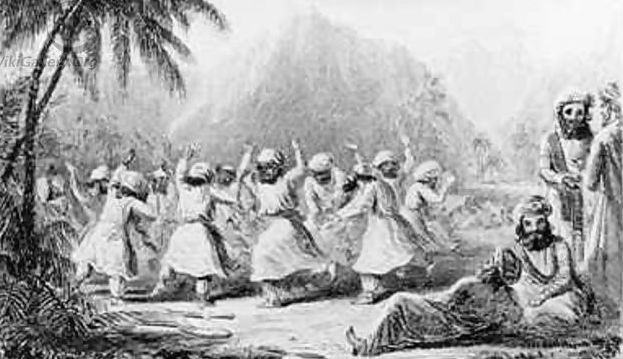 Atan dance, from the frontispiece of Vol. II of Lt. Arthur Conolly's 'Journey to the North of India through Russia, Persia and Afghanistan,' London 1834.Finally, many Afghan men like to consume tobacco snuff, called naswar, which they put in their mouths under the lower lip or behind their cheeks. Naswar, which is very popular in this part of the world, is a mixture of powdered tobacco and water, lime or juniper. In Afghanistan, naswar is often contained in small gourds that may be decorated with incisions or paintings. The gourd is stopped with a plug of leather.
14. Wedding outfits
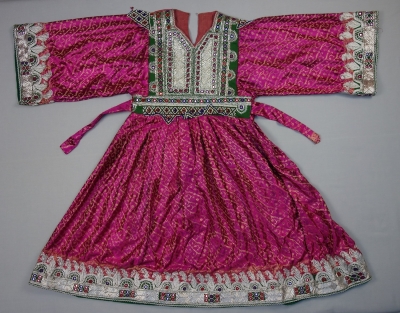
The guests at an Afghan wedding tend to wear new clothing with traditional forms. The female guests wear all their finery and jewels. Brides traditionally wear red or green clothing, although many modern brides wear white dresses based on Western fashions. The colour of the decorative braid along the hem of the bride's trousers corresponds to the braids on the dress and the head covering.
Brides and grooms often change clothing several times during the wedding day, and a white Western gown for the bride is easily swapped for a traditional ethnic outfit.
In Kabul and other Afghan cities the main celebrations take place in large wedding halls, full of glitter, where sometimes more than a thousand guests are entertained; but men and women are sitting in separate rooms!
 “Marriage party of poorer class – bridegroom and bride followed by girl carrying the bride’s clothes” From: Frank A. Martin, Under the Absolute Amir of Afghanistan, ……, 1907, opp. p. 96.