Beyond The Chador Regional Dress From Iran

1. Two lace bands
 Two lace bands. Top: TRC 2018.3173, bottom: TRC 2014.0921The illustration to the right shows two lace bands of a type that was used as a decoration for traditional Dutch caps in the early 20th century. Both examples follow the so-called Beveren lace design, which is a tulle lace with stylised flower motifs. The ground is made of an hexagonal mesh, often powdered with square tallies. The handmade piece (TRC 2018.3173) is a continuous-thread bobbin lace, and the machine made example (TRC 2014.0921) is manufactured on a Levers machine. Both examples are heavily starched, which indicates that they were used earlier, on another cap.
Filling: The handmade piece has a clear cloth stitch structure. You can see the threads of the filling being irregular, following the form of the gimp, which outlines the flower pattern. The fillings of the machine made example are more loose and have a regular and parallel structure with stitches in an obvious V-shape movement.
Gimp: In both pieces the gimp creates the outline of the floral motif. In the handmade lace it is visible on both sides. The gimp of the machine made piece is only visible at the front.
Ground: The ground for both pieces looks similar. The machine made lace has a good imitation of a tulle ground. An indicator to distinguish both laces are the stitches forming the ground. In the machine made example one side of the mesh is formed by a V-shaped stitch, while the handmade piece has a twist in the hexagonal structure.
Edge: Both examples have picots at the edges, but in the handmade piece the edge is created together with the main piece. The edge of machine made lace is produced separately and added later.
Side: The handmade piece is identical on both sides, while the machine made lace had a visible gimp on the front side.
| Handmade lace: | Machine-made lace: | |
 TRC 2018.3173 TRC 2018.3173 |  TRC 2014.0921 TRC 2014.0921 |


10. Kuba or Kasai 'velvet'
Kuba or Kasai ‘velvet’ is a form of textile that is produced in Congo. Although the textiles are often referred to as velvets or pile weaves, they are in fact a form of embroidery on a finished piece of raffia cloth.
According to Kuba legends, their 17th century ruler, Shyaam a-Mbul a-Ngoong, learnt the arts of weaving and embroidery from people living in the west and he introduced these techniques to his own people. What is clear is that this form of cloth has been produced in the region for at least 250 years, as there are two mid-18th century examples from the Zaire River region in the British Museum, London. By the 19th century, this type of cloth was being produced by Kuba and neighbouring peoples in the nearby Kasai River region.
 An example of Kuba embroidery made from raffia (mid-20th century, Congo; TRC 2017.3292).The first detailed description of this type of cloth was by the Hungarian explorer and writer, Emil Torday (1875-1931). He was not a textile specialist and described the textiles as ‘velvet’ to indicate their general appearance, rather than their technical nature, and this term has become generally attached to these textiles.
Basically, the ground cloth of a Kuba ‘velvet’ is made of raffia and is woven in a tabby weave. The thread that is used for the embroidery is a very fine, and has been rubbed until it is soft. The embroidery threads are often dyed in a range of colours, including brown, black, orange, purple, red and yellow. The embroidery is a form of counted thread work, whereby the thread is worked in lines (following the weft), which are creating blocks of colour. An iron needle with a large eye is used for the work. The needle carries the thread to the back of the cloth where it goes behind two or more warp threads before returning to the surface of the cloth. When a row is completed, the embroidery thread is cut with a small knife, thereby creating a pile, and the process is repeated. The pile created in this manner is only a few millimetres in height. The cloth is used for clothing as well as gifts and as a form of currency.

9. Some alternative velvets
There are various forms of textiles that are superficially related to velvet. These include warp and weft-piled weaves, as well as glued forms. The most common are:
Chenille
Chenille is the French word for a caterpillar and reflects the hairy nature of the material. Chenille is a form of tufted yarn that is created by weaving a piece of tabby weave cloth (the chenille blanket) with the warp ends grouped into sets, with a gap between the sets. The ‘blankets’ are then cut along the warp in order to make strips that can be used as a yarn. These strips are ‘hairy’ because of the cut weft threads. The chenille threads can then be re-woven into a velvet-like material.
 Sample of flock (mid-20th century, Europe; TRC 2017.0517).
The word corduroy may derive from French cord du roi, meaning ‘king’s cord’. It is a strong durable fabric with vertical cut-pile stripes. It is woven with weft threads that float over three or more warp threads followed by a section of tabby or twill weave. After the cloth is woven the floats are cut, allowing them to form ridges or cords. Compare TRC 2018.2511 and TRC 2018.2512.
Fleece
A type of cloth with a thick, heavy, fleece-like surface. By the end of the 20th century the term fleece was associated with synthetic micro-fibres woven as a supplementary thread into a knitted ground. The extra thread is cut, thereby creating a compact, piled surface. Sometimes there is a pile on both sides of the cloth.
 Detail of a woman's hat with a velvet ribbon and a plush ground (mid-20th century, Netherlands; TRC 2018.0572).Flock
Flock is made from old rags, clippings or cloth waste, which is cut and then ground into very short fibres. Some form of adhesive is then applied to a surface (paper, cloth, leather, etc) and the flock scattered over it. This produces a textured surface that superficially looks like a velvet. Compare also TRC 2017.0518, TRC 2017.0219, TRC 2017.0520, TRC 2017.0521, TRC 2017.0522, and TRC 2017.0523.
Plush
The term plush derives from the French word peluche, meaning plush or fluff (Latin: pilus). It is a warp pile fabric with a cut pile surface that is significantly longer than a velvet pile and less closely woven. Compare TRC 2018.0572, and TRC 2018.0574.
Terry towelling
Terry towelling or terry cloth is a woven fabric with a loop pile on one or both sides. The loops are in the warp and left uncut. The loops are much longer and more loosely woven than with velvet.

8. Furnishing velvets
Furnishing velvets are used around a building, either in public or private circumstances. These textiles can be divided into two basic forms, soft-furnishings, such as curtains and cushions, piano and table covers, tray covers, etc., and upholstery textiles, such as those used for chairs and sofas. In particular the bedroom and beds were regarded as important places for displaying velvet and the owner’s status.
 Advertisement for velvet curtains made by Lister & Co. of Bradford, England (1961; TRC 2018.2688
Between the 16th and 19th centuries in northwestern Europe, for example, a very elaborate system of bed dressing (a tester or half-tester) was developed among the elite in order to display their status. Sets of cloth for this purpose were known as bed hangings and could include:
(a) Canopy: a sort of cloth roof for the bed, which stretched above the bed and was kept in place with four poles, one in each corner. A half-tester canopy only went half way above the bed; (b) Valance: the sides of the canopy and the upper part of the curtains were covered with a valance or high valance; (c) Headcloth: this is the cloth that went behind the headboard of the bed; (d) Curtains: there could be between two and six curtains around a full-tester bed. They covered the long sides and end of the bed. Sometimes the curtains were in pairs, on other occasions single curtains were used; (e) Lower valance: the mattress and sides of the bed were covered with a length of cloth known as a valance, lower valance, or skirt, and finally (d) Counterpane: on top of the bed itself and covering the sheets, blankets, etc, was a counterpane or decorative cloth that often matched the other elements of the bed hangings.
Royal canopies
Royal court use of furnishing velvets included the canopy over a monarch’s throne. In Britain this is called the ‘Cloth of State’, which consists of a canopy called a ceeler and a long back cloth known as a tester, which goes against the wall. The set is hanging above and behind the monarch's throne. Much of it is made of velvet, which is at some places decorated with woven designs and at other places with embroidery.
ECCLESIASTICAL USE
The use of velvet, especially within the Roman Catholic Church and some of the Orthodox churches, also reaches to liturgical vestments, such as copes, chasubles and slippers worn by bishops and those higher within the hierarchy, as well as for church furnishings, such as altar coverings (notably altar frontals and superfrontals), banners and canopies. Velvet is also used for funeral purposes, such as palls placed over coffins, especially those on display in a public procession.

7. Clothing and velvets
Caps, hats, bonnets, shawls, dresses, cloaks and capes, coats, jackets, skirts and trousers have all been made in velvet. Some garments, such as the 10 m long velvet skirts worn by Kurdish women in eastern Iran are extremely heavy, while other forms, such as knitted velours, are very light in comparison.
It is noticeable that the types of velvets intended for clothing have changed dramatically over the centuries and across the world. When people (men, women and children) in Europe, for instance, wore velvet garments in the Renaissance period, these tended to be heavy, difficult to drape and decorated with large designs. The garments were intended to show off the designs and the expense involved in making and wearing such fabrics.
By that time, military garments and accessories were also made from velvet, such as royal surcoats worn at tournaments, etc. Velvet was also used to cover plate armour and, of course, it was applied for animal trappings and saddlecloths, as well as for reins, saddles and stirrups.
By the mid-16th century, there was a general movement towards the use of lighter, cut and uncut pile velvets with a satin ground and decorated with small designs. The garments could be shaped into more fashionable forms of clothing. These velvets became very popular, especially for women’s dresses and men’s jackets.
 Young boy wearing velvet jacket and trousers (England; 1880's; TRC 2018.3394).By the 19th century, a wide range of garments was still made from velvet, and these included various items, ranging from hats to shoes, literally from head to foot. Some of the most elaborate uses of velvet can be seen in the garments worn at coronations and royal marriages. The velvet used for the coronation of the French Emperor Napoleon and his wife Josephine de Beauharnais in 1804, for example, included vast quantities of velvet for their embroidered cloaks and trains.
Smaller quantities of velvet were used by ‘ordinary’ people, especially from the mid-19th century onwards, when velvet had become comparatively easy and much cheaper to produce.
The popularity of velvet declined during and after the Second World War (1939-1945) and the austerity that went with it. This changed in the 1960’s and 1970’s, when it was worn by men and women associated with the hippy tradition and the bohemian way of life.
The use of stretch velvet for indoor training outfits (tops and trousers) is regarded by some as the lowest of the low point for a once royal fabric. Perhaps it is time for a revival of Velvet!

6. Classic velvet designs
Up until the 15th century, designs on Italian velvets tended to be small and were regarded as suitable for any type of silk designs including velvets. Velvet weavers, for example, were producing small, crowded animal designs similar to those on contemporary silks. Small knot designs were also very popular.
But changes were taking place, and by the 1430’s a new style of velvet designs was evolving based on floral forms and worked on a much larger scale than previously known, with broader areas of velvet pile (especially using voided velvet forms). These patterns developed into large-scale asymmetrical and symmetrical forms. In addition, another type of velvet design developed that was called ferronnerie, because of its resemblance to ironwork tracery.
One of the most popular large scale asymmetrical designs were the so-called pomegranate and foliage motifs that became very popular from the 1430’s onwards. The repeat size on these could be about 50 cm or more and several widths of velvet were required to create the final motif.
Another very expensive and popular form of cloth in the late 15th and early 16th centuries was brocaded velvet (cloth of gold velvet), which included both gold and silver metal threads and velvet techniques. But the height of luxury for many clients were velvets woven with their coat of arms or personal badges. These commissioned velvets were produced in both Italy and Spain for royal courts, nobles and churches throughout Europe.
Changes in fashion and taste meant that by the 17th century velvets were becoming much lighter in weight and the designs started to become much smaller and the repeat distance much shorter.
 Modern figured velvet inspired by 18th century textiles (France, late 20th century; TRC 2017.3359).A feature of velvet patterns, in general, is that weavers often copied earlier designs, but using ‘modern’ equipment. It is possible, therefore, to find copies of 15th century Spanish motifs produced in 19th century Italy and France. This makes the dating of velvets more complicated! The same process of copying older motifs continues to the present day and such velvets are often used to restore the appearance of, for example, a 17th century room, or to replace well-loved wall hangings.
During the 19th and 20th centuries, a wide range of designs started to be produced using the Jacquard loom. This machinery was quicker to weave cloth and could produce more complicated designs, especially in the background. The motifs chosen reflected current tastes, such as the Neo-Gothic forms, or the Arts and Crafts motifs of the 1880’s and later. The latter can be seen in the velvet hangings in the Tweede Kamer of the Dutch Parliament buildings in The Hague. These include the so-called sunflower motifs that are now regarded as a typical Dutch velvet form.
Similarly, the Art Déco movement of the 1920’s and 1930’s created a wide range of geometric designs that reflected architectural forms, paintings, as well as other forms of textiles.
By the end of the 20th century the developments in modern computer driven looms have meant that virtually any type of design can be produced using velvet weaving techniques.

5. The main types of velvet
These are various ways in which velvet can produce different effects, such as changing the type of fibre or thread used, varying the colour of the pile, using cut and uncut pile, changing the height of the pile and by including a range of different background weaves (plain, satin), as well as using pile as part of another type of cloth.
Block printed velvet
A form of velvet with a solid pile ground and a block printed design. In very expensive forms, gold paint is applied to wooden or metal blocks and the design is printed on the velvet by hand.
Brocaded velvet
A form of velvet with metal thread as part of the background. Compare TRC 2011.0363, TRC 2011.0370, TRC 2011.0371, TRC 2011.0372, TRC 2011.0373, and TRC 2016.2128.
Chiffon (or transparent) velvet
A very lightweight velvet on a sheer silk or rayon chiffon base.
 Sample of a piece of 17th century (or is it an 19th century imitation?) voided velvet, cut and uncut pile (ciselé) (TRC 2011.0368).Ciselé velvet
A form of velvet where the pile uses cut and uncut loops to create a pattern. Compare TRC 2011.0368 and TRC 2011.0389.
Crushed velvet
A lustrous velvet with a patterned appearance that is produced by either pressing the fabric down in different directions, or sometimes by mechanically twisting the fabric while it is wet.
Cut velvet
A type of velvet in which the loops formed by the pile warp are all cut.
Devoré or burnout
A velvet treated with a caustic solution to dissolve areas of the pile, creating a velvet pattern upon a sheer or lightweight base fabric. Compare TRC 2017.0551 and TRC 2018.0894.
Double faced velvet
A form of velvet with a pile on both sides of the cloth.
 Dark blue devoré velvet with a design of stylised flowers (The Netherlands, 1930's; TRC 2018.0894).
A type of velvet that is extremely lustrous, appears dappled, and somewhat crushed.
Lyon velvet
A densely woven, stiff, heavy-weight pile velvet used for hats, coat collars and garments.
Mirror velvet
A type of exceptionally soft and lightly crushed velvet.
Nacré velvet
Velvet with an appearance similar to shot silk, whereby the pile is woven in one or more colours and the base fabric in another, creating a changeable, iridescent effect.
Panne velvet
A type of crushed velvet produced by forcing the pile in a single direction by applying heavy pressure. Sometimes, less frequently, called paon velvet. Since the 1970’s, the term ‘panne velvet’ has also been used for a pile knit velvet (sometimes called a velour), with a short pile that falls in many directions.
Pile-on-pile velvet
A particularly luxurious type of velvet woven with piles (cut or uncut) of differing heights to create a pattern.
 Advertisement in The Tatler, 1929, for printed velvet and dyed squirrel (TRC 2018.2546).Printed velvets
This is a form of velvet with a hand or machine printed design. Compare TRC 2007.0792; TRC 2018.1803; TRC 2018.2399; TRC 2018.2546; TRC 2018.2637, and TRC 2018.3399.
Solid (plain) velvet
A term used to indicate that the pile covers the entire ground and that there is no woven decoration. Compare TRC 1998.0368 and TRC 2001.0031.
Stamped (embossed)
A metal plate or roller is used to heat-stamp the fabric, producing a pattern. Compare TRC 1999.0255, TRC 2011.0367, and TRC 2018.2514.
Tie-and dye velvet
A plain or crushed velvet that has been hand coloured using a tie-and-dye technique.
Uncut velvet
Velvet in which the loops formed by the pile warp are left uncut. Compare TRC 2018.2513.
Utrecht velvet
Velvet made with a mohair pile and a linen ground. Compare TRC 2018.2502; TRC 2018.2503, and TRC 2018.2514.
Velour(s) (modern)
A form of velvet which has a knitted ground.
 Advertisement dating to 1885 showing a group of ladies, all wearing velveteen garments (UK, TRC 2018.2543).Velveteen (weft-pile weave)
Technically speaking, velveteen is a form of cloth in which the pile is created using supplementary weft threads, which are sometimes woven in the form of loops or as floating threads. The loops and floats are cut after weaving in order to create the pile. Sometimes, velveteen is described as an imitation velvet. Compare TRC 2018.2401 and TRC 2018.2543.
Voided velvet
A form of velvet that is deliberately woven with areas of ground that have no pile. Instead these areas are often produced with a tabby weave or satin weave in order to contrast with the piled areas. For voided velvet with a plain ground, compare TRC 2011.0374, TRC 2011.0375, and TRC 2019.0004. Fir void velvets on a satin ground, compare TRC 2011.0369.
Wedding ring or ring velvet
Another term for devoré and/or chiffon velvets, which are allegedly fine enough to be drawn through a ring.

4. The production of velvet
Currently there are three main ways in which warp-based (‘proper’) velvet are made. Two of these techniques use looms, the third applies a form of knitting frame. Velvets made on a loom are made of one of the three basic ground weaves, namely tabby, twill or satin. Sometimes two warp threads are used together and this is called an ‘extended’ tabby, twill or satin. These details are important as different ground weaves give an indication of when and where a piece of velvet was made.
Historical velvets
The historical method of velvet production uses a particular type of loom, depending on whether a plain or a figured velvet was being made. For plain velvets a heddle or treadle loom was used, and for figured velvet a drawloom and later a jacquard loom. But the basic method of weaving remains the same. It should be noted that because the amount of thread needed for the looped or pile warps is about x6 the amount required for the warp threads of the ground weave, the particular pile warp threads are wrapped around a separate warp beam at the back of the loom. The following description is based on the production of a plain or solid velvet.
The warp threads are divided into two groups, namely the (a) main threads (ends) that make the ground cloth and (b) the pile warp (pile ends) that are used to make the individual loops or tufts. When setting up the loom all the warp threads are passed through the teeth or dents of a comb (reed), which is placed across the width of the loom near to where the weaver sits and works. The warp threads are generally entered into the dents of the reed in the order of three main and one pile thread for a tabby or twill ground, and six main and one pile thread for satin.
 A sample of Genoese cut velvet in silk. This piece was woven on a Jacquard loom (Europe, 2018; TRC 2018.3021).In order to produce very compact velvets or more than one colour in the design, there may be two or more pile warps in a single dent. The best quality plain velvet known in Italy is terciopelo. It has three pile ends in a single dent. It is likely that this is what the English playwright, Willem Shakespeare, was referring to in Measure for Measure, when a gentleman compares the comedy character Lucio to a velvet: “Thou are good velvet; thou’rt a three pild-peece I warrant thee”.
In normal weaving, warp ends are lifted to create a shed and a weft thread (pick) is inserted. In velvet, two to four rows are completed (the vise sheds) and then the pile ends are raised and a fine metal wire or rod is inserted, instead of a weft thread. The rod separates the warp threads from the pile ends. The pile ends may then be cut creating the desired smooth and shiny appearance. When the loops are left uncut, the result is less smooth and less shiny.
The diameter of the pile rod dictates the height of the pile. The average rod is about 2mm in diameter. A rod with an asymmetrical curved profile is used for finer piles, while a square section rod for coarser pile. If the pile is going to be left uncut then the rod is smooth. If it is going to be cut, then the rod has a longitudinal channel or groove down its length, which guides the knife used to cut the loops. Skilled rod makers were highly regarded for their work and in great demand by velvet workshops.
Figured velvets are woven on a more complicated form of loom, called a drawloom, which requires at least two people to operate it.
In addition to the shafts or heddles, the reed and treadles of a plain loom, a drawloom also has a figure harness that consists of a system of cords (lashes) attached to the warp threads. These cords make it possible to control individual or groups of warp threads in order to create the desired pattern. The weaver would sit at the front of the loom and operate the treadles with his feet while passing the shuttle for the weft threads side to side. An assistant (drawboy) operates the figure harness by pulling lashes up in the correct order.
In addition, velvet drawlooms often had a series of warp bobbins for the pile warp rather than a second warp beam at the back of the loom.
Brocaded velvet
Brocading is the introduction during weaving of coloured silk or metallic wefts in areas where they are required by the pattern. Brocaded velvet developed in the 15th century and at first most forms included tightly packed metal threads visible on the obverse side, with a considerable amount of metal thread still left on the backside.
The earliest gold/silver thread was made of gilt strips of animal gut or parchment. Then in the late 15th century filé thread (passing) of silver-gilt plate wrapped around a silk core was developed. In addition, some weavers started to use drawn metal wire, which was used to create cloth of gold or silver, whereby the whole of the ground was covered with a metal thread.
Weavers quickly developed the skill of adding the metal thread only in the places where it was required (inlaying) and turning it back upon itself without the thread cracking or breaking. Sometimes yellow silk was woven with the gold threads, to make it appear that more gold was being used than was actually the case.
 An example of Italian allucciolato velvet (Italian, early 15th century; TRC 2011.0361).From the 1420’s, some Italian weavers enriched their velvets with gold weft loops. These could be raised at intervals within areas of cut silk pile giving a glinting effect, called allucciolato (‘lit up like fireflies’) or raised in massed bouclé (looped) effects, known as broccato riccio sopra riccio (‘loop over loop’). These velvets were popular in the 15th-16th centuries.
By the end of the 16th century light weight velvets with a satin ground became popular and these often included strips of silver or silver gilded thread, called lames in French.
Selvedges
An important feature of handwoven French, Italian and Spanish velvets is the selvedge. The oldest selvedges are in white (good quality), yellow or blue (poorer quality). Around 1457 the Venetians introduced striped selvedges that could include up to five colours in different combinations. This indicated where the velvet came from and its quality. Compare also TRC 2011.0380.
Double-cloth velvet
Double cloth is a form of fabric produced by weaving two layers, one above the other, at the same time on the same loom. This is a way of increasing production. Double-cloth velvet is where two lengths of cloth are woven with a gap in between of about 0.6 cm. The pile ends are woven in such a manner that they move between the two sets of cloth. The pile ends are cut on the loom by a reciprocating knife blade in order to produce two, separate pieces of velvet. These are then rolled onto two cloth (take-up) beams.
Knitted velours/velvets
In the mid-19th century warp knitted velvet, also often referred to as velours, started to be produced. It was cheaper than the woven forms. This form was popular as the cloth draped easily, but it was still regarded as an expensive, elite form. In the 1960’s knitted stretch velours started to appear, made with synthetic fibres that included spandex, which was known for its elastic qualities. These stretch velvets were comparatively cheap, but often of a poor quality with a very sparse and loose pile. One result of their introduction was that respect for velvet, once a kingly (literally) cloth, was lost by many. This type of cheap velvet comes in many different forms, including plain, crushed, printed, devoré and so forth.
 Velvet ribbon with a tartan design, made into a bow to decorate a woman's bonnet, early 20th century, Germany. (TRC 2018.3219).Velvet ribbons and bands
In addition to the lengths of velvet cloth that are produced, there are also velvet ribbons and bands that are being made. Velvet ribbons in general are soft, double sided lengths of cloth that are normally between 0.5 and 5.0 cm in width (think of a hair ribbon). Bands are stiffer, single-sided, and in general between 2 to 20 cm in width. Bands can be applied to garments, curtains, even to the outside of a door frame to hide the joins between the wood and the wall.
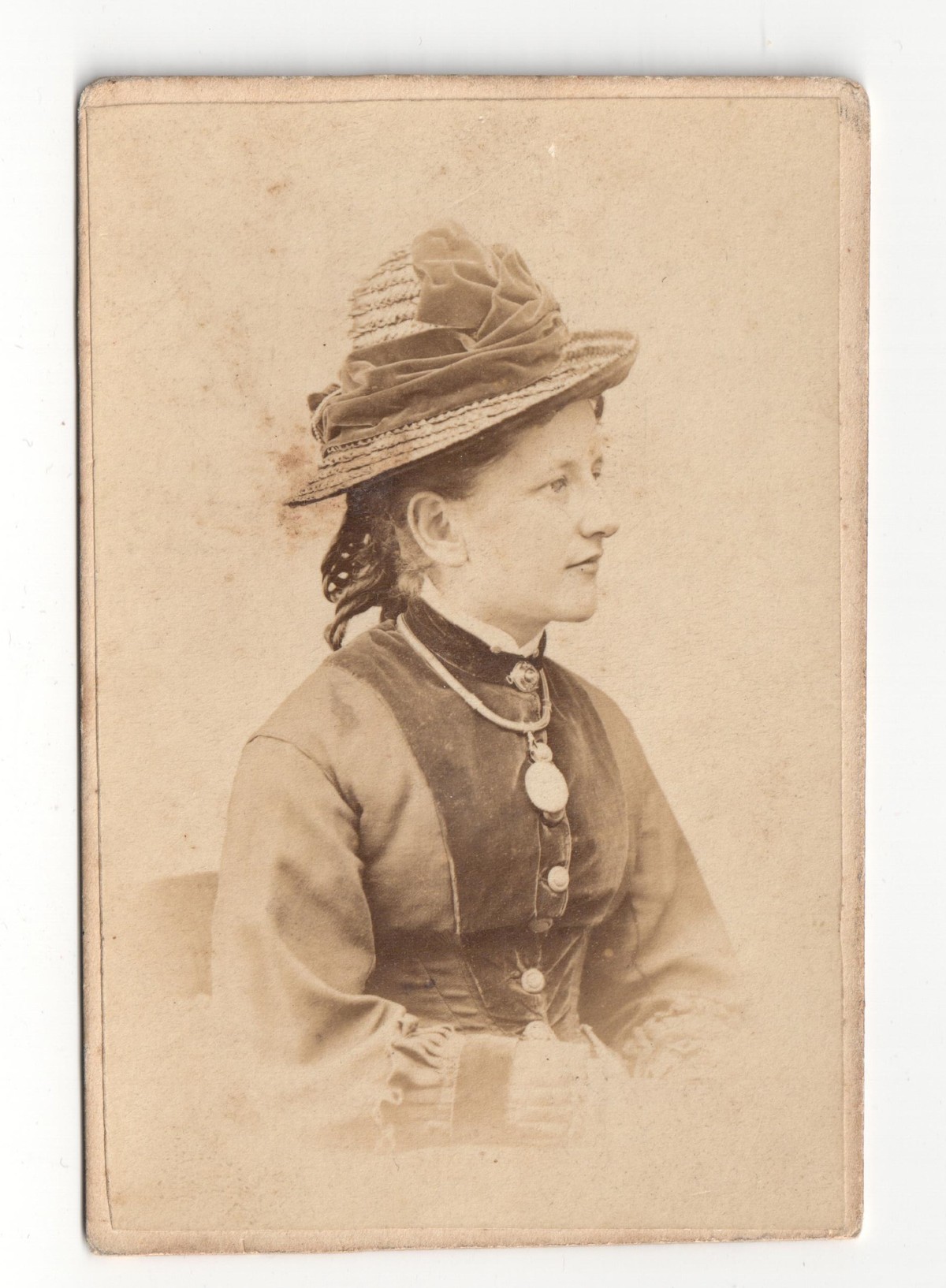 Woman wearing straw hat decorated with a velvet ribbon (Bristol, UK, late 19th century; TRC 2018.3144).The use of trims or bands of velvet for garments, for example, became increasingly popular from the 15th century onwards. At first small amounts were used on a collar or for the border of a hem or cuff. This was regarded as an economical technique to add a little distinction to a garment. In the 16th century, however, more and more garments were trimmed (guarded) with velvet bands and several metres of specially woven velvet were sometimes needed for a single garment or outfit. These bands became an expensive part of the final garment.

3. Raw materials
An essential feature in the production of velvet is the range of raw materials that are being used. Over the centuries these have changed dramatically. Not surprisingly, the late eighteenth century and the Industrial Revolution were to play an important role in the production of velvet.
Fibres
Before the Industrial Revolution of the eighteenth and nineteenth centuries, velvet was normally made from either silk or, less commonly, wool or mohair (especially in the Netherlands). In addition, some cotton and linen versions were produced. The most popular form, however, remained silk velvet. The silk for European versions came from China, Iran, Syria, as well as (but to a lesser extent) Egypt, Sicily, Italy and Spain. Later the French sericulture industry developed to such an extent that their velvet industry was significantly supplied by locally produced silk.
During the twentieth century velvets came to be made from acetate, nylon, polyester, viscose or a mixture of artificial, synthetic and natural fibres. Examples made from mixed cotton and bamboo fibres have recently become available. Sometimes spandex is added to the thread in order to give it a stretch – hence the term ‘stretch velvet’.
Dyes
One of the most expensive elements of a velvet was the dye used to create the various colours. These tended to be restricted in number. In order to create the best textiles, the fibres were first dyed, then spun and only then woven, rather than dyeing a finished piece of cloth.
Blues were created using indigo (Indigofera sp.) or woad (Isatis tinctorium), while yellows were made from fustic (Cotinus coggygria), Persian berries (Rhamnus family) or weld (Reseda luteola). Purples were produced using some types of lichens. But it was the red dyes that provided the widest range of colours, and these reflected dramatic developments that took place at the end of the 15th century, namely the opening up of the Americas to European traders and merchants.

Prior to the early sixteenth century, most red dyes were produced from madder (Rubia tinctorum), and to a lesser extent, redwood (Caesalpina sp.), or from European insect dyes, notably kermes (Kermes family, especially Kermes vermillio), which was known as grana in Italian and grain in English. Other insect dyestuffs included Polish lac (Porphyrophora polonica) and Armenian lac (Porphyrophora hamelii (Brandt)). The insect dyes produced the better colours and were far more expensive than those based on madder. But they were also more difficult to dye with.
But a major change in the red dyestuffs took place in the early 16th century with the introduction of New World cochineal (Dactylopius coccus). The first documented cargo of cochineal sent to Spain dates to 1523. Cochineal was soon imported on such a large scale that the price of some velvets actually came down, albeit only slightly. The red that was produced became known as ‘Crimson’ and was highly valued.


