
 Bamberg Cathedral, 2 July 2023. Photograph by Willem Vogelsang.On our way to Czechia, last Sunday 2nd July, Willem and I passed the beautiful medieval city of Bamberg. We came to this place in June 2016 (see a blog of 11 June 2016), and we simply wanted to visit the Bamberg Diocesan Museum again and see its amazing collection of medieval garments, such as the Star Mantle of Emperor Heinrich II and the Byzantine Gunthertuch.
We also needed some extra information for the fourth volume of the World Encyclopedia of Embroidery (covering Western Europe and Scandinavia), which we plan to send to the publishers in manuscript form later this summer. We decided to stay in Bamberg for a day and really take the time to have a close look at the textiles.
As we said in our 2016 blog, the museum is located next to the Bamberg Cathedral and is home to two significant collections of elite, medieval textiles and garments, both dating to the 11th century, as well as numerous other textiles and garments dating as late as the 19th century. Many of these garments and textiles are embroidered, and they present a marvellous picture of mid-medieval needlework.
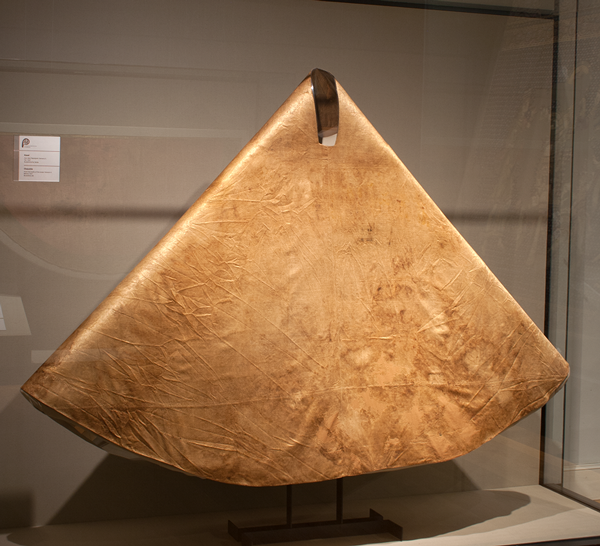 Bell-shaped chasuble associated with Pope Clemens II, 11th century. Diocesan Museum Bamberg.Pope Clemens II
With respect to the 11th century pieces, these include liturgical garments associated with Pope Clemens II (died 1047). He was originally Bishop of Bamberg before going to Rome in 1046 to become pope, and dying only a year later (possibly of poisoning). His wish was to be buried in Bamberg.
In 1942 his tomb was opened and the textiles and garments removed apart from some linen undergarments that did not survive the Second World War (1939-1945).
The pope’s garments include a golden silk dalmatic, a bell-shaped chasuble, pontifical stockings (buskins), cuffs, lappets from a mitre, etc., all made from silk. Some are decorated with woven, damask patterns and are probably of Byzantine origin.
Emperor Heinrich II and Queen Kunigunde
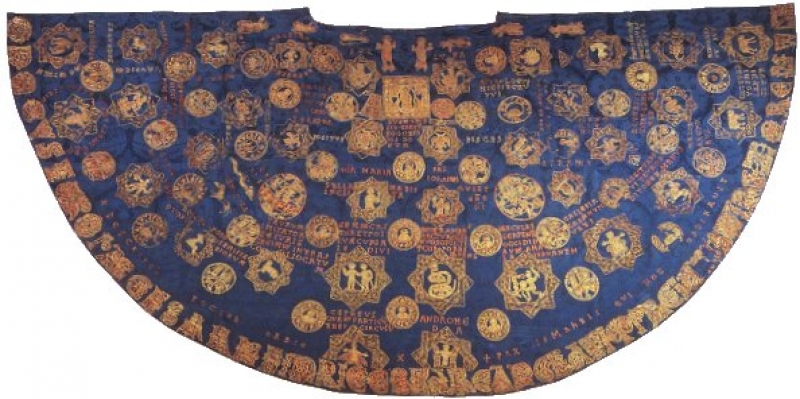 The so-called Star Mantle of Emperor Heinrich II, 11th century. Diocesan Museum Bamberg, Germany. Photograph public domain.
The second group of garments are associated with Emperor Heinrich II (born c. 973, reign 1002-1024) and his wife, Queen Kunigunde (c. 980-1033), and consists of various mantles embroidered in different techniques and styles, namely the Star Mantle of St Heinrich II (Sternenmantel), the Blue Mantle of St Kunigunde (Blauer Kunigundenmantel), the White Mantle of St Kunigunde (Weisser Kunigundenmantel), and the Rider’s Mantle (Reitermantel). There is also the Tunic of St Kunigunde (Bamberger Tunika), and a Rationale (Bamberger Rationale). All of which include embroidered areas.
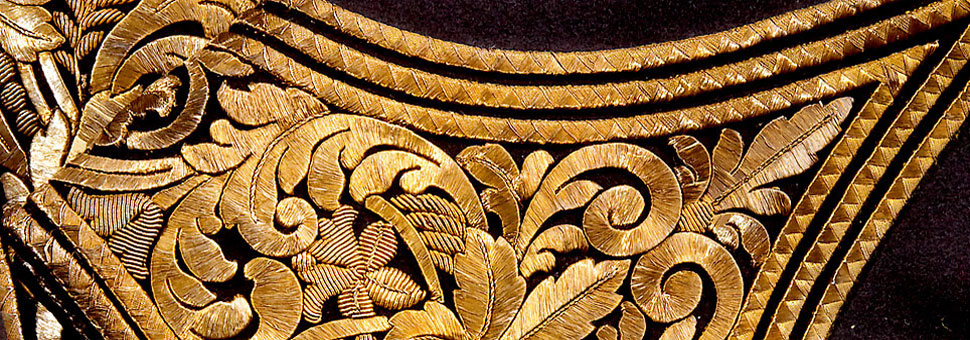
 Detail of the Star Mantle of Heinrich II, 11th century. Diocesan Museum Bamberg. Photograph by Willem Vogelsang.In the 12th century, both Heinrich and Kunigunde were canonised and their garments were soon turned into holy relics that were frequently moved and touched. As a result, over the years the various garments were seriously damaged. So by the mid-15th century, the embroideries were cut off the silk grounds and replaced on new grounds. These are the grounds that can still be seen to the present day.
We were particularly enthralled with seeing the Star Mantle again. Its history, apart from its specific value as a textile, is fascinating. It was a gift from a local Lombard leader in southern Italy who had risen against the Byzantine Empire.
This man, named Meles of Bari (an inscription on the mantle refers to him as Ismaeli), was defeated at Cannae in southeastern Italy, in 1018 ( in a battle not to be confused with another battle fought at that place, setting Hannibal against the Romans in 216 BC), and shortly afterwards he approached Heinrich II for help.
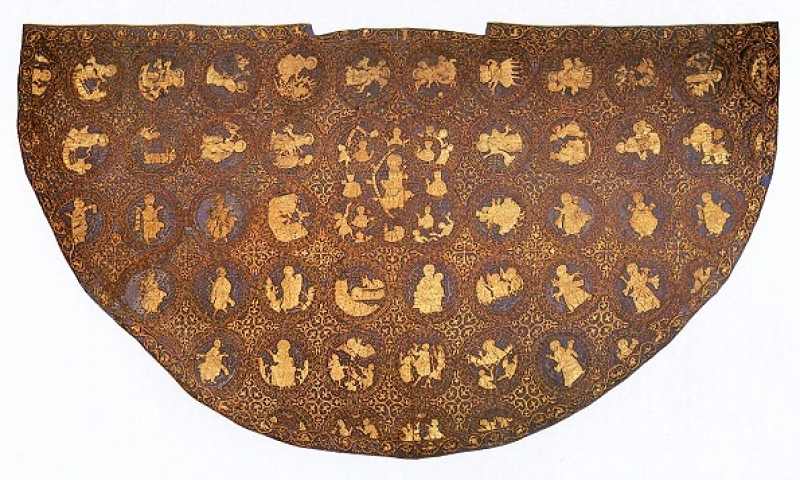 The Blue Mantle of St Kunigunde, 11th century. Diocesan Museum Bamberg. Photograph public domain.
It is known that the two men met in Bamberg at Easter in 1020, and it is likely that the Star Mantle was given by Meles to Heinrich at this meeting as a diplomatic gift. Meles died soon after, on 23 April, and was buried inside the cathedral.
 Hood attached to the White Mantle of Queen Kunigunde. Photograph by author.The Blue Mantle of St Kunigunde is semi-circular in form and includes 56 medallions. Because of the liturgical nature of the medallions it is likely that this mantle was a gift from Queen Kunigunde to Bamberg Cathedral. As in the case of the other garments, the embroidery was cut from the original garment and applied to a new ground sometime in the mid-fifteenth century.
There are only some extant fragments of the so-called White Mantle of St Kunigunde, including a cope hood/shield that depicts Queen Kunigunde holding what may be a depiction of Bamberg Cathedral. Part of the hood has been embroidered with surface couching as well as embellished with woven, gold thread bands.
 Embroidered remains of the Tunic of Kunigunde. Diocesan Museum Bamberg. Photograph by author.Also the Bamberger Tunika has only partially been reserved. Only the gold embroidered trimmings with medallions on the neckline, sleeves and the hem have survived from the medieval garment, as well as some of the original beadwork on the left sleeve.
But the original garment must have been richly embellished, as indicated by the surviving medallions, some of which include griffins. Apparently many pieces of this garment were cut off and given as gifts to other religious groups and individuals.
The Rider’s Mantle is one of the most spectacular of the garments, however, it did not originally have the semi-circular shape in which it is presented today.
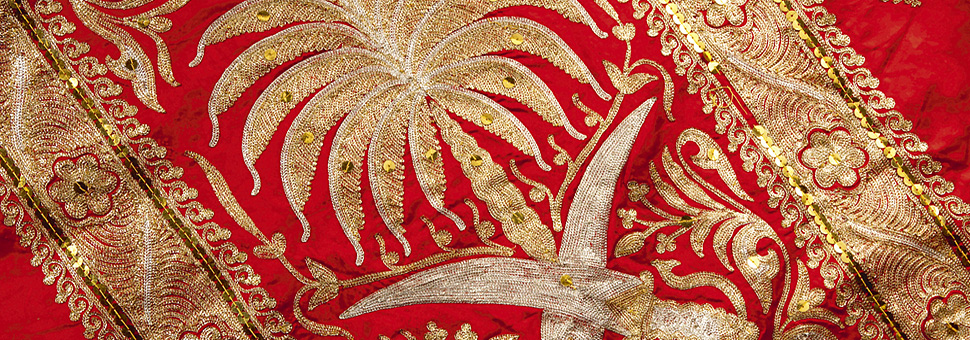
 Detail of the 11th century so-called Rider's Mantle, Diocesan Museum Bamberg. Photograph by author.Rather, it was originally either rectangular or a rectangle rounded at the bottom, which could be worn over the left shoulder and closed on the right shoulder with a fibula. Intriguing is a woven Kufic inscription, which probably was part of the original lining of the garment.
The pictorial elements of the embroidery appear to be based on Byzantine imperial and Sasanian hunting depictions, but there are elements that are not consistent, such as a falcon being used to hunt lions. In the fifteenth century the gold embroidery was transferred to a new silk atlas (satin) ground.
The Bamberger Rationale is equally fascinating. A rationale is a rare medieval garment that is worn by bishops. It would appear that a rationale has been worn by German bishops since the 10th century and later spread to France and England, but later died out in the latter two countries. It is based on the ephod worn by a Jewish high priest (see Exodus 28). It is basically a shoulder ornament, attached to, or worn over a chasuble.
 The Bamberger Rationale. Diocesan Museum Bamberg. Photograph by author.The original Bamberger Rationale probably was a gift from Emperor Heinrich and Queen Kunigunde to the first bishop of Bamberg, Eberhard I (reign: 1007-1040). The embroidery on the garment consists of fine surface couching with gold metal thread, worked in straight lines. The embroidery on the front depicts scenes from the Song of Songs, and shows Christ as a harbinger of peace.
The medieval garments in the museum have been the subject of extensive and detailed research, the results of which are presented in Die Bamberger Kaiser-Gewänder unter der Lupe. Methoden und Ergebnisse der aktuellen Forschungen, edited by Norbert Jung and Holger Kempkens, published recently, in 2021. It includes a wide range of analyses, from dyes and metal threads to weaves and design origins. Well worth having (and a copy of the book is now being included in the TRC Library).
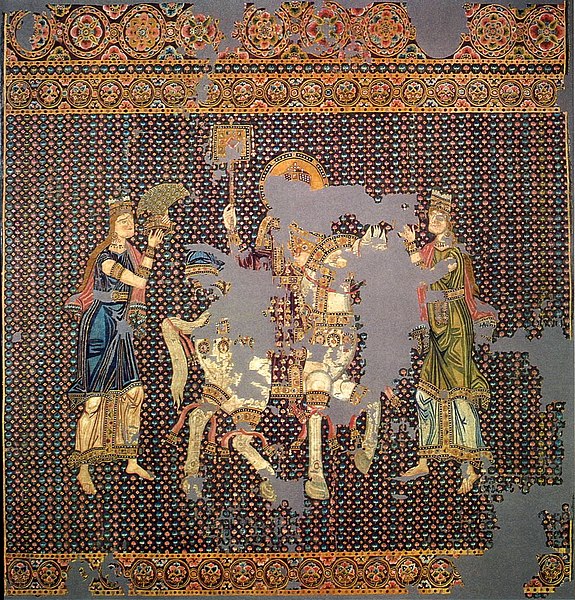 The so-called Gunthertuch, 11th century, Byzantine. Diocesan Museum Bamberg, Germany. Public domain.Gunthertuch
The Gunthertuch is a Byzantine silk tapestry that probably dates to the 11th century. It depicts the triumphal return of a Byzantine Emperor, on horseback. The cloth was acquired by Gunther von Bamberg, Bishop of Bamberg (reign 1057-1065) during his 1064-1065 pilgrimage to the Holy Land.
The bishop died on his return journey and he was buried with this particular cloth in Bamberg Cathedral. The tomb was opened in 1830 and the cloth removed and later put on display.
Other treasures
The museum also includes other medieval textiles, such as German tapestries depicting various religious themes, including the crucifixion of Christ, woven bands (mainly in the form of narrow girdles), as well as small pieces of embroideries.
 So-called Mitre of St Otto, late 12th century, restored in 14th century. Photograph by author.There is, for example, the silk mitre associated with Bishop Otto, which dates to the 12th century and was restored in the 14th century. The mitre has embroidered details and applied pearls. Bishop Otto of Bamberg was a missionary who worked most of his life in Pomerania. He died in 1139 and was canonised in 1189. The mitre is made of linen, parchment and silk, and decorated with gold thread embroidery and pearls.
As in Fulda (see the previous blog), there are reliquaries consisting of the skulls and bones of various saints that are covered with embroidered and applied decoration.
All in all lots of varied and vary interesting textiles and garments to see and think about!
Gillian Vogelsang-Eastwood, 4 July 2023