I am an MA student in Heritage and Memory Studies at Amsterdam University, and I started my internship at the Textile Research Centre a little over a month ago. Over the course of a month, I am discovering more and more about how the TRC preserves textile heritage through various means and about its approach to spreading knowledge through education. Being a student intern at the TRC, I had the privilege to assist and sit-in on their highly praised Intensive Textile Course from 23 to 27 May 2022.
 The class studying the different kinds of fiber using the microscope. May 2022. Photograph by author.
After five days of learning, touching and experimenting, I left Leiden feeling, to be frank, exhausted but also incredibly accomplished, fulfilled and inspired. Not only was I able to gain a comprehensive introduction into textile technology, I also had a chance to see TRC’s philosophy in heritage preservation put into action. In the following, I would like to share with you some of my favourite parts of the course and my main takeaways.
First and foremost, what I like about this course is the accessibility of its content despite being fairly technical. When tackling the subject of textile technology, one can find it quite intimidating as the topic could seem too big to handle and too technical to deconstruct.
 The microscopic view of the top hair and under hair of a mink. May 2022. Photograph by author.This course breaks down the subject by going through the techniques involved in the different stages of textile production. While everyone might have a different level of expertise in textiles at the beginning, we all started from the basics with the raw material of the fibres and progressed all the way to the different decorative methods such as dyeing, velvet-making, pattern-printing and so on. Instead of using lecture notes and PowerPoint slides, our tutor and also the director of the TRC, Dr Gillian Vogelsang-Eastwood, made use of a wide variety of teaching methods and equipment.
For instance, when we were learning about the properties of different fibres, we tried burning the materials to observe how they would light up and disintegrate. We also used the microscope to look into the structural differences of the fibres.
This course deconstructed the subject into its fundamental building blocks and provided us with the tools we need to dissect and ‘read’ a garment on our own.
 Dr Vogelsang teaching the class about natural dyes with over 80 colour results on the tables. May 2022. Photograph by author.Another reason why I think the course is so inspiring is because of the hands-on approach of teaching. As mentioned before, we had the opportunity to try out different tools and participate in simple experiments and activities. Instead of using elaborate theories and complicated jargons, most of the learning comes from actively participating with our hands.
Just to list a few examples, we tried preparing yarns with combing and carding, learnt about spinning through hand spinning and wheel spinning, experimented with fifteen types of natural dyes, resulting in more than eighty different colours and also tried out the different techniques of resist-dyeing, such as batik and ikat.
It is interesting to note that instead of learning the theories first and then putting them into practice, like most traditional teaching would do, it is quite the opposite for this course. In many cases, Dr Vogelsang would first let us dip right into practice and experience first-hand all the labour that goes into a certain procedure and then explain it with theories and textile samples.
When we were learning about weaving, Dr Vogelsang gave us a bare frame, two sticks, some cotton yarn and woolen threads and asked us to set up a 'loom' that is ready to weave. It took us some time but we eventually figured out that in order for the weft threads to pass through the warp threads without having to handpick them out every time, a heddle must be made to pull up the selected warp threads on the loom.
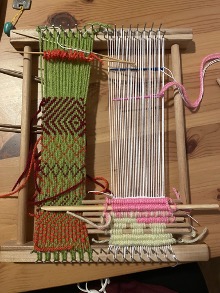 Practising weaving (left) and velvet-making (right) on a frame. May 2022. Photograph by author.I find this approach extremely effective, since with such thought processes, the mechanism of a loom becomes much more memorable and easy to comprehend.
Lastly, this course allowed me to understand the function and importance of a reference and handling collection. After going through the techniques, Dr Vogelsang would show us how they are applied to real garments using the objects in the TRC collection. This step effectively put everything we learnt into perspective, and giving us a clearer picture on how the building blocks in textiles are pieced together to create a product. Looking at the different parts of a piece of textile, examining their details up close and feeling its texture reveal so much more information about the textile compared to simply looking at it through a photo or a glass cabinet.
It has become clear that setting up an extensive reference collection and allowing the learner to actively engage with the material are essential to the teaching of textile technology. One of the most interesting textiles that Dr Vogelsang has shown us is an unfinished piece that is supposed to go through batik dyeing but since it is unfinished, the wax is still present on the cloth with little areas of colour, demonstrating a mid-stage of batik dyeing. It shows us that a reference collection is not just about collecting the most well-made items, but also the ones that can showcase the various stages of production and the different possibilities of a certain technique .
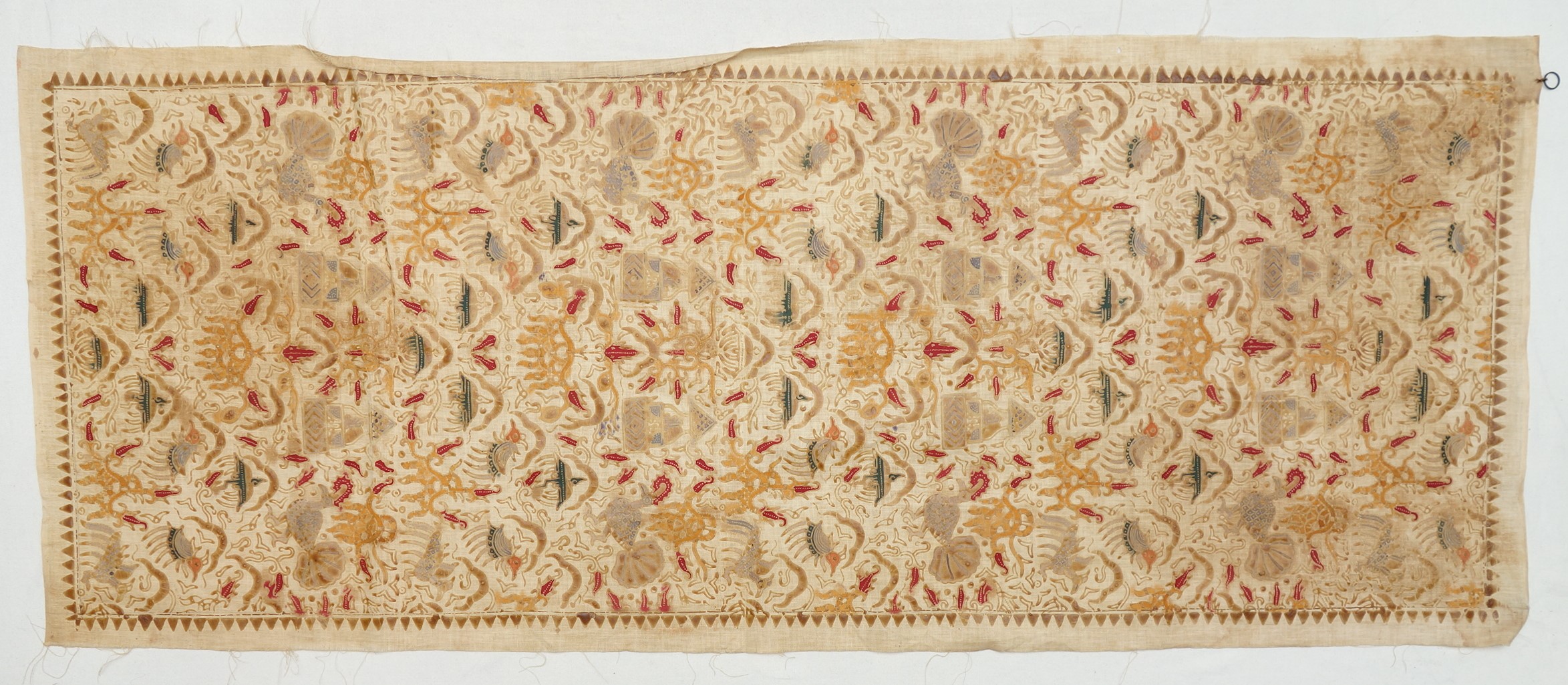 Panel of cloth with an unfinished batik design, Indonesia, mid-20th century (TRC 2019.1814).
To conclude, these five days have been a truly eye-opening experience. As Dr Vogelsang said multiple times, ‘You will never go shopping again in the same way as before’, which is absolutely true. It is amazing that in just five days, I have gained a whole new level of respect for all the craftsmanship that goes into making a garment, especially the traditional, hand-made items.
I am also fully aware that we were only scraping the surface level of all the knowledge surrounding textiles and there is still so much more to learn. I would recommend anyone who is or wants to be involved with textiles, professionally or not, to take part in this course as it is tremendously helpful in building up a solid foundation of knowledge for you to set off into your own exploration in a field you find interested.
As for me, I am excited to use my newly acquired textile language to conduct more in-depth research on TRC’s collection and deliver more interesting content to our audience.
Kelly Sum-tin Wong, 31 May 2022