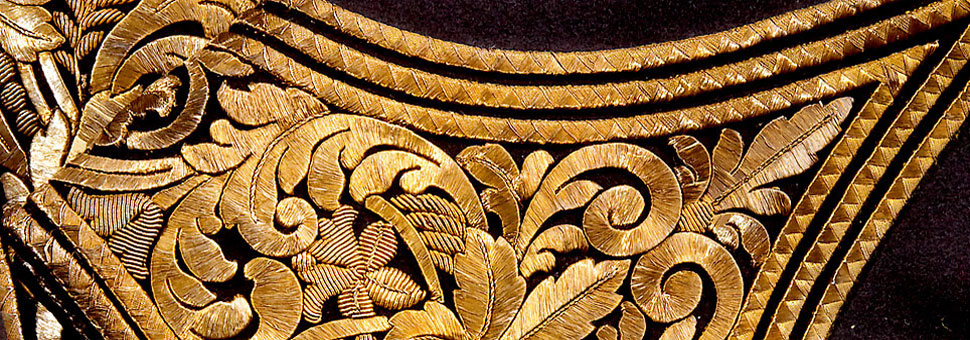
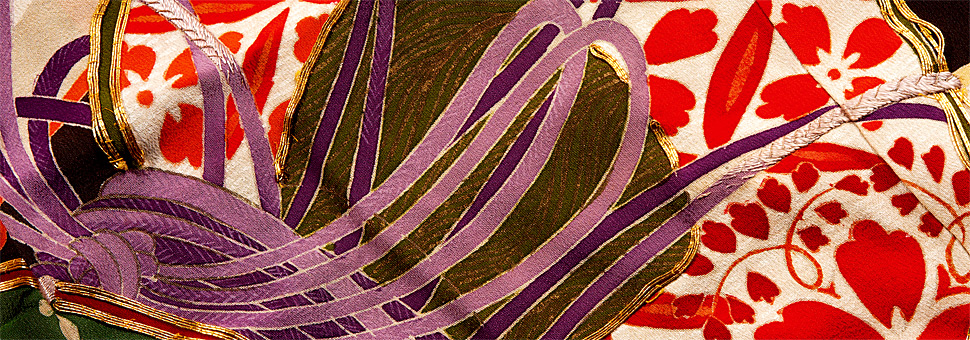
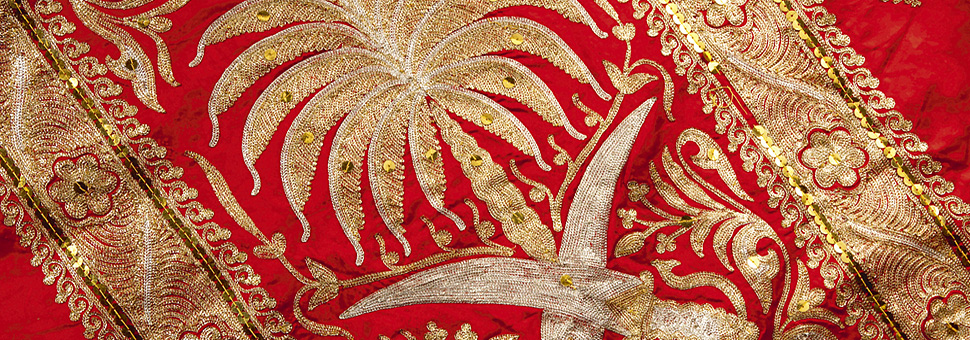
 Woman's outfit from the Kalocsa region, Hungary, mid-20th century, TRC pop-up exhibition, from 24 April until the end of May 2022.After the successful opening of the TRC pop-up exhibition on Sunday, April 24th, it was clear that one particular outfit was catching a lot of attention, due to its brilliant colours and floral patterns. This was one of the women’s outfits from the Kalocsa region in Hungary, which greeted visitors to the TRC as they came in. Several of the items from the Amsel Collection, which arrived at the TRC earlier this year, build up this outfit, which was so incredibly popular both in-person and online.
Both men and women from Kalocsa wear clothing adorned with a characteristic floral pattern, which can be seen both in the outfit on display as well as in several other pieces in the collection (e.g. the man's shirt, TRC 2022.0798). For the women it is most common that a white blouse with short sleeves was worn underneath a waistcoat with significantly more embroidery. The heavily pleated skirts, such as the red one pictured, could be layered over up to a dozen underskirts for added volume and flair, which would look incredible while dancing.
The aprons also often include a lace cutwork known as Richelieu and would have coloured ribbons woven throughout the lace. Most often the ribbon would be blue, although I have found that examples of other colours do exist. It was even common for ribbons to be woven through cutwork in the blouses and caps as well!
What makes the floral pattern of Kalocsa, just south of Budapest, so iconic is not only its use for clothing, but also for many other aspects of daily life. Florals can be found on everything, from dinnerware, to wallpaper, bedding, tablecloths, as well as decorated eggshells! Designs are also known to include the famous Kalocsa paprika that I look forward to spotting on a garment some day. It’s no wonder this outfit was catching everyone’s eye. This is part of what makes exhibitions at the TRC so unique, namely that visitors are able to view the embroidery very closely in order to fully appreciate the detailed patterns (see detail of TRC 2022.0450).
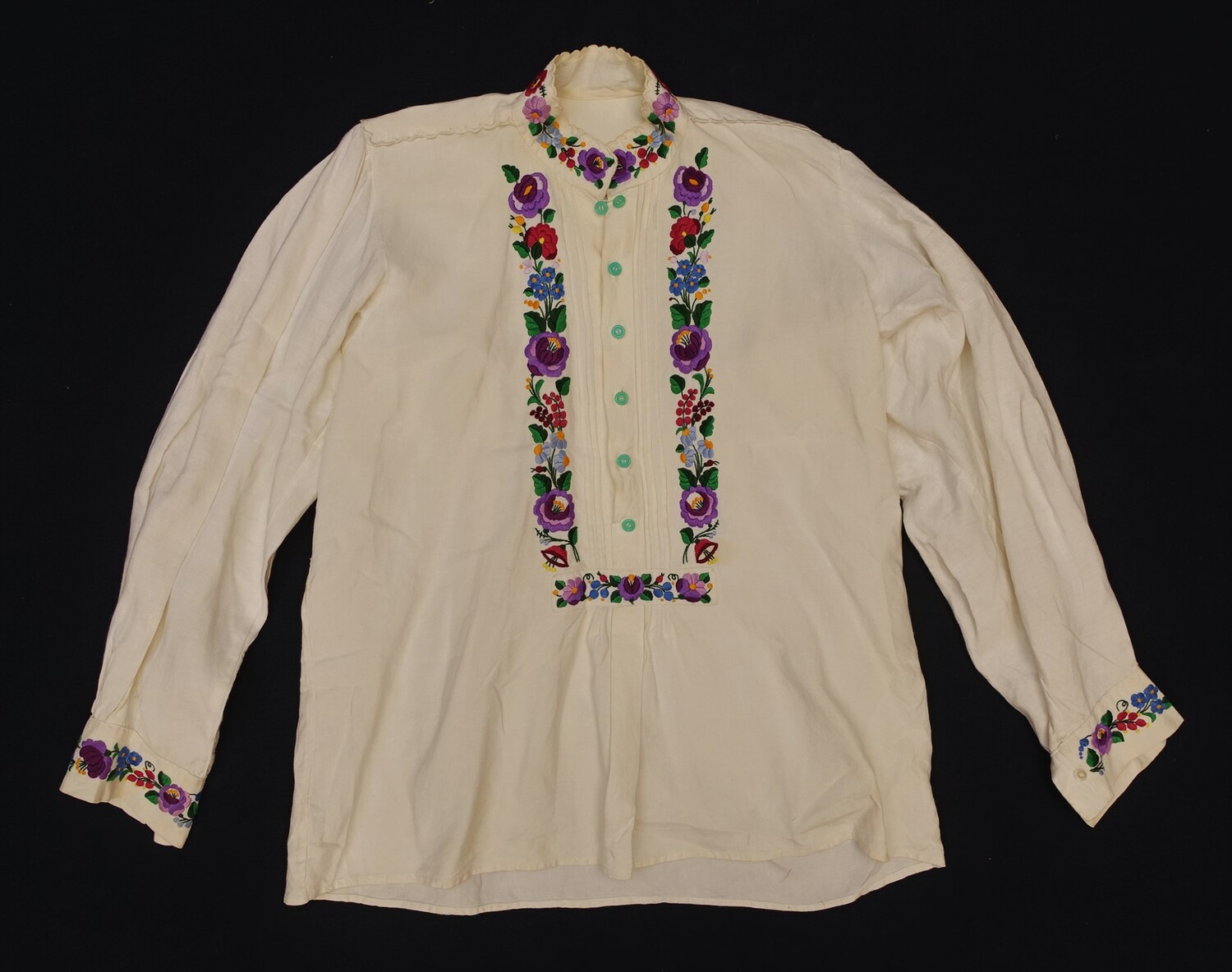 Embroidered man's shirt from Kalocsa, Hungary, mid-20th century (TRC 2022.0798).
Responses to seeing these items on display were overwhelmingly positive. It is true that I myself had not heard of this region before, nor had I ever seen pieces on display anywhere. However, now that I have, I am certain that I would be able to recognize it anywhere.
One of the reasons the two recent donations to the TRC (Amsel Collection and the Arizona Collection) are so incredibly important are the large amounts of Central European textiles. As we process these two donations we are learning more about the unique histories of different regions, and constantly make new connections to other pieces in the collection.
 Detail of an embroidered woman's waistcoat, Kalocsa, Hungary, mid-20th century (TRC 2022.0450).
Each of the incredible number of regions in Central Europe has a distinct style, and yet takes clear inspiration from its neighbours, resulting in a beautiful variety of traditions. We are looking forward to continuing our work at the TRC and to highlight more of the regional dress from Hungary and surrounding countries.
AJ Salter, MA Museums and Collections, TRC Intern, 28 April 2022