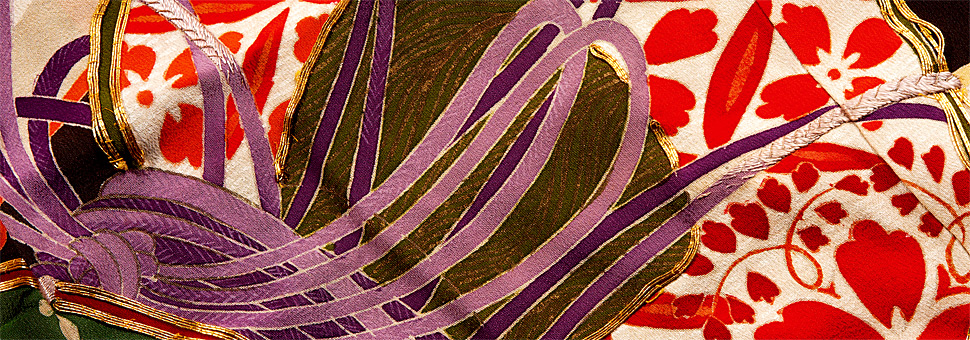
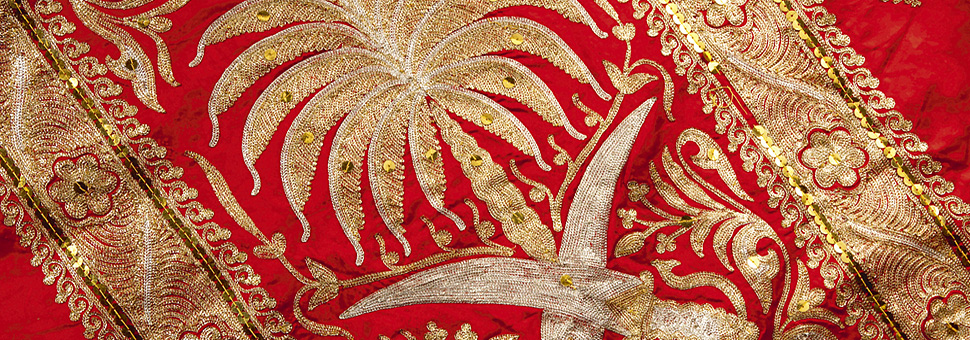

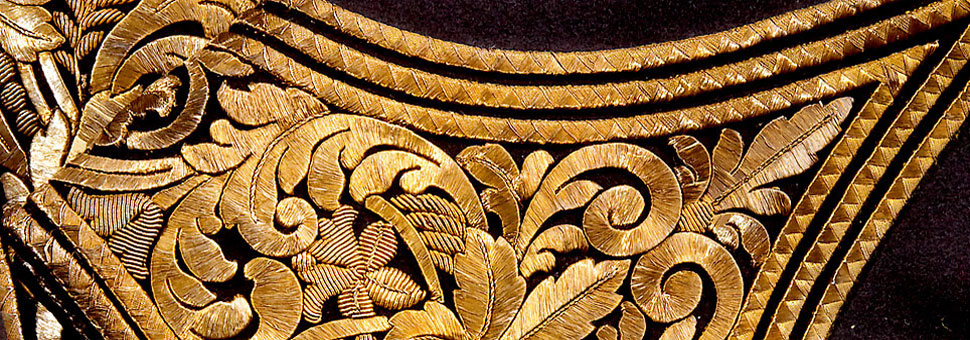
 Bib for a baby girl, Japan, 1920s-1940s (TRC 2021.2135a).Among the Japanese items recently donated to the TRC Leiden by the Noda and Shibata families there are various items relating to children’s rites of passage at various ages within Japanese family life.
Baby clothing and the Omiya mairi, the first shinto shrine visit
The baby’s bib (TRC 2021.2135a) and cap (TRC 2021.2135b, see also TRC 2021.2136) were used for the first omiya mairi (Shinto shrine visit) in the 1920s - 1940s of the children of Minoru and Tokiko Noda. This age-old custom originated in the Kamakura period (12th century), and was meant to tell a local god about the safe arrival of a baby. The ritual took place one month after birth.
Back then child mortality was high, and the family expressed their gratitude to the god and prayed for the baby’s health. The pink bib and cap were used for the girls (TRC 2021.2135b) and the white cap was worn by the boys (TRC 2021.2136), who would also wear a bib with the white side outwards (TRC 2021.2135a). The caps and bib have embroidered cranes that symbolise longevity.
 Minoru and Tokiko Noda and their children for the “omiya-mairi” of their third baby girl, Yoshiko, in 1936, in Naka-Shidami on the outskirts of Nagoya. The baby girl is wrapped up in a kimono, now in the TRC collection ( TRC 2021.2137). Photograph private collection.
 A white cap used for a baby boy, 1920s, Japan (TRC 2021.2136).Aged 3 to 7 years old - Shichi-go-san, further shrine visits, praying for their continuous growth
At the omiya mairi ceremony, as can be seen in the photograph, the baby was wrapped up in a kimono. This type of kimono was also used in ensuing ceremonies, associated with the daughters of the family. These were the three important rites of passage, called shichi-go-san. which literally means 'seven-five-three', and which were performed when the child was successively three, five and seven years old.
 One of Tokiko’s four daughters 1920s-1940s, at three years old, Naka-Shidami, on the outskirts of Nagoya. She is wearing a kimono (TRC 2021.2137) without an obi. Photograph private collection.The age of three was also important because, in the Heian period (8th-12th centuries), at that age the boys and girls of aristocratic families would start to grow their hair. At the age of five, boys would start to wear a proper hakama (kimono trousers), while girls at the age of seven would start to wear a kimono and obi in the same manner as their adult female relatives.
A pair of kimono sleeves
The oldest parts of a kimono donated to the TRC Leiden appear to be a pair of sleeves (TRC 2021.2134a-b), taken from a girl’s kimono, dating back to the early 1900’s. It was probably worn by Tokiko Noda (1904-1999) and her sister for their shichi-go-san at the age of seven.
 Kimono sleeves for a girl (TRC 2021.2134a-b).The bodice of the kimono has been lost, but the family kept the sleeves as a memento. The sleeves are finely tie-dyed and have auspicious patterns such as shippo tsunagi ('seven treasures connected'), which are isolated circles divided by four sections, often endlessly continued, and uchide-no-kozuchi, a hand drum that is said to bring good fortune and happiness.
The quality of the dye used for the sleeves was clearly not great and some bleeding took place. It was probably coloured using an early Japanese synthetic dye. Chemical dyes were first imported from Germany in the late 19th century, but for a long time and due to the First World War were not widely available. Locally produced dyes were of poor quaility, but were much improved especially from the mid-1920s.
 A girl’s kimono decorated with butterflies, flowers and family crests, Japan, 1926 (TRC 2021.2137). This kimono was worn by four girls between the 1920s and the 1940s and also one generation later, in the 1960s.
 Detail of some of the flowers decorating a young girl’s kimono, Japan,1926 (TRC 2021.2137).A family kimono
The girl's kimono (TRC 2021.2137) worn by the baby in the photograph of the omiya mairi ceremony in 1936 and by one of the daughters in the 1920s-1940s for a shichi-go-san ceremony in the other photograph was probably acquired in 1926 when Tokiko and Minoru Noda had their first baby girl. They had six children in total, four girls and two sons, between 1926 and 1944. The kimono was also worn in the 1960s by Sumiyo Noda, a granddaughter of Tokiko and Nimoru Noda.
The garment is a beautiful example of the kimono style of the 1920s, with its mixed patterns of Western flowers such as roses, daffodils and magnolias and traditional Japanese plants, such as chrysanthemums, peonies and maple leaves. It is delicately hand-painted with good quality chemical dyes that enabled the artisan to paint more dynamic and flamboyant patterns.
The family kimono and family crests
The same kimono worn by the daughters and granddaughter also has another, unusual feature, namely family crests. It has two crests in the upper front and three in the back (upper centre and at both sleeves), which is a formal arrangement, but uncommon for a girl's kimono. This ‘small’ detail shows the social standing of the Noda family. The family crest was taken from Tokiko’s maternal family, and not that of his father's (that would be the custom in eastern Japan).
How the same kimono was worn at different age and different obi styles by age
The family kimono was thus worn by the girls at different ages and on different occasions. When they were still very young, the kimono was just draped over the baby, as can be seen in the family group photograph, but at the age of three, the kimono was shortened by pulling it up and sewing it around the waist, and it was stretched out again when they turned five and seven. The kimono now in the TRC Collection still has some remaining threads that were stitched for pulling-up the garment.
 An elaborate maru obi, Japan,1926 (TRC 2021.2138).
As for the sash or obi, a simple sash called shigoki was tied around the waist when a child was three years old and the child and her (family) kimono were covered with a waistcoat-like garment without sleeves, called a hifu (see the photograph of one of Tokiko's daughters). At the age of seven, a girl would wear a proper obi, like the one donated to the TRC Leiden (TRC 2021.2138), which was worn in the same manner as that of adults. This obi was used with the family kimono. It is a gorgeous form, called maru obi, with patterns spread all over the garment and on both sides. Today, most obi for adults have patterns only on the visible area or on specific parts. Having all-over patterns facilitates more intricate ways of tying. Today this type of maru obi is seen only on brides’ and maiko’s (apprentice geisha) kimono.
Shichi-go-san kimono from the 1970s
My friend Masako wore a shichi-go-san kimono (TRC 2021.2152) in the 1970s, at the age of seven, in the middle of the economic and baby boom. Synthetic fibres had become common for all clothing, and this kimono was no exception. The use of vibrant colours of the kimono reflects the up-beat atmosphere of the era, but it still has traditional and auspicious motifs for the aristocracy, such as plums, chrysanthemums, bamboo leaves, and the wheels of an ox-cart.
 A Schichi-go-san kimono decorated with the wheels of an ox-cart, 1970s, Japan (TRC 2021.2152).
The associated obi (TRC 2021.2153a and TRC 2021.2153b) was made from two sections, a decorative bow already tied with a hook, and the belt itself, so that anyone could tye it correctly. By that time, most people wore Western clothing and no longer knew how to tie an obi properly. Still, people’s wish for children’s healthy growth and happiness remained unchanged, and traditional ceremonies were, and still are being observed. At any time of the year, you can still see the new-born and their family dressed formally at shinto shrines.
 Modern obi sash decorated with flowers. Japan, 1973 (TRC 2021.2153a).
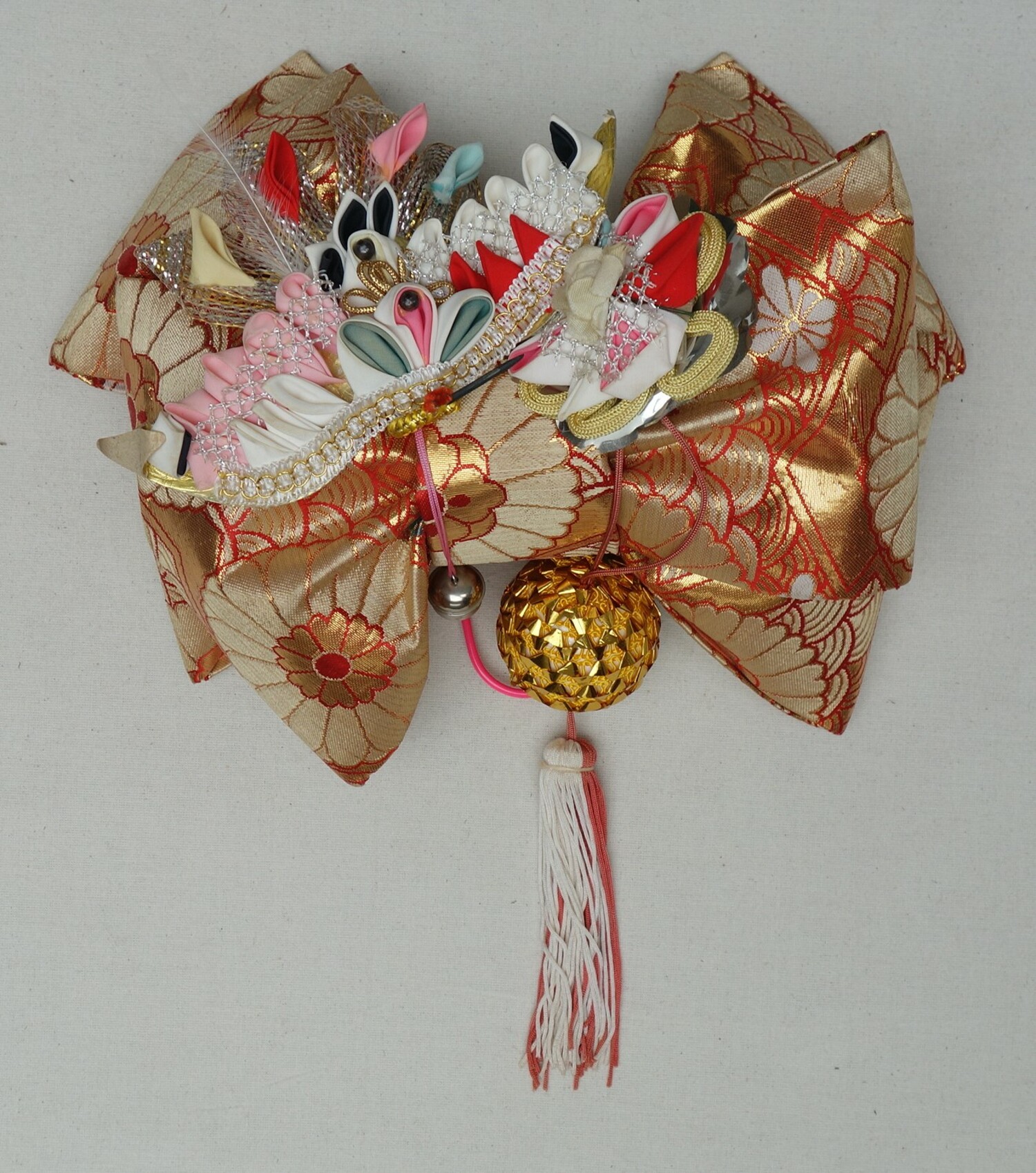 Modern obi bow decorated with flowers. to be added to the sash. Japan, 1973 (TRC 2021.2153b).Children aged three, five and seven, in formally donned kimonos, often visit Shinto shrines around the 15th November, although their styles of dress might be somewhat different from traditional outfits.
Many children paying a visit to local shrines for shichi-go-san have a long paper bag with chitose ame ('thousand years candy'), which are long sticks of candy that symbolise longevity. An appropriate treat!
Naoko Kikuchi, 3 October 2021