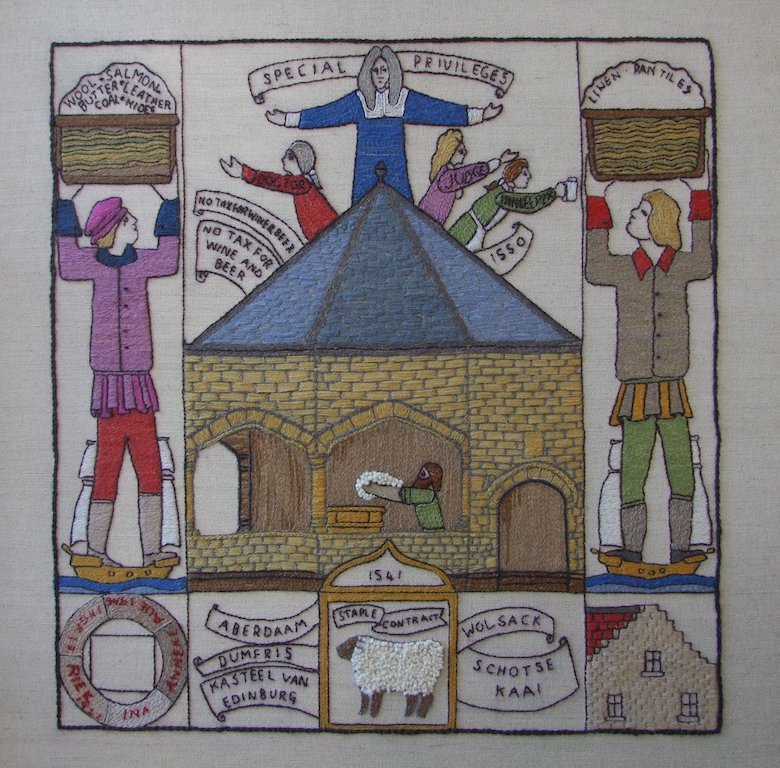
 One of the panels of the Scottish Diaspora Tapestry (2012-2014), showing the cistern in Veere, Zeeland, built for the Scottish wool traders in AD 1551.In TRC Needles, our online encyclopedia of needlework, you will find a brief entry on the Scottish Diaspora Tapestry, a commemorative embroidery first shown to the public in Prestonpans, Scotland, in May 2014. It tells about the emigration of Scottish people throughout the centuries. The embroidery also includes scenes that reflect Scottish links with a small town in Zeeland, in the southwest of the Netherlands, called Veere.
Last weekend, when Gillian and I had gone on another textile trip, we visited Veere, along the northern shores of the former island of Walcheren.
Not everyone has seen the Scottish Diaspora Tapestry, and therefore not many may know that there was a fairly large Scottish community in Veere for hundreds of years. Many of them were involved in the wool and fleece trade. By the mid-16th century, there were some 400 Scots among about 3500 locals. They had their own laws, church, and cemetery.
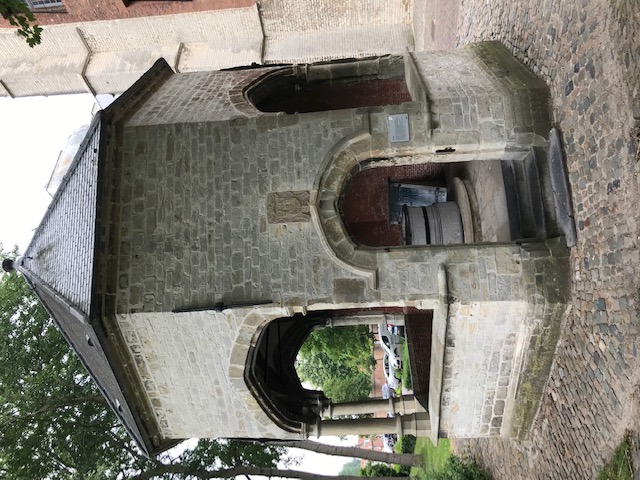 Photograph of the cistern in Veere, built for the Scottish wool traders in AD 1551 (photograph Willem Vogelsang, 2021).Scottish people would continue to live and work in Veere until 1799 when they were evicted upon the orders of the French under Napoleon Bonaparte. That was also the year that the last Scottish vicar, James Likley, left Veere, more than 175 years after the first, Alexander Macduff, had accepted the position.
For many years in the Middle Ages, Scottish trade with the continent had centered upon the city of Brugge in Flanders, but from the early 16th century, and officially from AD 1541, Veere held the monopoly on the import in the Netherlands of wool from Scotland.
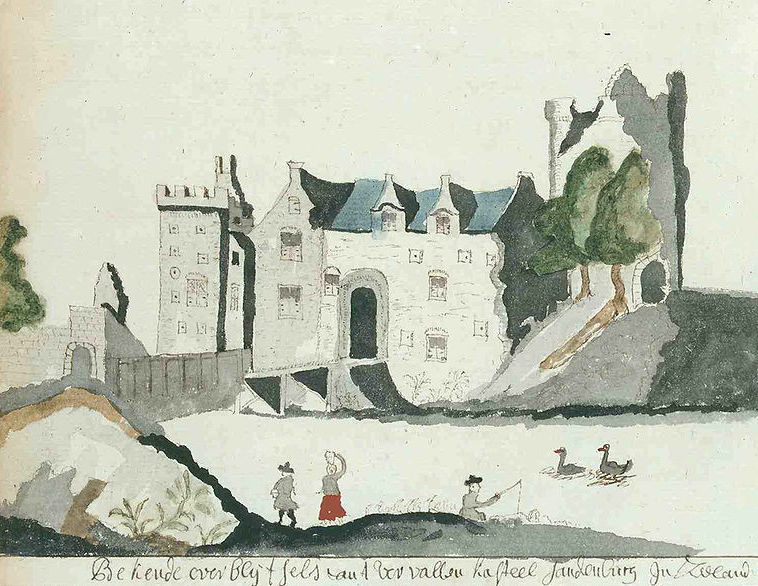 Ruins of the castle of Sandenburgh near Veere, where Mary Stewart lived after her marriage to Wolfert van Borselen in 1444. From the Atlas Schoemaker, 1660-1735.The close contacts between Veere and Scotland have a long history. In 1444 Wolfert van Borselen, a local aristocrat from the island of Walcheren and Heer van Veere (‘Lord of Veere’), married Mary Stewart (1428-1465), a daughter of the Scottish king, James I and Lady Joan Beaufort. The wedding took place at the castle of Sandenburgh, just outside of Veere (see illustration). The couple had two children, both of whom died young.
To further emphasise the growing contacts between Scotland and Veere, Wolfert was awarded the fiefdom of Buchan in Aberdeenshire (eastern Scotland) and became known as the Count of Buchan. The couple lived on the island of Walcheren and the story goes that she allowed her Scottish compatriots to dry their wool and fleeces on the lawns of the castle. After her death, Mary Stewart was buried in the Grote Kerk, or Onze Lieve Vrouwekerk, the main church of Veere. A nephew of Wolfert, Pauwel (or Paulus) van Borselen, was granted the fiefdom of Lauderdale, south of Edinburgh, and their residence in Veere came to be known as Huize Laterdale.
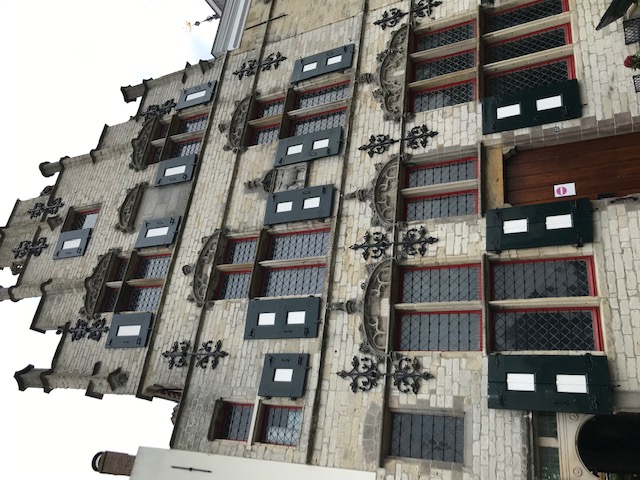 Huize Het Lammetje along the Schotse Kaai in Veere, one of the houses built for the Scottish traders in Veere. Now part of Museum Veere (photograph Willem Vogelsang, July 2021).While walking through Veere, we saw many of the houses and other buildings related to its Scottish past, including a cistern that was built in the mid-16th century upon the request of the Scots who wanted clean water for washing the wool (see photograph). This cistern is depicted in the Scottish Diaspora Tapestry (see photograph). A plaque with the coat of arms of Veere, inserted into the wall just above the entrance to the cistern, shows two men guarding the Veere harbour, and between them holding the crest of the Van Borselen family. But we also saw the grand houses that were built for the Scots along the Schotse Kaai, part of the harbour where ships from Scotland used to moor.
The Scots in Veere made use of part of the main church of the town, which had been badly ruined in 1686 during a fire and was never fully restored. When the Scottish community was forced to leave in 1799, their section of the church was given to the Lutheran community, but they also soon vacated the building. It was demolished in 1837. The pulpit of the Scottish church ended up in the church of nearby Westkapelle, but was destroyed during the Second World War. The communion silver ware, however, made in 1620 in Middelburg, close to Veere, eventually found its way to Manchester Cathedral.
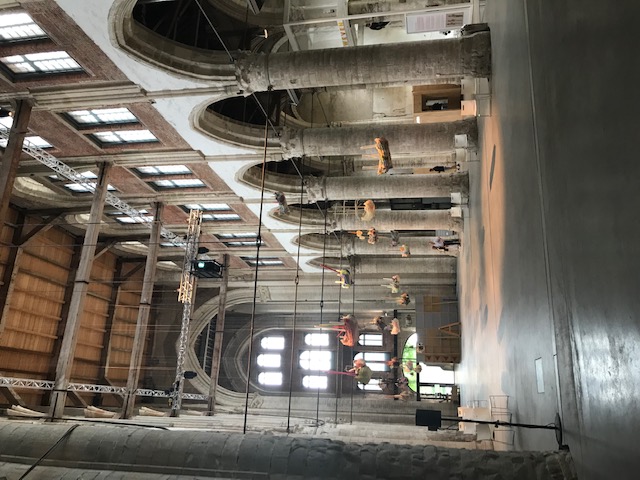 Interior of the Grote, or Onze Lieve Vrouwekerk in Veere. The small windows clearly indicate the various floors built into the church when it was used by the British and French as a field hospital between 1809 and 1813 (photograph Willem Vogelsang, July 2021).The Grote Kerk, for so long the focal point of the Scottish community in Veere, was used by the British army in 1809 as a field hospital when some 40,000 soldiers occupied Walcheren in their war against France and when so many British died (ca. 4,000), not because of the fighting, but because of a fever epidemic (the ‘Walcheren Fever’). In those days, different floors were built into the church, and traces of them can still be seen in the walls (see photograph).
Most of the information above is from: Peter Blom, Schotten lusten geen spek. Vier eeuwen Schots leven in Veere. 2003/2015. There is a special website about the Scottish relations with Veere: www.veere-schotland.nl
Willem Vogelsang, 1 August 2021