
 Sampler dated 1756 worked by Jacoba Jans Adegeest, from the Rijnland, the Netherlands (TRC 2020.3683).Two weeks ago the TRC published a blog about lace caps from the Rijnland based on a photo album with photographs of the Van den Akker family, many of whom lived in Zoeterwoude or thereabouts, in the late nineteenth century. In this blog I more or less return to Zoeterwoude, a small village just southeast of Leiden, in the heart of the Rijnland, following the trail of an eighteenth century sampler now in the TRC Collection (TRC 2020.3683).
The sampler has two alphabets: one in small gothic letters, the other in straight capitals. And one line of numbers. For the rest, the sampler is mostly symmetrical. There are two sets of men carrying a big bunch of grapes, a very common motif on Dutch samplers (the two Israeilis returning from the reconnaissance in the land of Canaan). This motif, it so happens, is also depicted in a stone plaque in the centre of the old town of Leiden (see a TRC blog of 4 July 2020).
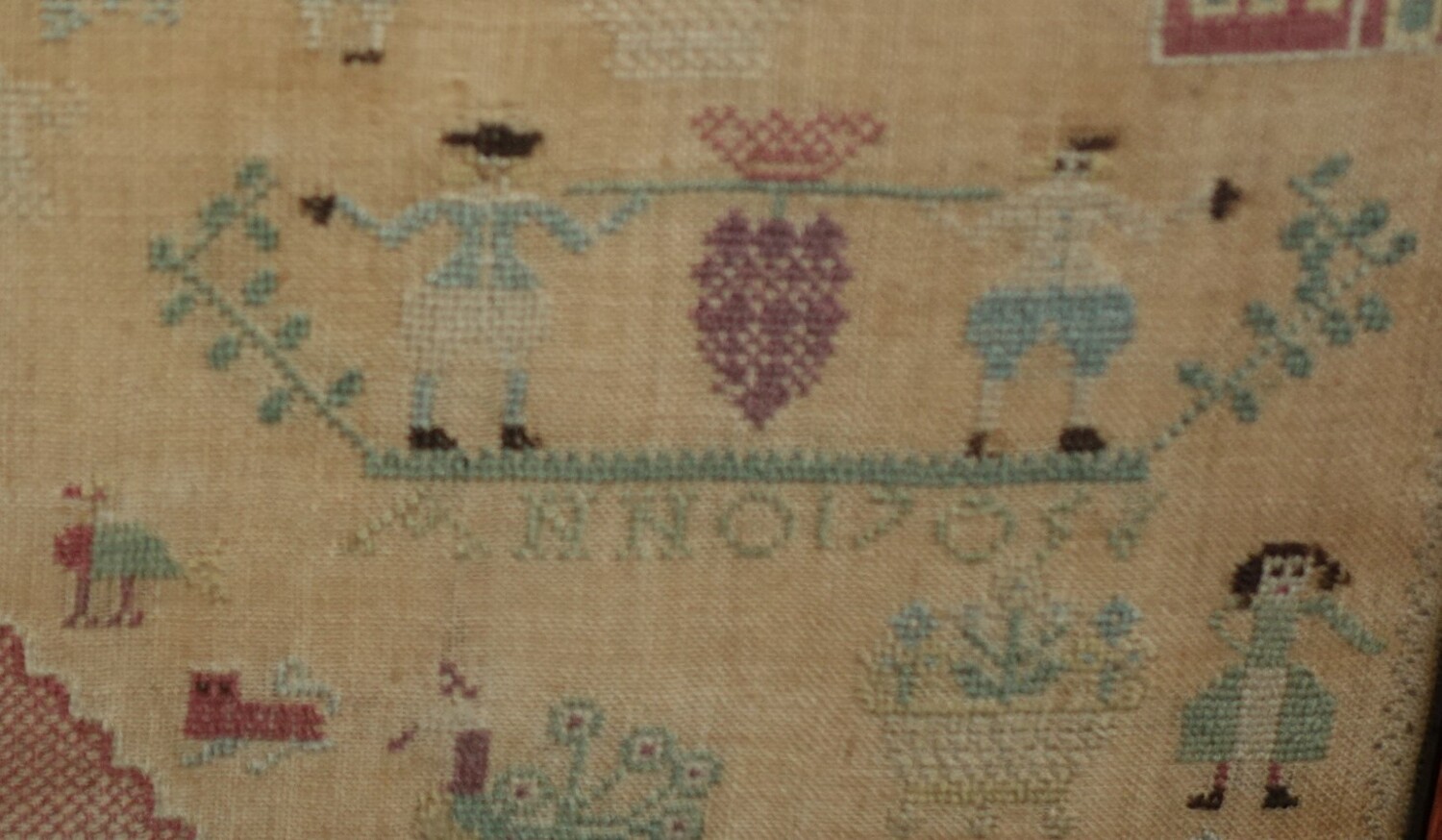 Detail of sampler TRC 2020.3683.
Below on the left there is a man wearing a hat, and on the right a woman wearing a white apron. In the corners two ships have hoisted a flag. The square below the flag is probably a sail.
![Plaque placed along the Nieuwe Beestenmarkt in Leiden. The text reads: Int la[n]t van beloften. In de nieve stadt (In the promised land. In the new town').](/trc/images/stories/frontpage/NL-LdnRAL_HVOL_hs0096_2.jpg) Plaque placed along the Nieuwe Beestenmarkt in Leiden. The text reads: Int la[n]t van beloften. In de nieve stadt (In the promised land. In the new town').
Plaque placed along the Nieuwe Beestenmarkt in Leiden. The text reads: Int la[n]t van beloften. In de nieve stadt (In the promised land. In the new town').
The big eyecatcher is the house in the lower centre. It has a stepped gable, a tiled doorstep in front, windows with shutters and large black hinges. The door is in two parts. The upper part is open, and inside there is a black-hatted man. On the roof there is a stork.
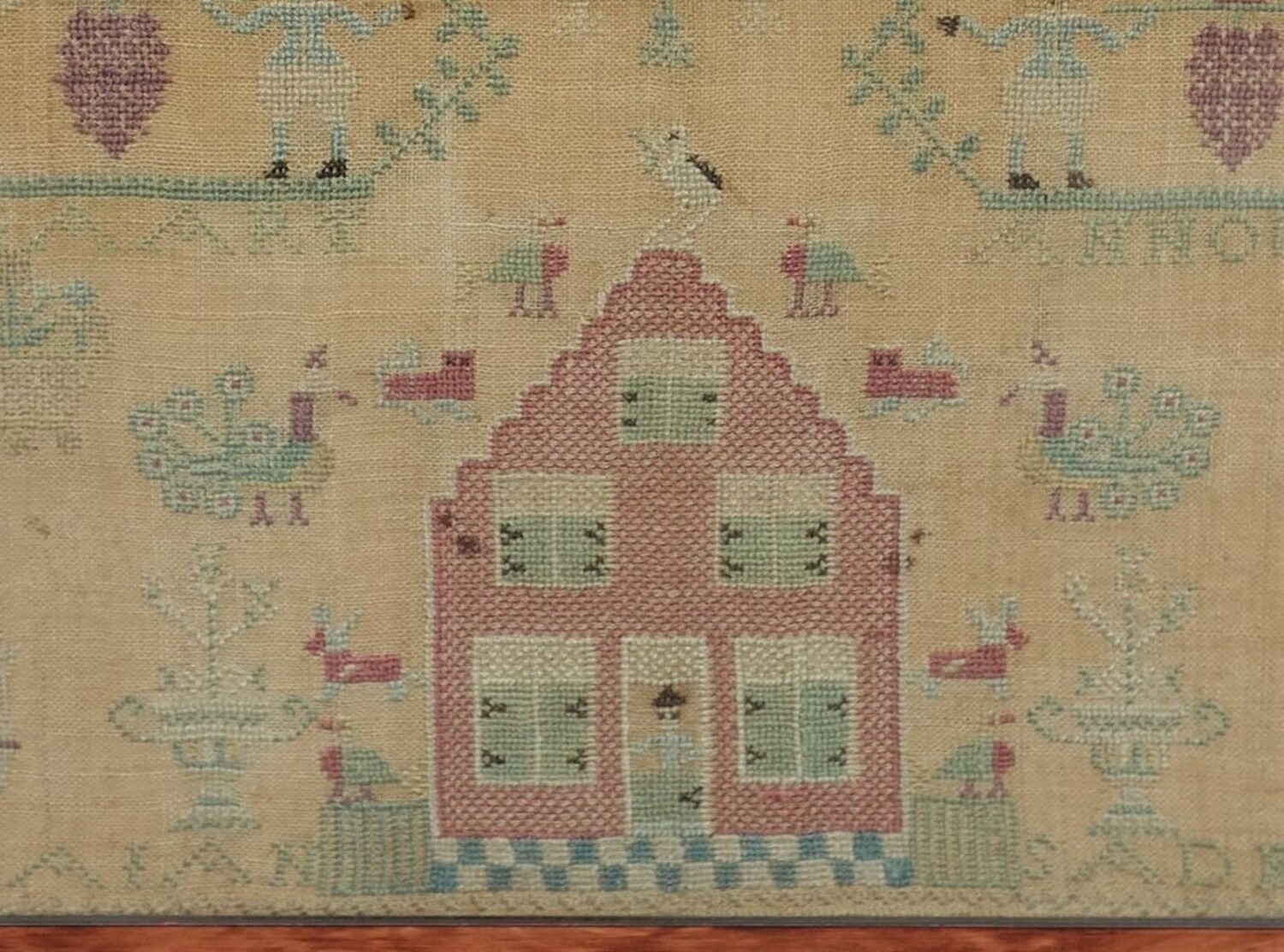 Detail of sampler TRC 2020.3683.
So who made this sampler, where and when?
The sampler carries the date of 17056. Is this 1756, or another date? There is also a name on the sampler, Jacoba Jans Adegeest. Adegeest is now part of Voorschoten, a village just south of Leiden. The name is that of a medieval castle of which only a farm and a surrounding park remain. It is likely that the family of Jacoba Jans originated from this part of the country. The name Jans (for Jan's-daughter) indicates that she was a daughter of someone called Jan. Her father's name would have been Jan Adegeest, or more accurately, Jan 'someone's son' Adegeest.
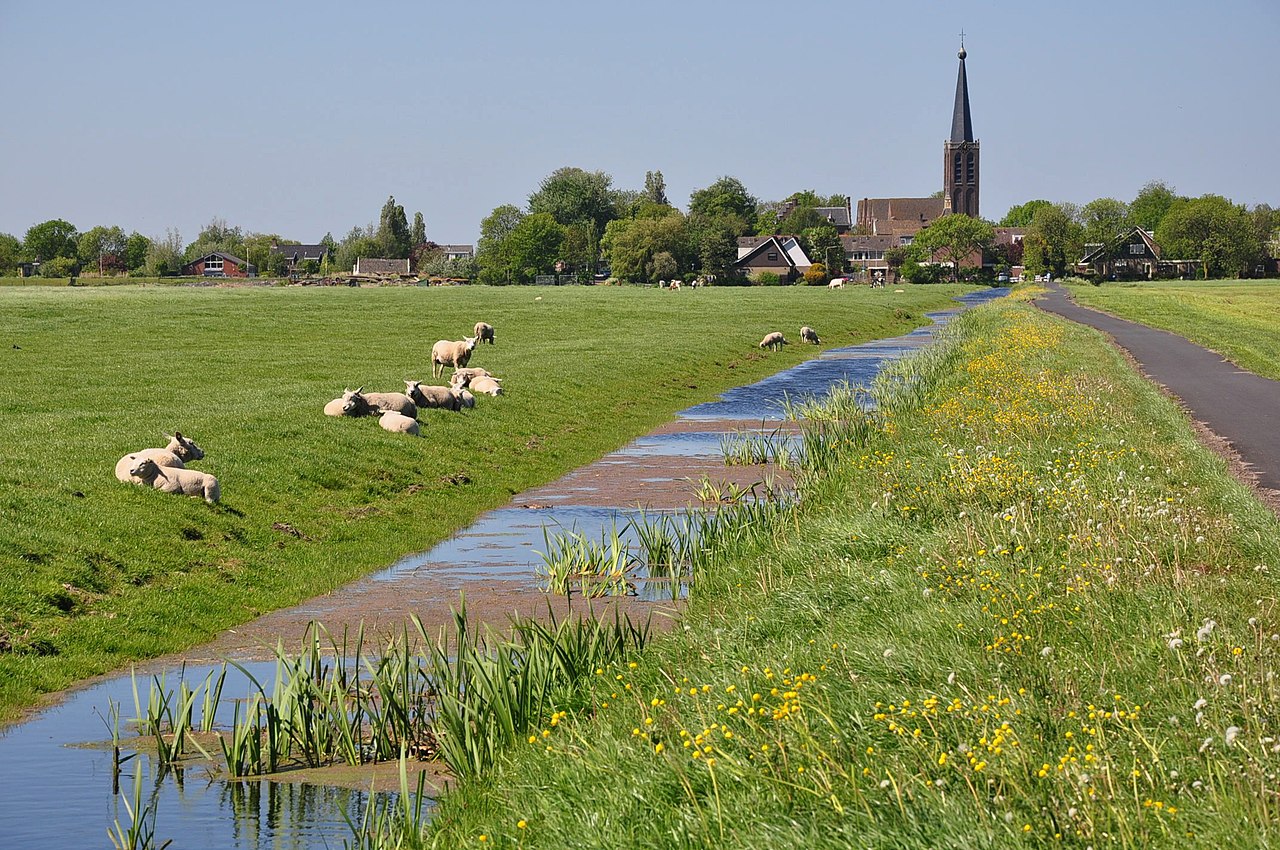 Modern view from the Weipoort west towards the Zuidbuurt of Zoeterwoude. The Catholic church can be seen in the distance. Photograph open domain.
I found a death certificate of a woman called Jacoba Jans Adegeest who died in 1792. She was buried in Leiderdorp. Her father’s name is not mentioned, but her husband's name was registered as Teunis Polman. I also found her marriage certificate, dated 1 October 1775 and registered in the village of Zoeterwoude (very close to Voorschoten/Adegeest and Leiderdorp). I could not find her birth certificate. This is the only eighteenth century Jacoba Jans Adegeest I could find from Leiden or beyond. Was she the same person who worked the TRC sampler? Was her father's name Jan "someone's son" Adegeest?
There are indeed eighteenth century records that mention a man called Jan Pietersz Adegeest. He originated from Voorschoten. He married twice, the first time in Voorschoten, in 1725. They had a daughter called Marijtje Jans Adegeest. There is no mention of a daughter called Jacoba. His second wife was Marijtje Jacobs Papendorp from Zoeterwoude and they were married on 25 January 1735 in Zoeterwoude.
The records tell that Jan Pietersz Adegeest and Marijtje Jacobs Papendorp had at least one daughter, namely Geertje Jans Adegeest, who was born in Hazerswoude in 1735. The couple had apparently moved from Zoeterwoude to nearby Hazerswoude. Was there another daughter called Jacoba? This would seem likely, since Geertje and Jacoba are mentioned together in various records relating to the Adegeest family. If she was a daughter of Jan Adegeest, she was born sometime after ca. 1737. hence a date of 1756 for the sampler that she made is likely..
Jan Pietersz Adegeest died sometime before 1747 when we hear that his widow Marijtje was married, for the second time, to a man called Gerrit van Bemmel. The marriage was registered in Zoeterwoude. She had probably returned to her own village after the death of her first husband. When her second husband died she became a widow again, and on 17 January 1782 she married her third husband, the widower Dirk Polman, also in Zoeterwoude.
 Map of Zoeterwoude, 1867.By 1756, when as I suggest Jacoba worked her sampler now in the TRC collection, she was between ten and nineteen years old. She lived with her mother, with her elder sister Geertje and with her step-father Gerrit van Bemmel. Geertje and Jacoba also had a much younger half-sister, Adriana (Ariaantje) van Bemmel, who was born in Zoeterwoude in 1751. Marijtje had probably moved from Hazerswoude back to Zoeterwoude, together with her second husband. A daughter of Jan Pietersz Adegeest with his first wife (Marijtje Jans Adegeest), may also have lived with them. She married in Zoeterwoude in 1765 when she was 35 years old.
All of Jacoba's family were Roman Catholics, and many of the weddings and baptisms of the family would have been conducted in the so-called Zuidbuurt of Zoeterwoude, where nowadays rises the early twentieth century Sint-Jan Onthoofdingskerk (St John Decapitation church).
We hear that Marijtje and Gerit van Bemmel were witnesses at a baptism on 25 March 1753 in Zoeterwoude. Geertje and Jacoba most likely attended the ceremony. Next we hear about Jacoba's elder sister Geertje, who in 1765 married Matthijs Louweris, and also this marriage was registered in Zoeterwoude.
But there is more, and this makes the sampler even more intriguing. I found a notarial deed dated 1773 for the lease of a house, with three people acting as lessors (owners), namely Marijtje Jacobs Papendorp, Jacoba Jans, and Matthijs Louweris, who is listed as the widower of Geertje Adegeest, This would be a document that clearly links a woman called Jacoba Jans Adegeest to Marijtje Jacobs Papendorp and to Geertje Jans Adegeest, the (deceased) wife of Matthijs Louweris. It seems that the house had belonged to an Adegeest family member, and bequeathed to these three people, likely the mother, her daughter Jacoba, and the widower of her deceased daughter, Geertje.
Next we hear about the marriage of Jacoba herself, in Zoeterwoude in 1775. Her husband was Teunis Polman. Both are listed as living in Zoeterwoude. From 1788 there is a record that again mentions Jacoba, our presumed embroideress, and her husband Teunis Polman. It includes the name of the third husband of Marijtje Jacobs Papendorp, Dirk Polman. They were married on 17 January 1782, again in Zoeterwoude.
Jacoba died in March 1792 and was buried in Leiderdorp. Her husband, Teunis Polman, died in September 1798, and was also laid to rest in Leiderdorp. Her step-father, Dirk Polman, died in 1799 and was also buried in Leiderdorp. Marijtje, Jacoba's mother, died in February 1802, but she was buried in Zoeterwoude. Ariaantje, Jacoba's half-sister, died in 1823. Her last address, it so happens, was at the Hogewoerd in Leiden, the same street where the TRC is located since 2009.
Nelleke Ganzevoort, with Willem Vogelsang, 24 August 2021