On 24 October 1811, while on his way from Amsterdam to The Hague, Napoleon Bonaparte stopped briefly at a stately canal house along the Rapenburg (No. 48) in Leiden. The house still rises majestically opposite the medieval Academy Building of Leiden University. It is located some hundred metres from the place where his younger brother, Louis Napoleon, as King of Holland, had visited the site where on 12 January 1807 a ship loaded with gun powder had exploded, thereby devastating part of the inner city of Leiden.
Last week, the Textile Research Centre (TRC) in Leiden, located at a ten minutes' walk from the Rapenburg, received a fragment, kindly donated by Kees van der Zwan, of what may have been the pall that covered Napoleon's coffin. The cloth was allegedly used when Napoleon's remains were transported back from St. Helena in the southern Atlantic (his place of exile from 1815 until his death in 1821) to France, on board the frigate La Belle Poule. This occurred in the second half of 1840, and Napoleon's remains were eventually laid to rest in the Domes des Invalides in Paris.
 Fragment of broadcloth (to the left), purportedly cut from a pall of Napoleon's coffin in 1840/1841. To the right is a piece of paper with a text in Dutch identifying the piece of cloth (TRC 2020.4528).
The gift comprises a small fragment of a woollen and napped broadcloth, some 5 x 4.5 cm, and dyed purple. It came together with a slip of paper with a text, written with a neat hand in beautiful 19th century Dutch. The text reads as follows:
“Stukje van het laken waarmee de kist van Napoleon is bedekt geweest, tijdens de overbrenging van deszelfdes assche van St. Helena naar Parijs, bij gelegenheid der bijzetting in den Dome der Invaliden werd dit laken in duizenden stukken gesneden en verscheurd, en ieder der aanwezigen bemoeiden zich er een gedachtenis in te vinden met zich een stukje hoe gering ook van hetzelve toe te eigenen. Ik heb dit van de Generaal Petit welke het eerst den degen in het laken stak om het te verdeelen.”
‘Piece of the broadcloth covering Napoleon's coffin, during the transfer of his remains from St. Helena to Paris, on the occasion of the interment in the Dome des Invalides, this cloth was cut and torn into thousands of pieces, and each of those present wanted a memento and appropriated for himself a small part of it. I got this [the fragment; the information?] from General Petit who was the first to stick the sword into the broadcloth to distribute it.’
The textile fragment (now registered in the TRC Collection under number TRC 2020.4528) was discovered around 1990 among the household effects of a house in The Hague (Nassauplein). According to the Dutch researcher, Kees van der Zwan, the house had belonged to a member of the Beelaerts van Blokland family. For many generations this patrician family has been the source of ministers, ambassadors and other highly placed officials in Dutch society.
The fragments came together with a drawing of Napoleon, and a piece of thick paper dated 26 June 1815, with a Dutch text that announces the arrest of Napoleon "by his own people", obviously following Napoleon's defeat at Waterloo nine days before (17 June).
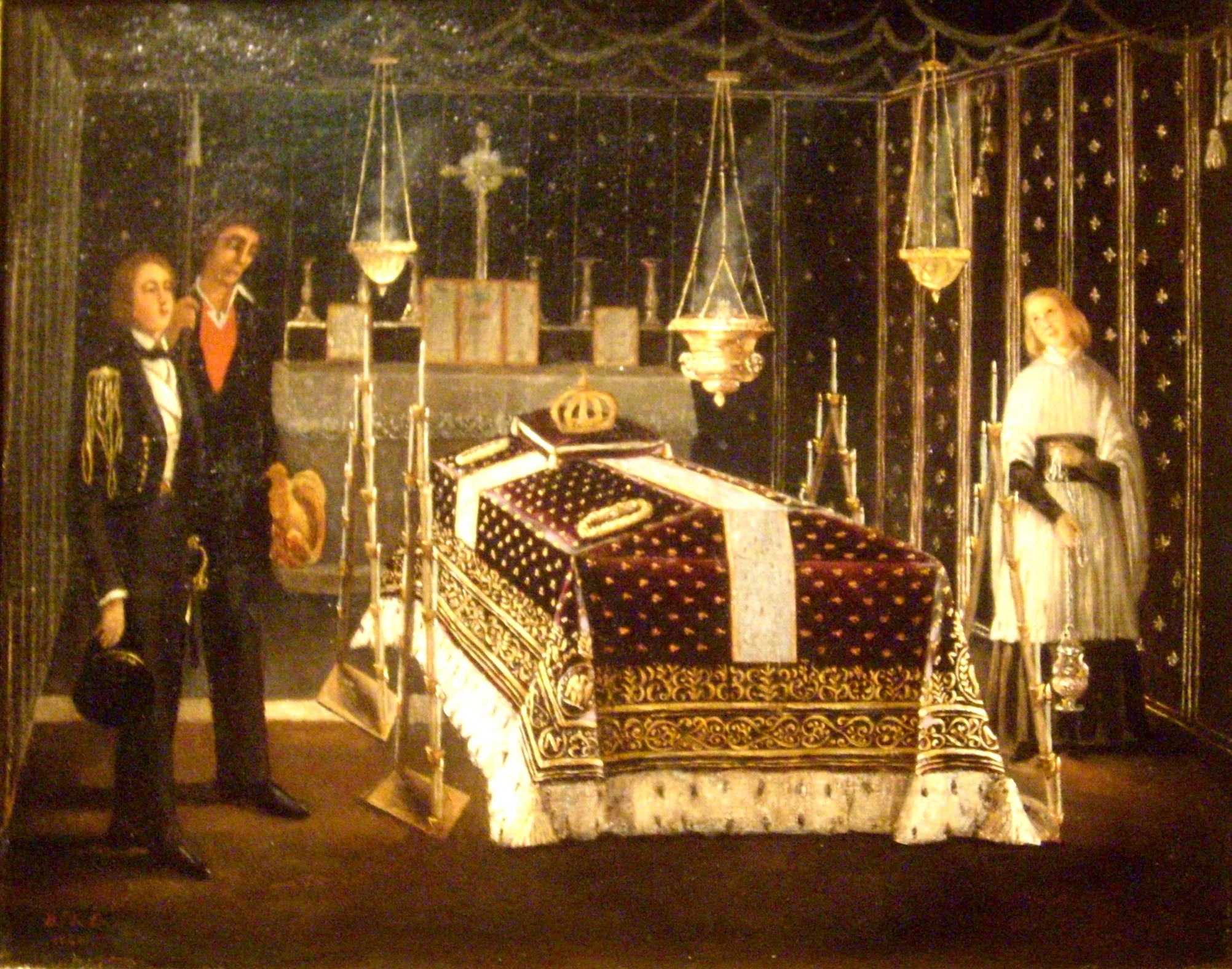 Chapelle ardente on board La Belle Poule, on the return voyage from St. Helena to France.
The episode described in the Dutch text that accompanies the textile fragment would refer to a specific occasion in late 1840 or early 1841, when the coffin with the remains of Napoleon was taken to the Dome des Invalides in Paris.
Napoleon had died on St. Helena on 5 May 1821. He had been taken there on board a British warship after his defeat at Waterloo in 1815. He was buried on the island. In 1840 the French government reached an agreement with the British authorities to disentomb Napoleon’s remains and bring them back to Paris (the so-called Retour des Cendres). The state funeral in Paris took place on 15 December, after which for a number of weeks the coffin was left for public viewing. Early January, the coffin was moved within the Dome to the side chapel of St. Jerome, where it remained until the final resting place of Napoleon, underneath the central dome of the church, was completed.
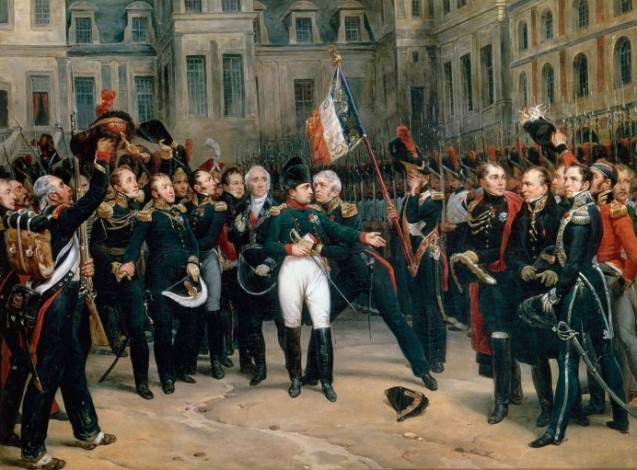 Adieux de Napoléon à la Garde Impériale dans la Cour du cheval-blanc du Château de Fontainebleau, Antoine Alphonse MONTFORT (1802 - 1884). The man behind Napoleon, to his left, is General Petit.
The Dutch text tells that General Petit was the first to cut up the cloth covering the coffin. The French officer was (Baron) General Jean-Martin Petit (1772-1856), the military commander of the Invalides. He was a close associate of Napoleon and happens to be portrayed in the famous painting by Antoine Montfort, showing the departure by Napoleon from Fontainebleau on 20 April 1813, en route to Elba, his first place of exile before he returned to France (for his 100-days’ rule) and his defeat at Waterloo on 17 June 1815.
General Petit was no doubt present on 15 December 1840 when Napoleon's remains were officially taken to the Dome and a funerary service was held (with Mozart's Requiem!). The cutting up of the pall could have occurred shortly afterwards, on the same day or shortly thereafter.
Perhaps the most suitable occasion would have occurred some weeks later when the coffin was taken from the centre of the Dome to St. Jerome's chapel to the right of the altar. General Petit was one of the two commanding officers on this occasion. Unlike the solemn occasion of 15 December, this event was attended only by a small group of people. If there ever was an appropriate moment for General Petit to cut and divide the pall, without too many people around him, that would have been the perfect occasion. Anyhow, as Commander of the Invalides, who would have had ample opportunity before and after.
Cutting up textiles and keeping them as a souvenir were not uncommon, and happened on one or more occasions with respect to Napoleon. There is a reference by Jean Bourguignon (Chapter 7), which tells that many of the (velvety) hangings in the Dome during the official mass on 15 December 1840, were made by a firm in Lyons, especially for the occasion. After the service, the hangings were cut to pieces and fragments were collected as souvenirs, and these, Bourguignon continues, could still be found with antique dealers and collectors. But would the broadcloth now in Leiden have been part of the textile decoration in the Dome? Broadcloth is not normally regarded as a luxury textile on the level of velvet, quite the contrary. And would these textiles from the Dome be described as having belonged to Napoleon's pall? It is possible, but ...
So what was this ‘pall’ that covered Napoleon’s coffin? Charles Montholon, in his publication of 1847 (p. 335), tells about the Imperial Pall that was made in France in advance and taken to St. Helena by the recovery party, and covered the coffin all the way back to Paris. “It was made of purple velvet, trimmed with ermine. The outer border was composed of arabesques in gold; the inner border of palm leaves; in the four corners were medallions of the imperial eagle. The emperor’s cipher was repeated eight times in the circumference of the pall, which was embroidered with bees, striped with silver, and finished at the corners by four large golden tassels.” The Imperial Pall is illustrated in many prints and paintings (compare the illustration of the chapelle ardente on board the Belle Poule).
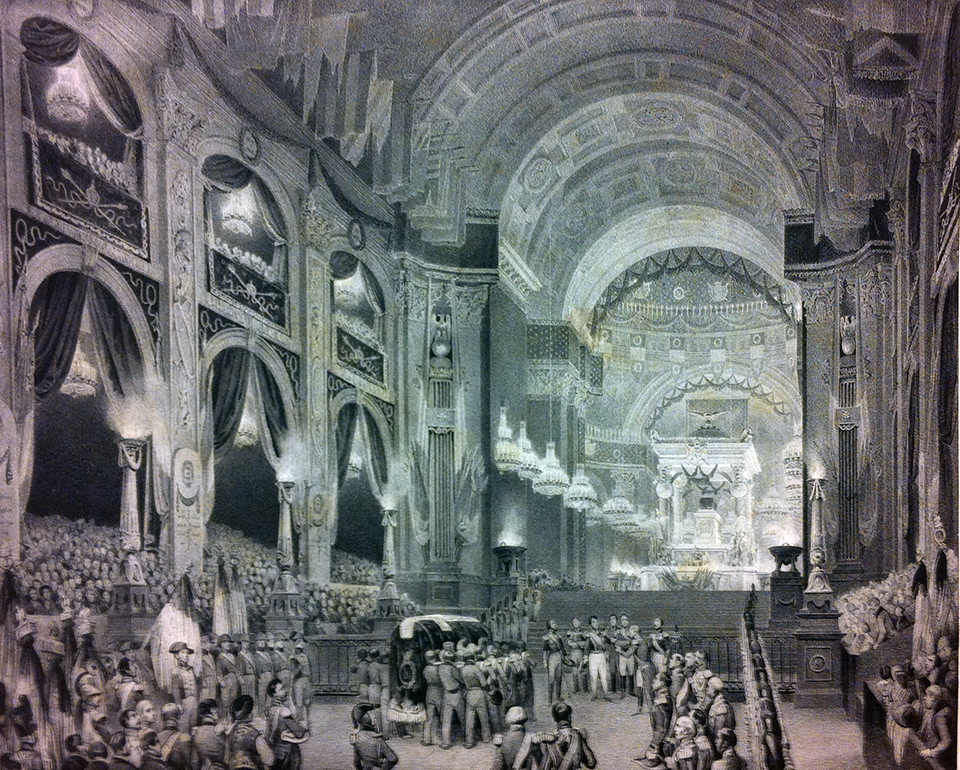 Solemn service in th Dome des Invalides, Paris, on 15 December 1840, marking the (temporary) re-entombment of the remains of Napoleon Bonaparte.
Clearly the textile fragment now in the TRC collection did not form part of the Imperial Pall. It is a broadcloth (the ‘laken’ in the Dutch text), and not velvet. So, assuming that the TRC fragment was indeed cut from a pall that once covered Napoleon's coffin, which pall are we talking about? All assuming the TRC fragment was actually cut from a pall of Napoleon's coffin (and not a nineteenth century fake), we may have to look elsewhere to identify the fragment.
This example of broadcloth now in the TRC collection is relatively rough, and of the type that is used for coarse clothing and military uniforms. It is a sturdy, felt-like woollen material, and not the type of cloth that one would use for ceremonies and luxury decorations. Experts of the Dutch Army Museum, who had a look at the fragment some time ago, correspondingly suggested that the fragment was made of material for an army uniform. If so, how would a simple and practical textile become used as a pall for the coffin of the French emperor?
We may assume that broadcloth was on board the French ships that sailed to St. Helena and that brought back Napoleon's remains, and it is very well possible, even likely, that during the voyage the coffin was covered, not by the luxurious Imperial Pall, but by a more practical cover, made of purple broadcloth. But perhaps there is a more romantic origin.
There is an interesting episode recounted by Jean Bourguignon, which refers to the (British) inhabitants and the military garrison of St. Helena donating a patchwork French flag (the tricolore) and French imperial flag to the French officials who had collected Napoleon's remains. The French had to promise that the flags would cover Napoleon's coffin all the way to Paris. The patchwork pieces were made of all sorts of textiles, including strips from British uniforms, likely made out of broadcloth.
Is the TRC fragment in fact a piece from a British army uniform?
Few historical figures have been the subject of so many books and studies as Napoleon, and even the Retour des Cendres has been studied extensively ever after Napoleon's remains arrived in Paris (including various YouTube documentaries). Perhaps further information about the enigmatic 'functional' pall can be found in one of these studies. More to follow!
We hope to display the fragment at the TRC next year, in May 2021, on the occasion of the 200th anniversary of Napoleon's demise.
We will soon come back to this fascinating fragment, with more scientific details and information.
Gillian and Willem Vogelsang, Kees van der Zwan, 7 November 2020.
References:
- Bourguignon, Jean, Le retour des cendres. Paris 1941.
- Montholon, Charles-Tristan de, History of the Captivity of Napoleon at St. Helena. Philadelphia 1847.
- Zwan, Kees van der, ‘De lijkwade van Napoleon’, De Haagse Tijden, 7 July 2020, p. 18.