

 Length of African wax print, made in China, early 21st century (TRC 2020.3841).The TRC in Leiden recently acquired a piece of fabric for an upcoming exhibition on the Paisley motif (TRC 2020.3841). The green material sold as an African wax print or Ankara cloth, upon closer inspection, seems to be a poorly printed imitation of the original.
African wax prints are colourful fabrics, traditionally made in a similar fashion to batik, namely with wax resist printing. They are common to most African countries but more especially to West Africa. The printing technique of wax prints travelled from Indonesia through Dutch merchants to Africa.
There are some clues that led us to reconsider the provenance of this particular piece. The design is printed sideways and only on one side. Moreover, the paisley motif in the middle is surrounded by flowers more reminiscent of Chinese or Russian forms. More than that, on the selvedge (a part of African wax fabrics that usually carry the name of the company and quality of the cloth), a shoddily spelled text literally reads: “VERITABLE EMPEROR BATIC CLASSIC QUALITT ORER”.
As with many cheaply printed textiles, we suspect that the origin of the piece might be Chinese. As a volunteer at the TRC, I am constantly reminded of how motifs or textiles travel through cultures and time in a way that questions even the idea of “authenticity”. From the idea of the motif reinterpreted across different countries, to the production site of the material and the end point where a piece of fabric is bought or even how it is worn, a simple textile piece tells one thousand different stories.
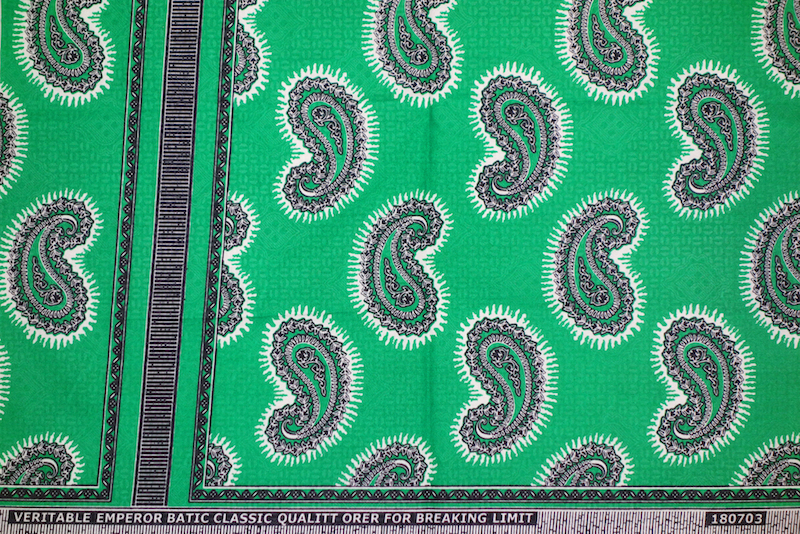 Detail of African wax print, made in China, early 21st century (TRC 2020.3841).As I was studying this piece of cloth, I noticed the strong smell of chemical dye emanating from it (for even olfactory clues may help in understanding textiles), which reminded me of a personal experience relating to African wax prints produced in China. My father once took me on a trip to Guangzhou, the enormous port city in southern China situated above Hong Kong. There, we visited what the locals referred dubiously to as “chocolate city”; a district populated by the African community engaging in business around China. What was especially interesting about the place were the innumerable buildings specialising in products catering to the African markets, including shops selling wax prints.
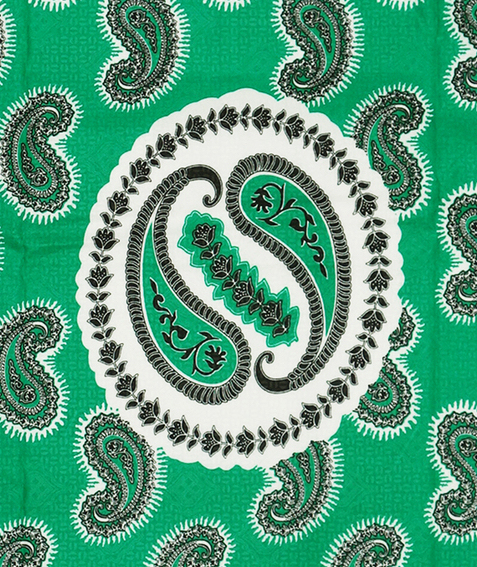 Paisley motif in the centre of an African wax print from China (TRC 2020.3841).These shops were mostly owned and run by Chinese who sourced their fabrics from local Chinese factories and then either sold it locally to the district’s inhabitants or sent it to other shops in Africa. The range in quality of these fabrics was impressive, from strong smelling, one-sided cheap prints to double-sided, quality cotton ones.
As we talked to some owners of the shops, they let us know that their interest in the fabrics was limited to the demand for them rather than a personal one and that they personally would never consider using or wearing their wares. Nonetheless, their lives were singularly influenced by this style of cloth, as their dealing with it sometimes brought them or their families to go live in West African countries in order to build up their businesses. There is something quite peculiar in thinking of what we would see as a very “typically” African print, produced and sold in China and sent to Africa for sale.
This was a few years ago and it seems that since then, the Chinese government has decided to grant less and less visas to African residents or business people in Guangzhou, ultimately making those same shops close their doors.
One wonders which textiles are now in demand and have replaced the wax prints in the shops. But African wax prints made in China do clearly still travel back to Africa and the rest of the world, as testified by this latest piece in our collection.
Augusta de Gunzbourg, 4 October 2020.