
 Silk cloth fragment with traces of woven Chinese characters (TRC 2000.0009).Dr Monica Klasing Chen is assistant-professor in Chinese art history at Heidelberg University, Germany. She participated in the April edition of the TRC Intensive Textile course, and wrote a blog about her experiences, further to an earlier blog published on 15 May.
+++
The TRC Intensive Textile Course was not only rewarding for the many skills we learned, but also because Dr Vogelsang selected materials and objects that catered to the specific interests of the participants.
As a sinologist, I was ecstatic to see a textile with Chinese characters woven during the 2nd century (see illustration) next to an exquisite 19th century velvet produced for the European market (see illustration). When the course took place, the TRC had coincidentally set up a display case with several lotus shoes (see illustration) and the tools for making them, also featured in their online exhibit. This was especially interesting to me, because my great-grandmother had bound feet.
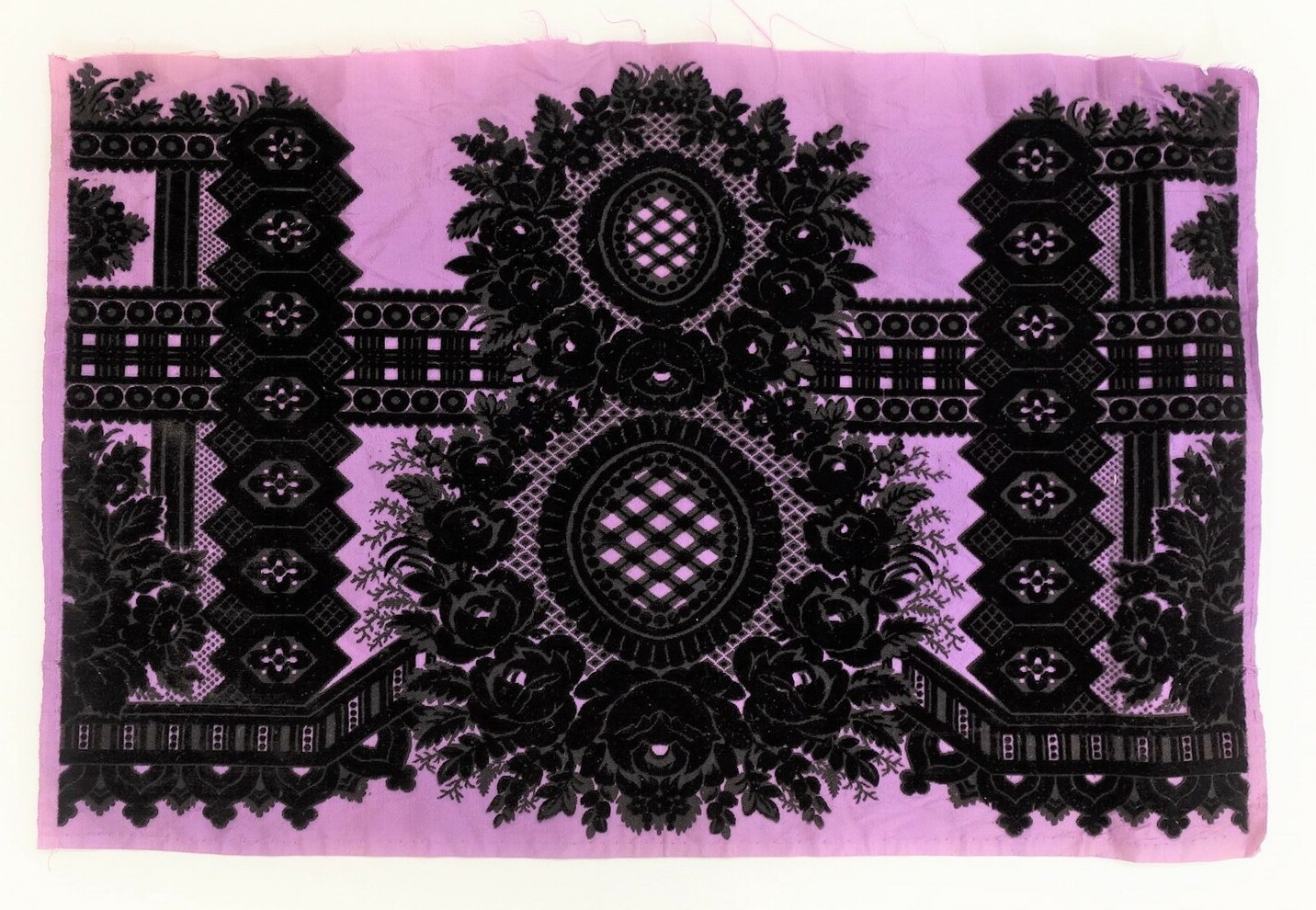 Hand woven cut and uncut velvet panel, apparently produced for the European market, 19th century, China (TRC 2018.2401).
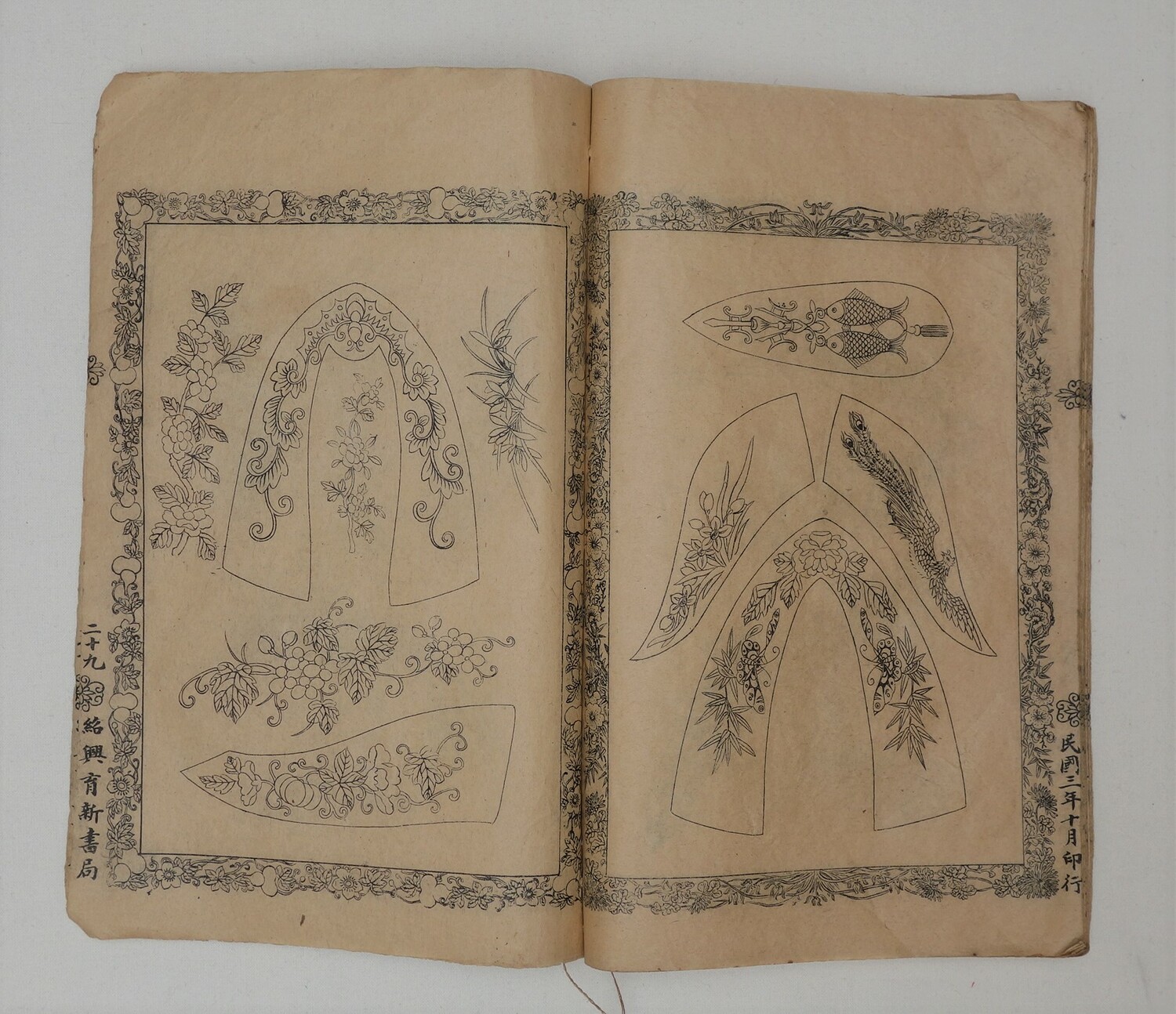
Among the objects in the glass case was an embroidery pattern manual published in China in 1914 (see illustration). This richly illustrated booklet had lost its front cover and first four pages, but with a little bit of research, I found a complete edition, which revealed that the volume carries no title or preface. Nevertheless, it must have been quite popular among customers, as this was at least the second (modified) edition of the pattern manual.
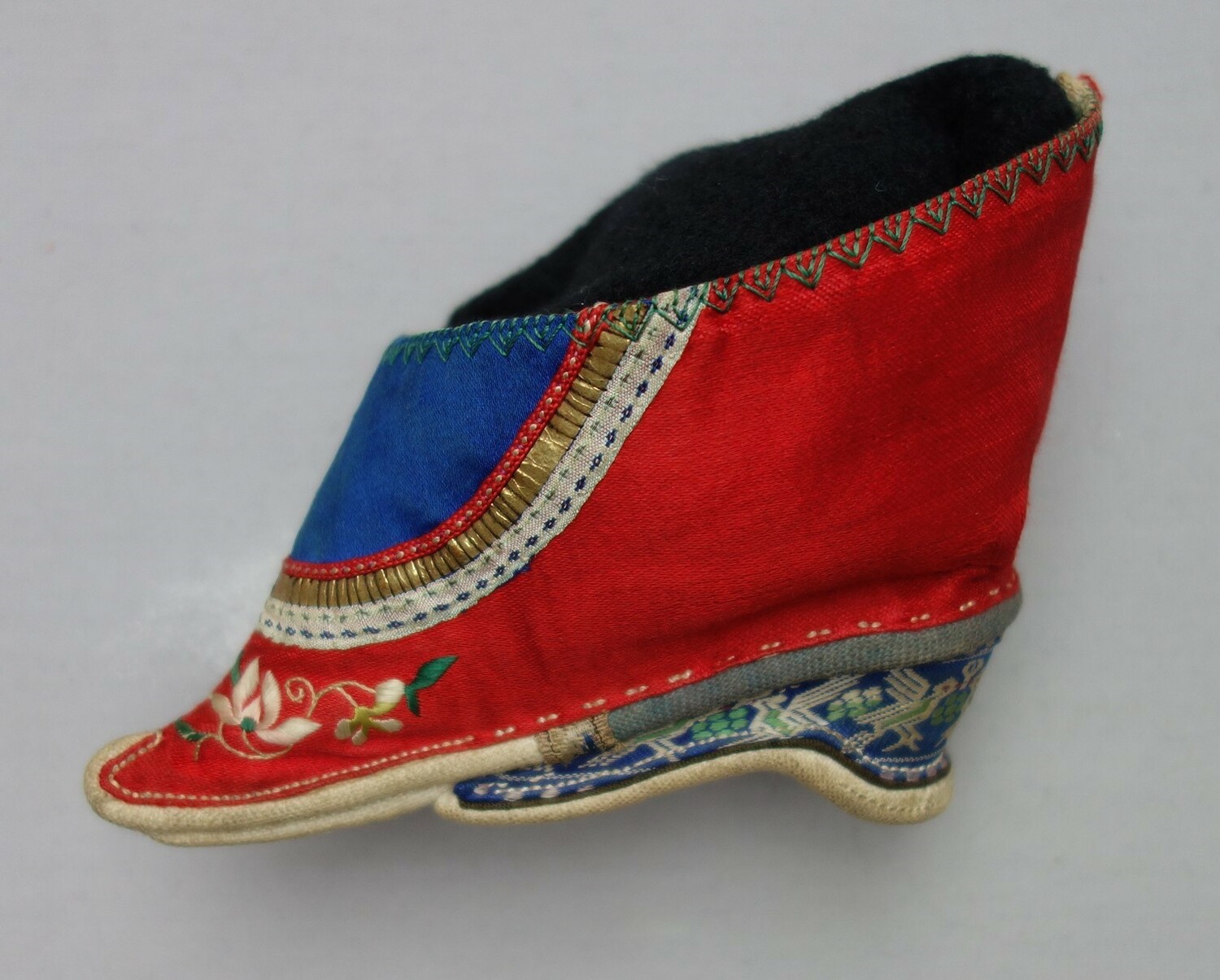 Lotus shoe from China, with hand embroidery c. 1900 (TRC 2013.0061).An earlier version, published just a year earlier, already contained many of the motifs that are reproduced in the TRC edition. Several of the earlier motifs are scaled down in the TRC manual, which was something relatively easy to do with lithographic printing, but interestingly enough, the TRC version contains more embroidery patterns designed for lotus shoes.
Similar outlines delineating the fabric cut with embroidery designs especially created to fit these shapes already circulated in China during the late Ming dynasty (1368-1644), such as in the earliest known Chinese embroidery manual titled A Collection of Snipped Rosy Clouds 剪霞集, a woodblock-printed volume published between 1625-1644.
The Collection of Snipped Rosy Clouds was most likely a costly volume intended for elite consumption, featuring elaborate designs rendered in multiple colors to embroider, for example, headbands, pillow covers and mirror covers. Later works, such as the Precious Mirror of Feminine Virtues 坤德寶鑑 (1777), feature real-size cutting patterns for shoes and other accessories, such as a hat with eight panels, as well as for appliqué borders. (See vols. 8 and 9. Access the copy from the Harvard University Library here).
 Pattern book for embroidery, early 20th century, China (TRC 2014.0030).The concern to fit and cut pattern pieces for a garment from certain amounts of fabric is obvious to any tailor, and it even functions as a premise for a late 16th-century joke titled "Mocking a Fortune Teller," which circulated broadly in popular encyclopaedias of the period:
There was once a fortune teller who took two zhang of fabric (ca. 6,4 m) to the tailor to have a garment made. The tailor said: This fabric is only enough to sew a left sleeve and the front panels of the garment. To which the fortune teller retorted: Well, what should I do without the left sleeve and back panel? The tailor explained mockingly: The left side would be sleeveless, which is good for writing with brush and ink (as a non-existent sleeve won’t get dirty), while the right side has a sleeve, which is good for hiding your money pouch in; the front side has a panel, which is good for covering and embellishing, and the back is open, which is good for passing wind (a common euphemism for tricking other people). (translation by author)
嘲星士 昔一算命先生拿二丈布與裁縫做一件衣服。裁縫云:此布只勾左邊一個袖,前面一個襟。星士曰:如何右邊無袖,後靣無幅?載縫曰:右邊無袖好冩字,左邊有袖好袋錢;前頭有襟好遮修,後面無幅好放屁.
The tailor relies on fabric requirements to make a garment to point out that the fortune teller is a money-grubbing charlatan. In printed manuals, however, the concern with the layout of pattern pieces on fabric was a rather late occurrence. The TRC volume and the earlier 1913 edition take pattern-cutting designs to a next level, providing the embroiderer not only finely outlined shapes and motifs that could be transferred onto silk, but also measurements and visual instructions on how to draft and distribute cutting patterns for entire garments on fabric.
The user no longer had to rely on "life-size" patterns, but could also plan the cutting and sewing of vests and robes by following the written instructions and graphs. They are early examples in which short notes to aid the user in the process of pattern drafting are included.
Another interesting feature of the TRC volume is that it carries traces of use. White silk thread was stored between the pages by its user and a set of pages have been cut out, indicating that the embroiderer might have cut out the printed motifs and attached these to the fabric, covering them with embroidery, or created a pounce with pricked holes to transfer the design to fabric with colored powder.
The objects I got to see during the Intensive Textile Course at the TRC inspired me to dive deep into the world of textiles and think about production processes and techniques. I am convinced that the vast collection of the TRC has something to inspire every visitor.
25 May 2022