• F3
  • F4
  • F1
  • F2

Embroidered shawl, presented by Ghada Abhari.Embroidered shawl, presented by Ghada Abhari.De objecten die ons dierbaar zijn, hebben vaak een diepe en familiale betekenis. Voor mij persoonlijk reflecteren een geborduurde sjaal, een wandpaneel en een Palestijnse jurk, niet alleen mijn Palestijns erfgoed, maar ook de verbinding met mijn familie en de waardes die doorgegeven zijn van generatie op generatie.

Elk item vertelt een ander verhaal over identiteit, herinnering en de voortdurende band met mijn herkomst.

Geborduurde sjaal

Deze sjaal borduurde ik met de hand tijdens de COVID-19 pandemie. Ik gebruikte hiervoor traditionele Palestijnse borduurtechnieken. Elke steek gaf me een gevoel van kalmte en diepere verbinding met mijn Palestijns erfgoed.

Ik droeg deze sjaal met trots toen ik mijn Nederlands staatsburgerschap in ontvangst nam, een moment van vreugde waarbij ik zowel mijn nieuwe leven in Nederland en mijn niet aflatende trots voor mijn Palestijnse herkomst, iets wat ik nooit los zal kunnen laten, vierde.

Wandpaneel uit Palestina, gepresenteerd door Ghada Abhari.Wandpaneel uit Palestina, gepresenteerd door Ghada Abhari.Wandpaneel

Dit paneel komt uit het huis van mijn ouders en ik heb het meegenomen toen mijn moeder was overleden. Het geeft me een behaaglijk en veilig gevoel, alsof mijn moeder altijd bij mij is. Ze hing het altijd bij de ingang van ons huis als symbool van veiligheid en vrede. Deze traditie heb ik nu voortgezet in mijn eigen huis. De stof die bekend staat als Damascus brokaat werd in het verleden geweven met zijde, zilver en goude draden, maar tegenwoordig wordt het niet meer zo gemaakt. Het paneel, dat voorzien is van Koran verzen, voelt als een kunstwerk en een dierbare herinnering. 


Palestijnse jurk 

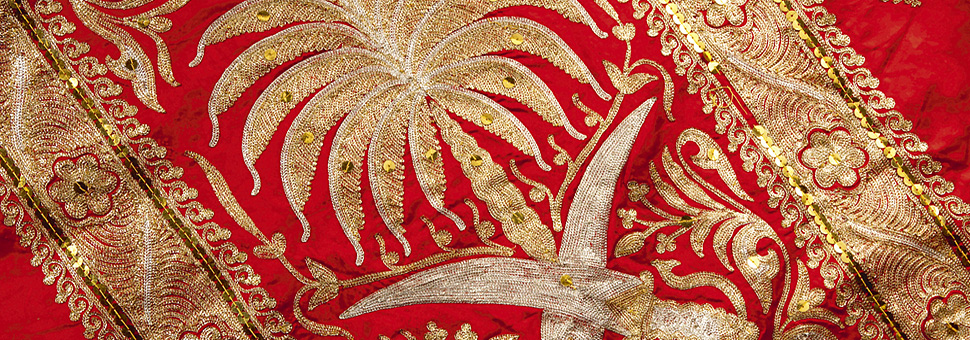
Dit is niet zomaar een jurk; het is onderdeel van mijn thuisland. Geborduurd met de Palestijnse vlag, de woorden “Vrede voor Palestina” en het symbool van de phoenix, die wedergeboorte vertegenwoordigt na ontberingen, vertelt het verhaal van een natie waar we niet fysiek in leven, maar die sterk met ons leven verweven is.

Detail van een Palestijnse jurk, Syrië, laat-20ste eeuw  (TRC 2003.0004a).Detail van een Palestijnse jurk, Syrië, laat-20ste eeuw (TRC 2003.0004a).

Ulos doek van de Toba, Sumatra, gepresenteerd door Herra Pahlasari.Ulos doek van de Toba, Sumatra, gepresenteerd door Herra Pahlasari.Ik ben gepassioneerd over textiel en de connectie ervan met mijn thuisland, mijn thuis en mijn familie. Via het TRC project heb ik textiel gevonden dat aansloot bij mijn ervaringen met familietradities.

De zoektocht naar verhalen en verbindingen begon toen ik bij het TRC een aantal verzamelingen zag van Indonesisch textiel die mij deden denken aan mijn herinneringen aan het moederschap: namelijk Ulos uit Toba, Sumatra; een babydrager gemaakt van kralen genaamd Bening uit Borneo, en batikdoeken uit Java. Deze combinatie van textiel hielp mij om langzaam mijn herinneringen aan mijn familie en aan Indonesië terug te halen. 

Ulos, het beroemde textiel van het eiland Sumatra, wordt meestal door een familielid gegeven wanneer iemand een nieuwe levensfase ingaat: de geboorte, het huwelijk of de begrafenis. Het wordt een heilig object door “Mangup”, een kleine ceremonie waarbij de familie advies en begeleiding geeft en er gebeden wordt.

Lange batikdoek uit Java, gepresenteerd doo Herra Pahlasari.Lange batikdoek uit Java, gepresenteerd doo Herra Pahlasari.Het textiel dat ik heb meegenomen naar Leiden is Ulos Sadum/Ulos Parompa. Ik kreeg het van mijn schoonfamilie toen ik beviel van mijn eerste kind. Het is geweven met kleurrijk garen en ornamenten, daarnaast zijn geel en groen toegevoegd aan de primaire kleuren van Ulos Batak: rood, wit en zwart.

Er staat geschreven “Horas Mamake” (fijn gebruik) en “Simbur Magodang” (snel opgroeien/groot worden), een groet en boodschap voor het kind om te groeien, te leven en waardevol en nuttig te zijn voor anderen. 

Het lange batikdoek uit Java doet me denken aan mijn kinderfoto met traditionele kleding (kebaya, samping) en de nabijheid met mijn dochter, als ik het gebruik als een gendongan (dragzak). Het motief dat hier wordt getoond is Parang, met de basisvorm van de letter “S” die is overgenomen uit de golven van de oceaan, die een geest afbeelden die nooit uitgaat.

Vervolgens kwam ik door mijn nieuwsgierigheid in aanraking met deze babydrager, gemaakt van kralen, uit Kalimantan, genaamd Bening. De Dayak bevolking van Borneo gelooft dat de kleurrijke goddelijke figuren, gemaakt van kralen, troost en vrede kunnen brengen, terwijl zij de baby en de ouders beschermen.

Deze ervaringen hebben mijn nieuwsgierigheid naar mijn afkomst en erfgoed versterkt, naar de stille boodschap van mezelf en anderen door Parompa, de warmte van bescherming binnen de familie. 

Baby-drager versierd met kralen, Dayak, Kalimantan, Indonesië, eind-20ste eeuw (TRC 2021.2370).Baby-drager versierd met kralen, Dayak, Kalimantan, Indonesië, eind-20ste eeuw (TRC 2021.2370).

Gon Homburg.Gon Homburg.Dit najaar organiseert de TRC Artisan School for Textiles and Dress een cursus kantklossen, die wordt gegeven door Gon Homburg. Zij leerde het kantklossen van haar moeder en vanaf 1983 is zij officieel geregistreerd als kantklosdocente. Zij geeft les aan liefhebbers en geeft workshops aan verschillende kunstopleidingen.

De cursus is opgebouwd uit tweemaal drie lessen. In de eerste drie lessen worden de beginselen van het kantklossen besproken en geoefend. In de tweede serie lessen wordt een klein Kerstornament gemaakt.

U kunt ervoor kiezen alleen de eerste drie lessen te volgen, of alleen de laatste drie. Indien u alleen de laatste drie lessen volgt, verwachten we wel dat u de basisbeginselen van het kantklossen onder de knie hebt.

De cursus wordt gegeven op een zestal donderdagen, van 10.00-13.00:

  • Donderdag 7 oktober; Donderdag 21 oktober; Donderdag 4 november
  • Donderdag 11 november; Donderdag 2 december; Donderdag 16 december

Plaats: TRC Leiden, Hogewoerd 164, 2351 HW Leiden. Docente: Gon Homburg. Taal: Nederlands. Kosten: 35 euros per donderdag (per set van drie lessen te betalen op de dag zelf). Materiaal/koffie/thee worden verzorgd. Max. aantal deelnemers: 10. Graag ruim tevoren aanmelden voor drie of zes lessen: Dit e-mailadres wordt beveiligd tegen spambots. JavaScript dient ingeschakeld te zijn om het te bekijken..

By the end of the 1930’s, kits of various kinds became a feature of American quilt life. These included patterns for quilt blocks and all the cloth that was required, sometimes pre-cut into the desired shapes. The kits also sometimes included embroidery charts, or patterns that were printed directly on cloth using a system of X’s for the embroiderer to work in cross stitch.

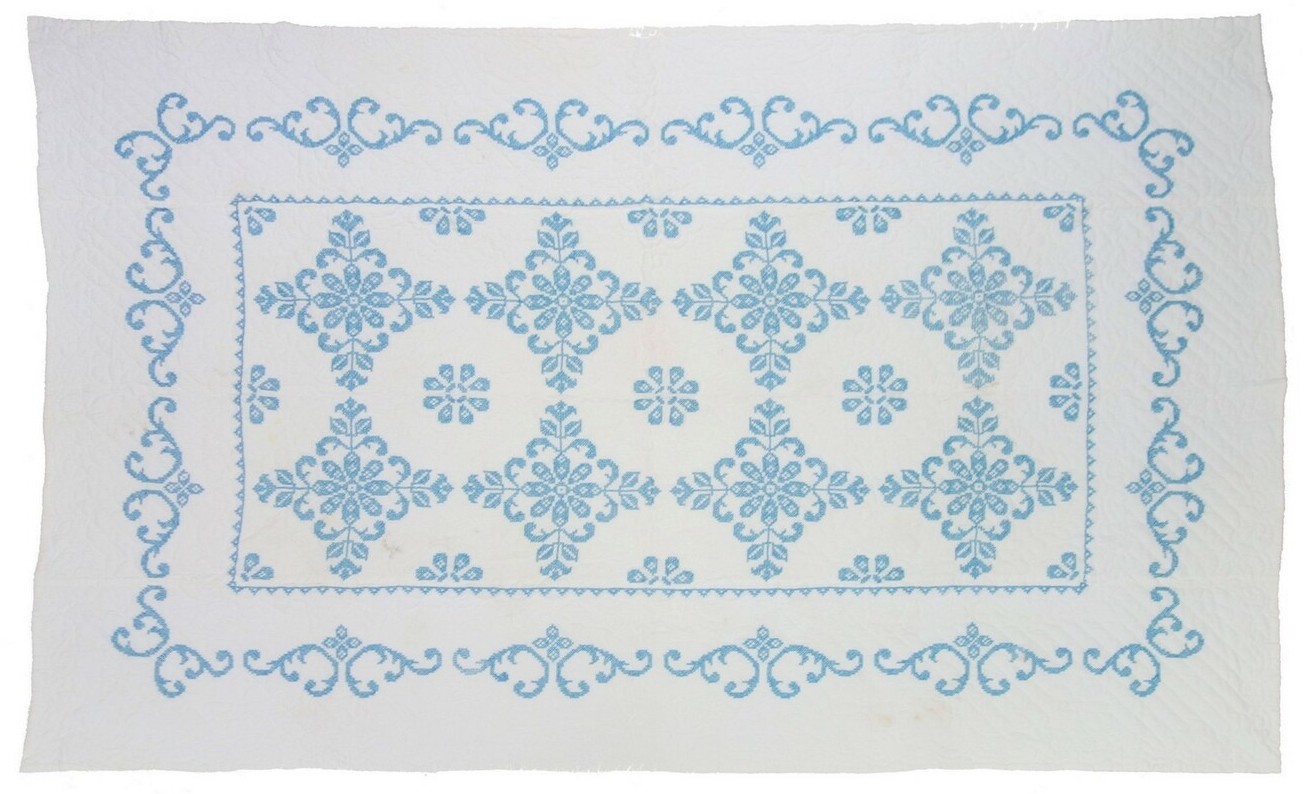
A 1950's embroidered quilt made from a kit, USA (TRC 2019.2926).A 1950's embroidered quilt made from a kit, USA (TRC 2019.2926).

The example of an embroidery chart for a quilt corner derives from an embroidered quilt in the TRC collection (TRC 2019.2926), from the USA in the 1950's. It was worked in a thick turquoise cotton yarn on a white ground, in cross stitch.

Cross stitch chart for the corner of an embroidered quilt (USA, 1950’s; TRC 2019.2926). For a detailed pdf file, please click on the image.Cross stitch chart for the corner of an embroidered quilt (USA, 1950’s; TRC 2019.2926). For a detailed pdf file, please click on the image.


Exhibition starts with the quilt block ' Dutchman's breeches', to the left. The quilt to the right is called 'Birds in the Air'.Exhibition starts with the quilt block ' Dutchman's breeches', to the left. The quilt to the right is called 'Birds in the Air'.

Quilts from the first half of the 20th century.Quilts from the first half of the 20th century.

Hanging down the wall, a Star Burst quilt from the 1860's. Hanging down the wall, a Star Burst quilt from the 1860's.

Detail of an appliqué and embroidered quilt, 1840's.Detail of an appliqué and embroidered quilt, 1840's. 

A selection of quilts and quilttops from the 1880's and 1890's.A selection of quilts and quilttops from the 1880's and 1890's.

Three quilts from the early 20th century.Three quilts from the early 20th century.

Three historic quilts from 1916 (left), late 19th century (centre), and 1840's (right). The appliqué coat was made in early 21st century by Henny Vogelsang from Schagen, The Netherlands.Three historic quilts from 1916 (left), late 19th century (centre), and 1840's (right). The appliqué coat was made in early 21st century by Henny Vogelsang from Schagen, The Netherlands.

Two modern quilts by Lies van de Wege, The Netherlands.Two modern quilts by Lies van de Wege, The Netherlands.

'Chinese Coin' quilt, c. 1900.'Chinese Coin' quilt, c. 1900.

Amish quilt, late 19th century.Amish quilt, late 19th century.


For more information, click on the illustration.For more information, click on the illustration.ASKARI, Nasreen and Hasan Askari (2019). The Flowering Desert: Textiles from Sindh. London: Paul Holberton Publishing, Mohatta Palace Museum, Karachi. ISBN 978-1-911300-71-7, hardback, pp. 168, fully illustrated in colour and b/w, bibliography, glossary. Price: GB ₤30.

A beautifully illustrated and presented book about woven, dyed and hand embroidered textiles and garments from the Sindh Province of Pakistan. Most of the items date from the 20th century and are items worn by girls and women, with some pieces for men. In addition, there are accessories and household items, such as game boards and covers for objects.

The subject matters are divided into five essays, a chapter about the collection, as well as a glossary and extensive bibliography. The essays include numerous details concerning different peoples and tribes, materials, techniques (especially embroidered and dyed forms), patterns, and the general diversity of the textiles produced and used in this vast region.

There are numerous high quality object and detail colour photographs that make following the complexity of the different groups and their textiles a pleasure.

Recommendation: This book should be in the library of anyone interested in embroidery, let alone South Asian textiles and accessories. It will also be worth while having just for the sheer enjoyment of looking at these diverse, colourful and decorative textiles (especially the embroideries). The textiles are indeed flowers in the desert.

Gillian Vogelsang-Eastwood, March 2020

Alabama beauty, Ashland rose, Brunswick star are not the names of flowers or birds, instead they are just a few of the thousands of different types of blocks used for making American quilts. For a long period of modern American history, quilts were one of the main means of women’s personal and artistic expression. They became a unifying force, an interest shared, while quilt gatherings provided a support service and mutual encouragement.

But what exactly is a quilt?

Basically a quilt is a bedcover or bedspread. These were initially made from two layers of cloth. At some point it was discovered that by adding a filling between the two layers it was possible to significantly increase the amount of warmth created. It was also quickly learnt that it was necessary to secure these layers together in some manner and that a series of small running stitches was the solution. This became one of the most popular techniques of quilting.

Quilting dates back for at least three thousand years. Ancient examples have been found at archaeological excavations in various Central Asian countries. Quilting was used for a range of objects, including floor coverings, wall hangings, as well as boots.

Bedspreads decorated with quilting were made in Scandinavia and Europe long before they were being made in America, with some of the most elaborate extant examples dating from the 14th century and originating from Sicily (the famous Tristan Quilt, made with trapunto or padded quilting), while later ones come from Britain, France, Germany, Sweden and The Netherlands. These quilts were made in a variety of techniques, including what is now called English paper piecing (using a card template) and ‘wholecloth’ quilting (quilts made from one piece of cloth).

Introduction of quilts into the US

When the Mayflower and the Pilgrims arrived in America in 1620 there were no bed quilts on board, but the settlers would have had the basic skills and knowledge of quilt making. The earliest surviving American quilts are made using the so-called wholecloth technique, but in later years quilts were being made that consisted of three layers. In the early 19th century the top layer often consisted of patchwork, made out of blocks. By the 1850’s, a typical American quilt was thus defined as being a covering for a bed that was made from three layers of cloth, with a patchwork top layer. The use of blocks seems to have been developed for convenience, as it was easier to draft a small design in a square rather than on a full quilt.

Amish and Mennonite quilts

Two related religious groups have had a particular influence on American quilts. These are the Amish and the Mennonites. The Amish are a traditional, Christian group who are known for their simple way of life, plain dress and dislike of modern technology. They originated in the late 17th and early 18th centuries among the Swiss German Anabaptists and a man called Jakob Amman, hence the name of Amish. In the early 18th century, many of the Anabaptists and followers of Amman emigrated to Pennsylvania, US, and to Canada. The patchwork top layers of the Amish quilts are characterised by graphic, often symmetrical designs made with solid-coloured fabrics that are often made from the same material that is used for Amish clothing. Although these quilts have simple designs, the quilting itself can be very complex. A popular quilting pattern among the Amish is the feather motif.

In the late 19th century the Amish split up into the Old Order Amish and the Amish Mennonites. The Mennonites are named after Menno Simons (1496-1561), from Friesland (now a province of The Netherlands). They are a mixed Anabaptist group who believe in a different version of the mission and ministry of Jesus than the official Roman Catholic and later Protestant doctrines. Over the years Mennonites have migrated to many parts of the world, including America, and they were joined by some of the Amish, who subsequently became known as the Amish Mennonites, or simply dropped the name of Amish. Mennonite quilts tend to be much lighter and brighter than Amish quilts, especially as they use figured fabrics.

Social functions (quilting bees)

A quilting bee is basically a social gathering based around the activity of quilting. This may be a regular meeting on a weekly or monthly basis, or a special occasion such as quilting a finished top by a group of people for a bride-to-be. In the latter case, there would probably be other activities and food would be brought to share, there may even be music. One of the most important features is the opportunity to talk and chatter with other women, which was said to sound like ‘bees in a hive’, hence the term quilting bee.

One of the most famous groups is the Gee’s Bend quilters’ quilting bees This is a group of African American women who live in the isolated hamlet of Gee’s Bend in Alabama. The quilts made in Gee’s Bend are regarded as being simply made and with a distinctive free form, using whatever materials are available to them.

Over the last two hundred years, many bees have come together to create group quilts, which were produced to support charities, events and movements, such as the Red Cross, the American Civil Rights movement and the AIDS epidemic support groups, to name just a few.

Competitions

Quilt competitions have been held since the early 19th century at State and County Fairs, even at rodeos. Mostly, people were competing for ribbons and the kudos of winning, but some competitions did occasionally feature cash prizes. In the 1970’s and 1980’s, the National Quilt shows started to offer cash prizes that were sponsored by quilt related companies. The prizes gradually became larger and larger. The American Quilt Society (AQS) show in Paducah, for example, came up with the idea of a ‘purchase prize’, where the ‘Best of Show’ quilt earned a cash prize, and the quilt would go to the AQS museum. By the early 21st century there are quilt shows all over the US, from local guilds putting on their own show, to ones held by state-wide organisations.


Wollen gebreide kousen van de Turkmenen in Iran, 1999, TRC 1999.0130a-b.Wollen gebreide kousen van de Turkmenen in Iran, 1999, TRC 1999.0130a-b.

Elke ochtend trekken we ze aan, die sokken. Vaak denken we er niet eens aan. Maar achter de ogenschijnlijk gewone sok zit een wereld vol verrassingen. Wist je dat men in Tadzjikistan de meest kleurrijke sokken van bijna een meter lang en een halve meter breed breit? En dat in het Midden-Oosten sokken vanaf de teen omhoog worden gebreid, terwijl we in Europa de gewoonte hebben om bovenaan te beginnen? En dat handgebreide sokken weer erg populair zijn geworden?
 
Een belangrijke aanleiding voor de tentoonstelling zijn de zijden kousen die werden gevonden in een wrak uit het midden van de zeventiende eeuw, ontdekt voor de kust van Texel in het noorden van Nederland. Deze met de hand gebreide kousen werden het onderwerp van een speciaal project onder leiding van Chrystel Brandenburgh om de technieken te bestuderen die werden toegepast om deze ultrafijne kousen te breien.
 
Het project wordt gesponsord door het Prins Bernard Cultuurfonds. De tentoonstelling, naast voorbeelden van gebreide sokken uit de hele wereld,  toont het verhaal van het project en de met de hand gebreide kousen gemaakt door een groep toegewijde en bekwame breiers die de zijden kousen uit de zeventiende eeuw hebben gereconstrueerd.

Zoek in TRC website

Contact

Hogewoerd 164
2311 HW Leiden
Tel. +31 (0)6 28830428  
info@trc-leiden.nl

facebook 2015 logo detail


instagram vernieuwt uiterlijk en logo


Abonneer u op de TRC Nieuwsbrief


Bankrekening

  • NL39 INGB 0002 9823 59
  • Stichting Textile Research Centre

Openingstijden

Maandag t/m donderdag van 10.00 tot 15.00 uur

Financiële giften

Het TRC is afhankelijk van project-financiering en privé-donaties. Al ons werk wordt verricht door vrijwilligers. Ter ondersteuning van de vele activiteiten van het TRC vragen wij U daarom om financiële steun:

Giften kunt U overmaken op bankrekeningnummer (IBAN) NL39 INGB 000 298 2359, t.n.v. Stichting Textile Research Centre. BIC code is: INGBNL2A

U kunt ook, heel simpel, indien u een iDEAL app heeft, de iDEAL-knop hieronder gebruiken en door een bepaald bedrag in te vullen: 


Omdat het TRC officieel is erkend als een Algemeen Nut Beogende Instelling (ANBI), en daarbij ook nog als een Culturele Instelling, zijn particuliere giften voor 125% aftrekbaar van de belasting, en voor bedrijven zelfs voor 150%. Voor meer informatie, klik hier