
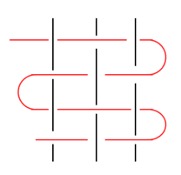
 Fig. 1. Plain weave with selvedge to the right.Why bother about selvedges? Who cares? These are just a few of the comments I heard when I said that the TRC has a reference box for all sorts of selvedges.
To be short: Selvedges are important. They are an essential part of a piece of woven cloth. Below there are some thoughts of Alice van Duijnen, the TRC’s indefatigable weaving and knitting specialist.
 Fig. 2. Brown hessian cloth with selvedge to the right, with a narrow purple selvedge stripe and double warps (TRC 2023.0849b).Selvedge is the term for the two self-finishing sides of a normal piece of woven fabric. It is the edge where the weft threads return in the opposite direction into the warps of the weave (Fig. 1). A 'normal' piece of hand woven cloth has two selvedges and two borders.
A selvedge occurs 'naturally'. But it also prevents the cloth from unraveling and fraying along two of its sides. It may have extra strengthening or embellishment. A sample in the TRC collection (Fig. 2. TRC 2023.0849b) has a coloured thread, for embellishment, and doubled warp threads for strengthening).
 Fig. 3. Sample of cloth with floating weft threads and a selvedge in a plain weave. Some of the floating weft threads intrude into the selvedge (TRC 2023.1531).Many selvedges have a flat (‘finishing’) edge, which is woven in a different manner to the weave of the main, remaining piece. This occurs particularly when the cloth is woven with floats. These are weft or horizontal threads that go over several warp threads, rather than going over one, under one, as in a plain weave). If this 'irregularity' reaches the edge of the cloth, the successive weft threads leave a series of gaps, whereby the weft threads do not cover all the warp threads. This results in an uneven, and vulnerable edge.
This problem is solved by weaving the cloth along its longitudinal edges (along the selvedge) in a different way, for instance, with a plain weave. Examples for this technique can be seen in TRC 2023.1531 (Fig. 3) and TRC 2024.1753).
 Fig. 4. Early 17th century velvet, showing the extra stripes along the selvedge indicating the quality of the cloth (TRC 2011.0376).Sometimes the weaver uses the selvedge to provide additional information about the cloth. For example, the number of coloured warp stripes woven into the selvedge may not merely be a form of decoration, but also mark the cloth's quality (the more coloured stripes, the better the quality, and higher the price). An example of this can be seen in an 18th-century velvet sample (Fig. 4. TRC 2011.0386).
In modern times, symbols and texts, rather than extra warp threads, are sometimes woven into the selvedge providing additional information, for instance about the fibre type used for making the cloth, or the name of the manufacturer (TRC 2023.1537b).
Selvedges can also be very informative with respect to fabric analysis. A handwoven form, for example, differs from a modern machine woven cloth. A handwoven selvedge is a often irregular, unlike the 'perfect' machine made cloths (compare Fig. 5. TRC 2024.3155c).
 Fig. 5. A piece of silk ikat cloth with an (irregular) selvedge. India, 20th century (TRC 2024.3155c).In the last quarter of the 19th century, the rapier selvedge was invented, although it was not until the 1960s and later that their use became widespread. A rapier loom is where the weft is not thrown in two directions using a shuttle. Instead single threads are entered from one side only and then cut off and this process is repeated again and again. So, for instance, all weft threads are entered from right to left.
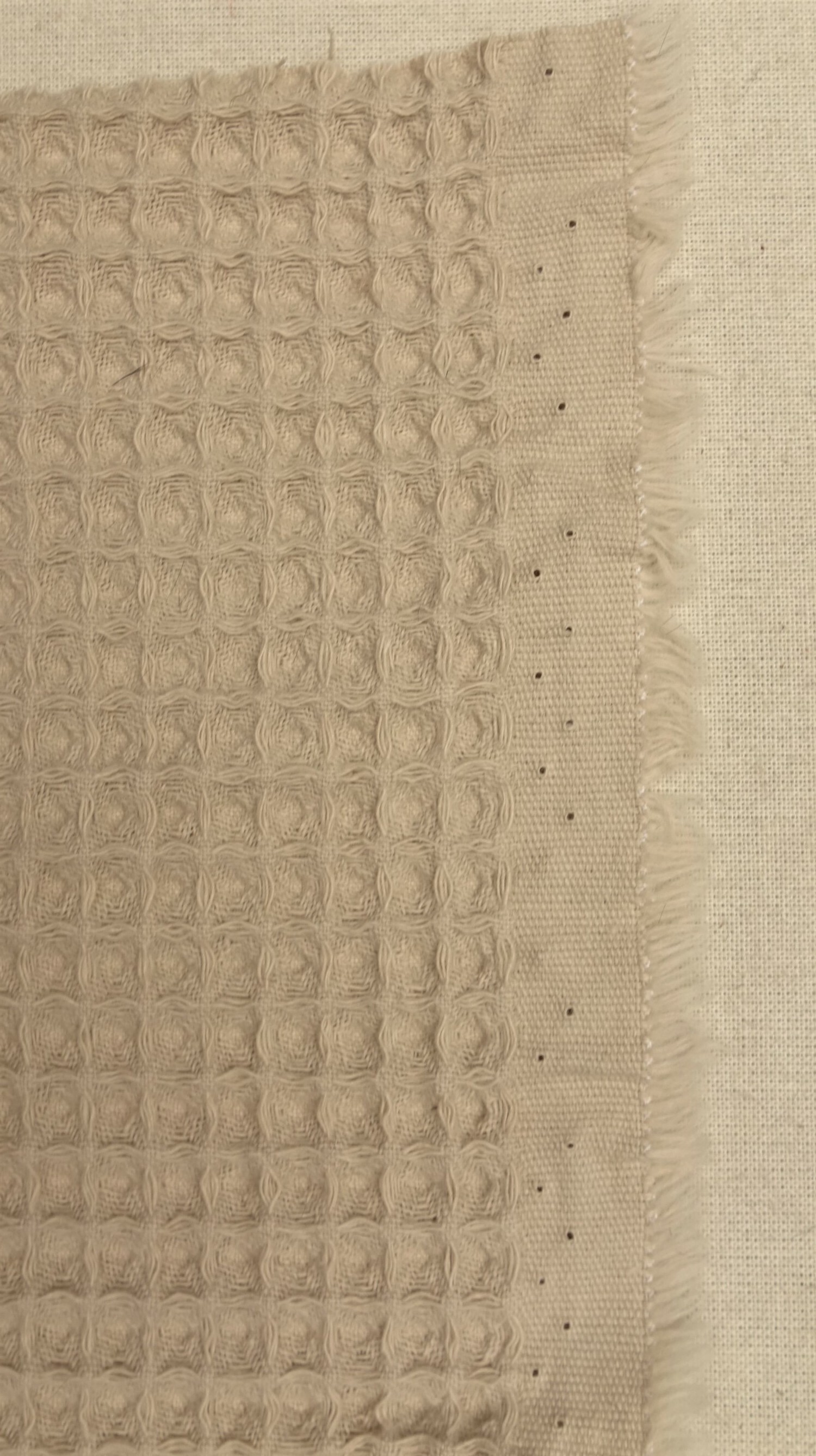 Fig. 6. Sample of cloth woven on a rapier loom. The selvedge area has been strengthened with extra warp threads (TRC 2023.0638).This method speeds up the weaving process. As a result you see the fringed selvedges that are so common nowadays (for example TRC 2023.1535c; Fig. 6). In this sample, apart from the rapier selvedge you can also see the regularly placed tenter hook holes. These are made by the small hooks on the side of the loom that are used to keep the cloth straight during the weaving process.
An interesting feature in this context is the twill weave. This type of cloth is, by definition, woven with floats. To make the selvedge, as discussed above, weavers often use a different weave, in this case a basket weave. Sample TRC 2024.0456 (Fig. 7) is a herringbone twill with a basket weave selvedge.
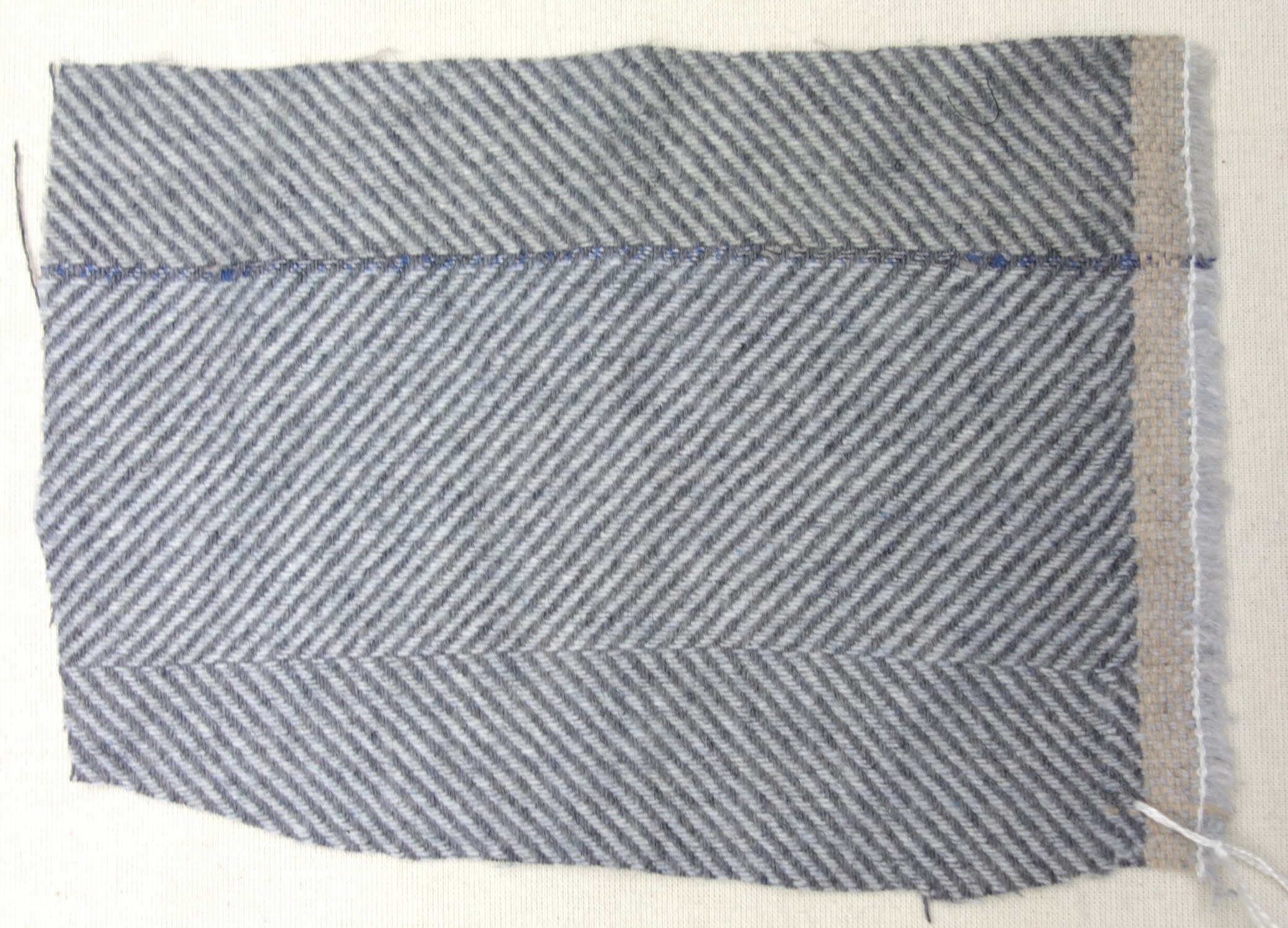 Fig. 7. Sample of a twill weave with a rapier selvedge strengthened with basket weave (TRC 2024.0456).However, the same example also shows the characteristic fringes of a rapier selvedge. With rapier selvedge you do not have the problem that floats do not cover all of the warp threads, because the weft threads do not turn at the side. But still, most probably out of habit after centuries of weaving twills with basket weave selvedges, this sample also has a basket weave selvedge.
There are many more types of selvedges, hence the need for a reference collection of selvedges, an unsung hero of the weaving world.
Alice van Duijnen, TRC volunteer, 5 May 2025