
Description:
Swimwear from the Netherlands

a.Woolen swimsuit, male, 1920s; b. Cotton swimsuit, female, late 1950s; c. Polyamide bikini, female, late 1980s
The TRC Object of the Month for July is a set of swimwear dating from the last century and worn in the Netherlands. The dark blue swimsuit is a woolen men’s swimsuit, machine knitted and worn in the 1920s at the Dutch coast. The blue-cream swimsuit is a female suit made of woven cotton and fully wrinkled with elastic, dating from the later ‘50s. The bikini is made of polyamide and dates from the late 1980s.
Bathing in sea came in vogue not earlier than at the end of the eighteenth century. At first it was a rather serious business with a strong medical character. The salt water was thought to be wholesome by disorders like asthma, arthritis, ulcers, hernia and for the bathing a special therapy program was used, including the drinking of sea water. Originally bathing huts , also called bathing machines were driven into the breakers, where the patients were submitted naked to the waves by attendants called dippers. The strict moral standards of the time soon made dressed bathing the norm. Bathing costume did not differ very much from daily summer dress. Women even let their corset under their dresses, to prevent the wet cloths to show their body shape. Only in 1880 the one-piece swimsuit was introduced, which also made women wearing pants for the first time. The early swimsuits were made of knitted wool, but soon more comfortable materials were used. The lady’s swimsuit, made by the Dutch company Tweka, shows a good improvement and the fabric was even patented as Tweka telescopic.The introduction of synthetic fibres such as Nylon, Helanca and the today Lycra allowed an even better shape. These quick drying materials guaranteed form maintenance during swimming, but also didn’t let you with a soaking afterwards.
Swimsuits more and more became a fashion article, the blue-cream swimsuit bears a label of the renowned Dutch fashion house Gebroeders Gerzon’s Modemagazijnen N.V. (1889-1968). The 1970s tended to more and more exposed body and hence less material. This now seems to have reached the top: swimsuits anno 2012 increasingly have a concealing shape with a figure corrective interior to let the woman swim as flattering as possible.
Keywords: Clothing, swimwear
Object type: two swimsuits, one male(a) and one female(b); bikini(c)
Local name: badpak; bikini
Country: Netherlands
Date: 1920s; late 1950(-early‘60s); late 1980s(-early‘90s)
Materials: wool; cotton and elastic; polyamide
Techniques: machine knitted; machine woven and machine sewn and wrinkled; machine knitted
Dimensions: H75cm x W50cm; H70cm x W45cm; H22cm x W45cm + H12cm x W45cm
TRC number: 2007.0785; 2007.0944; loan
Further reading:
Ferry, Kathreen, Beach Huts and Bathing Machines, Shire, 2009
Galjaard, J.M. , Pootje Baden: de vaderlandse geschiedenis van het badleven, Utrecht, 1966
Hemmen, P. van, De geschiedenis van de badmode. TWEKA 75, 1916-1991, Nuenen ,1991
Kessels, J.A.W., Het Huis Gerzon – Geschiedenis van een Modehuis, 1889-1964, Uitgave: Gebr. Gerzon`s Modemagazijnen N.V., 1964
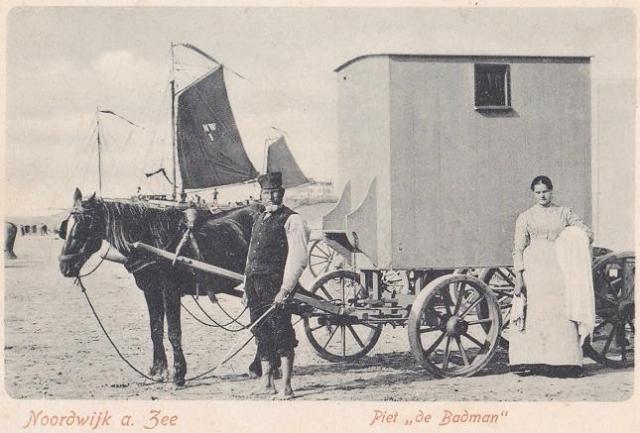

Bathing machines on the beach of Noordwijk, Netherlands and driven into the breakers. Late 19th century
Badkoetsen op het Noordwijkse strand en doorrijdend tot in de branding . Eind 19e eeuw
(Bron: http://www.dekker-bu9.nl/genealogie/bedijn/gen_Bedijn.htm; http://nl.wikipedia.org/wiki/Badkoets)
Man wearing a woolen swimsuit, 1934
Man in wollen herenbadpak, 1934