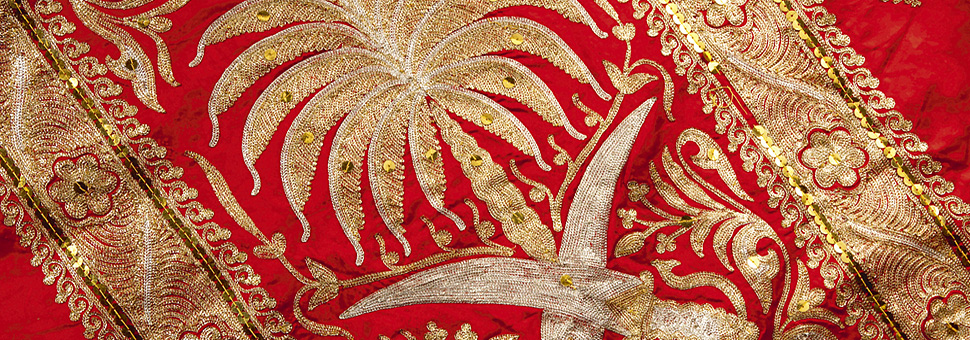

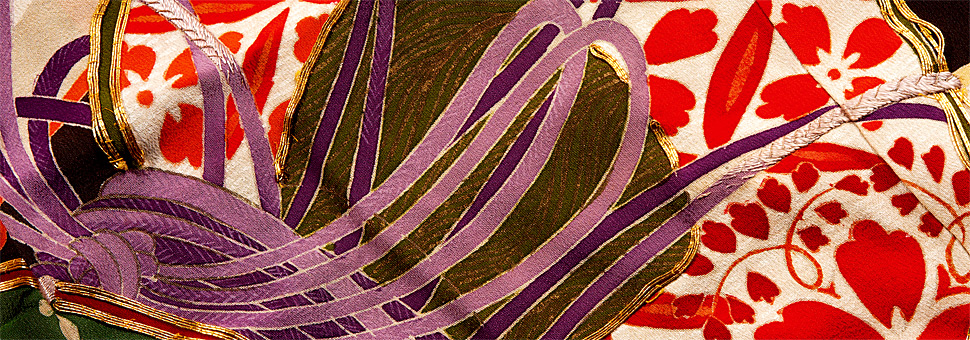
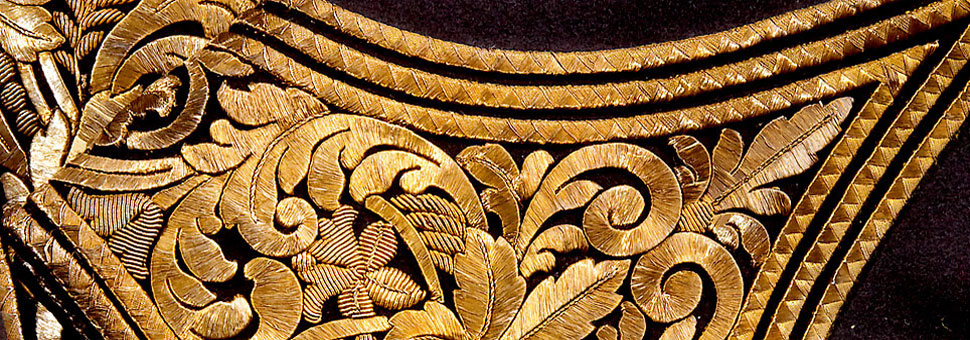
The TRC’s latest exhibition (on until the end of December 2022) explores how African, Asian and European textiles and dress have influenced each other. But their influences also extend to North America, as the following example illustrates.
The large tract of land now known as Louisiana (USA) was a French colony, officially until 1803 (the socalled Louisiana Purchase when the remaining French parts of Louisiana were ceded to the Americans). Louisiana included the busy port city of New Orleans, built in large part by enslaved labour. But New Orleans also had a population of between 400 to 800 gens de couleur libres, or free people of African descent. These free blacks spoke French and called themselves Creoles.
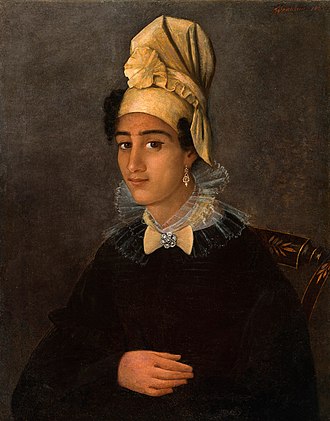 Painting of Creole woman in tignon, with lace collar and jewellery. From the Historic New Orleans Collection.For part of the 18th century, much of Louisiana was controlled by the Spanish. During that time, the Creole population doubled. Creole women had a reputation for beauty and for dressing elegantly. They worked as seamstresses and laundresses, kept taverns and boarding houses; wore European fashion and decorated their hair with feathers and jewels.
Louisiana’s Spanish Governor Esteban Rodríguez Miró was disturbed by reports of Creole women’s ‘haughty’ manners, their ‘excessive attention to dress’, and the many relationships between white men and Creole women.
In 1786 he enacted the tignon law: every free black woman in New Orleans now had to cover her hair with a scarf or handkerchief (called tignon, probably after the French word chignon, or hairstyle) in public, just like an enslaved woman. Hair could no longer be elaborately curled or decorated with feathers or jewellery. The law sought to remind Creole women of their “inferior” status.
Creole women began buying expensive, vibrantly coloured fabrics such as silks, which they draped around their hair in elaborate folds and tucks, like the West African headwraps called gele or the angisa of Surinam. They then used feathers, ribbons and jewellery to decorate the tignon.
Historian Carolyn Long writes that, "Instead of being considered a badge of dishonor, the tignon ... became a fashion statement. The bright reds, blues, and yellows of the scarves, and the imaginative wrapping techniques employed by their wearers, are said to have enhanced the beauty of the women of color." (A New Orleans Voudou Priestess: The Legend and Reality of Marie Laveau, University Press of Florida, 2006, p. 21).
The tignon law was eventually abandoned, but the headwrap remains. It can be found in the work of visual artist Chesley Antoinette Williams and on superstars like Beyonce, a symbol of beauty, creativity and resistance.
By Shelley Anderson, 28 September 2022