• F4
  • F1
  • F2
  • F3

Embroidered shawl, presented by Ghada Abhari.Embroidered shawl, presented by Ghada Abhari.The objects we hold close, often carry deep personal and familial significance. For me, an embroidered shawl, a wall panel, and a Palestinian dress reflect not only my Palestinian heritage, but also the connection to my family and the values passed down through generations. Each piece tells a story of identity, memory, and the enduring bond with my roots.

Embroidered Shawl

I hand-embroidered this shawl during the COVID-19 pandemic lockdown, using traditional Palestinian embroidery techniques. Each stitch brought me a sense of calm and a deeper connection to my Palestinian heritage.

I wore this shawl with pride when I received my Dutch citizenship, a moment of joy that celebrated both my new life in the Netherlands and my unwavering pride in my Palestinian roots, something I can never let go of.

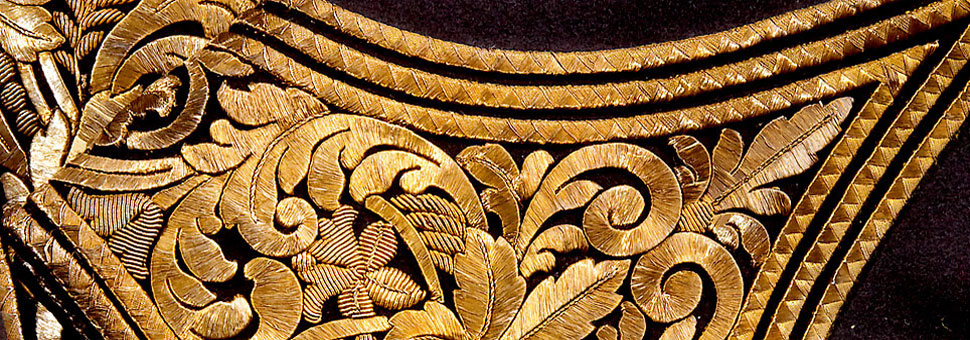
Wall panel from Palestine, presented by Ghada Abhari.Wall panel from Palestine, presented by Ghada Abhari.Wall Panel

This panel comes from my parents' home, and I took it with me after my mother passed away. It brings me a sense of comfort and security, as if my mother is always by my side. She used to place it at the entrance of our house to symbolize safety and peace.

Now, I’ve continued that tradition in my own home. The fabric, known as Damascus brocade, was once woven with silk, silver, and gold threads, though it’s no longer made that way today. This piece, inscribed with verses from the Quran, feels like a work of art and a cherished memory.

Palestinian Dress

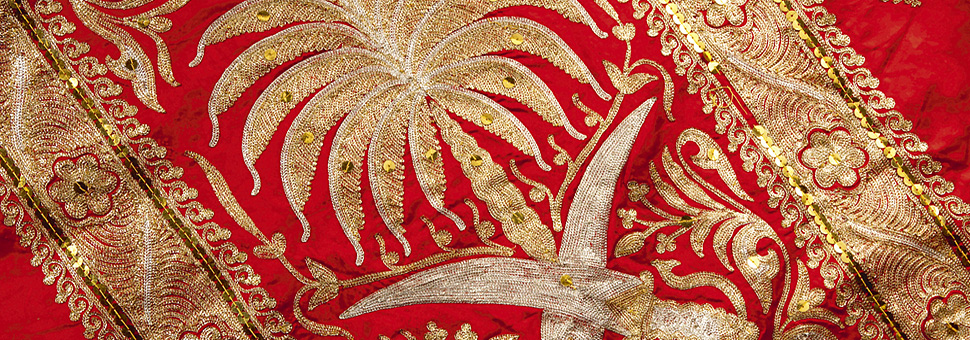
TRC 2003.0004a is not just a dress; it is a piece of my homeland. Embroidered with the Palestinian flag, the words "Freedom for Palestine," and the symbol of the phoenix, representing rebirth after hardship, it tells the story of a nation that we may not physically live in, but one that lives deeply within us.

Detail of Palestinian dress, Syria, late 20th century (TRC 2003.0004a).Detail of Palestinian dress, Syria, late 20th century (TRC 2003.0004a).

Ulos cloth from the Batak, Sumatra, presented by Herra Pahlasari.Ulos cloth from the Batak, Sumatra, presented by Herra Pahlasari.I am passionate about textiles and their connection to my homeland, home, and family in Indonesia. Through the TRC project, I found textiles that resonated with my experiences of family traditions.

The search for stories and connections began when I saw Indonesian textiles that connected me to my memories of motherhood: Ulos from Toba, Sumatra; a beaded baby carrier called Bening from Borneo; and batik cloths from Java, Indonesia. This combination of textiles helped me slowly trace back my memories of my family and Indonesia.

Ulos, the famous textile from Sumatra, is usually given by a family when someone enters a new phase of life: at birth, a marriage, or at a funeral. It became a sacred object through a small ceremony called Mangupa, when the families give advice, guidance, and offers its prayers.

Long cloth of batik from Java, presented by Herra Pahlasari.Long cloth of batik from Java, presented by Herra Pahlasari.The one I brought to Leiden is Ulos Sadum/Ulos Parompa, I received it from my family-in-law when I gave birth to my first child. Woven in colourful threads and ornaments in which yellow and green are added in with the Ulos Batak primary colours: red, white, and black. A greeting and message for the child to grow and live as valuable and useful for the others are embroidered on the fabric: Horas Mamake (enjoy using this) and Simbur Magodang (grow quickly and healthily) are embroidered onto the cloth.

The long batik cloth from Java reminds me of my childhood photograph with traditional dress, kebaya and samping and closeness with my daughter where I use it as gendongan (baby carrier). The motif shown here is called Parang, with the basic shape of the letter “S” taken from the ocean waves, which depict a spirit that never goes out.

Then, my curiosity made me connect with this beaded baby carrier from Kalimantan called Bening  (TRC 2021.2370). Dayak people from Borneo/Kalimantan believe that the colourful beaded deity figures could bring comfort and peace while protecting the baby and the parents.

These experiences have deepened my curiosity about my roots and heritage, the silent message of the self and the others through Parompa, the warmth of family protection.

Beaded baby carrier, Dayak, Kalimantan, Indonesia, late 20th century (TRC 2021.2370).Beaded baby carrier, Dayak, Kalimantan, Indonesia, late 20th century (TRC 2021.2370).

Gon Homburg.Gon Homburg.This autumn, the TRC Artisan School for Textiles and Dress organises a bobbin lace course which is taught by Gon Homburg. She learned to make lace from her mother and from 1983 she is officially registered as a bobbin lace teacher. She teaches enthusiasts and gives workshops to various art schools.

The course consists of two sets of three lessons each. In the first three lessons, the principles of bobbin lace making are discussed and practised. In the second series, a small Christmas ornament is made.

You can choose to take all six lessons, or only the first or second set. If you only take the last three lessons, we expect you to have mastered the basics of bobbin lace making.

The course is given on six Thursdays, from 10.00-13.00:

Thursday October 7; Thursday October 21; Thursday 4 November
Thursday 11 November; Thursday December 2; Thursday December 16

Venue: TRC Leiden, Hogewoerd 164, 2351 HW Leiden. Teacher: Gon Homburg. Language: Dutch. Costs: 35 euros per Thursday (to be paid per set of three on the day itself). Material/coffee/tea are provided. Max. number of participants: 10. Please register well in advance for three or six lessons: This email address is being protected from spambots. You need JavaScript enabled to view it..

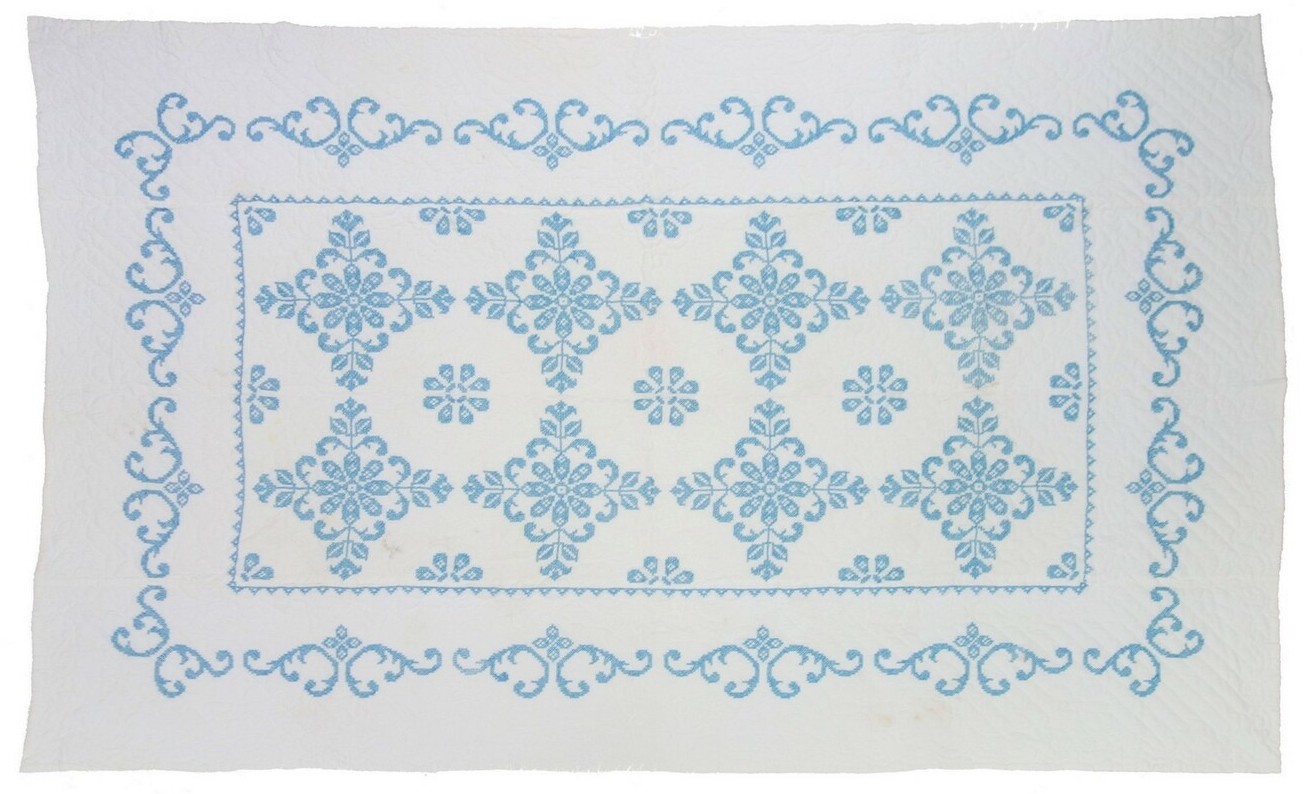
By the end of the 1930’s, kits of various kinds became a feature of American quilt life. These included patterns for quilt blocks and all the cloth that was required, sometimes pre-cut into the desired shapes. The kits also sometimes included embroidery charts, or patterns that were printed directly on cloth using a system of X’s for the embroiderer to work in cross stitch.

A 1950's embroidered quilt made from a kit, USA (TRC 2019.2926).A 1950's embroidered quilt made from a kit, USA (TRC 2019.2926).

The example of an embroidery chart for a quilt corner derives from an embroidered quilt in the TRC collection (TRC 2019.2926), from the USA in the 1950's. It was worked in a thick turquoise cotton yarn on a white ground, in cross stitch.

Cross stitch chart for the corner of an embroidered quilt (USA, 1950’s; TRC 2019.2926). For a detailed pdf file, please click on the image.Cross stitch chart for the corner of an embroidered quilt (USA, 1950’s; TRC 2019.2926). For a detailed pdf file, please click on the image.


Exhibition starts with the quilt block ' Dutchman's breeches', to the left. The quilt to the right is called 'Birds in the Air'.Exhibition starts with the quilt block ' Dutchman's breeches', to the left. The quilt to the right is called 'Birds in the Air'.

Quilts from the first half of the 20th century.Quilts from the first half of the 20th century.

Hanging down the wall, a Star Burst quilt from the 1860's. Hanging down the wall, a Star Burst quilt from the 1860's.

Detail of an appliqué and embroidered quilt, 1840's.Detail of an appliqué and embroidered quilt, 1840's. 

A selection of quilts and quilttops from the 1880's and 1890's.A selection of quilts and quilttops from the 1880's and 1890's.

Three quilts from the early 20th century.Three quilts from the early 20th century.

Three historic quilts from 1916 (left), late 19th century (centre), and 1840's (right). The appliqué coat was made in early 21st century by Henny Vogelsang from Schagen, The Netherlands.Three historic quilts from 1916 (left), late 19th century (centre), and 1840's (right). The appliqué coat was made in early 21st century by Henny Vogelsang from Schagen, The Netherlands.

Two modern quilts by Lies van de Wege, The Netherlands.Two modern quilts by Lies van de Wege, The Netherlands.

'Chinese Coin' quilt, c. 1900.'Chinese Coin' quilt, c. 1900.

Amish quilt, late 19th century.Amish quilt, late 19th century.


For more information, click on the illustration.For more information, click on the illustration.ASKARI, Nasreen and Hasan Askari (2019). The Flowering Desert: Textiles from Sindh. London: Paul Holberton Publishing, Mohatta Palace Museum, Karachi. ISBN 978-1-911300-71-7, hardback, pp. 168, fully illustrated in colour and b/w, bibliography, glossary. Price: GB ₤30.

A beautifully illustrated and presented book about woven, dyed and hand embroidered textiles and garments from the Sindh Province of Pakistan. Most of the items date from the 20th century and are items worn by girls and women, with some pieces for men. In addition, there are accessories and household items, such as game boards and covers for objects.

The subject matters are divided into five essays, a chapter about the collection, as well as a glossary and extensive bibliography. The essays include numerous details concerning different peoples and tribes, materials, techniques (especially embroidered and dyed forms), patterns, and the general diversity of the textiles produced and used in this vast region.

There are numerous high quality object and detail colour photographs that make following the complexity of the different groups and their textiles a pleasure.

Recommendation: This book should be in the library of anyone interested in embroidery, let alone South Asian textiles and accessories. It will also be worth while having just for the sheer enjoyment of looking at these diverse, colourful and decorative textiles (especially the embroideries). The textiles are indeed flowers in the desert.

Gillian Vogelsang-Eastwood, March 2020

Alabama beauty, Ashland rose, Brunswick star are not the names of flowers or birds, instead they are just a few of the thousands of different types of blocks used for making American quilts. For a long period of modern American history, quilts were one of the main means of women’s personal and artistic expression. They became a unifying force, an interest shared, while quilt gatherings provided a support service and mutual encouragement.

But what exactly is a quilt?

Basically a quilt is a bedcover or bedspread. These were initially made from two layers of cloth. At some point it was discovered that by adding a filling between the two layers it was possible to significantly increase the amount of warmth created. It was also quickly learnt that it was necessary to secure these layers together in some manner and that a series of small running stitches was the solution. This became one of the most popular techniques of quilting.

Quilting dates back for at least three thousand years. Ancient examples have been found at archaeological excavations in various Central Asian countries. Quilting was used for a range of objects, including floor coverings, wall hangings, as well as boots.

Bedspreads decorated with quilting were made in Scandinavia and Europe long before they were being made in America, with some of the most elaborate extant examples dating from the 14th century and originating from Sicily (the famous Tristan Quilt, made with trapunto or padded quilting), while later ones come from Britain, France, Germany, Sweden and The Netherlands. These quilts were made in a variety of techniques, including what is now called English paper piecing (using a card template) and ‘wholecloth’ quilting (quilts made from one piece of cloth).

Introduction of quilts into the US

When the Mayflower and the Pilgrims arrived in America in 1620 there were no bed quilts on board, but the settlers would have had the basic skills and knowledge of quilt making. The earliest surviving American quilts are made using the so-called wholecloth technique, but in later years quilts were being made that consisted of three layers. In the early 19th century the top layer often consisted of patchwork, made out of blocks. By the 1850’s, a typical American quilt was thus defined as being a covering for a bed that was made from three layers of cloth, with a patchwork top layer. The use of blocks seems to have been developed for convenience, as it was easier to draft a small design in a square rather than on a full quilt.

Amish and Mennonite quilts

Two related religious groups have had a particular influence on American quilts. These are the Amish and the Mennonites. The Amish are a traditional, Christian group who are known for their simple way of life, plain dress and dislike of modern technology. They originated in the late 17th and early 18th centuries among the Swiss German Anabaptists and a man called Jakob Amman, hence the name of Amish. In the early 18th century, many of the Anabaptists and followers of Amman emigrated to Pennsylvania, US, and to Canada. The patchwork top layers of the Amish quilts are characterised by graphic, often symmetrical designs made with solid-coloured fabrics that are often made from the same material that is used for Amish clothing. Although these quilts have simple designs, the quilting itself can be very complex. A popular quilting pattern among the Amish is the feather motif.

In the late 19th century the Amish split up into the Old Order Amish and the Amish Mennonites. The Mennonites are named after Menno Simons (1496-1561), from Friesland (now a province of The Netherlands). They are a mixed Anabaptist group who believe in a different version of the mission and ministry of Jesus than the official Roman Catholic and later Protestant doctrines. Over the years Mennonites have migrated to many parts of the world, including America, and they were joined by some of the Amish, who subsequently became known as the Amish Mennonites, or simply dropped the name of Amish. Mennonite quilts tend to be much lighter and brighter than Amish quilts, especially as they use figured fabrics.

Social functions (quilting bees)

A quilting bee is basically a social gathering based around the activity of quilting. This may be a regular meeting on a weekly or monthly basis, or a special occasion such as quilting a finished top by a group of people for a bride-to-be. In the latter case, there would probably be other activities and food would be brought to share, there may even be music. One of the most important features is the opportunity to talk and chatter with other women, which was said to sound like ‘bees in a hive’, hence the term quilting bee.

One of the most famous groups is the Gee’s Bend quilters’ quilting bees This is a group of African American women who live in the isolated hamlet of Gee’s Bend in Alabama. The quilts made in Gee’s Bend are regarded as being simply made and with a distinctive free form, using whatever materials are available to them.

Over the last two hundred years, many bees have come together to create group quilts, which were produced to support charities, events and movements, such as the Red Cross, the American Civil Rights movement and the AIDS epidemic support groups, to name just a few.

Competitions

Quilt competitions have been held since the early 19th century at State and County Fairs, even at rodeos. Mostly, people were competing for ribbons and the kudos of winning, but some competitions did occasionally feature cash prizes. In the 1970’s and 1980’s, the National Quilt shows started to offer cash prizes that were sponsored by quilt related companies. The prizes gradually became larger and larger. The American Quilt Society (AQS) show in Paducah, for example, came up with the idea of a ‘purchase prize’, where the ‘Best of Show’ quilt earned a cash prize, and the quilt would go to the AQS museum. By the early 21st century there are quilt shows all over the US, from local guilds putting on their own show, to ones held by state-wide organisations.

Woollen Turkmen socks from Iran, 1999, TRC 1999.0130a-b.Woollen Turkmen socks from Iran, 1999, TRC 1999.0130a-b.Every morning we put them on, those socks. Often we don't even think about it. But behind the apparently common sock there is a world full of surprises. Did you know that people in Tajikistan knit the most colourful socks of almost one metre long and half a metre wide? And that in the Middle East socks are knitted from the toe upwards, while in Europe we tend to start at the top? And that hand knitting socks has become very popular again?

A major element of the exhibition were the silk stockings found in a mid-seventeenth century wreck discovered off the coast of Texel in the north of The Netherlands. These hand knitted stockings became the focus of a special project led by Chrystel Brandenburgh to study the techniques applied to knit these ultra-fine stockings.

The project was sponsored by the Prins Bernard Cultuurfonds. The exhibition will show the story of the project and the hand knitted stockings made by a group of dedicated and skilful knitters.


Search in the TRC website

Contact

Boerhaavelaan 6
2334 EN Leiden.
Tel. +31 (0)6 28830428  
office@trcleiden.org 

facebook 2015 logo detail 

instagram vernieuwt uiterlijk en logo


Bank account number

NL39 INGB 0002 9823 59, in the name of the Stichting Textile Research Centre.

TRC closed until 4 May 2026

The TRC is closed to the public until Monday, 4 May 2026, due to our move to the Boerhaavelaan. The TRC remains in contact via the web, telephone and email. For direct contact and personal visits, please contact the TRC at office@trcleiden.org, or by mobile, 06-28830428.

Donations

The TRC is dependent on project support and individual donations. All of our work is being carried out by volunteers. To support the TRC activities, we therefore welcome your financial assistance: donations can be transferred to bank account number (IBAN) NL39 INGB 000 298 2359, in the name of the Stichting Textile Research Centre. BIC code is: INGBNL2A.

 You can also, very simply, if you have an iDEAL app, use the iDEAL button and fill in the amount of support you want to donate: 


Since the TRC is officially recognised as a non-profit making cultural institution (ANBI), donations are tax deductible for 125% for individuals, and 150% for commercial companies. For more information, click here