
One of the things we enjoy at the TRC is linking an object to a person (or persons) and telling a little of their backgrounds. In the case of a recent donation there are two stories, a technical one about a piece of cloth, and the history of the people who once owned it. Both have a Leiden element.
 Mantle piece cover made from mohair (trijp), the Netherlands, 20th century (TRC 2023.1928).
A few days ago Els Bonte, a long term friend and TRC volunteer (and born and bred in Leiden) who regularly donates items, came to the TRC with a length of dark brown velvet (TRC 2023.1928), decorated with a small geometric pattern in various shades of brown. It had been used by her grandparents, Arie Vijlbrief (1879-1970) and Engelina Magdalena de Jong (1878-1967), who were both born and brought up in Leiden (see below). The cloth was used as a mantle piece cover in their home at the Magdalena Moonsstraat, Leiden.
The cloth has a mohair pile on a cotton, plain weave ground. Mohair velvet was and still is used mainly for upholstery and comes in various qualities, from finely and compactly woven forms to loosely woven examples. In the Netherlands this type of velvet is generally known as velours d’Utrecht, Utrecht velours or Utrechter Plüsch, after the Dutch city of Utrecht that has been associated with the production, distribution and sale of velvet since at least the late seventeenth century.
 Piece of mohair velvet, as used for the chairs in the House of Parliament, the Hague, the Netherlands (TRC 2018.2514).
The TRC Collection includes various examples of modern, mohair velvet from Germany (TRC 2018.2505) and France (TRC 2018.2502 and TRC 2018.2503) as well as one piece made in France especially for the Dutch Parliament (TRC 2018.2514). The latter example is made in the technically complicated (and expensive) pile-on-pile form and has an elaborate, repeating pattern of sunflowers, which refers to the Dutch painter, Vincent van Gogh.
 Engelina Magdalena de Jong, 1878-1969.Which brings us back to trijp (pronounced tripe). This is a Dutch term for velvet made from mohair, and the word, of French origin, can be traced back in the Netherlands to at least the sixteenth century. According to Els Bonte, in Leiden at least, the term trijp was specifically associated with a lesser quality velvet with a more ‘open’ pile (as compared with top-quality velours), used by middle class people.
The original owners of the cloth, Arie Vijlbrief (Veijlbrief) and Engelina Magdalena de Jong, met each other in the Heilige Geest Weeshuis (‘Holy Ghost Orphanage’, Hooglandse Kerkgracht 17, Leiden). They had ended up in the orphanage when both of their fathers died young. After leaving the orphanage, Engelina came to work, it so happens, with Doctor Abraham Seret (a GP), not far from the current premises of the TRC (Hogewoerd 164).
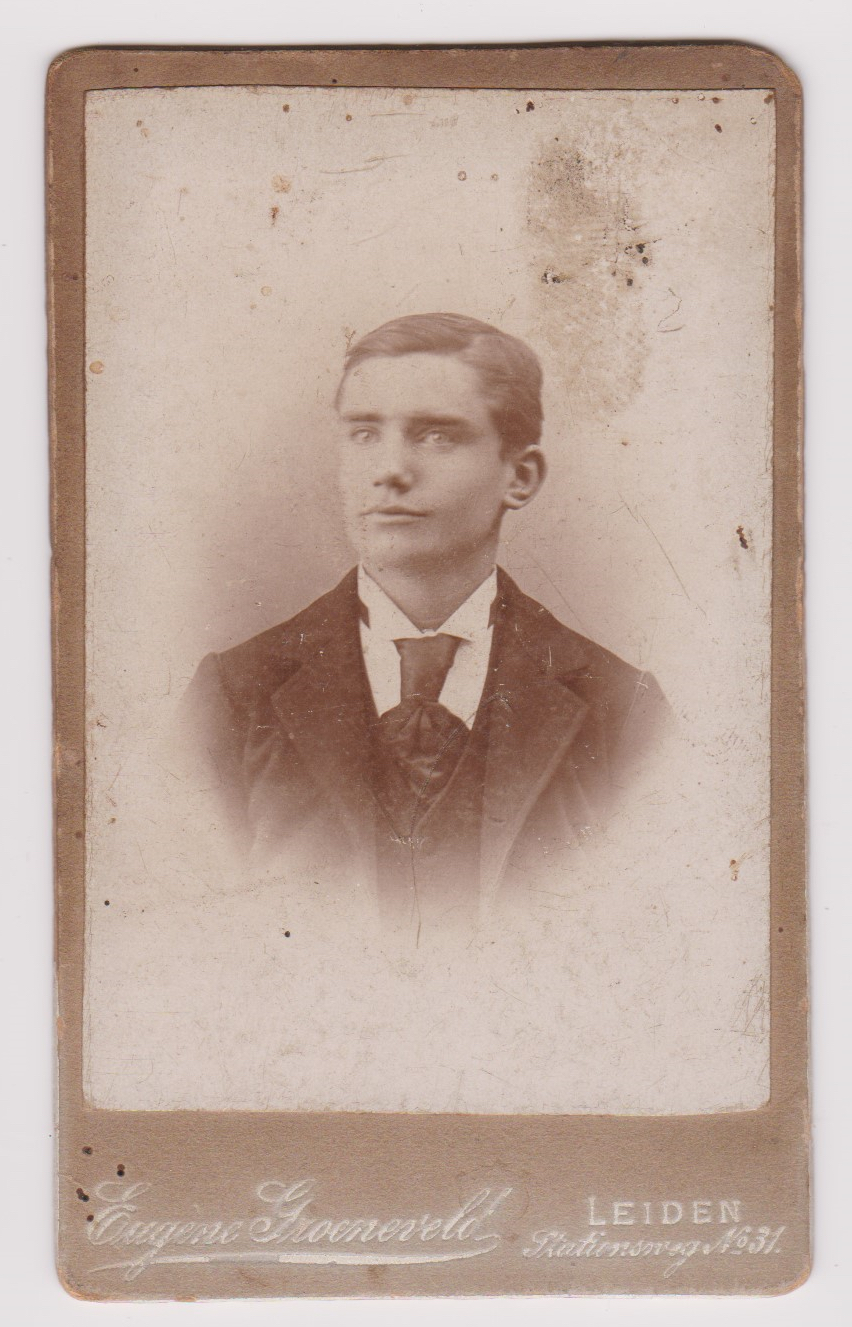 Arie Vijlbrief, 1879-1970.They married in May 1906 and had two children, Hendrik and Aaltje (the mother of Els Bonte). They came to live in the Magdalena Moonsstraat, just outside the old heart of the city.
Arie was a carpenter working for the cannery firm of Tieleman en Dros (Middelstegracht complex, where Sleutelstad Radio is now housed). They celebrated their 50th (1956) and 60th (1966) wedding anniversaries in the same house on the Magdalena Moonsstraat, and yes, Els remembers the velvet cloth still decorating the mantle piece!
The two photographs were taken in the studio of Eugène Groeneveld at the Stationsweg, apparently at the time that Arie Vijlbrief and Engelina de Jong left the orphanage at the age of 21.
We are very pleased to welcome this piece of cloth, with its wealth of Leiden connections, in the TRC Collection!
Gillian Vogelsang-Eastwood, 14 October 2023