
 Author in front of Durham Cathedral, 25 May 2023. Photograph: Willem VogelsangI am looking out of my hotel window at the spectacular sight of the towers of the medieval cathedral of Durham and neighbouring castle; a building complex with over a thousand years of history. I could sit here for a very long time! However, this blog is about saints and embroidery, not early medieval buildings.
In previous blogs Willem and I have talked about our visits to look at the St Petrock’s altar cloth in Exeter Cathedral, England, and also about the embroideries associated with Frankish St Harlindis and St Relindis in Maaseik, Belgium, about St Thomas Becket’s garments and embroideries in Sens, France and the embroidered cope associated with St Thomas Becket in Kortrijk, Belgium.
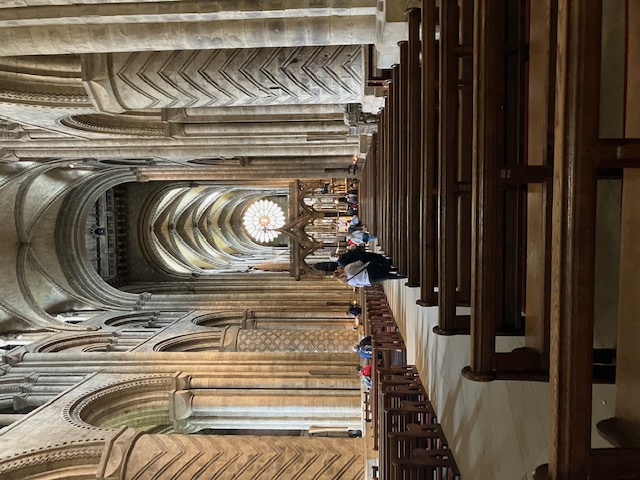 Inside the Early Gothic cathedral of Durham. Photograph: Willem VogelsangAll of these trips were made for the upcoming fourth volume of the Bloomsbury Encyclopedia of Embroidery, which is about Scandinavian and Western European embroidery.
In Durham we are looking at the embroideries associated with St Cuthbert (c. 634-687), as well as various embroidered medieval and later copes housed in Durham Cathedral in northern England.
St Cuthbert of Lindisfarne was an Anglo-Saxon saint from Northumbria. He became a monk, bishop and hermit, and is particularly associated with the monasteries of Melrose and Lindisfarne. After his death in 687 he became a popular, local saint with a following based at Durham Cathedral where he is buried. Cuthbert is generally regarded as being the patron saint of Northumberland.
The St Cuthbert pieces are the oldest known English embroideries and appear to date from the seventh century and later, as the tomb was opened on various occasions over the centuries and items were added to the burial.
 Fragment of a 10th century gold embroidered stole, contained in the tomb of St Cuthbert. Durham Cathedral. Photograph by author.Some of the embroidered items are on display in the old kitchen of the monastic community, which is situated in the undercroft of the cathedral complex, and can be seen during opening times of the cathedral museum. The embroideries include complete and fragments of bracelets, sashes, maniples and a stole. They are decorated with gold work embroidery using floss silk worked in split stitch (filling), stem stitch (outlining), as well as surface couching (not underside couching as associated with Opus Anglicanum) using gold metal thread. A feature of the embroideries are the names of saints and donation panels on some of the pieces.
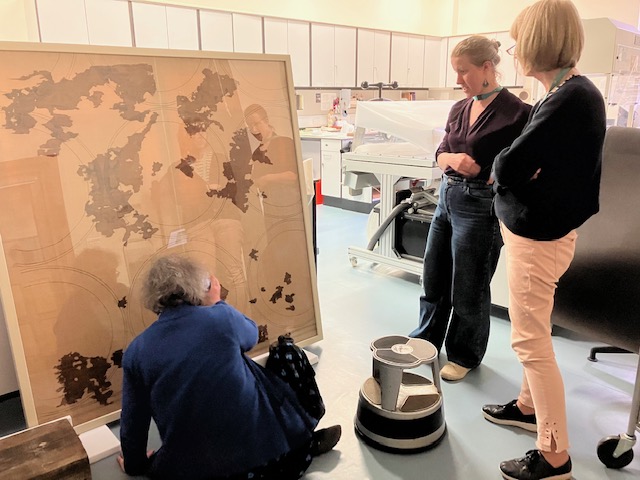 Studying fragments of one of the early medieval textiles found in St Cuthbert's tomb. 26 May 2023. Photograph: Willem VogelsangThere are also some woven silk items from the tomb of St Cuthbert in a nearby storage facility, notably four silk textiles in various weaves including twill weave and weft-faced compound twill (samite). These can only be seen by special appointment. The pieces are probably of North African, Islamic Spain, and/or Middle Eastern origin and include two pieces with large, connecting roundels, one of which includes stylised peacocks.
Another woven cloth, beautifully detailed, has the bottom of a decorative vase or urn with pairs of ducks swimming in water near its base. There are fishes swimming in the same water. Another piece that caught my eye was a fine twill cloth in silk that has traces of a roundel pattern that appears to have been printed rather than woven.
We have taken dino-lite microscope images of these textiles and these will form the basis for another blog. All of these pieces would have been imported into England, possible as trade goods, or perhaps via soldiers, merchants, clergy or visitors to various royal and ecclesiastical courts.
It is worth noting that there are also some small fragments (BM 1896,0501.96) of St Cuthbert textiles in the collection of the British Museum, which were given to the BM in 1896.
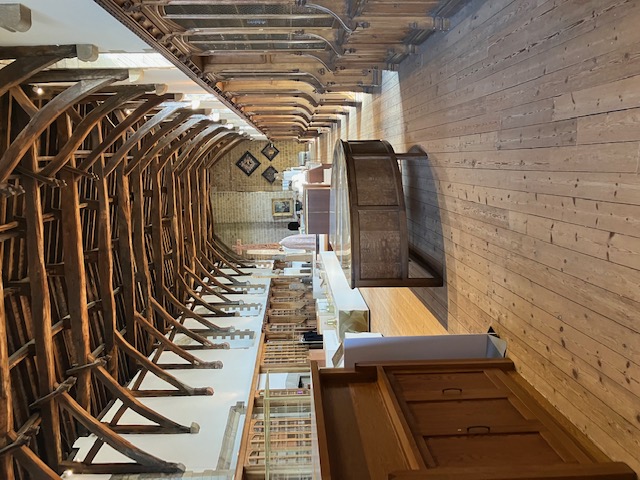 The Victorian-era library, the former monastic dormitory, with the large semi-circular cupboard holding a collection of copes. Durham Cathedral complex. 25 May 2023. Photograph: Willem Vogelsang.Durham Cathedral and copes
The collection of the cathedral also includes a number of medieval and later, embroidered copes, some made of velvet, others of damask, but all are embroidered in a variety of techniques, including Opus Anglicanum, couching and stumpwork, as well as including applied metal sequins (not spangles).
One of the most spectacular garments is the so-called ‘Blue velvet cope’ that dates from c. 1440-1470 and is made from blue velvet with a gold thread ground and details in allucciolato (alluciolato) or ‘fire fly’ (modern Italian; lucciola), which is a decorative technique of inserting loops of very fine gold thread into the cloth during the weaving process, which will glitter in the (candle) light.
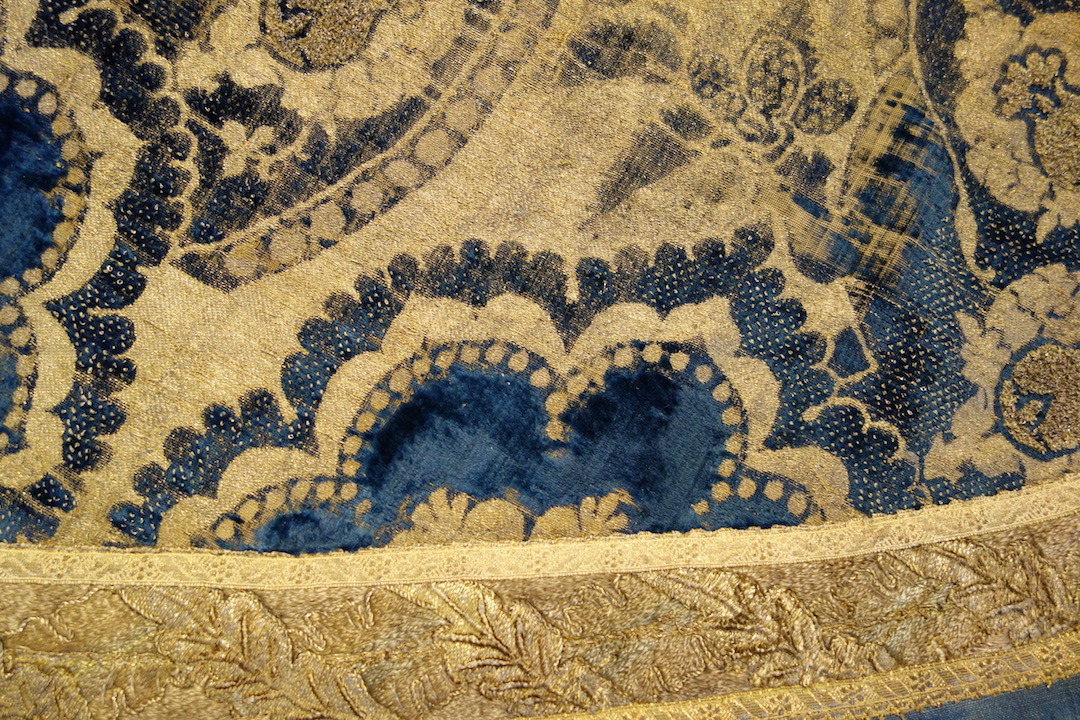 Detail of a 15th century Italian velvet cope with fire fly detail. Durham Cathedral. Photograph by author.The cope hood and orphries down the front were embroidered. Two other copes should be mentioned, firtstly the ‘Red cope’ that was worn by clergy when King Charles I visited the Cathedral in 1633. It is embroidered with tiny cherubim whose heads are in stumpwork. The cope hood has the image of David and Goliath (1 Samuel 17, 42-51), more specifically David holding Goliath’s head. Considering how King Charles lost his head in 1649, a somewhat foreboding embroidery.
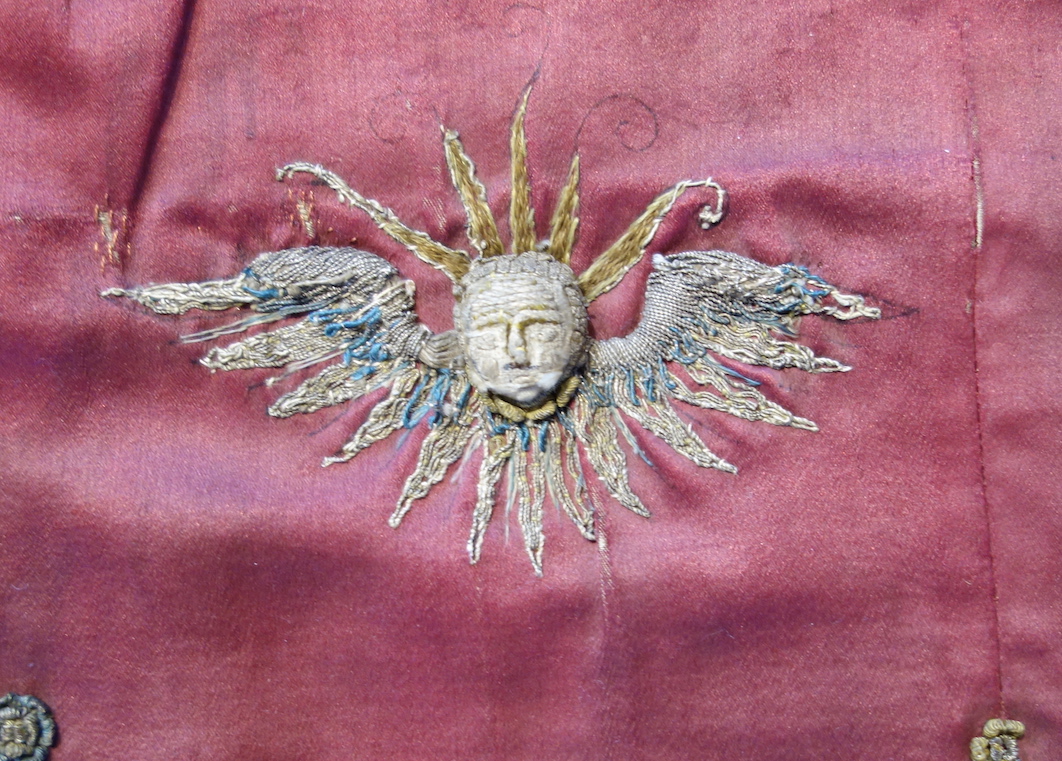 Detail of an early 17th century cope, with stumpwork cherub, made for the Bishop of Durham on the occasion of a visit by King Charles I in 1633. Durham Cathedral. Photograph by author.Another ‘royal’ cope was made for the then Bishop of Durham for the coronation of Edward VII (1902), and then worn again by the bishop at the coronations of George V (1911), George VI (1937) and Elizabeth II in 1953.
Most recently, and to the disappointment of colleagues at the Cathedral, it was decided by Buckingham Palace that the current bishop should not wear the cope during the coronation (May 2013) of Charles III.
These copes are not on public display and an appointment needs to be made in order to see them. A TRC blog about these copes will be published shortly.
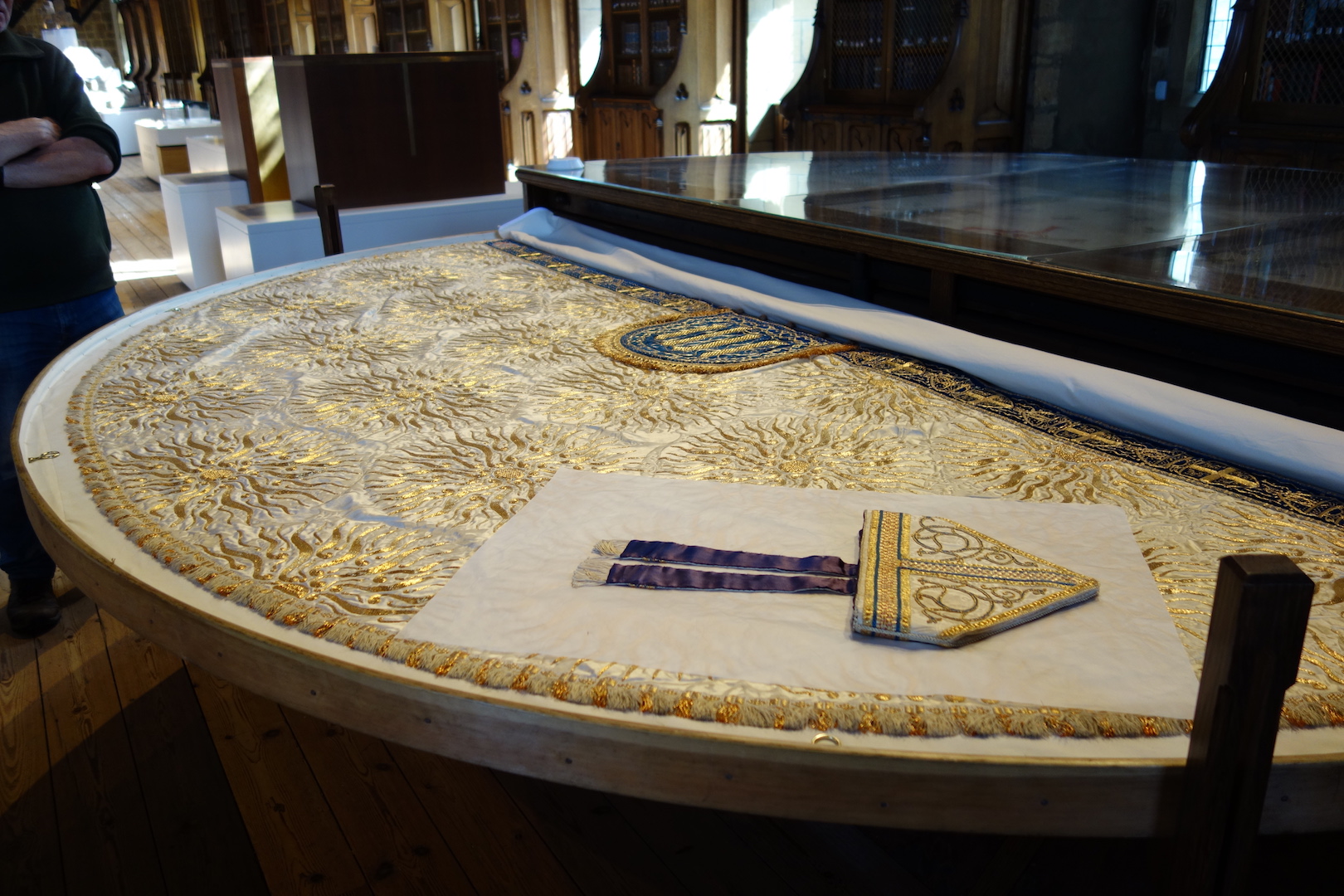 Cope and mitre made for the bishop of Durham for the coronation of Edward VII in 1902. Durham Cathedral. Photograph: Willem Vogelsang.We would like to thank Durham Cathedral authorities for allowing us to see these items, and in particular Marie-Thérèse Mayne (Durham Cathedral), as well as Lauren Moon-Schott, Tony King and Fiona Butterfield, for all their help while looking at these various pieces in the off-site storage facilities.
Gillian Vogelsang-Eastwood, 28 May 2023.