
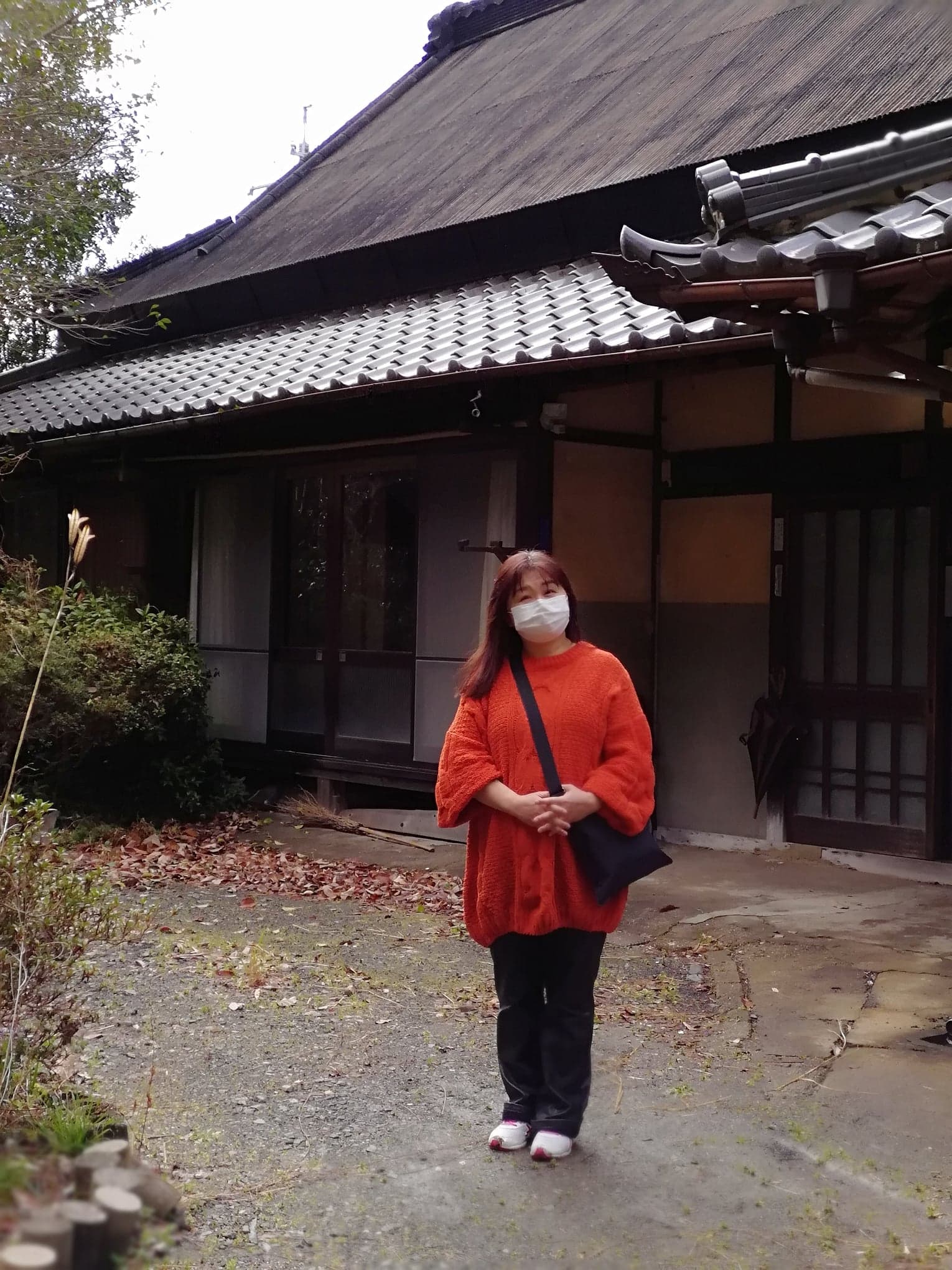
 Masako Noda in front of the now demolished ancestral home of her husband's family, March 2021.Between March and May 2021, I received a series of kimonos from my friend Masako Noda (née Shibata) after the demolition of her husband's grandparents' house on the outskirts of Nagoya, in the Aichi Prefecture. I have given these items to the TRC Leiden. Masako values traditional Japanese culture and kimonos and performs traditional dance and tea ceremonies in kimono, and therefore preferred these items to go to an institute that would appreciate the garments and present them to a wider audiencce.
Masako's own family is from the former samurai class in Okazaki. She married Tetsuji Noda, from a family of a former powerful landlord, village headmaster, and later, a city councilor. In the Edo period (around the mid-19th century) the Noda family’s contribution to local farming and to the local Owari Tokugawa domain was such that they were allowed to have a family name – this was very unusual as farmers didn’t normally have a family name and swords which were only for samurai.
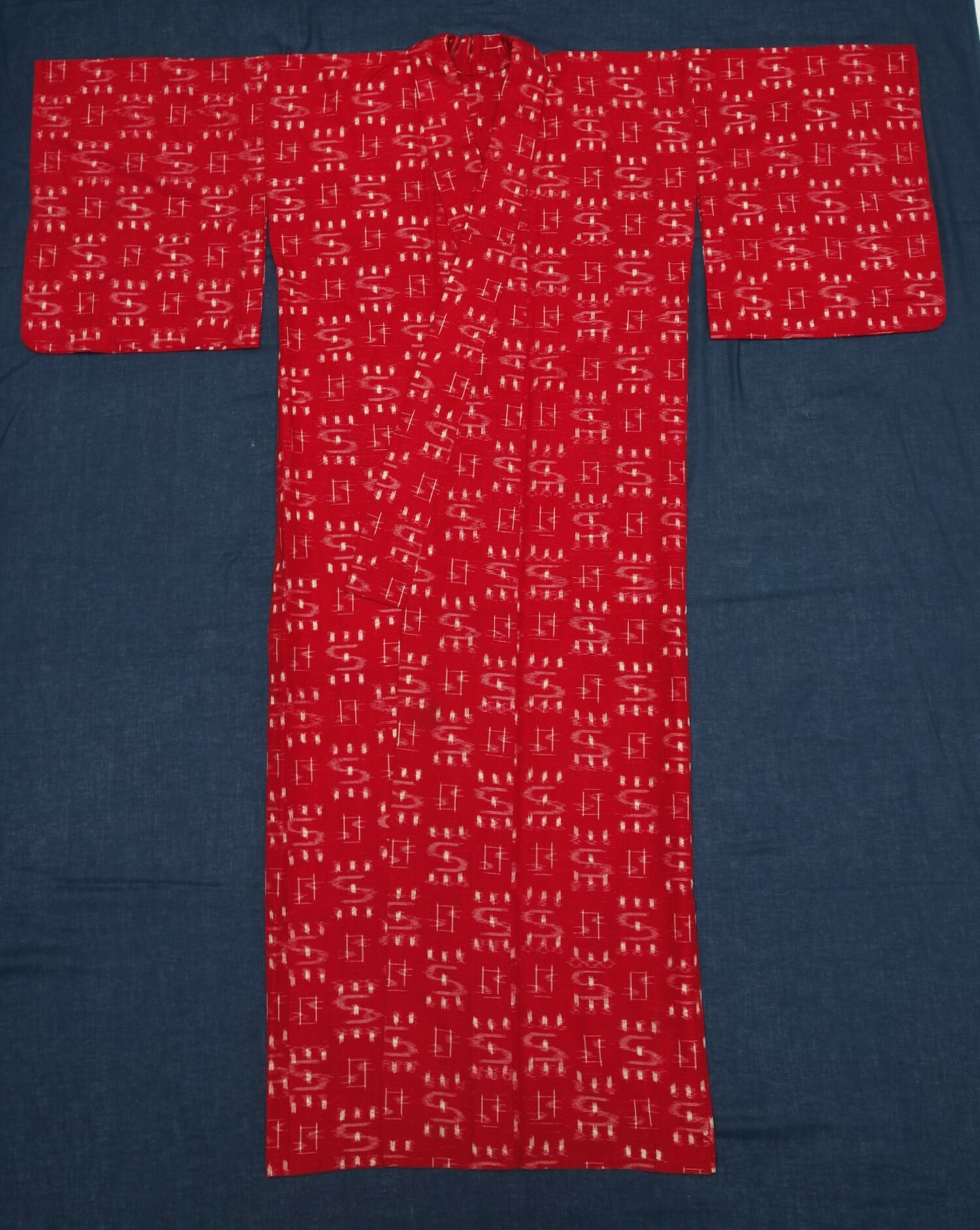 Casual, woollen kimono with a pattern typical for traditional cotton kasuri (ikat) garment (TRC 2021.2144).The Noda and Shibata family donations to the TRC includes kimonos from over three generations - ranging from children’s celebratory kimonos from the early 1900s through casual kimonos from the 1960s - 1970s. They reflect a traditional Japanese custom passed down through generations, the modern history of Japanese textiles and how people’s attitude towards kimonos changed or remained the same.
Below I want to focus on a number of kimonos that reflect the development in the style of these garments from the late 1950s to the 1970s (TRC 2021.2143 to TRC 2021.2148).
By the mid-fifties, a decade after the Second World War, the Japanese economy started to boom and more and more people moved from the countryside to cities and at the same time started to wear Western clothes on a daily basis. Wearing a kimono takes much more time than donning Western clothes, and a kimono requires special care to wear and store properly, something that did not fit with people’s busy, urban lives. Many of them did not even know or want to learn how to wear a kimono. The kimono industry struggled to find new customers.
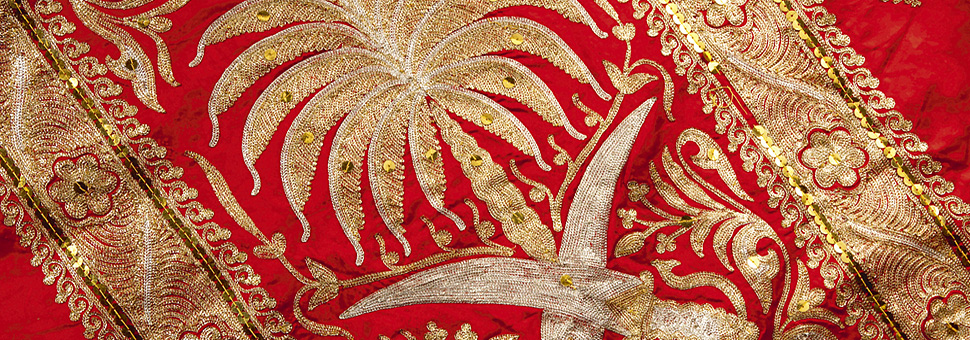
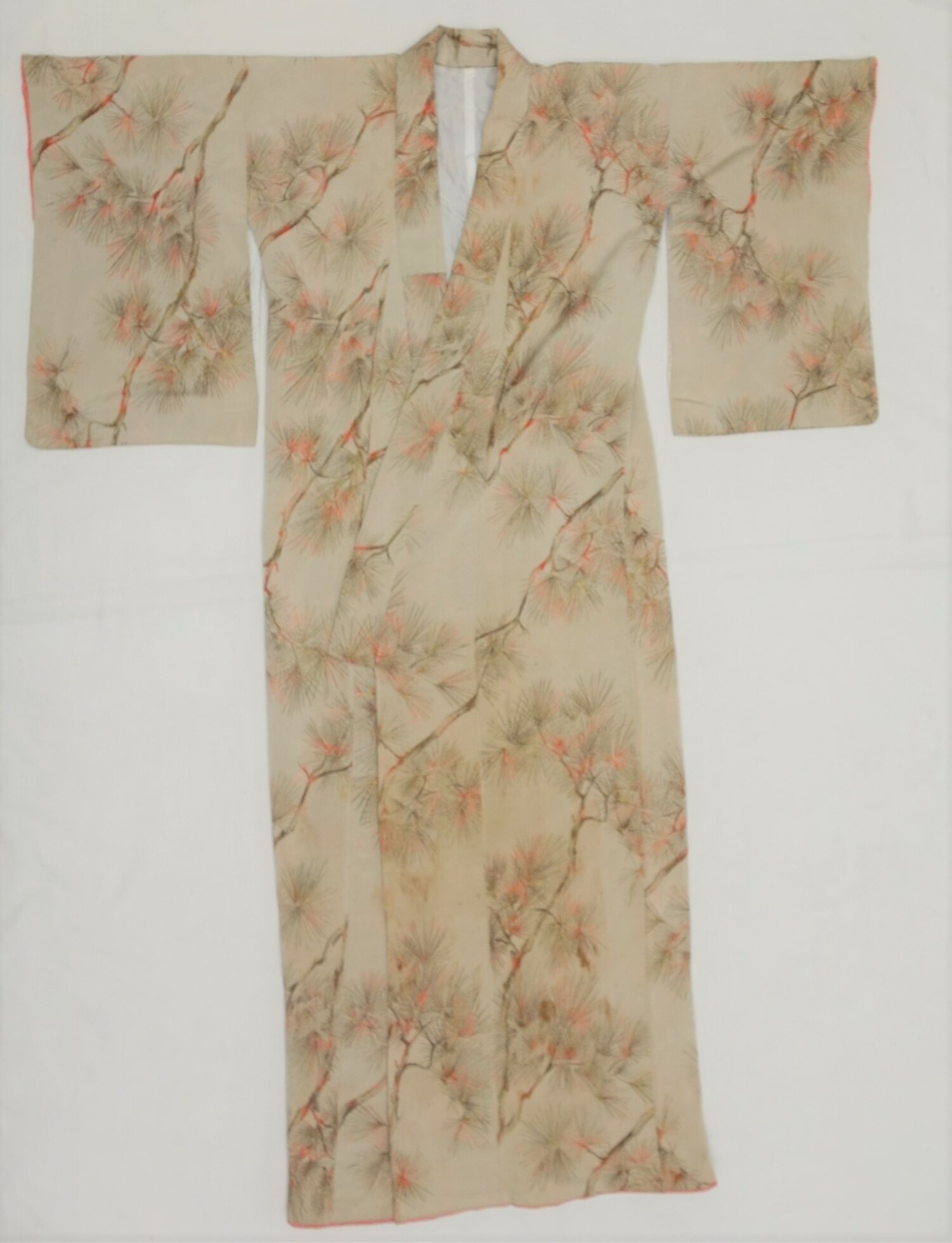 Casual Nishijin kimono, early 1970s, from silk and synthetic fibres, with metallic threads creating a Majolica Omeshi pattern (TRC 2021.2146).See also the attached photograph.A turning point was the imperial wedding between Michiko Shoda and Crown Prince Akihito in 1959. The bride wore a gorgeous furisode kimono, which is a formal garment with long sleeves to be worn by unmarried women. This in turn inspired young people to wear a kimono on special occasions, such as the coming of age ceremony and attending someone’s wedding parties. Still, most women could not put it on without assistance. So some women started to rent a kimono from special shops that also helped them to wear both the individual garments and accessories correctly. Some hairdressers also helped them with their hair to match kimono.
Majolica Omeshi kimonos
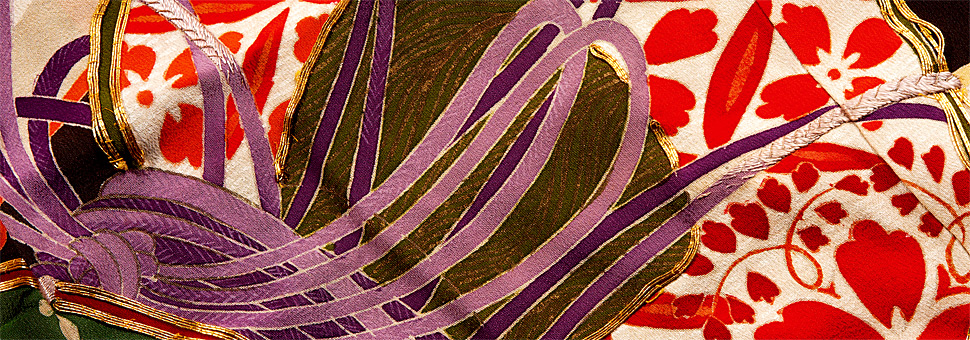
In 1959, the same year as the imperial wedding, kimono artisans in Tôkamachi, Niigata prefecture, started to produce Majolica Omeshi kimonos. ‘Omeshi’ is one of the most valued woven silk forms used for a kimono. Its weft is hard-twisted and starched first, which makes a crisp texture of the textile when woven, and the patterns are created by dyeing the weft threads prior to weaving (a form of ikat). The artisans incorporated exotic patterns taken from Western majolica porcelain into their design, using metallic threads as well as bright colours. This new form of kimono turned out to be a great success.
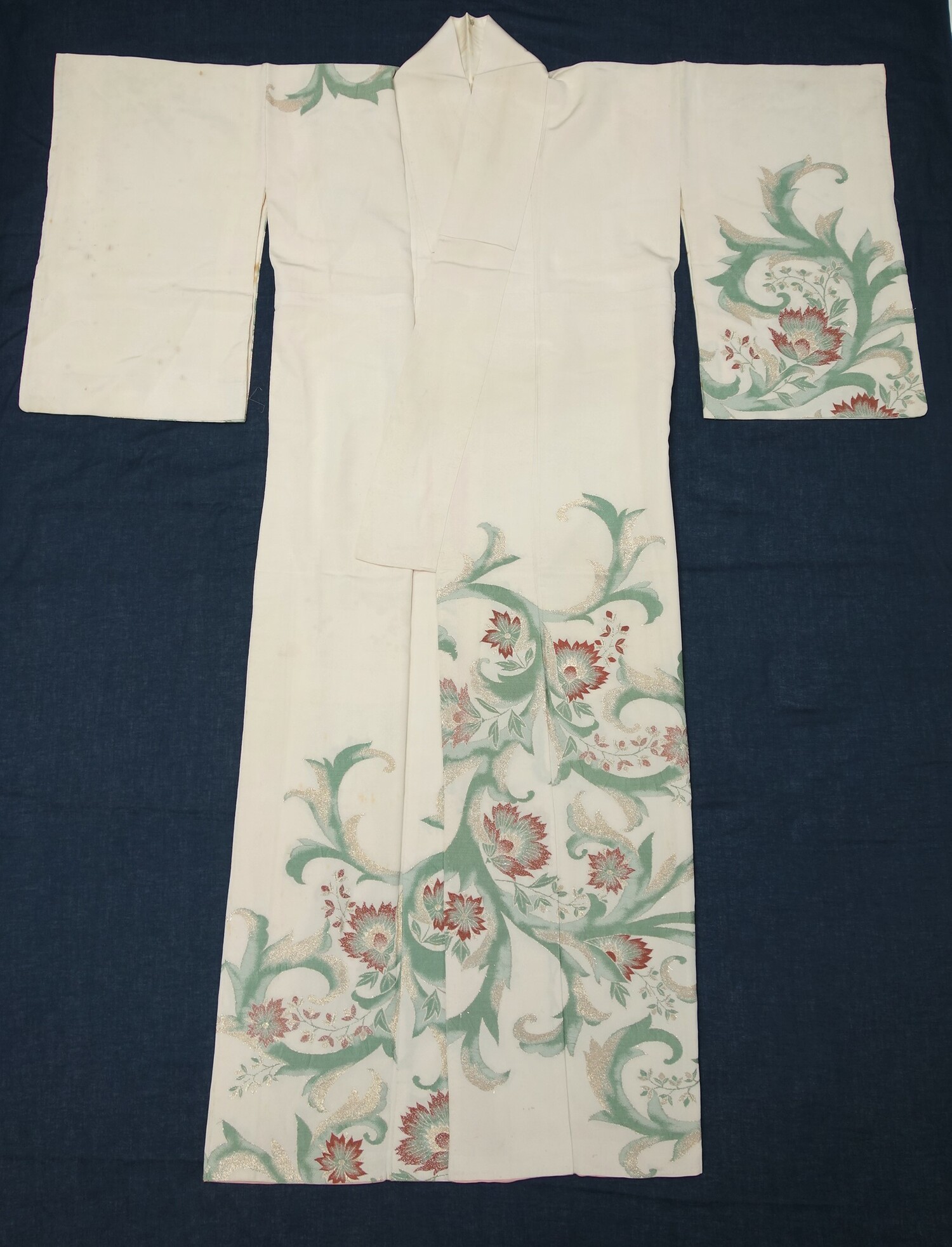 Silk kimono with Majolica Omeshi motifs, late 1950s (TRC 2021.2145).Maiolica (later anglicized to Majolica) dates from the mid-15th century and derives from Mediterranean countries including Spain, Majorca and Italy. It is a form of tin-glaze pottery with bright colours. During the 19th century majolica was made using both lead and tin glazes in order to produce a wide range of bright, hard wearing pottery items that were extremely popular and exported all over the world.
Chieko Noda (b. 1936) bought a Majolica Omeshi kimono for her wedding. Although she seldom wore a kimono, it was the custom for a newly wed to bring with her a complete set of kimonos in all varieties, and one of these has been donated to the TRC (TRC 2021.2145). Its condition is still pristine and it does not look as if it has been worn.
 Beaded bag with Art Deco design, 1950s-1970s, Japan (TRC 2021.0632).Following the popularity of Majolica Omeshi, similar kimonos were made in synthetic fibres, sometimes with traditional Japanese motives, while Nishijin artisans in Kyoto made such garments in silk, using metallic embroidery threads, although the lining was made with synthetic fibres to make the garments more affordable.
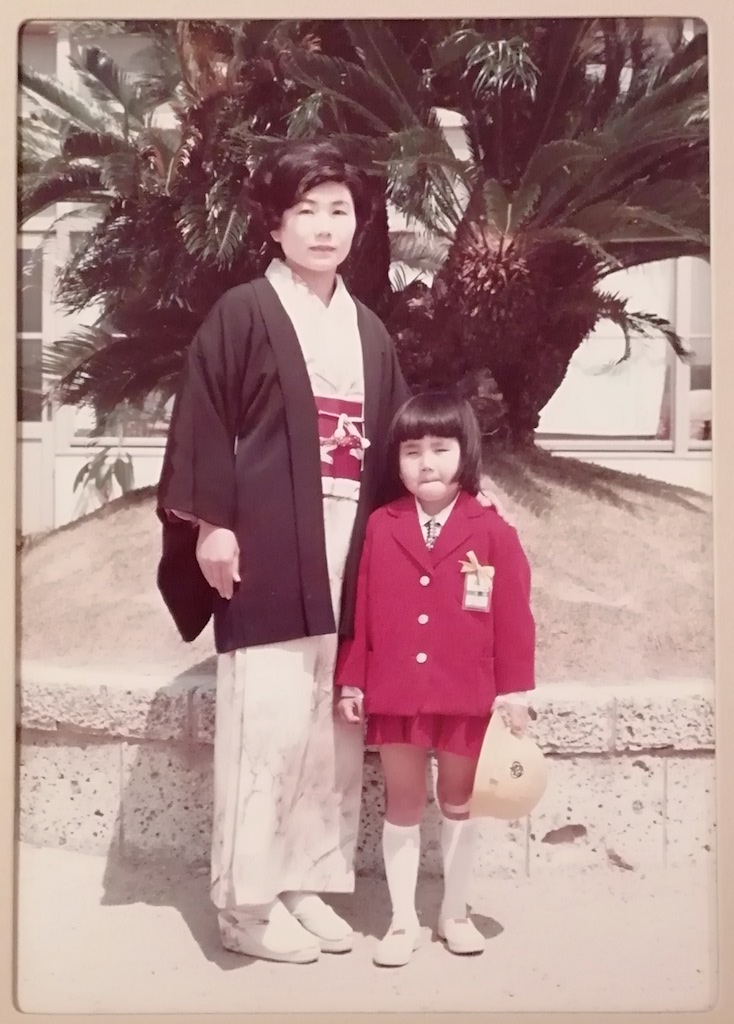 Masako and Kiyomi Shibata (wearing a Nishijin kimono TRC 2021.2146) on the day of Masako's primary school entry ceremony, Okazaki, Aichi prefecture, 1973.
Kiyomi Shibata (the mother of Masako Noda), who loved kimonos, acquired various such garments, including a Nishijin kimono with a pine-leaf pattern (TRC 2021.2146). This garment was part of a kimono set purchased for her wedding in 1964. Kiyomi wore this kimono again for Masako's school admission ceremony, along with the typical black haori (kimono jacket) for young mothers. These shiny kimonos were often accompanied by beaded bags, examples of which were acquired by the TRC sometime ago (see TRC 2021.0631 and TRC 2021.0632).
The production of silk Majolica Omeshi stopped in the early 1960s. Some say this was due to a massive number of the cheaper kimonos made from synthetic fibres, or the artisans became too busy producing Kuro-E-baori.
 Kuro-E-baori jacket, made of silk, Japan, 1960s-1970s (TRC 2021.2147).Kuro-E-baori
The Tôkamachi artisans also started to create Kuro-E-baori (a black patterned kimono jacket) in the early 1960s. The Kuro-E-baori jacket now in the TRC Collection (TRC 2021.2147) was owned by Chieko Noda and was worn on semi-formal occasions and has a family crest at the upper centre on the back. It was made in the same manner as Majolica Omeshi, with some shiny decorative yarns on a black background. They were a ‘must-have’ for young mothers to attend school events for their children and generally called the ‘PTA look’.
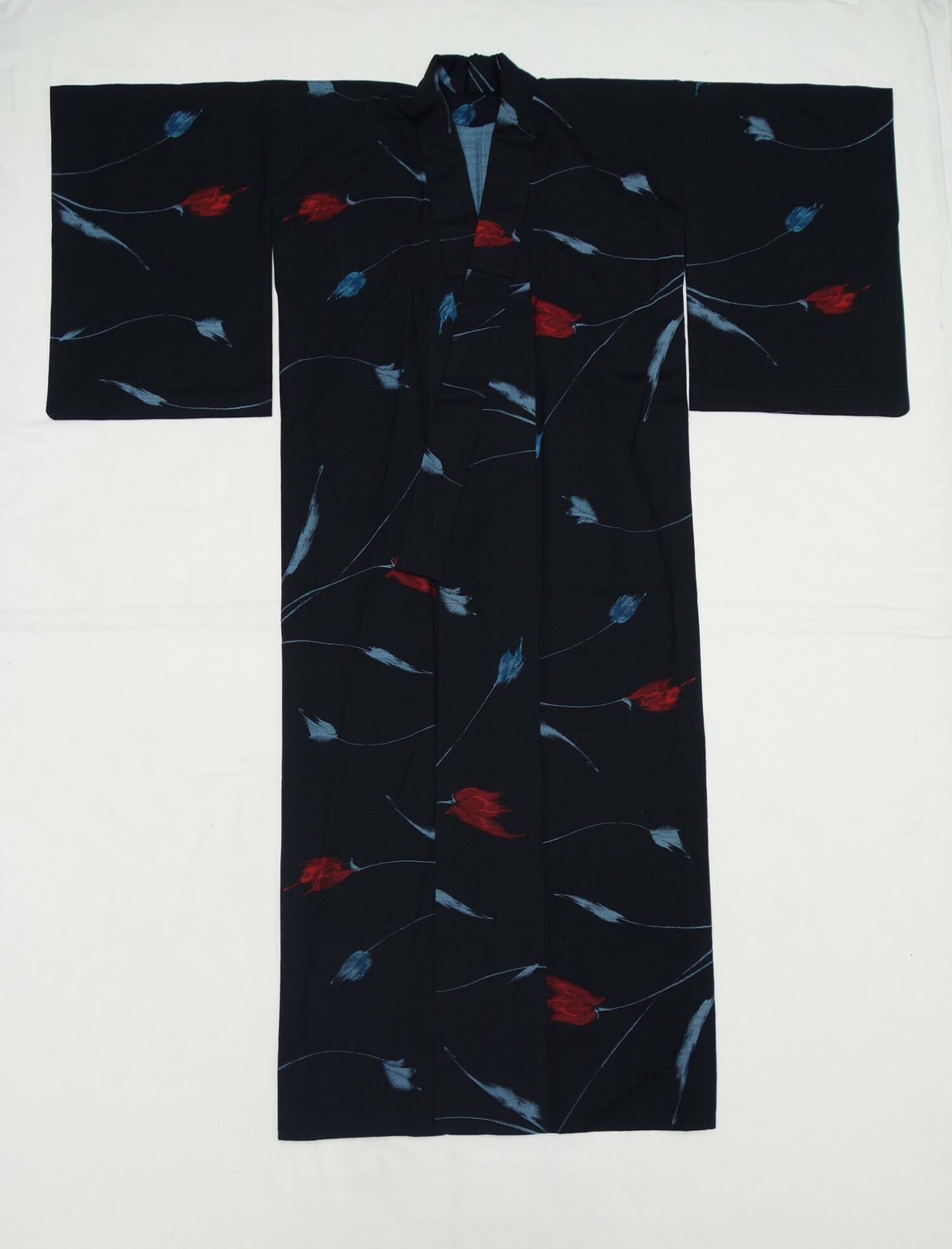 Woollen kimono, late 1950s, Japan (TRC 2021.2143).Woollen kimonos
Until the 1970s there were still people who wore a kimono on a daily basis. As their life became busier, around the 1960s and 1970s they came to regard a woollen kimono as being much handier. These garments were mass-produced in factories with beautiful colours, reasonably-priced, warm, and home-washable, while a silk kimono woven on a small loom by artisans was expensive and needed special care and cleaners.
Chieko Noda bought a woollen kimono in 1959 as part of her kimono set for her wedding (TRC 2021.2143). It has a modern design with tulips in red and blue on a black background, and the pattern was woven like tapestry weaving. As she lived close to the Bishu area, which is a centre of wool production, she could easily obtain such a garment. Even if she did not wear it, its design reflects her taste for Western culture.
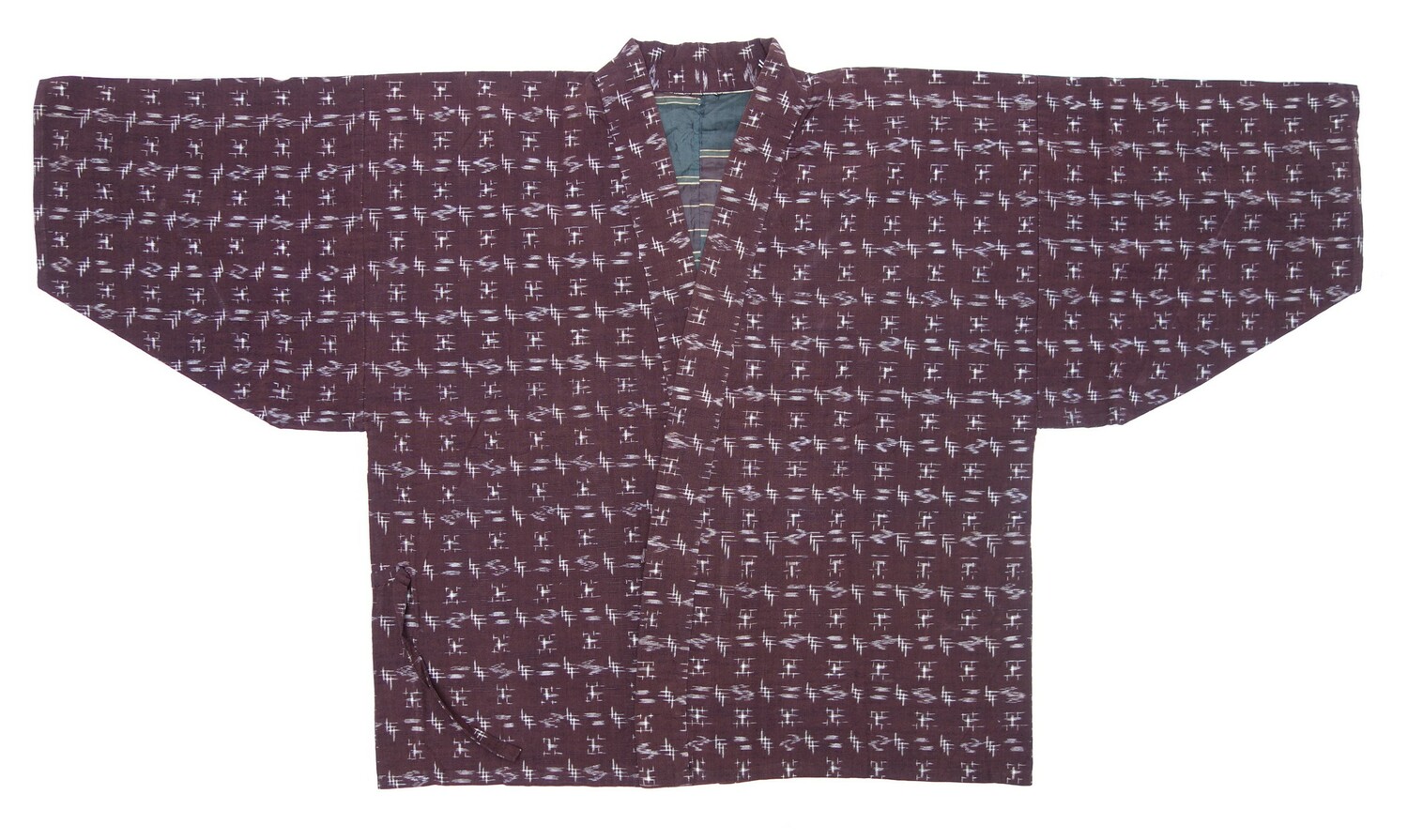 Cotton and silk women's jacket (haori) with ikat (kasuri) pattern, Japan, 1950s-1960s (TRC 2021.2148).On the other hand, Kiyomi Shibata bought a woollen kimono that has a typical Japanese ikat pattern (TRC 2021.2144) just like the traditional cotton kimono jacket donated by the Noda Family (TRC 2021.2148), although its colour was unconventionally bright red.
These donations reveal that the kimonos made in roughly the same period show a wide range of variations, reflecting different tastes and attitudes towards the traditional Japanese garment.
Naoko Kikuchi, 19 August 2021