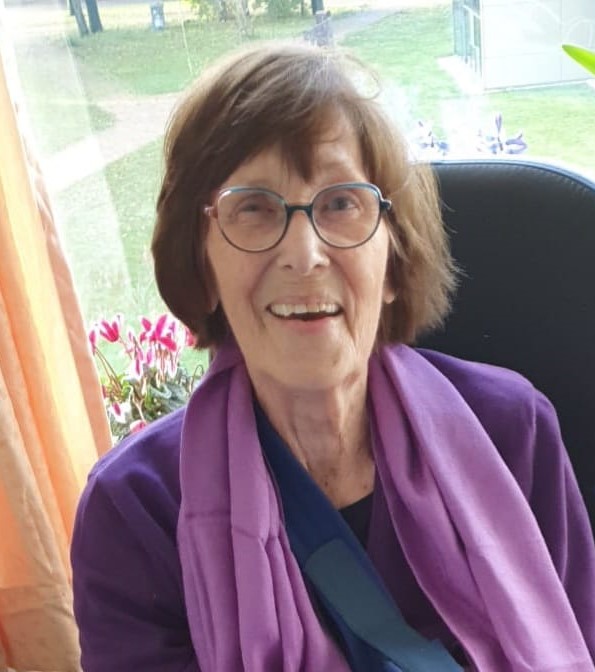
So said Miss Hutchinson, my needlework teacher at Bingley Grammar School, West Yorkshire, in the early 1970’s. Perhaps she was right, but textiles and trying to understand them and their sheer diversity have been the red thread (sorry for the pun) throughout my life. They have also been a motivating force behind the TRC as a knowledge centre for passing down textile skills, experience and knowledge in all the many forms of this huge subject.
 Sampler in ecru and blue with several techniques. Initials: "IS, HB, 1902 1903" in satin stitch. Worked by Henriëtte Slavekoorde-Braunstahl, 1903 (TRC 2017.0107).The words of Miss Hutchinson have been playing in my mind recently, thanks to several donations to the TRC of samples made by trainee needlework teachers from about 1900 to 1920. In particular there are the samples made by Henriëtte Braunstahl (1885-1983) from Den Haag, who was presented in 1904 with a diploma from the Industrieschool voor Meisjes (‘s-Gravenhage) as a handwork teacher.
A few days ago we were given samples of the work of Marie Koets, who took an exam for Nuttige Handwerken ('useful needlework') in 1913 and an exam for Fraaie Handwerken ('decorative needlework') in 1915, at the St. Pius-School in Amsterdam. These pieces will come online in the TRC Collection database over the next few weeks.
 Piece of black card with a sample of square network with darned and needle woven patterns using a thick, white thread. Worked by G.H.P. Wening, c. 1922 (TRC 2023.2805.023).There are also textile and garment samples made by Geertruida Henriette Pauline Wening, who trained as a needlework teacher at the Technische Hoogeschool, Delft in c. 1920.
The important observation that struck me when studying these samples, is the wide range of skills these would-be teachers had to learn and be good at. From knitting and mending a sock, to elaborate embroideries, and especially the stitching of marking and initials.
As noted above, many of these courses were divided into nuttig (useful, i.e. useful in a household situation for running, making and mending textiles and garments), for which a wide range of skills were needed, as well as courses for more decorative forms of needlework (fraaie handwerken). That was roughly the situation before the 1960s.
In contrast, Miss Hutchinson, of the wise words given above, was one of the first generation of needlework teachers who were taught that creativity was far more important than knowledge and skill. ‘Let's see what happens when you play/work with textiles, etc.’ Creativity was all important. Perhaps I was not artistic enough.
 Piece of black card with a sample of square network with darned and needle woven patterns. Worked by G.H.P. Wening, c. 1922 (TRC 2023.2805.022).On a wall in the needlework class room at Bingley Grammar School, she had three panels with decorative embroidery using a range of grounds and techniques, such as a panel with two machine embroidered and appliqué cats on a star ground.
She proudly showed them off as examples of her creative needlework and as a turning point from skill-based needlework to creative (artistic) needlework.
In those days, creativity was becoming more important than skill. And indeed, as could be expected, not long afterwards many schools stopped the teaching of needlework for girls as a useful life skill. You don’t need textiles, or even textile skills, to be creative, do you?
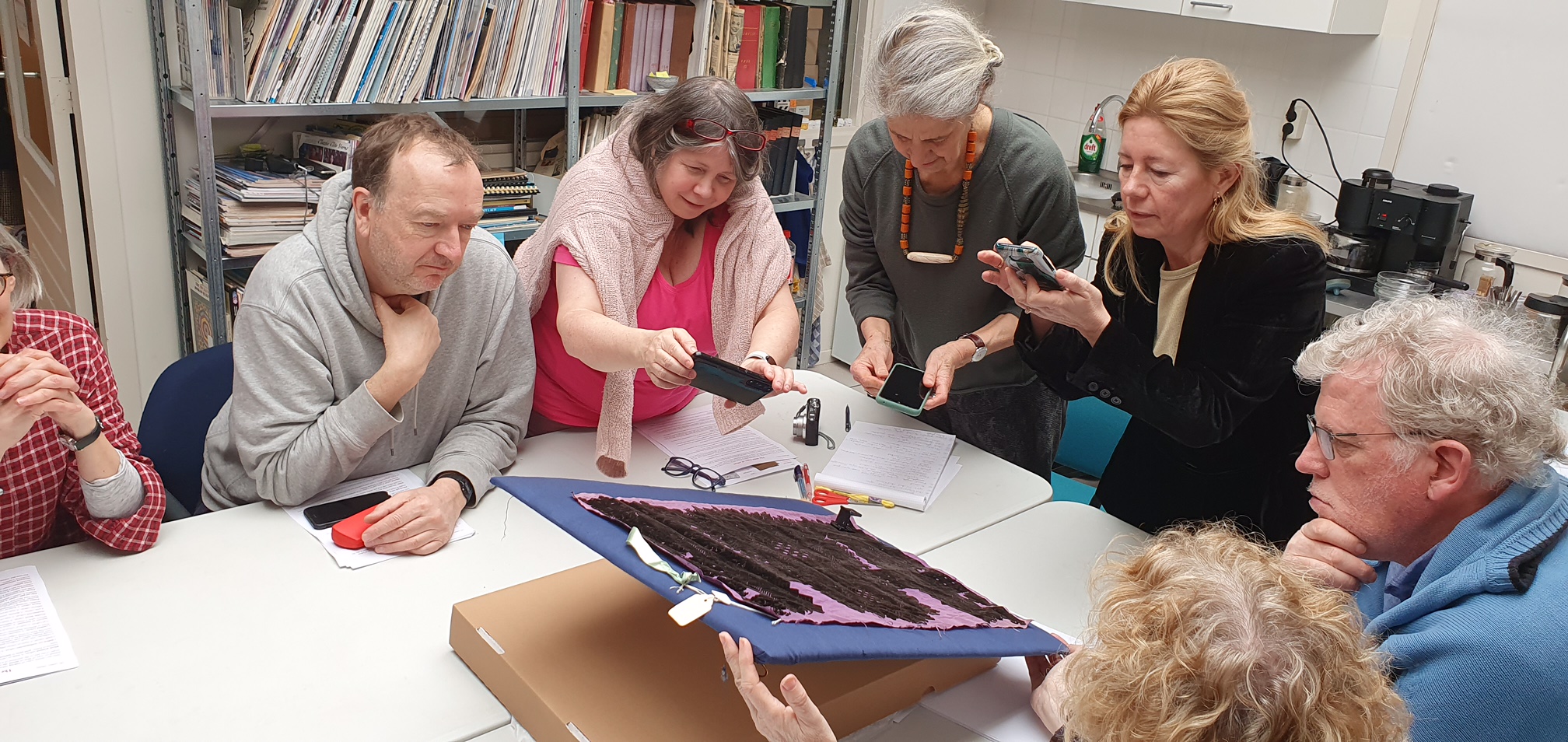
 Example of an appliqué with machine embroidery. From McCall's 'Needlework Treasury. A Learn and Make Book' (1964).At the TRC, fortunately, we notice that this situation is slowly changing, and during the last week, for instance, we welcomed three very different groups that discussed with us the need of textile skills. The simple conclusion was that, if you know the basic techniques and skills, the (artistic) end product (whatever it may be) will be much better!
Oh yes, some years later I found the appliqué cat panel in Miss Hutchinson's class room back in McCall's Needlework Treasury. A Learn and Make Book (1964). Miss Hutchinson had simply copied it……
Gillian Vogelsang-Eastwood, Director TRC, 19 March 2024.


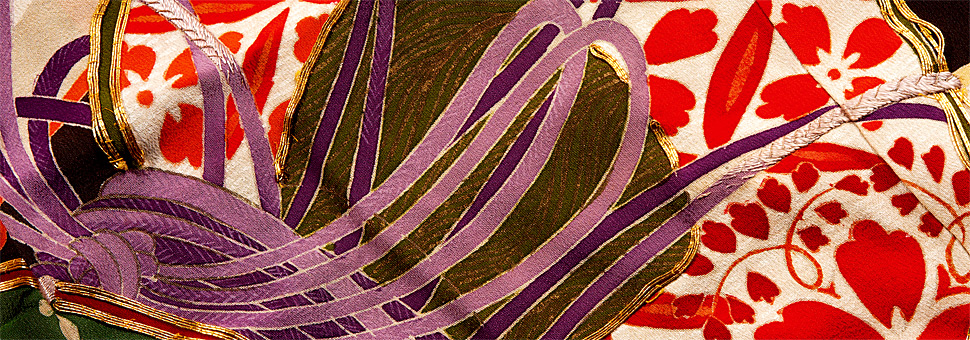
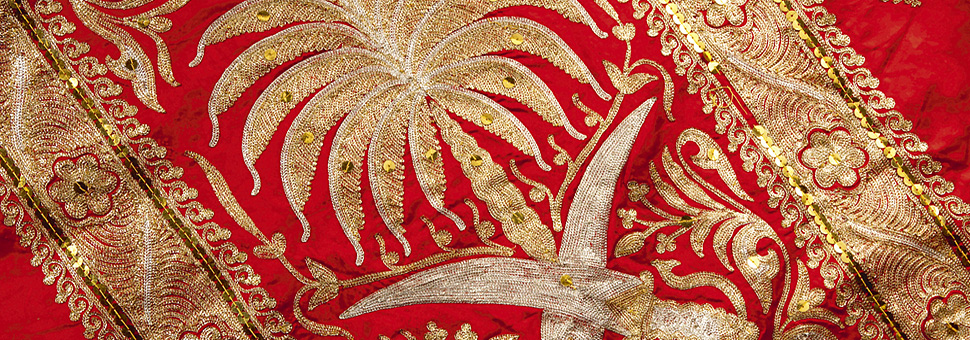

 Quilt with an appliqué design of large, stylised flowers and leaves in various materials. USA, 1850s-1860s (TRC 2019.2402).