
by Hanke van Prooije, TRC volunteer
Not many items in the TRC collection are as easy to date as this pair of socks from 2019, illustrated below (Figs. 1-2). The cuff detail with the year of knitting, but also the initials of the wearer are a famous feature of the Sanquhar design.
 Fig. 1. Pair of Sanquhar hand knitted socks, 2019 (TRC 2019.0274a-b).
This small town in the Lowlands of Scotland (Dumfries and Galloway) has been famous for hand-knitted items with a distinctive grid pattern since the end of the 18th century. The two-colour pattern is mostly used for stockings and gloves, but has also been applied to scarves, jumpers, hats and other items.
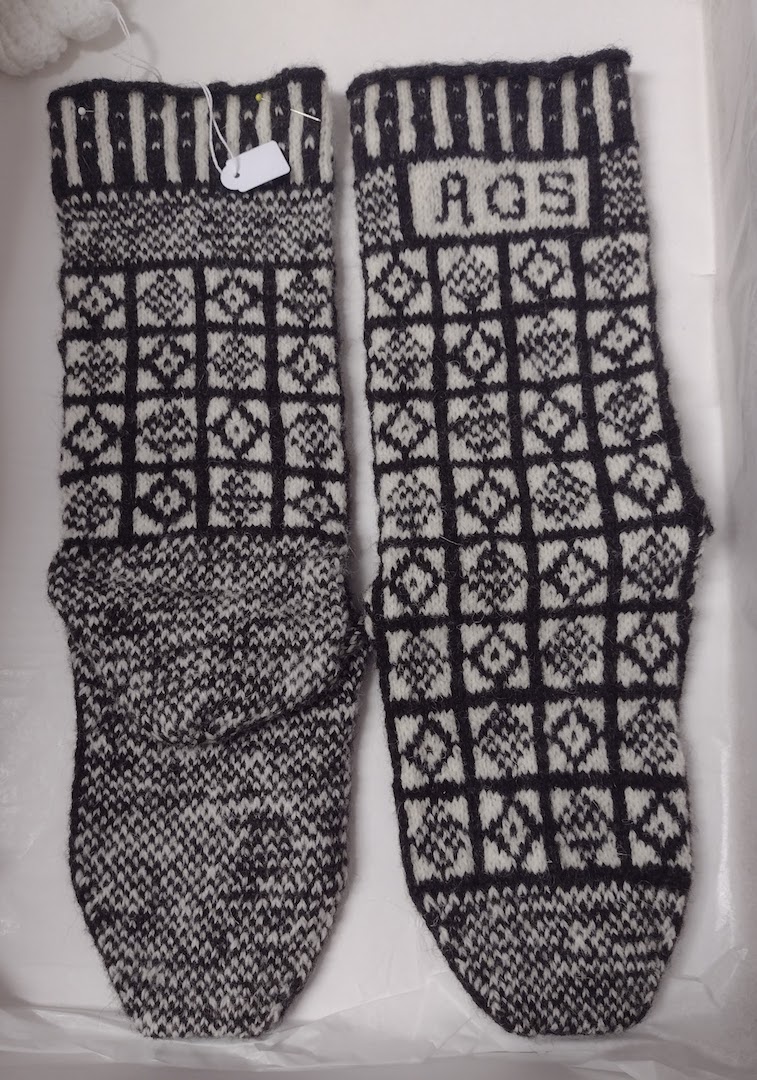 Fig. 2. Hand knitted Sanquhar socks, showing the initials of the wearer (TRC 2019.0274a-b).
The grid of 11 by 11 stitches is always the same, but there are variations within the squares. The diamond shape in this particular pair of socks is called the Duke, most likely named after the Dukes of Queensberry and Buccleuch, supporters of the knitting industry in Sanquhar.
Other variations include the Cornet and Drum (diamonds and hour-glass shapes against a speckled background), and the Prince of Wales.
Hand-knitted items from Sanquhar were almost always meant to be sold, rather than made for personal use: knitting was a way to earn money. In 1807, a local printer, Thomas Brown, wrote in his 'Union Gazetteer for Great Britain and Ireland':
The principal articles manufactured, are carpets, coarse serges, knitted stockings and mitts. The stocking trade is the oldest, and was formerly more considerable than at present, though the fabric is both curious and serviceable and almost peculiar to the place. The knitters, by the dexterous use of two threads, produce a substance resembling an outside and a lining. Most of the stockings are parti-coloured, and of great variety of patterns.
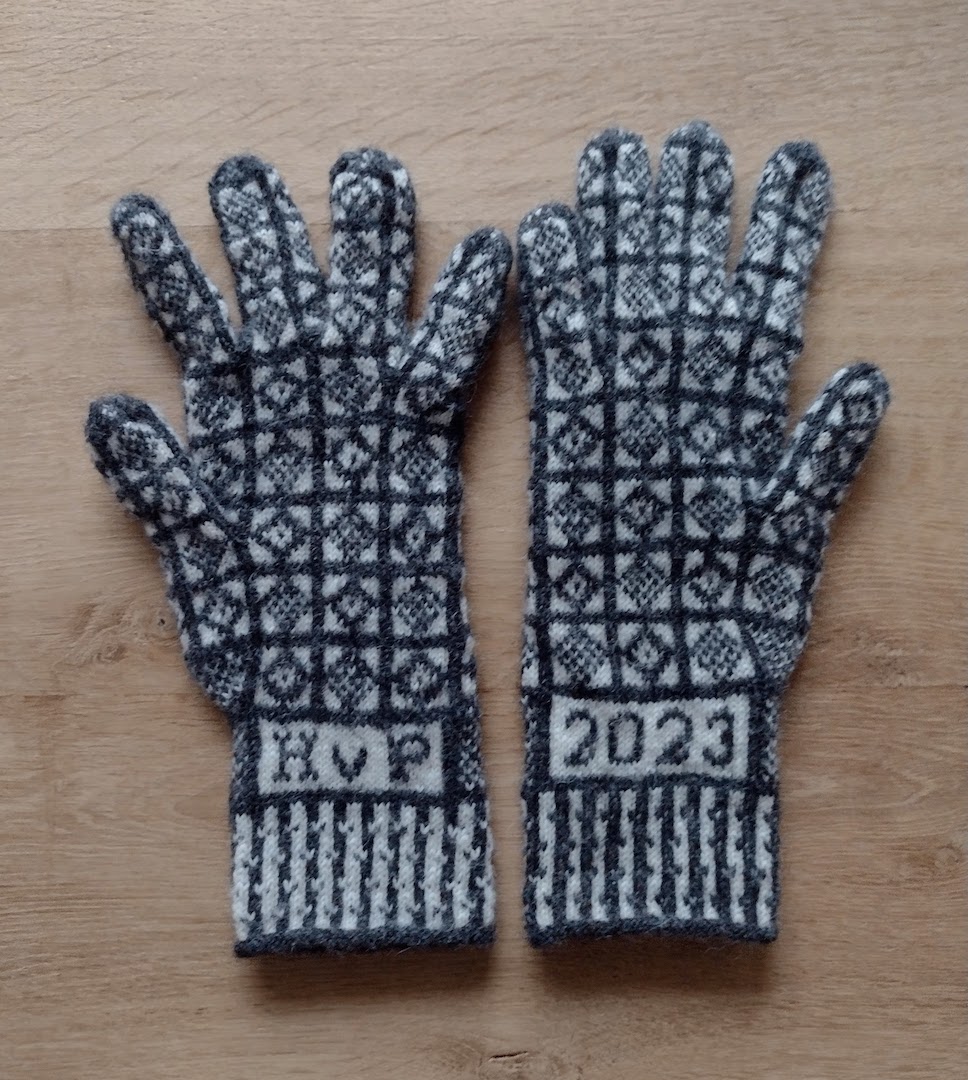 Fig. 3. Pair of Sanquhar gloves, hand knitted by the author, 2023.In Sanquhar, this cottage industry of knitted fabrics continued well into the 19th-century.
By that time, however, knitting machines were becoming more common and were outcompeting hand-knitting crafts. Perhaps this is why gloves became the main hand knitted product. Gloves, especially with intricate patterns, were more difficult to replicate by machine, and the personal touch of the initials and date on the cuff made Sanquhar gloves unique.
There were no written patterns for the Sanquhar style until the 1950s. Before that, the knowledge of how to knit them was passed on from knitter to knitter. However, the publication of patterns brought more attention to Sanquhar, and the patterns gained worldwide fame over time.
I knitted a pair of Sanquhar gloves in 2023 (Figs. 3-4). The gloves are traditionally knitted on double-pointed needles with one strand of yarn held in each hand. Using two strands of yarn results in a thicker fabric, because the yarn that is not used is kept stranded behind the knitted work. Even with the thin yarn used to obtain the fine gauge for these gloves, the end result is a warm pair of gloves.
 Fig. 4. The same gloves photographed inside out, to show the floats.The Sanquhar design started out as a distinctly regional pattern, but is now reproduced all over the world. The international knitting database Ravelry currently has 1530 projects with the tag ‘Sanquhar’. I first encountered Sanquhar gloves here, and borrowed the cuff pattern for my gloves from a Ravelry user based in Japan.
This begs the question: how the socks in the TRC collection should be classified: as a Scottish pair of socks? Or as Western, or in my case, as Japanese?
The socks discussed here (TRC 2019.0274a-b) were made in the Netherlands and were part of the 2019 TRC exhibition on socks and stockings. Although the pattern originated in Sanquhar, its fame means it is now knitted all over the world.
Originally, the accessories from Sanquhar would have been made with local yarn from Scottish sheep, but this is probably rarely the case for the 1530 Sanquhar projects on Ravelry. In the end, we decided to classify these socks as Western.
Read more about Sanquhar knitting here:
- https://sanquhargloves.centerforknitandcrochet.org/
- https://www.futuremuseum.co.uk/collections/life-work/key-industries/textiles/sanquhar-knitting
24 February 2025.