
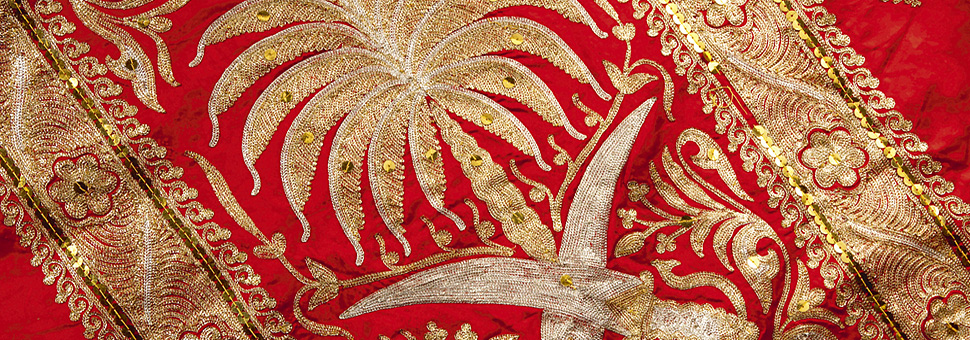

 Sample of a weft-faced compound tabby weave, Egypt, late 20th century (TRC 2005.0044).The history of compound weaves is complex and intriguing, and reflects ancient contacts along the Silk Road as far back as the early first millennium AD. A silk, warp-faced tabby was first developed in China in the first millennium BC, and was adopted and adapted to local needs and technologies in Central Asia. The 'new' version that emerged was a weft-faced tabby, which quickly spread to Iran and the Middle East, where it is still being produced.
This thesis focuses on the weft-faced tabby weaves (taqueté). The weft-faced tabbies are, and were mainly made in wool, or wool and linen, and used for domestic purposes, such as cushions, curtains, mattras covers, etc. The thesis was completed in 1988 by Gillian Vogelsang, Director of the TRC in Leiden.
Title: The Development and Spread of Compound Weave Textiles, with Particular Reference to Weft-Faced Compound Weave Textiles in Wool from Egypt. A thesis submitted in 1988 to the University of Manchester for the degree of Ph.D. in the faculty of Arts, by G.M. Vogelsang-Eastwood.
Part 1 >> (PDF 11 MB)
Part 2 >> (PDF 11 MB)
Part 3 >> (PDF 100 MB)
Part 4 >> (PDF 200 MB)
The information contained in this thesis may be freely downloaded and used. We would appreciate mentioning the source of the information.