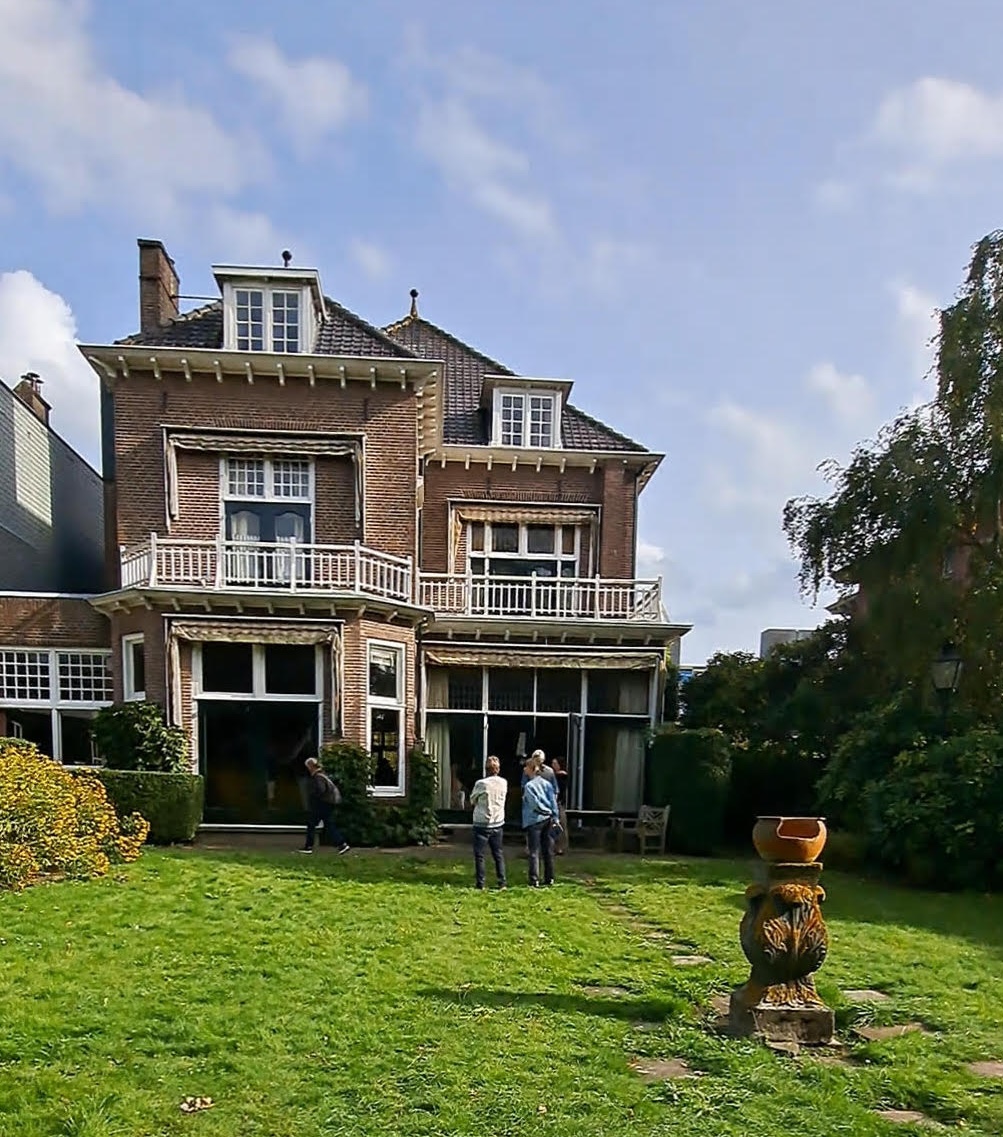
 Fig. 1. Boerhaavelaan 6 as seen from the garden. TRC plans to use part of the garden to grow textile-related plants, in cooperation with the Leiden University Botanical Gardens. Photograph Willem Vogelsang, 2025.In April 2026, the Textile Research Centre (TRC) moved from its former address along the Hogewoerd in the centre of Leiden, into a new 'home'. It is an early-twentieth century urban villa just behind the main Leiden railway station (Fig. 1). The house, at Boerhaavelaan 6, was occupied by the same family for more than one hundred years.
The last resident, Mrs Hélène Nauta-Barge, lived there for her entire life, almost uninterruptedly, until she died in 2023, aged 99. Since then it has become the property of the Stichting Monumentenbezit, which now rents it out to the TRC upon the recommendation of Leiden City Council,
 Fig. 2. Statue of Herman Boerhaave, since 1931 standing at the beginning of the Boerhaavelaan. Photograph Creative Commons.The house has a fascinating background and reflects the rich, and sometimes turbulent history of Leiden.
At the TRC we are fortunate to work in this beautiful building, and we are also pleased with the help of the Nauta-Barge family when learning about the history of the building and its former occupants.
Herman Boerhaave
The area where the house was built used to be part of the municipality of Oegstgeest until 1896, when it was added to Leiden. This explains the original name of the street, laid out in 1906, namely the Oegstgeesterlaan, which allegedly was given to the new street in recognition of the area's history.
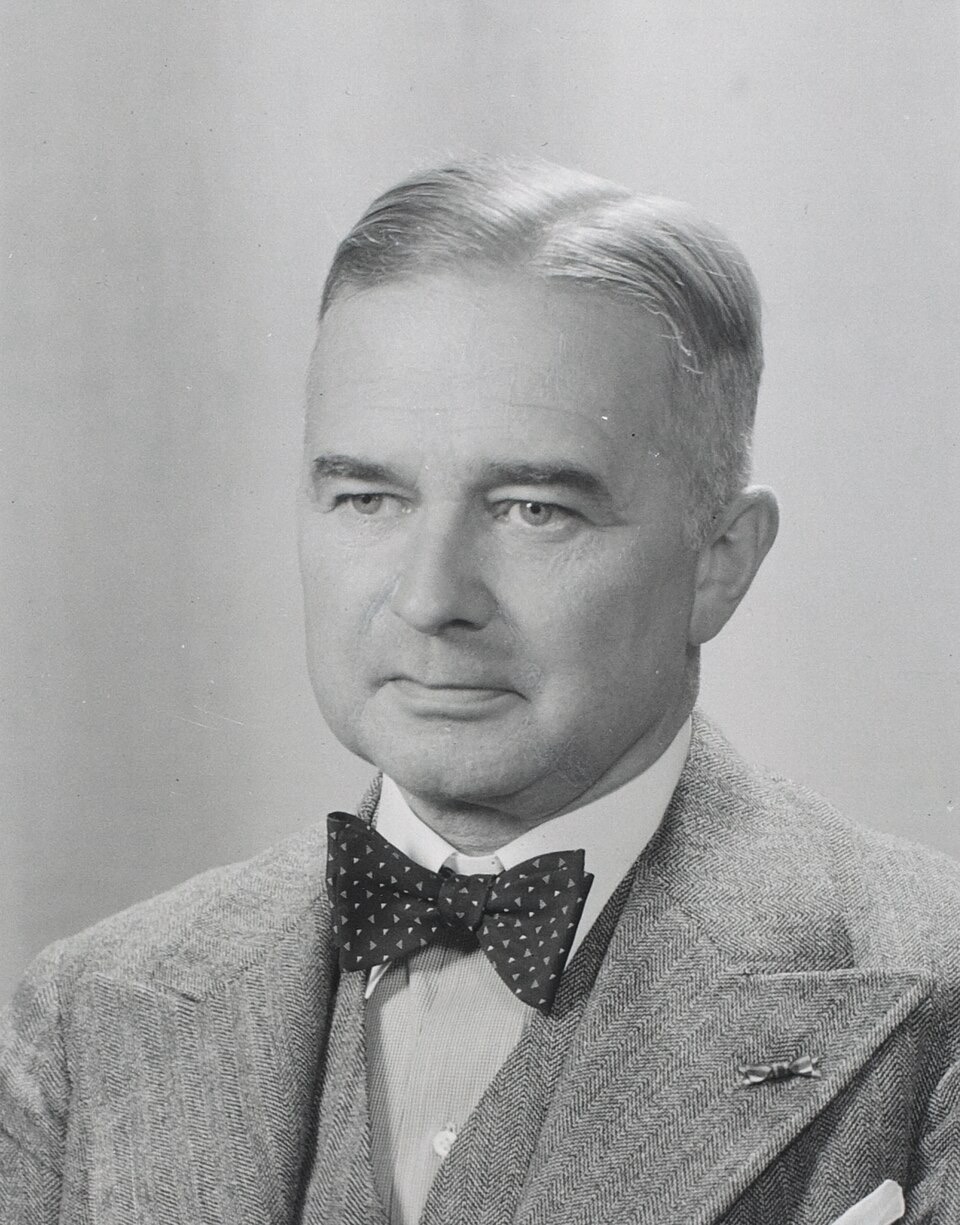 Fig. 3. Prof. Joannes Antonius James (Ton) Barge (1884-1952). Photograph public domain.The street received its current name in 1931, after a statue (Fig. 2) of Professor Herman Boerhaave (1668-1738), a famous 17th and 18th-century botanist, chemist, and physician at Leiden University, was placed at the beginning of the street, opposite the new academic hospital (which had opened in 1928) and some fifty metres from Boerhaavelaan 6.
Previously, the statue had stood at the entrance to the former academic hospital (opened in 1873), the same building which in 1937 opened its doors again as the Rijks Ethnografisch Museum, now known as the Wereldmuseum.
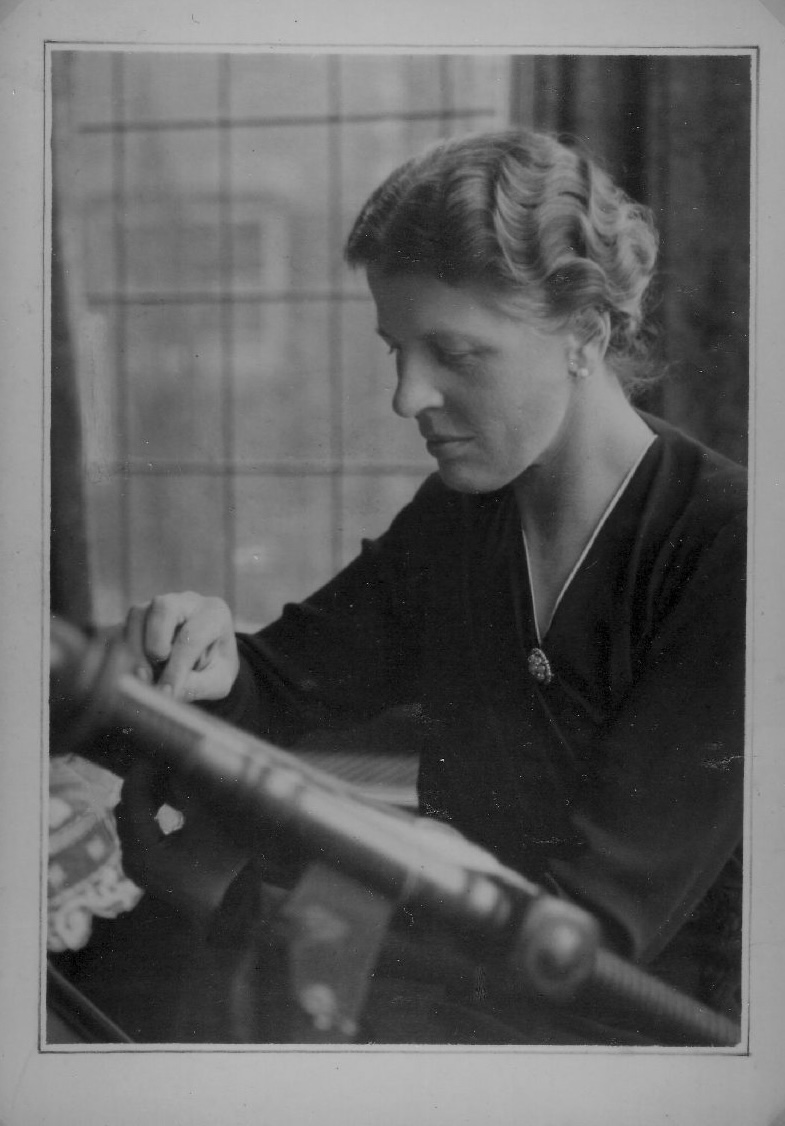 Fig. 4. Theresia (Thérèse) Antoinette Maria Barge-Dreesmann (1893-1991) in c. 1939, working on an embroidery frame that is still in the house. Photograph courtesy Nauta-Barge family.Early occupants
Boerhaavelaan 6 was designed around 1909 by architect Willem Fontein (1864-1949) for Mr. P.J. van Hoeken, a timber merchant. However, his wife apparently did not like the house and its location.
They moved out, and in 1920 the property was purchased by the young Professor Ton Barge (Fig. 3), who the previous year had been appointed as Professor in Anatomy and Embryology at Leiden University. He was born in Semarang, in the Dutch East Indies, as the son of a coffee merchant with an English ancestry (Manchester).
In the same year that he accepted his new position at Leiden University, he married Theresia (Trees) Dreesmann (Fig. 4), daughter of Anton Dreesmann (1854-1934), the co-founder of the Vroom & Dreesmann chain of department stores (V&D).
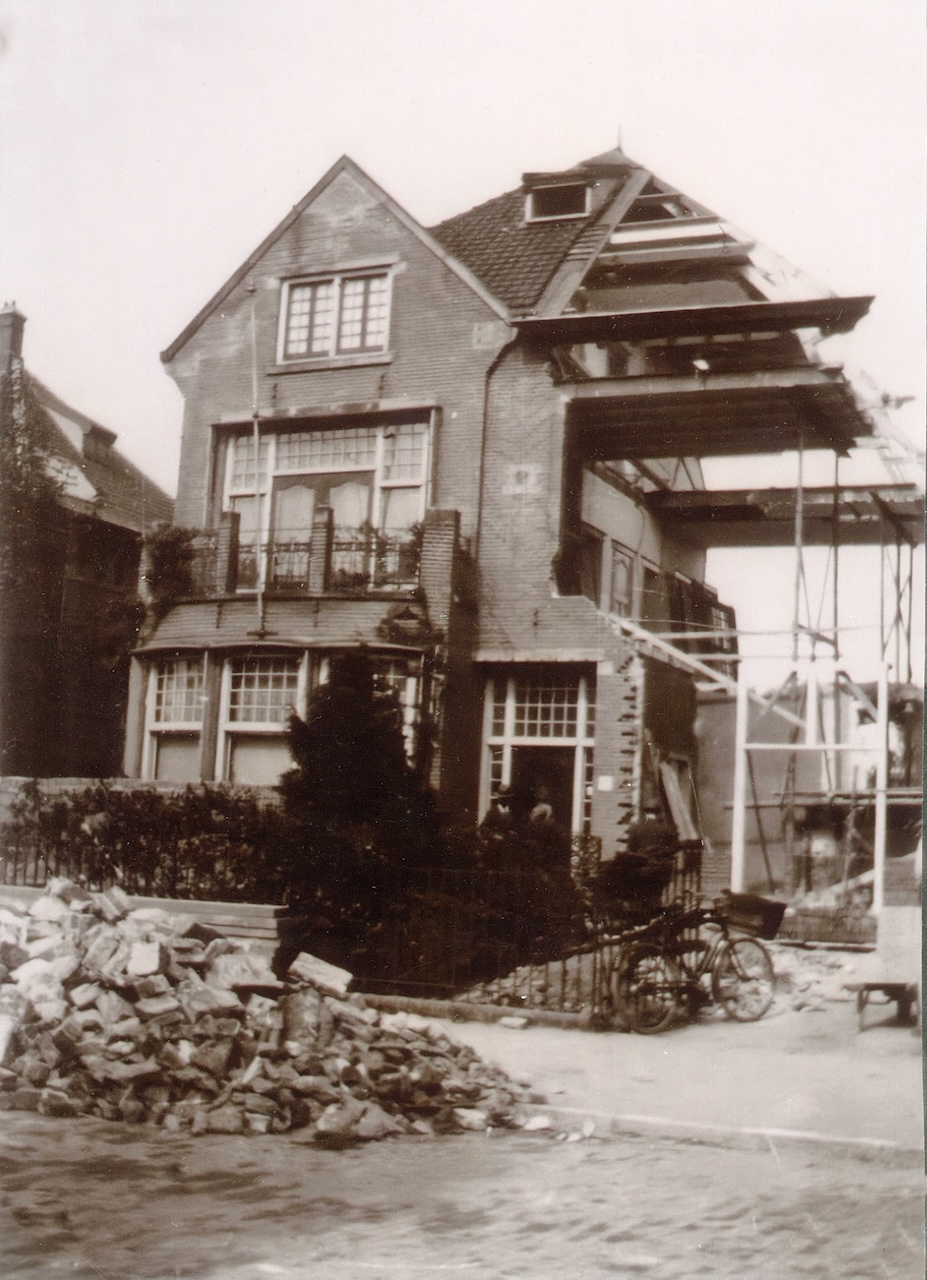 Fig. 5. The house being expanded, 1926. Photograph public domain.Shortly after buying the property, Barge commissioned the architect Hendrik Jesse (1860-1943) to considerably expand the house (Fig. 5). The work was completed in 1926.
The house
Members of the Nauta-Barge family told us that before the war the interior of the house was very classic, featuring many antiques and presenting a distinguished appearance (Fig. 6). The house was well-organised and spaciously laid out. The kitchen and utility room were the domain of the kitchen maid and chambermaid.
Many of the walls were covered with a wooden frame that supported a jute cloth and layers of paper. This type of wall covering (betengeling in Dutch, often referred to as battening or batten work) was widely used in Holland and beyond until the mid-20th century. The betengeling is still extant in many places, including the large ground floor rooms, but had to be drastically restored last year in the small ground floor room at the front. Actually, this work was used and filmed by the decorators to preserve the knowledge of this old technique. Various layers of the betengeling are intentionally left exposed, in order to show TRC students and others this technique.
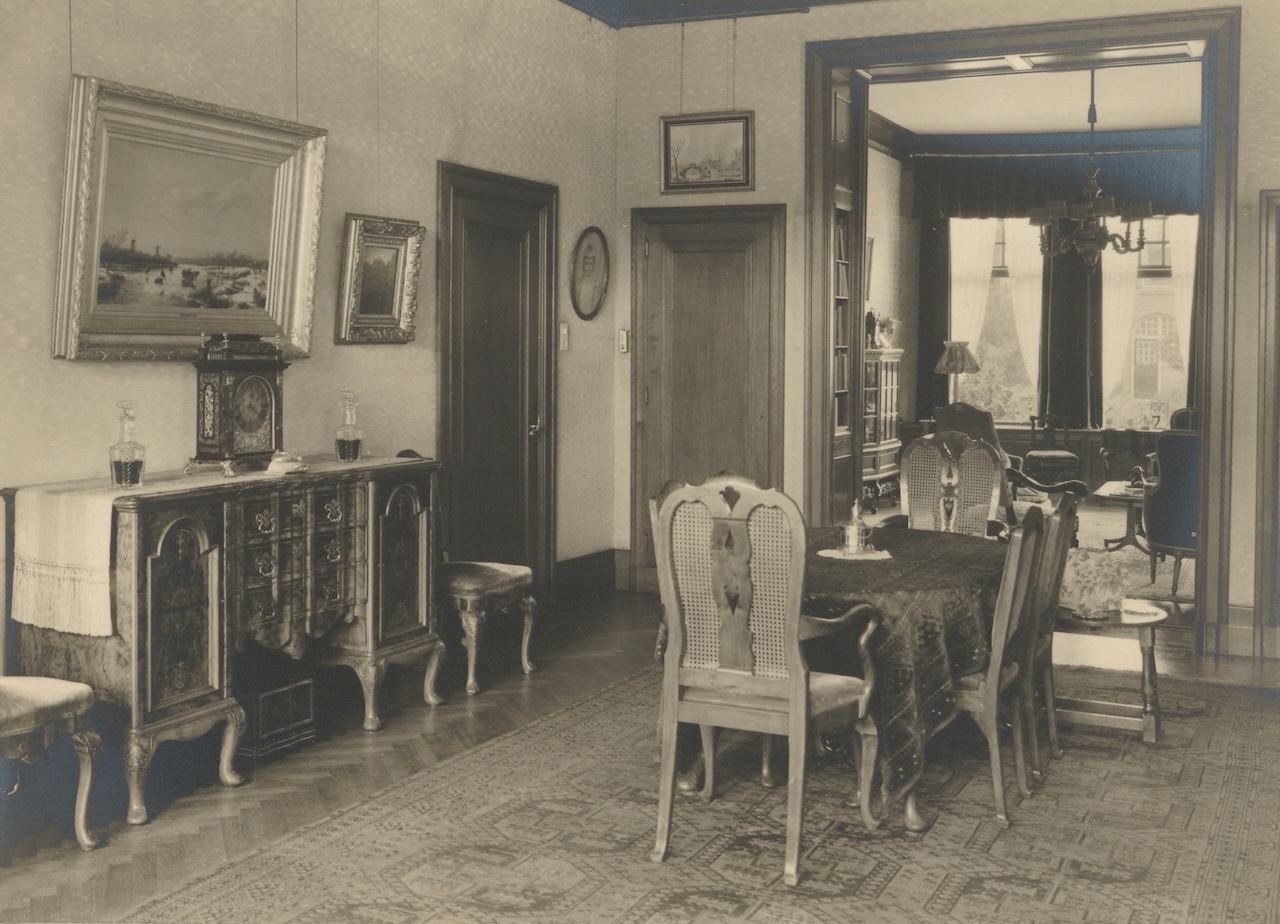 Fig. 6. Dining room of Boerhaavelaan 6. Beyond the partition is the sitting room. Photograph courtesy Nauta-Barge family.
Until the 1950s, a central bell board indicated in which room a bell had been rung. In the post-war period however, things changed, the number of people living in the house increased and the kitchen became the centre of family life.
The house still has a large garden, and at the back there is a garden pavilion (Figs. 7 and 8). This charming little, wooden construction originates from Amsterdam. It allegedly dates to the mid-19th century and until 1903 stood on a bridge across the Singel, between de Leidsestraat and Heiligeweg (near the Koningsplein).
 Fig. 7. The garden pavilion, originally from a bridge across the Singel in Amsterdam, now in the garden of Boerhaavelaan 6. Photograph: Willem Vogelsang 2025.
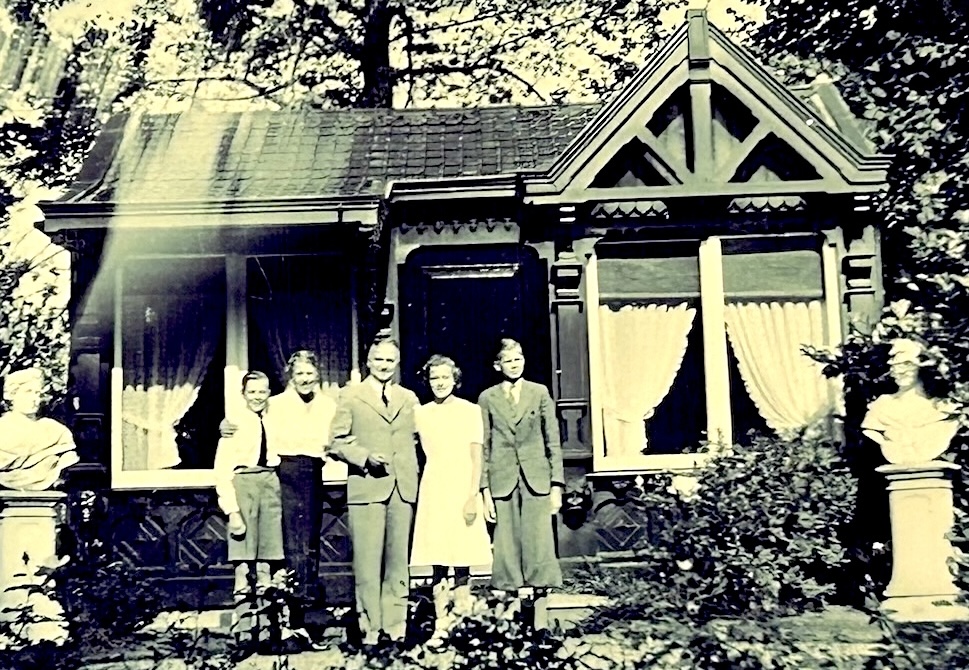 Fig. 8. Photograph taken in August 1939 in front of the garden pavilion in the garden of Looverhof, Anton Dreesmann's villa in Bussum. From left to right: Fred Barge, Thérèse Barge-Dreesmann, Ton Barge, Hélène Barge and Jim Barge. Photograph courtesy Nauta-Barge family.
The owners sold waffles under the canopy and slept in the tiny attic. When the bridge was widened, the pavilion was taken down and reconstructed at Anton Dreesmann's villa ('Looverhof') in Bussum, at the back of the garden. After the war it was moved to Leiden where it still stands.
Life at Boerhaavelaan 6
Prof. Ton Barge, according to the grandchildren, was an amiable and remarkable man. In 1927, with four of his university friends, he founded a walking club, ‘de Beentjes’, which met each week (Fig. 9). Actually, this informal walking club still exists (their bulletin is called 'Op pad met de Beentjes').
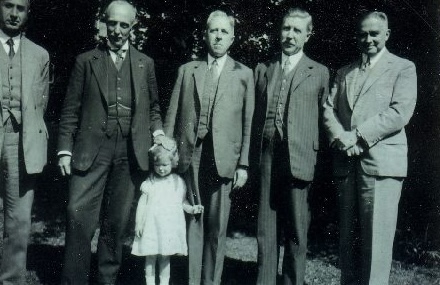 Fig. 9. "De Beentjes." A group of Leiden professors that met for a walk every Wednesday afternoon at 15.30 under the clock of the (new) Academic Hospital. From left to right: Prof. Eduard Meijers (1880-1954), Prof. Jan van der Hoeve (1878-1952), Prof. Johan Huizinga (1872-1945), Prof. Gerrit Jan Heering (1879-1955), and Ton Barge. The little girl is said to be Laura, Huizinga's daughter (born in 1941), which would date the photograph to the end of the war.
Ton was very successful in his field and also active in university management. He served as the Rector Magnificus (Chancellor) of Leiden University between 1937 and 1938). There is a drawing (Fig. 10) made by Professor Johan Huizinga (the author of the famous book Herfsttij der Middeleeuwen, published in 1919) for his friend, Ton Barge, on the occasion of the Dies Natalis dinner on 8 February 1938. It illustrates the various roles and functions of Prof. Barge, including his campaign to replace Boerhaave's statue and to rename the Oegstgeesterlaan to Boerhaavelaan, and also his work for the Lakenhal Museum and the Stedelijk Gymnasium.
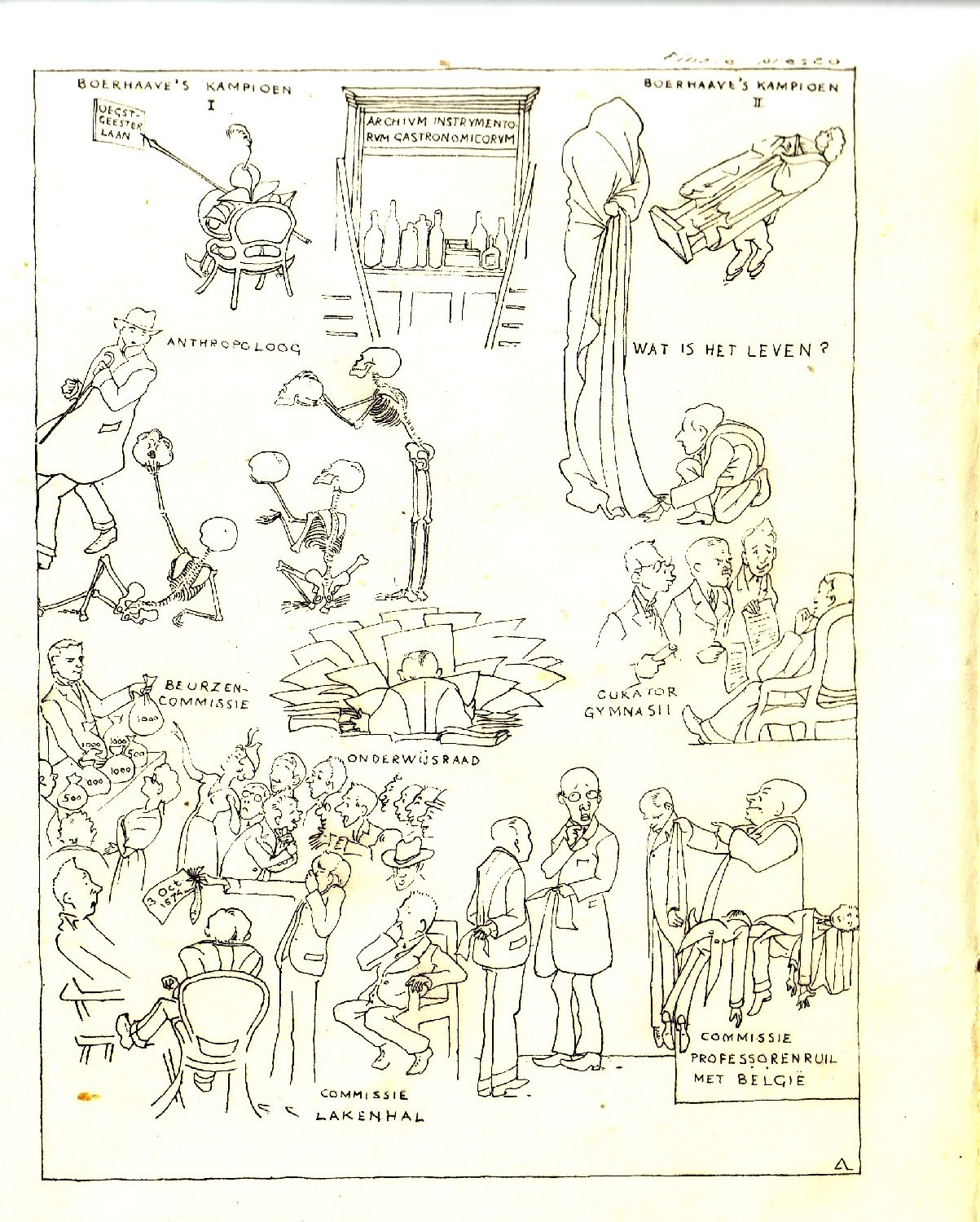 Fig. 11. Drawing made by Prof. Johan Huizinga for Ton Barge. In the top right hand corner there is a reference to the role that Ton Barge played in erecting Boerhaave's statue at the beginning of the Boerhaavelaan. Photograph of drawing courtesy Nauta-Barge family.
He and his family were devout Catholics (as were his in-laws of the Dreesmann family) and he was a member of de Eerste Kamer (Senate) between 1937 and 1940, and again from 1945 to 1949, representing the Rooms-Katholieke Staatspartij (before the war) and the Katholieke Volkspartij, after the war. His eldest daughter Susanna (1920-2022) married a son of the prominent Catholic politician Rad Kortenhorst (1886-1963), who for fifteen years was the chairman of the Tweede Kamer (House of Representatives). Ton Barge also advised on the Leiden municipal museum De Lakenhal, the Leidse Schouwburg (Theatre) and the local Stedelijk Gymnasium (Grammar School). In his study (Fig. 11), at the back of the ground floor overlooking the garden, he meticulously prepared his lectures, and he was renowned for his loquacity. His contemporaries used to call him "The Rembrandt of the Spoken Word."
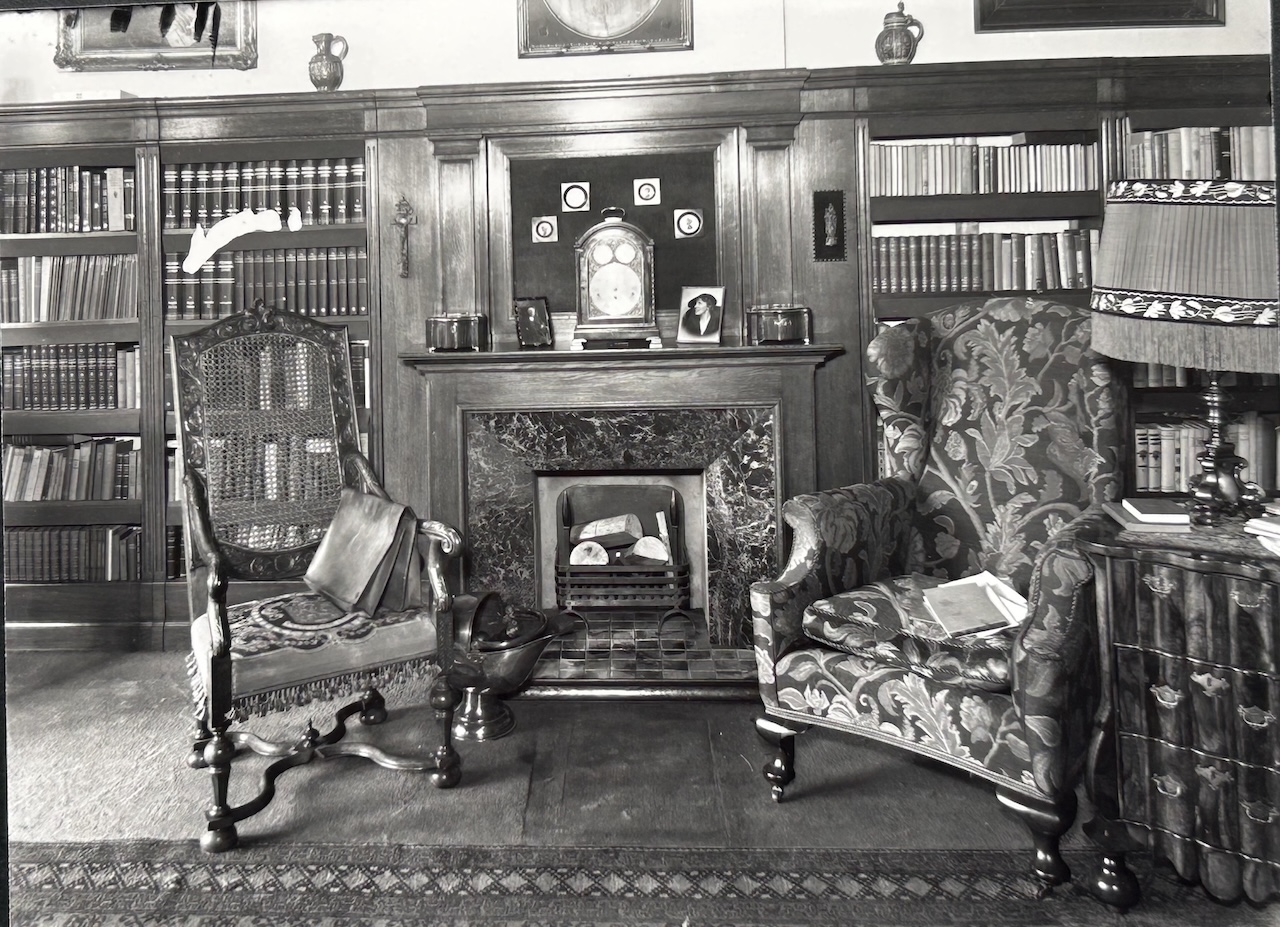 Fig. 10. The ground floor study. The album that contains this photograph dates from 1948. Photograph courtesy Nauta-Barge family.
The couple had four children: Susanna (Suus, 1920), James (Jim, 1922), Hélène (Hélènetje, 1924), and Frederic (Fred, 1927). He was an outspoken opponent of the racial theories of the German Nazis, who occupied The Netherlands in 1940-1945. He did not hide his views, and he spoke out openly during a lecture on 26 November 1940. A plaque to the right of the front door of Boerhaave 6 (Fig. 12), placed on 26 November 2014, commemorates his speech.
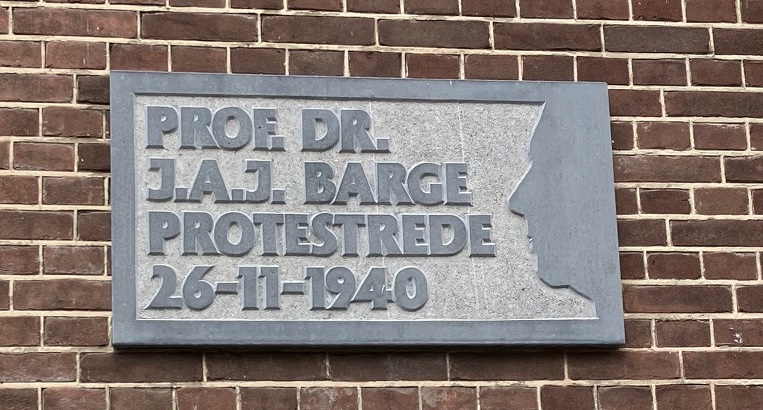 Fig. 12. The plaque attached next to the front door, commemorating Prof. Barge's protest speech, 26 November 1940. Photograph Willem Vogelsang 2026.On the same day, comparable plaques were placed elsewhere in Leiden, to mark anti-Nazi lectures read that day by two of Barge's colleagues, namely by Prof. Rudolph Cleveringa (1894-1980), who lived nearby, at Rijnsburgerweg 29, and by Prof. Lambertus van Holk (1893-1982; Plantage 26).
All three were subsequently arrested by the German authorities. Prof. Barge was arrested on 4 May 1942 and held hostage in Sint Michelsgestel, Noord-Brabant, until December 1942. After his release he and his family moved between various addresses. Barge and the two other Leiden professors survived the war.
Prof. Barge's house along the Boerhaavelaan was confiscated by the German authorities and from early 1943 until late 1944 served as the Ortskommandantur of the German Wehrmacht in Leiden They also confiscated the house next door (Boerhaavelaan 4) for the Feldgendarmerie. Many of the rooms in Boerhaavelaan 6 were numbered (the numbers still survive on the doors).
The cellar sometimes served as a prison. It was only after 45 years that Pieter R. from Leiden came to tell about his experiences during the war as a 16-year old. He had been imprisoned in the cellar. Until the 1990's he didn't dare to walk down the street and look at the house. Afterwards, Pieter would occasionally visit the family for a coffee at the kitchen table.
But the new German residents perhaps had no idea of the link that the house and the Barge family had with Dutch resistance. Barge's house still has a small hiding space on the second floor. Several children could be accommodated there behind the bed, where the young Hélène would pretend to have diphtheria.
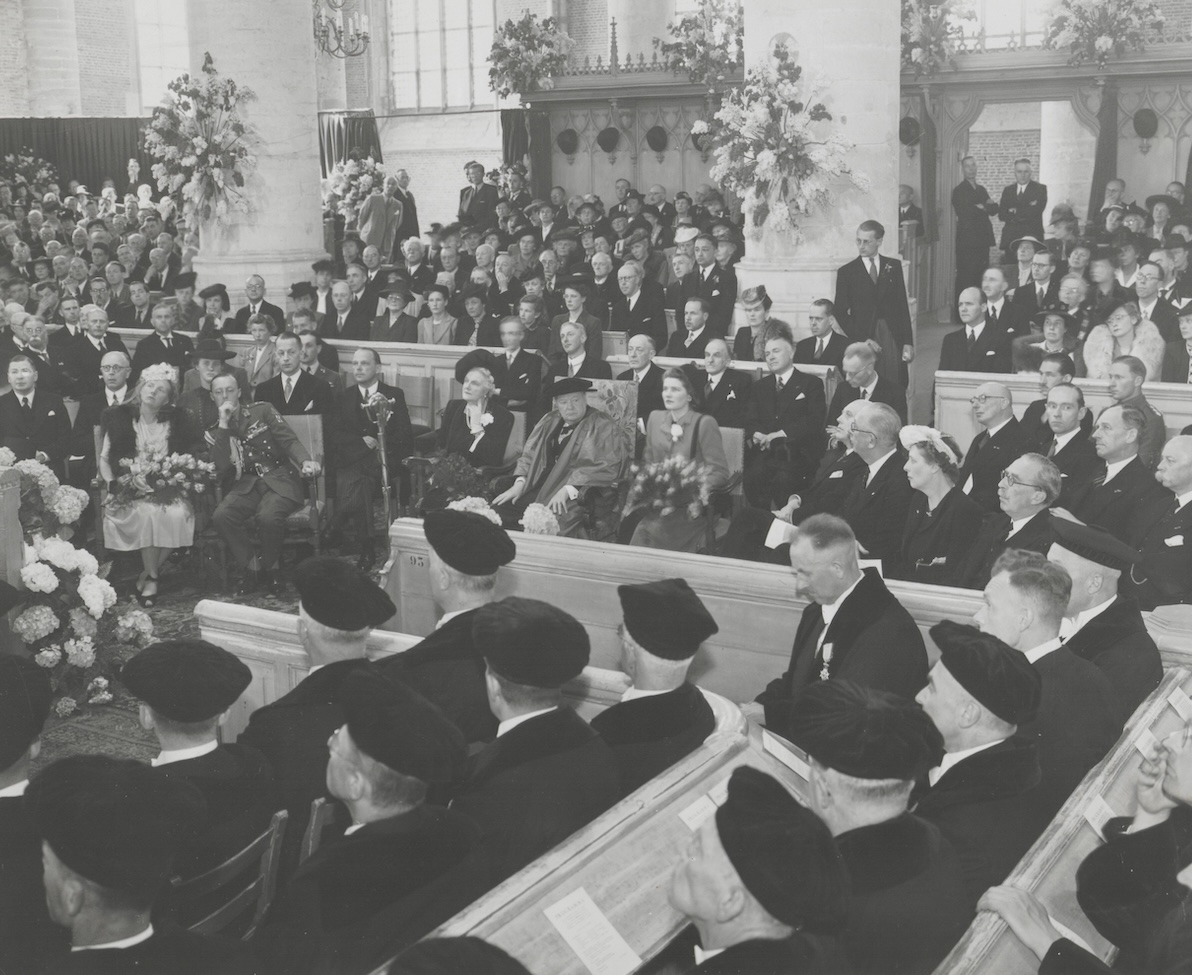 Fig. 13. Winston Churchill received an honorary doctorate at Leiden University on 10 May 1946. He is sitting in the Pieterskerk, in one of the embroidered chairs from Boerhaavelaan 6. Photograph courtesy Nauta-Barge family.
After the war
After the Second World War, in 1949, Hélène married Jan Nauta (1922-2013), who trained as a heart surgeon in Leiden and subsequently became co-founder of the medical faculty and the Thorax Centre in Rotterdam. During the Second World War, Jan had been active in the resistance. He was betrayed in May 1944 and ended up in the German concentration camp of Sachsenhausen, where he was liberated in April 1945 by Russian troops. Hélène also held her own during the war. She once brought an Allied pilot to safety on her bicycle after an emergency landing near Leimuiden, close to Leiden.
Jan and Hélène met after the war when the NBBS (the travel agency for students) was re-established in Leiden and they were both working there. Hélène and Jan had five children.
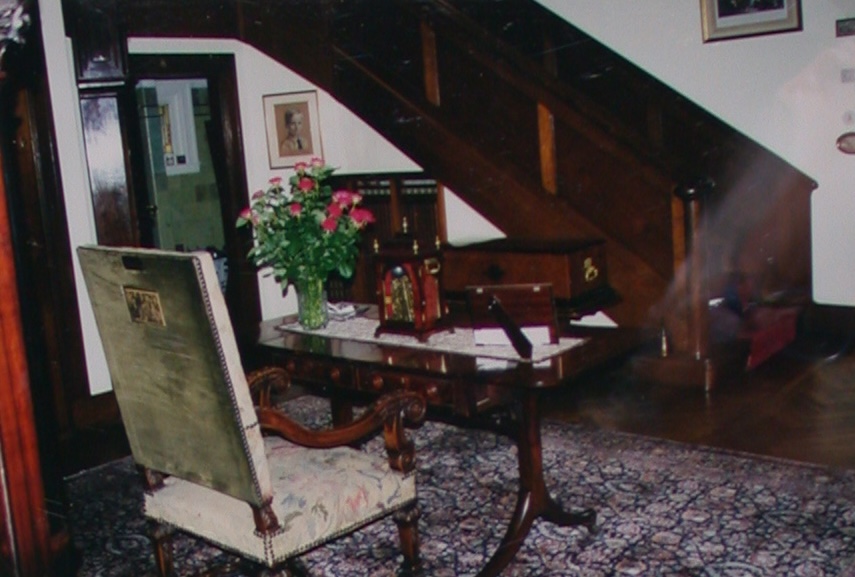 Fig. 14. Hallway of Boerhaavelaan 6. The chair in front, with embroidered upholstery, has a plaque at the back commemorating Winston Churchill who sat in this chair on 10 May 1946 when he received an honorary doctorate from Leiden University. Photograph courtesy Nauta-Barge family.
After the war, the house was returned to the family, and Prof. Barge also returned to Leiden. Fascinating is the film *Zes Jaren* (see Youtube) released in 1946 as a tribute to student resistance in Leiden against the German occupation. The name of Hélène Barge appears in the credits. Somwe of the scenes in the film were actually filmed inside Boerhaavelaan 6.
In the same film, it so happens, we also see a chair inside the house, which was used by Winston Churchill on 10 May 1946 when he received an honorary doctorate in Leiden (Figs. 12 and 13). This chair, with embroidered upholstery, was borrowed from among the furniture of Boerhaave 6.
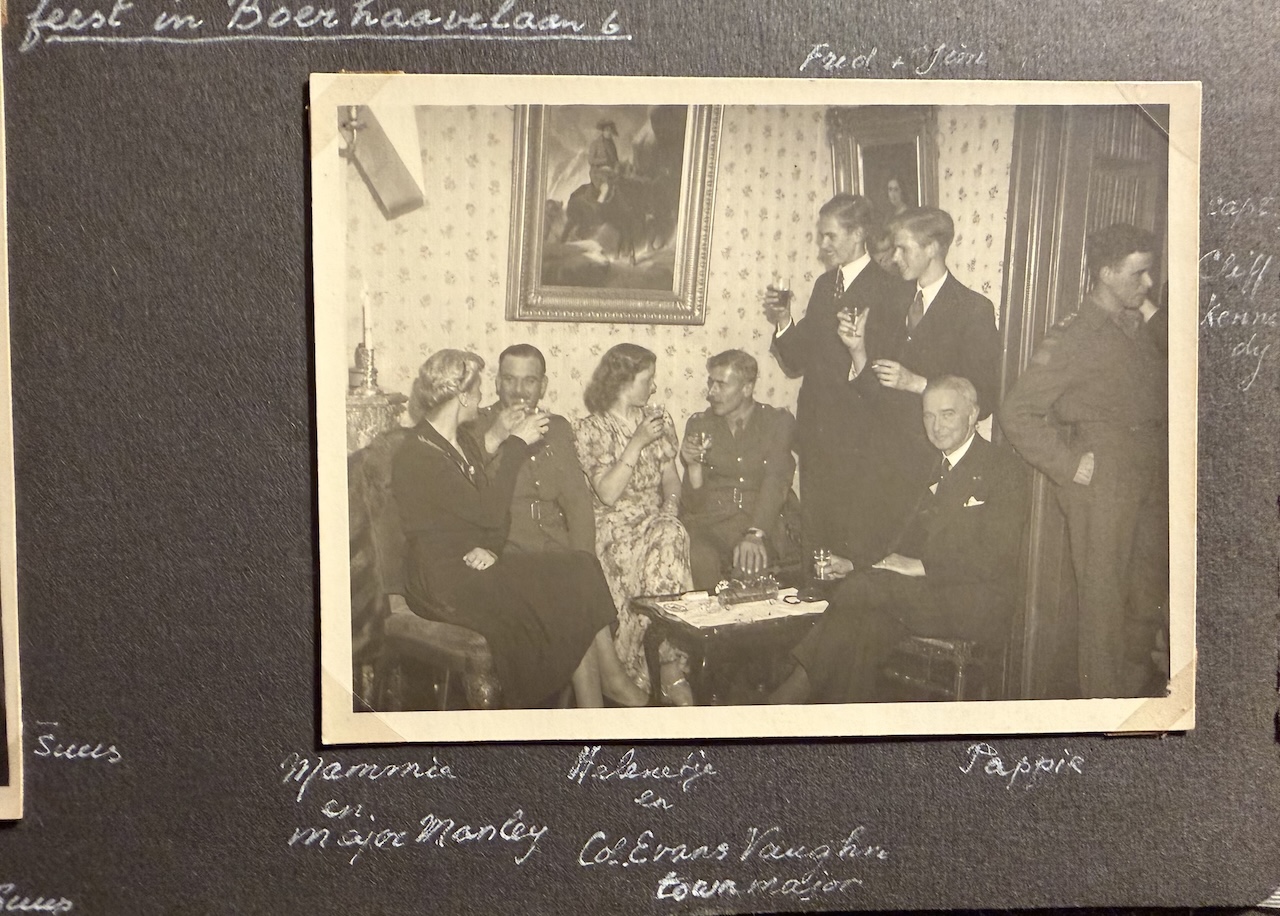 Fig. 15. Small party after liberation and after the house had been returned to the family. From left to right: Thérèse Barge-Dreesmann, Major Manley, Hélène Barge, Colonel Evans Vaughn (the Town Major), Fred and Jim Barge (both standing), Ton Barge, Cliff Kennedy. Photograph courtesy Nauta-Barge family.
The Nauta-Barges
After the war and due to a housing shortage, the house became very crowded. Besides the parents—Ton and Trees—there was the still unmarried Fred and the families of Jim and Hélène. The fourth child, Suus, soon moved out. Ton Barge died in 1952, and his widow, Thérèse, moved out in 1956. She was a spirited woman who had always been active as a volunteer helping the poor and the blind. After her husband's death she left for Tanzania for a year, where she worked as a nurse, often under challenging conditions. She spent much time preparing books for the blind with the help of a braille typewriter. She was the aunt of Cécile Dreesmann (1920-1994), a famous textile artist who published widely on the subject of embroidery and many of whose books are included in the TRC library.
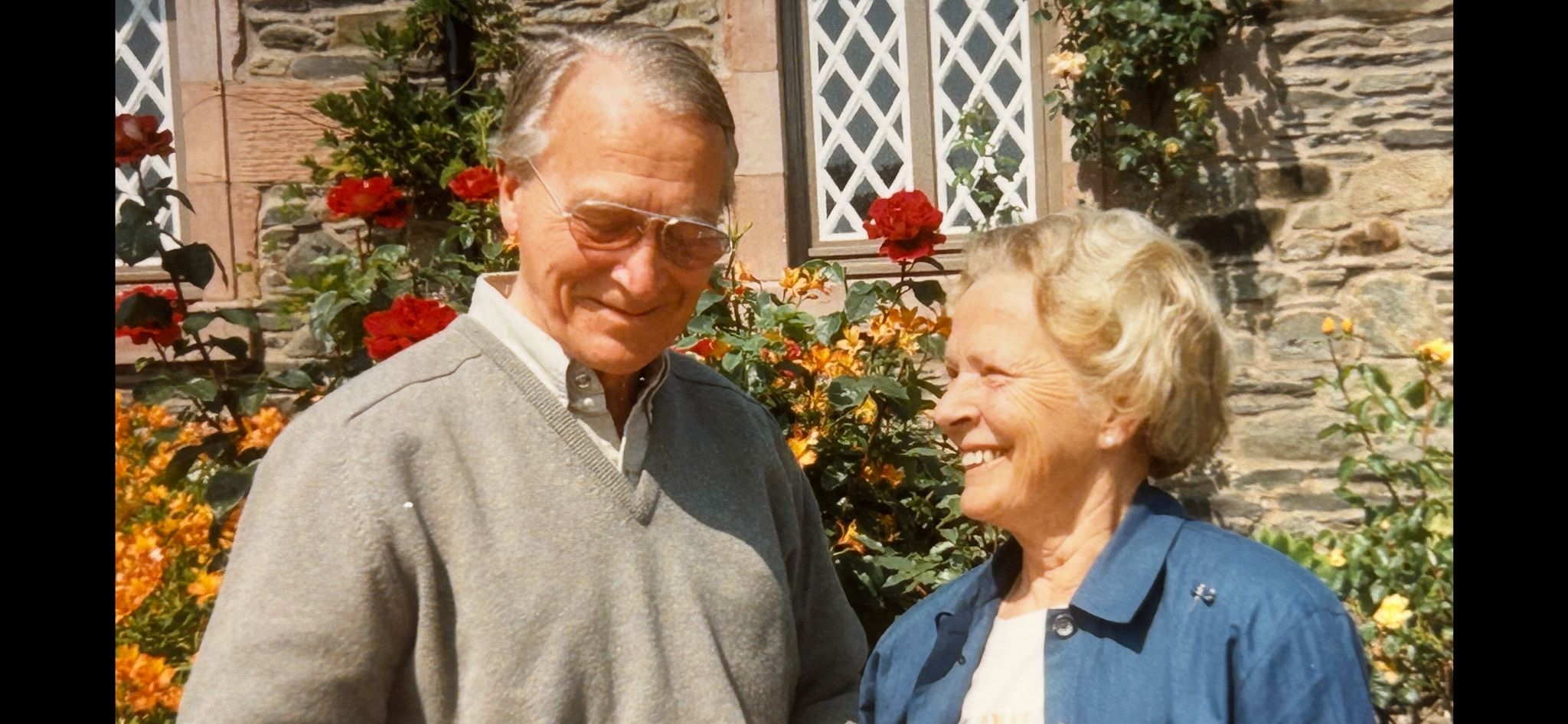 Fig. 16. Jan Nauta (1922-2013) and Hélène Nauta-Barge (1924-2023). Mrs Nauta-Barge lived at Boerhaavelaan 6 almost uninterruptedly her entire life. Photograph courtesy Nauta-Barge family.The rooms in the house acquired ever-different purposes and occupants. For instance, the large en-suite room on the first floor was split into two bedrooms. On the ground floor, the en-suite space has always been divided into a sitting room at the front and a dining room with a conservatory at the rear. The sitting room was used for receptions and festivities, such as Sinterklaas evenings.
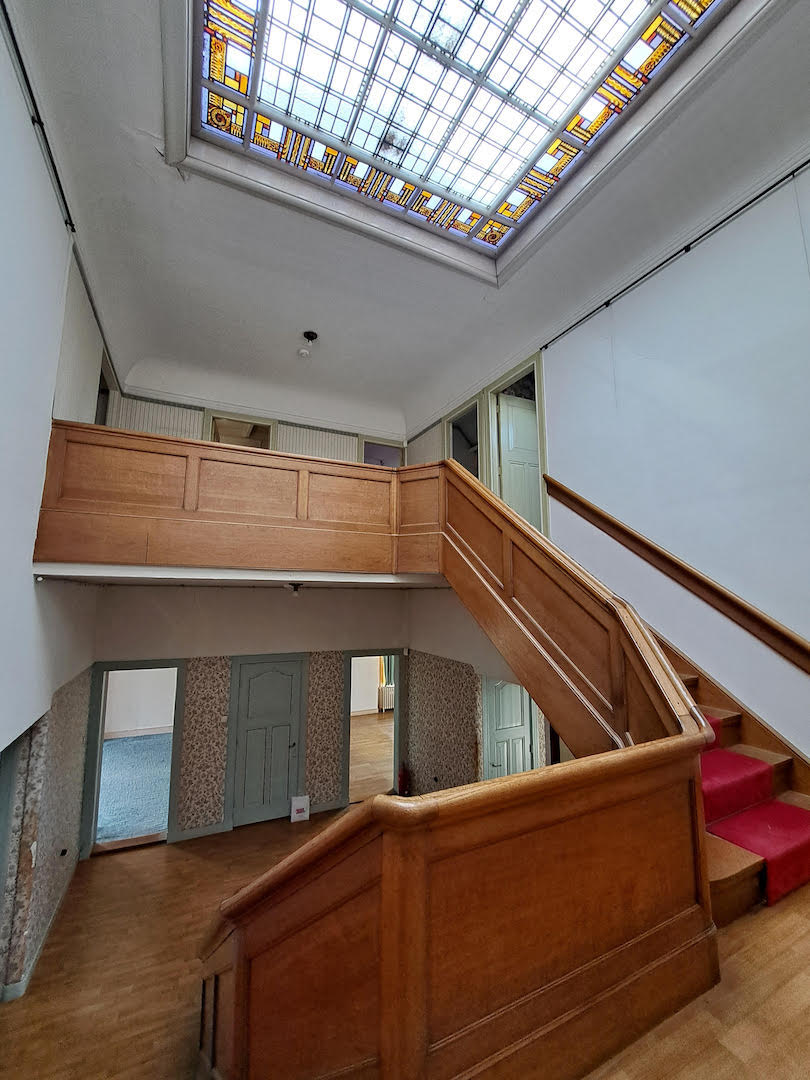 Fig. 17. The staircase of Boerhaavelaan 6, 2025. Courtesy Monumentenbezit.In the dining room stood an imposing cabinet with Chinese porcelain. Before the war, dinners were held there with white tablecloths, lots of silver, and table service. Later, space was created for table tennis and a TV corner. After Barge's death in 1952, his study at the back of the ground floor first became a family room for the Nautas and later the study for Jan Nauta.
The room next to the front door served for a time as a bedroom for grandmother Thérèse, featuring a life-sized painting of the Virgin Mary with Child. Later it became a ‘playroom’, sewing room, junk room, and medical library. This space was eventually used for many years by Jan Nauta, by then a grandfather and retired, as a workspace for the family archive that he kept at the very top of the house.
 Fig. 18. The ground floor rooms at Boerhaavelaan 6, looking through the sitting room to the dining room. Photograph courtesy Monumentenbezit.Hélène always gave a lot of attention to the back garden, with its flower borders all around the large lawn. There was the garden pavilion, but also two gas lanterns that were removed from along the Rapenburg canal in the centre of Leiden. The sunken central section of the garden was once an ideal ice rink for the children (alhough not so very good for the grass).
In later years, Hélène would feed the seagulls in the garden. She really liked them, and they liked her. Eventually, all those seagulls would nest on the roof. The resulting disturbance (and filth) in the adjoining street was full-page news in the national newspaper the NRC: 'Ook een broodje sambal jaagt the meeuw niet weg" ('also a chili hot sauce sandwich does not scare the seagull away'; NRC 7 July 2006). But although the journalist lived across the street, he never found out why the gulls were so attracted to the area.
The family that for so many years was linked to the house added this remark:
Ultimately, the house was intensively inhabited by the Nautas for over 70 years, ever since they got married in 1949. Because of the many memories—including, for example, ice skating in the garden, romantic dinners in the garden pavilion, and the many Sinterklaas evenings—saying goodbye was not easy for the four children and twelve grandchildren of the Nautas. They searched for a long time for a dedicated new owner with an eye for the historical character of the property. The combination of Stichting Monumentenbezit and the TRC fully met that wish.
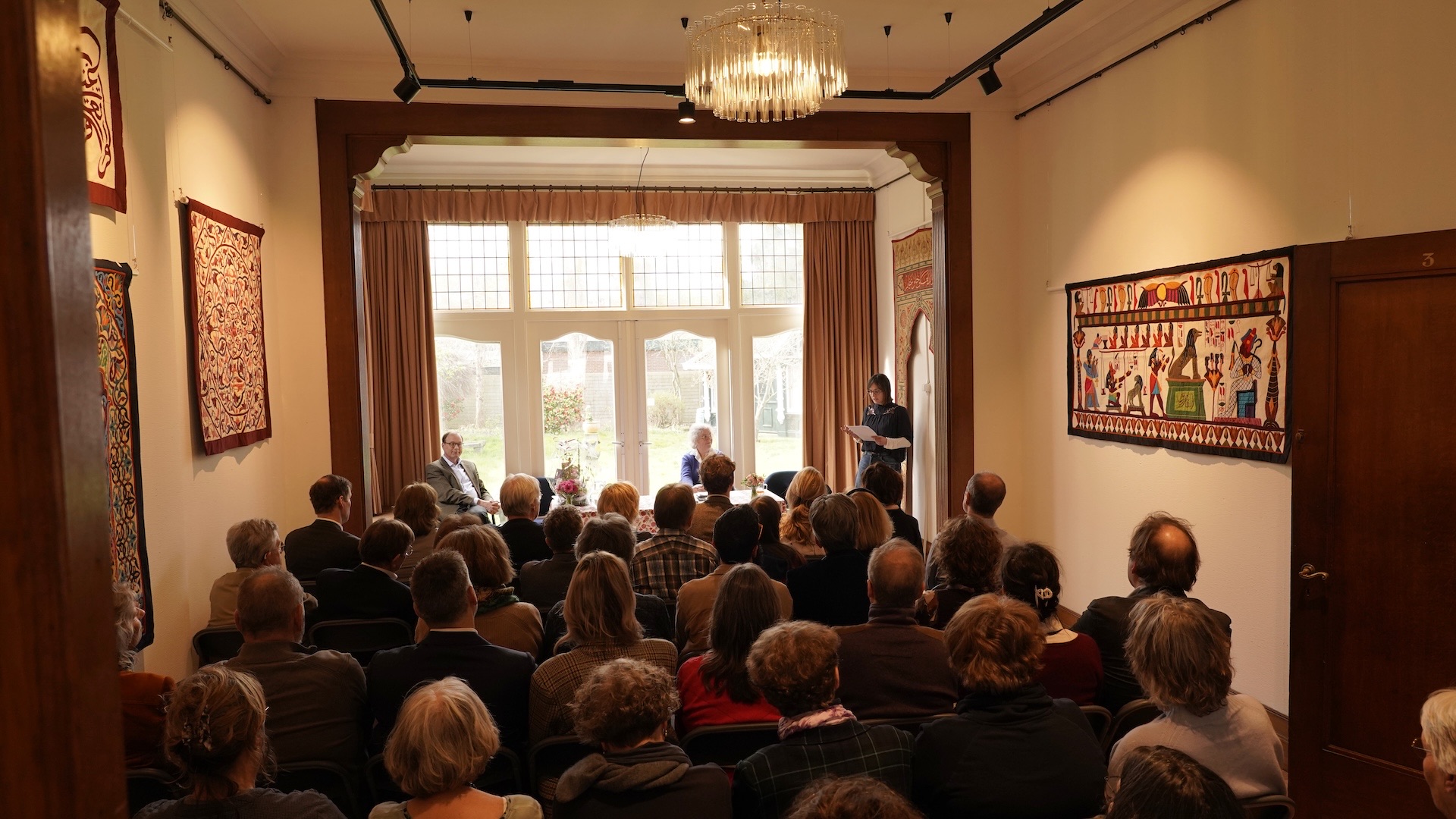 Fig. 19. The first main public event of the TRC at Boerhaavelaan 6 on 26 March 2026: The presentation of The Atlas of World Embroidery, written by the TRC director Gillian Vogelsang-Eastwood, to the Leiden Mayor, Peter Heijkoop.
Willem Vogelsang, 2 June 2026



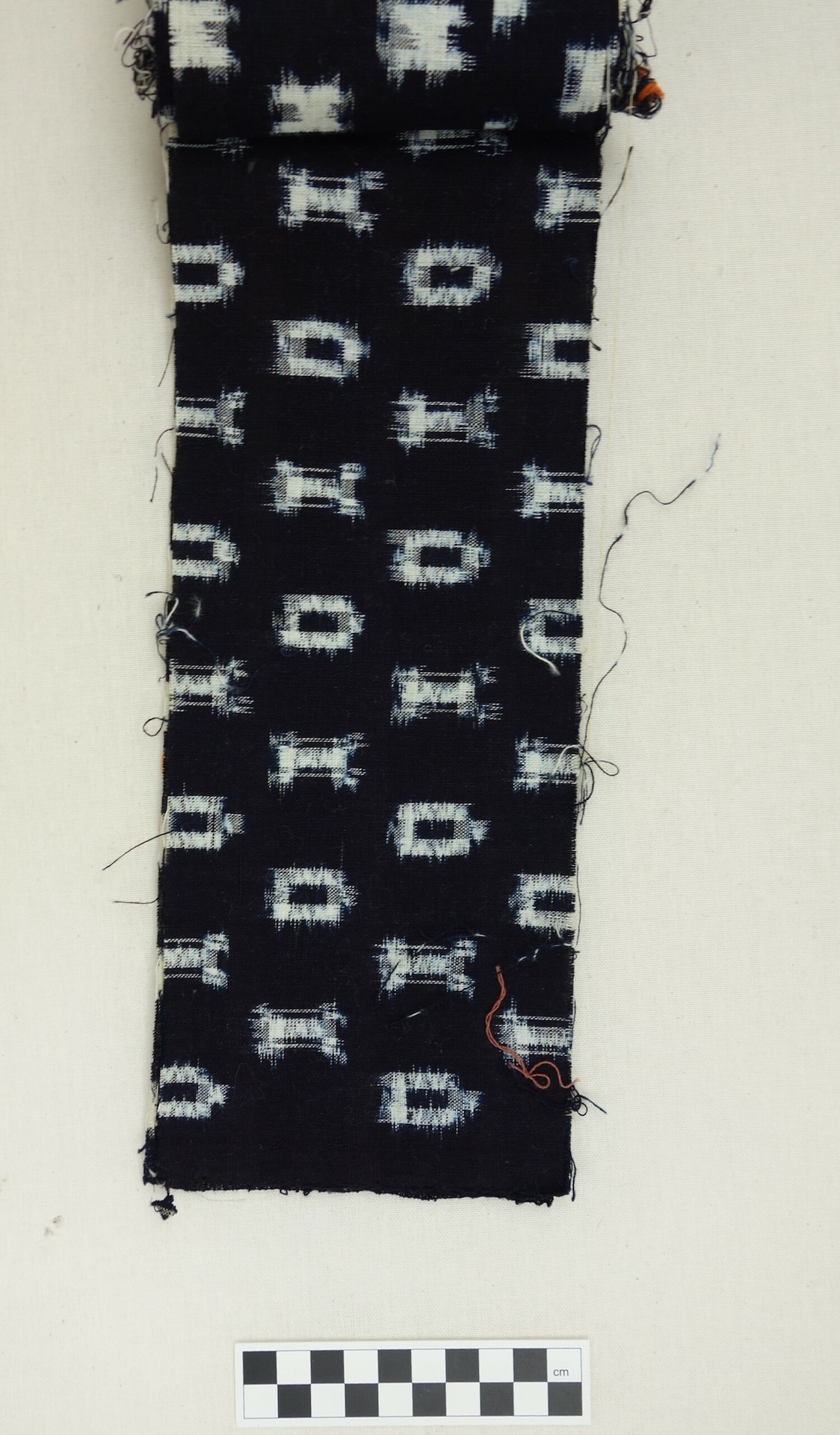 Fig. 1. Kasuri cloth sample (TRC 2017.1478-23). Japan, 20th century.This April, I began my research fellowship at the TRC Leiden as the first junior fellow in the TRC Fellowship Programme, sponsored by the Gieskes-Strijbis Foundation, Amsterdam. My project, Thread, Dye, and Pattern: A Historical Study of Japanese Kasuri Techniques in the TRC Leiden Ikat Cloth Sample Collection (Pepin Collection), focuses on the extraordinary technical and artistic complexity of Japanese kasuri textiles preserved in the TRC collection.
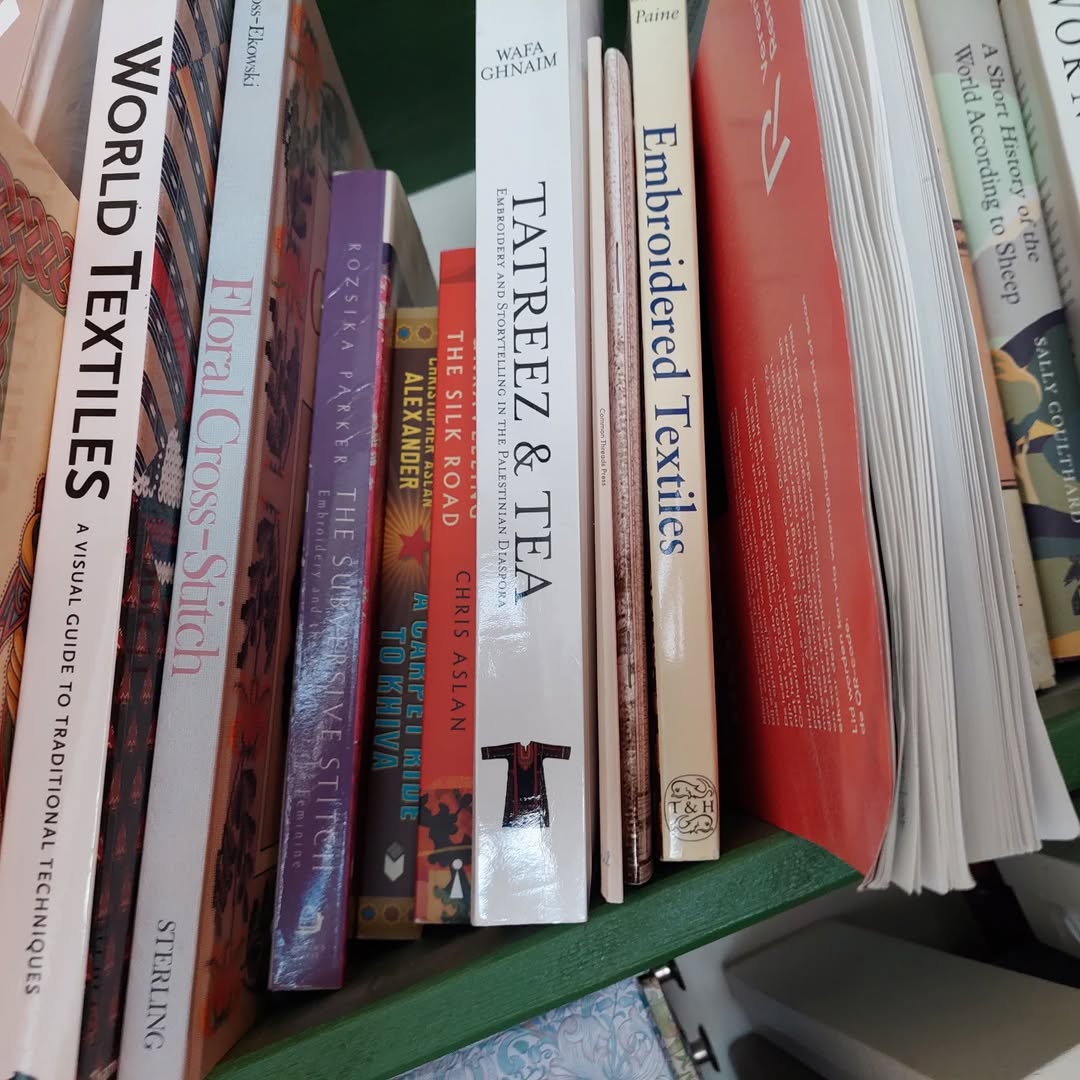 Find the books you have long been looking for, and help support the TRC by buying some of them!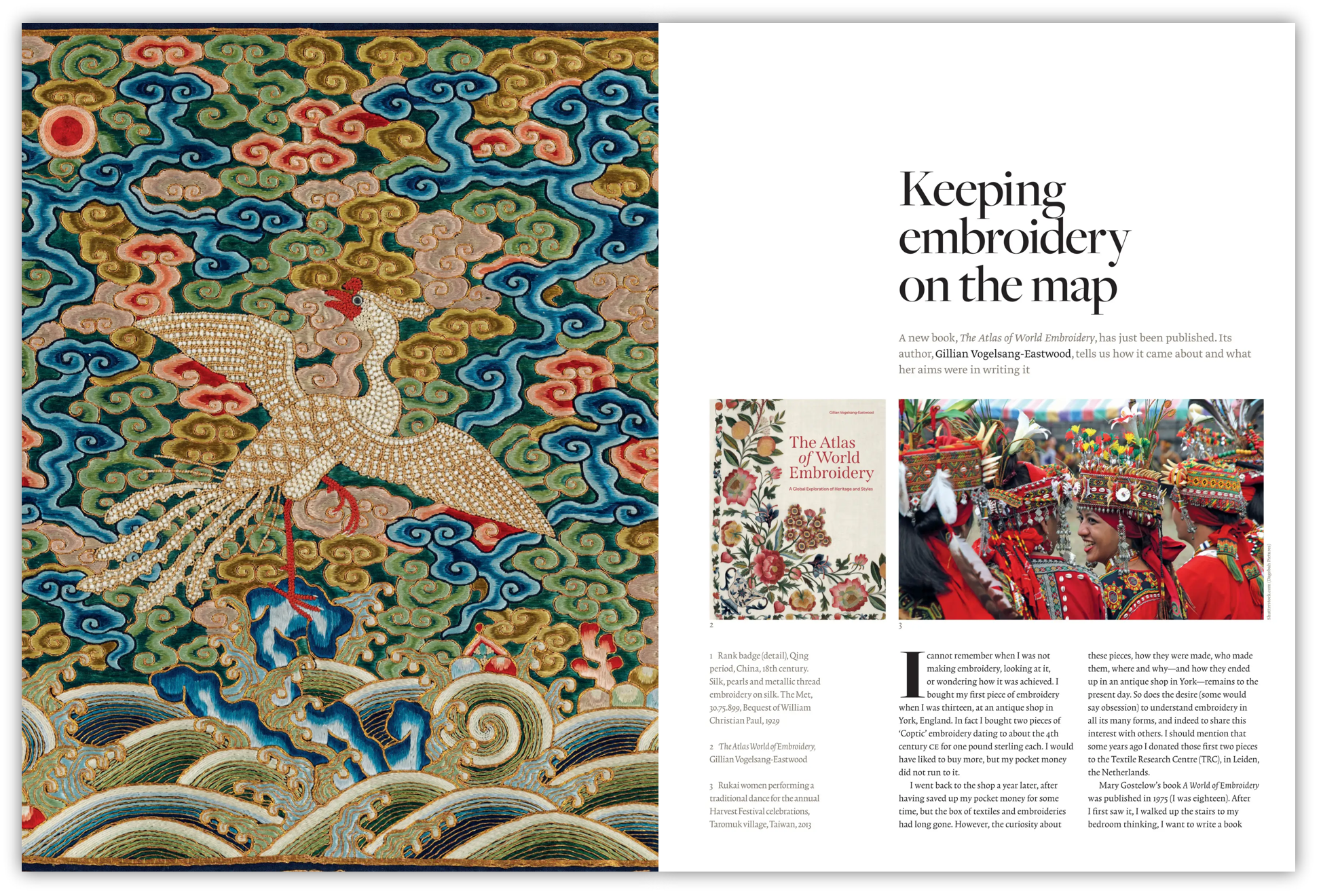
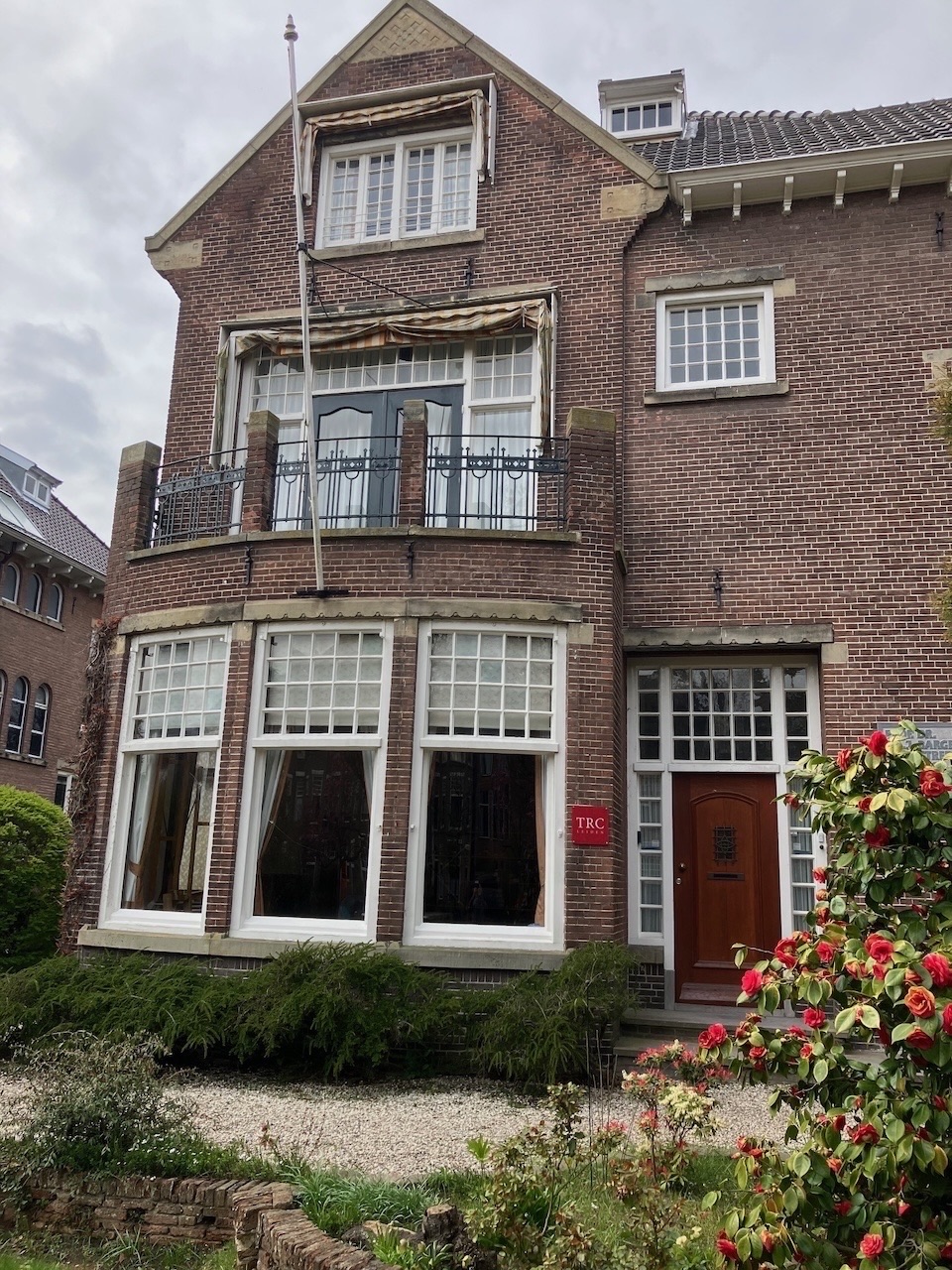
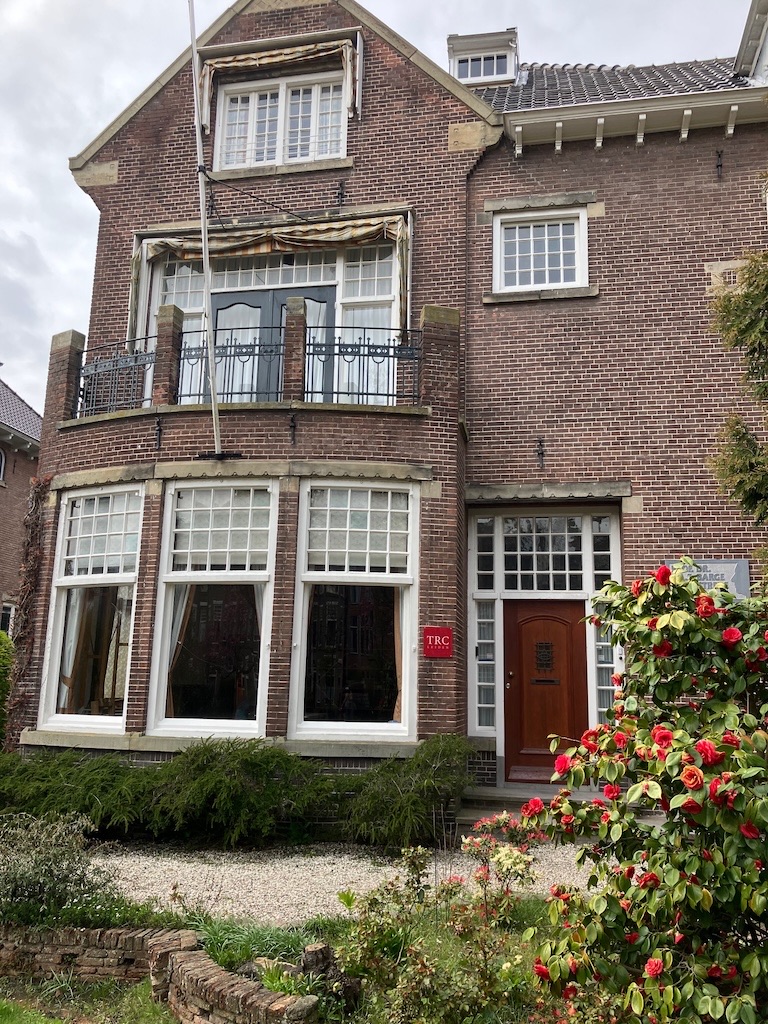 The move to Boerhaavelaan 6 is nearly finished, just a few more weeks and all the rebuilding, painting, furnishing, packing and putting away of boxes will be over! A great relief to all.