• F4
  • F3
  • F1
  • F2

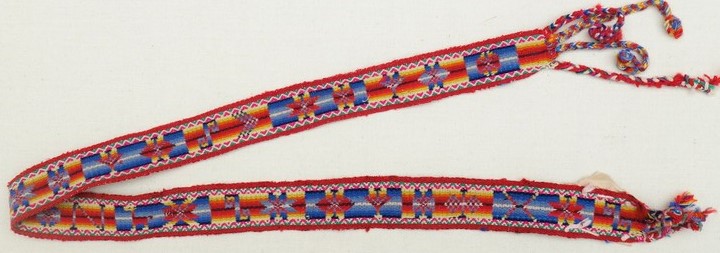
Tablet weaving (also known as card weaving) is an old technique for weaving strong, narrow and colourful bands. Already before Roman times. people used this technique to weave beautiful bands with patterns.

Card woven band from Bolivia, 20th century (TRC.2020.2778).Card woven band from Bolivia, 20th century (TRC.2020.2778).

During the workshop we look at examples from different times and different places. Then the participants learn how to card weave themselves. They also receive advice to weave as neatly and evenly as possible.

In principle, participants do not have to bring anything, but if you have weaving cards yourself, you can of course bring them. Please indicate when registering if you can bring your own cards, so that the teacher knows how many to provide. 

This Wednesday morning workshop is given by Dorothee Olthof, an expert in the field of archaeological textiles and the reconstruction of medieval and later clothing.

  • Date: Wednesday, 18 March 2026.
  • Time: 10.00 - 13.00 pm.
  • Venue: TRC Leiden, Boerhaavelaan 6, 2334 EN, Leiden.
  • Teacher: Dorothee Olthof.
  • Language: Dutch and/or English.
  • Costs: 45 euros. Coffee, tea and materials are provided.
  • Maximum number of participants: Maximum 10, minimum 4. If the minimum number of participants is reached, confirmation and invoices shall be sent.

The tablet weaving workshop is full. 

 Please register well in advance: This email address is being protected from spambots. You need JavaScript enabled to view it.
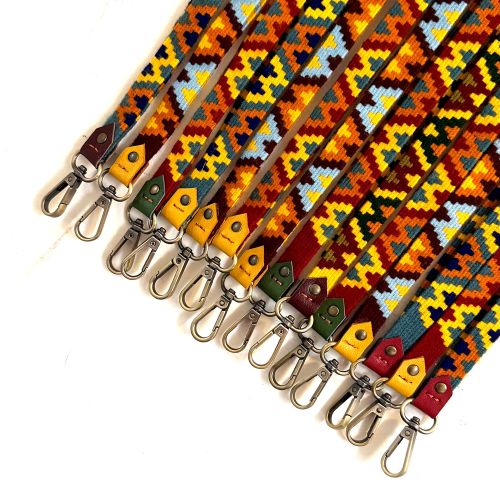
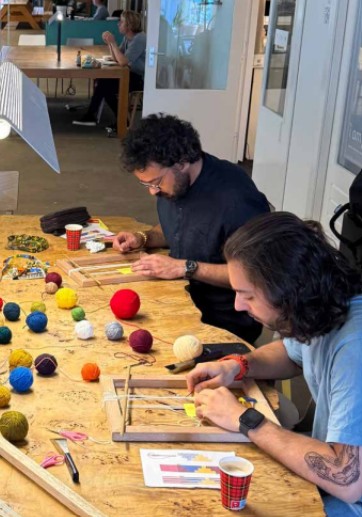
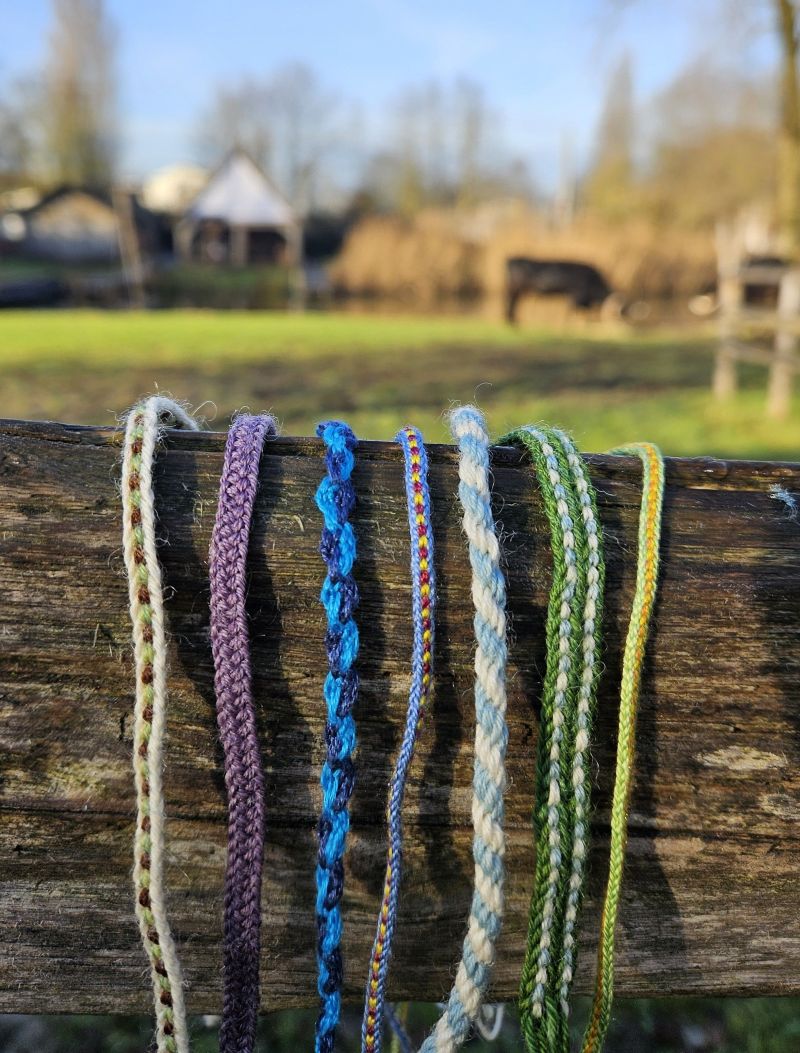
Examples of fingerloop braiding. Source: Karin VingerhoetsExamples of fingerloop braiding. Source: Karin VingerhoetsFingerloop braiding is an old technique to create decorative, but strong, cords. These cords have been used for centuries to close pouches or clothing, or to apply wax seals to official documents. Today these beautiful cords are wonderful bracelets or bookmarks.

The workshop will start with a presentation on historical examples of fingerloop braiding, after which participants will learn the technique themselves. There is ample time to make multiple cords, using multiple patterns. Whoever feels confident in their abilities can join forces to create a two create a two-person braid! 

The patterns we will use come from Tak V bowes departed by Elizabeth Benns & Gina Barrett. This work is based on an earlier 15th century manuscript from the collection of the British Library.

Fingerloop braiding requires some manual agility, but patience is the most important skill to bring. Materials will be provided for, but participants can bring their own threads if they wish to experiment.

This wednesday morning workshop will be taught by Karin Vingerhoets. She is a volunteer with the weavershouse in (pre)-historical museumpark Archeon. She specialises in historical textile techniques.

  • Date: Woensdag 16 september 2026.
  • Time: 10.00 - 13.00 uur.
  • Location: TRC Leiden, Boerhaavelaan 6, 2334 EN, Leiden.
  • Teacher: Karin Vingerhoets.
  • Language: Dutch (English if necessary).
  • Costs: 45 euros. Coffee, tea, biscuits and materials are included.
  • Maximum number of participants 8, minimum number of participants 4. When the minimum amount of participant has been reached, you will receive the confirmation and the invoice.

You can sign up for this workshop by emailing us at: This email address is being protected from spambots. You need JavaScript enabled to view it.

Example of band weaving with pick-up patterns. Photograph by Dorothee Olthof.Example of band weaving with pick-up patterns. Photograph by Dorothee Olthof.Band weaving is a technique of weaving sturdy, narrow, larger bands that can serve as a belt, sling or a solid start for a large fabric. Finds from the Stone Age show that the technique has a long history. Ethnography teaches that technology is applied worldwide.

During the workshop we look at examples from different times and from different places. Subsequently, the participants learn to put on a ribbon fabric, weave simple pick-up patterns and possible finishes of bands. They also receive advice for weaving as neatly and evenly as possible.

In principle, participants do not need to bring anything with them, but if you have a weaving frame of your own, you can of course bring it (please indicate when registering).

This Friday morning workshop is given by Dorothee Olthof, an expert in the field of archaeological textiles and in the reconstruction of medieval and later clothing.

  • Date: Wednesday, 2nd of September 2026.
  • Time: 10.00 - 13.00 pm.
  • Location: Textile Research Centre, Boerhaavelaan 6, 2334 EN, Leiden.
  • Instructor: Dorothee Olthof.
  • Language: Dutch/English.
  • Costs: 45 euros. Equipment / coffee / tea are provided. Max. number of participants: 8.

Please register in advance: This email address is being protected from spambots. You need JavaScript enabled to view it.
This three-day course introduces hand spinning as both a practical craft and a form of embodied knowledge. Participants work hands-on with fibres and spinning tools while also engaging with questions of labour, sustainability, and the role of handmade processes in contemporary life. Each day combines demonstration, guided practice, independent experimentation, and short reflective activities.A postcard from early 19th century Spain, showing a woman handspinning with a distaff and a drop spindle,TRC.2020.4383A postcard from early 19th century Spain, showing a woman handspinning with a distaff and a drop spindle,TRC.2020.4383

The course will be taught by Akash Kumar. Akash Kumar is an artist, researcher, and educator working at the intersection of material culture, with a focus on textiles, folklore, storytelling, and the transmission of knowledge. Rooted in hands-on making as both a method of inquiry and a medium for cultural exploration, his practice examines how and what skills, traditions, and wisdom are passed down across generations.

  • 26th of August - Session 1 — Foundations of Hand Spinning
    Focus: fibre basics, twist introduction, and spindle techniques
    • Short history of the spindle, charkha, great wheel, and treadle wheel, including
      Gandhi’s use of spinning as non-violent resistance.
    • Introduction to local fibres (wool, linen, alpaca) and tools (takli, charkha, carders)
    • Hands-on fibre prep: carding and pre-drafting
    • Drafting by hand and inserting twist with a spindle or petite charkha
    • Mini-lesson on twist structure (S-twist vs. Z-twist)
    • Students spin small samples of each twist type
    • End-of-day reflection: sensations of material, patience, skill, and surprise.
  • 9th of September - Session 2 — Technique, Tools & Yarn Metrics
    Focus: tool comparison, fibre properties, measurement skills
    • Shared reflections from Day 1
    • Rotations through the drop spindle, charkha, and treadle wheel
    • Fibre comparison: cotton, wool, blends, staple length differences
    • Practice plying: creating a balanced two-ply yarn
      • Homework:
        Spin, spin and spin. Write a short reflection on differences in tools and fibres
  • 23rd of September - Session 3 — Creative Spinning & Custom Yarn
    Focus: design, experimentation, and finishing techniques
    • Warm-up spinning
    • Design session: creating custom blends with coloured cotton, wool, linen, alpaca,
    • and optional textural additions (seeds, slubs, etc.)
    • Spinning 50–150 m of custom yarn; optional plying
    • Finishing: skeining and steam-setting twist
    • Labelling yarn with fibre content, twist type, and measurements
    • Final group discussion: skill growth, slow craft, labour, sustainability, and the
      relevance of hand spinning today
    • Final reflection: connecting personal experience to ideas of craft and modern
      technology

The course is given on three Wednesdays, the 26th of August, the 9th of September and the 23rd of September, from 10.00-13.00.

Please note that, in order to really learn the technique and obtain results, this course does involve some homework. The participants will be finishing techniques and projects, started during the meetings, at home. This will take about an hour, no more than three hours.Akash Kumar amongst spinning equipmentAkash Kumar amongst spinning equipment

  • Venue: TRC Leiden, Boerhaavelaan 6, 2334 EN, Leiden.
  • Teacher: Akash Kumar
  • Language: English
  • Costs: 135 euros per three lessons. Coffee/tea/threads are provided. All necessary materials will be provided
  • Maximum number of participants: 8. Minimum: 4. If the minimum number of participants is reached, confirmation and invoices shall be sent.

Please contact us to register: This email address is being protected from spambots. You need JavaScript enabled to view it.

Examples of band weaving.Examples of band weaving.Band weaving is a technique for weaving strong, narrow, colourful bands that can serve as a belt, sling or a solid start for a large fabric. Finds from the Stone Age show that the technique has a long history. Ethnography shows that the technique is found worldwide.

During the workshop we look at examples from different times and different places. Then the participants learn how to weave a band, make threading patterns and possible ends for bands. They also receive tips for weaving as neatly and evenly as possible.

In principle, participants do not have to bring anything, but if you have a band weaving frame yourself, you can of course bring it (please indicate when registering, so that I know how much to take with me).

This Wednesday morning workshop is given by Dorothee Olthof, an expert in the field of archaeological textiles and the reconstruction of medieval and later clothing.

  • Date: Wednesday, 15 April 2026.
  • Time: 10:00 am - 13:00 pm
  • Location: TRC Leiden, Boerhaavelaan 6, 2334 EN  Leiden, the Netherlands.
  • Teacher: Dorothee Olthof.
  • Language: Dutch and/or English.
  • Costs: 45 euros. Materials /coffee/tea are provided.
  • Max. number of participants: 8.

Please register well in advance: This email address is being protected from spambots. You need JavaScript enabled to view it. 


Braiding a band of sprang. Photograph: Dorothee Olthof.Braiding a band of sprang. Photograph: Dorothee Olthof.Sprang is an age-old braiding technique in which threads are twisted around each other in certain patterns to make an elastic textile. Prehistoric hair nets, Roman caps, medieval bras and 18th century officer sashes bear witness to the long history of this technique.

During this workshop we get acquainted with the technique, the setting up, the basic stitch and the finish.This technique is know to be finicky. Participants do not need to bring anything except a lot of patience. 

This Wednesday morning workshop is given by Dorothee Olthof, an expert in the field of archaeological textiles and in the reconstruction of medieval and later clothing.

  • Date: Wednesday, 8 July 2026.
  • Time: 10.00 - 13.00 pm.
  • Venue: TRC Leiden, Boerhaavelaan 6, 2334 EN, Leiden.
  • Teacher: Dorothee Olthof.
  • Language: Dutch/English.
  • Costs: 45 euros. Coffee, tea and materials are provided.
  • Maximum number of participants: 8. Minimum: 4. If the minimum number of participants is reached, confirmation and invoices shall be sent.

 Please register in advance: This email address is being protected from spambots. You need JavaScript enabled to view it.

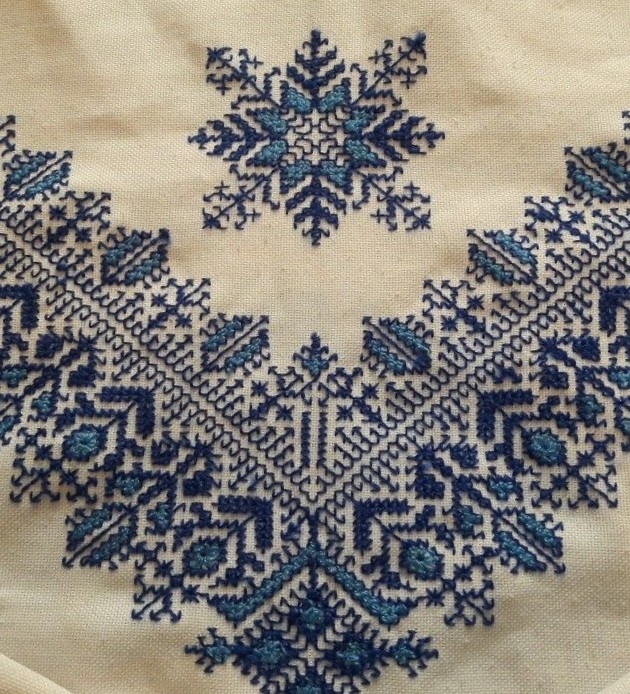
Embroidered dress yoke from Hebron, Palestine, early 20th century (TRC 2016.2035).Embroidered dress yoke from Hebron, Palestine, early 20th century (TRC 2016.2035).Embroidery has been used to decorate Palestinian clothing for centuries, it has been a way to express both individual skills and a connection to the village.

During the workshop we are going to talk about the rich and fascinating history of Palestinian dress, the meaning of some common embroidered patterns and the transformation that Palestinian dress went through until now. Subsequently, the participants will learn the basics of the Palestinian cross stitch by following a specific pattern from a particular region of Palestine. All materials will be provided by the TRC, and use will be made of the TRC Collection for showing examples.

  • Date: Wednesday, 20 May 2026.
  • Time: 10.00 - 13.00 pm.
  • Venue: TRC Leiden, Boerhaavelaan 6, 2334 EN, Leiden.
  • Teacher:  Fatima Abbadi.
  • Language: English (Dutch if necessary).
  • Costs: 45 euros. Coffee, tea and materials are provided.
  • Maximum number of participants: 8. Minimum: 4. If the minimum number of participants is reached, confirmation and invoices shall be sent.

 Please register in advance: This email address is being protected from spambots. You need JavaScript enabled to view it.
 

The Orenburg shawl is a type of Russian knitted-lace textile made from goat underhair. It is regarded as one of the classic symbols of Russian handicraft. Traditional scarves are made of very fine yarns. Like Shetland lace, the knitwear looks very intricate and complex. However, it consists of small and relatively simple patterns, combined to produce a very sophisticated result.

Example of Orenburg knitted laceExample of Orenburg knitted lace

In this workshop we will get our hands on several of the basic patterns that are used in Orenburg knitted lace, and we will look at the different charting methods used. More experienced knitters can try out very thin yarns.  Everyone is welcome, but you need to be able to do basic knitting (knit stitches suffices). Materials will be supplied. But, if you like your own knitting needles, you can bring them along (size around 4mm). 

The workshop is given by Alice van Duijnen, who is experienced in many textile techniques ever since she learned knitting at the age of 6. She has taught knitting, crochet making and weaving. As volunteer at the TRC she works on the technique-oriented Reference Collection.

  • Date: Wednesday, 3 June 2026.
  • Time: 10.00 - 13.00 pm.
  • Venue: TRC Leiden, Boerhaavelaan 6, 2334 EN, Leiden.
  • Teacher: Alice van Duijnen.
  • Language: Dutch/English, as required.
  • Costs: 45 euros. Coffee/tea/threads are provided. 
  • Maximum number of participants: 8. Minimum: 4. If the minimum number of participants is reached, confirmation and invoices will be sent.

  Please register in advance: This email address is being protected from spambots. You need JavaScript enabled to view it.
Search in the TRC website

Contact

Boerhaavelaan 6
2334 EN Leiden.
Tel. +31 (0)6 28830428  
office@trcleiden.org 

facebook 2015 logo detail 

instagram vernieuwt uiterlijk en logo


Bank account number

NL39 INGB 0002 9823 59, in the name of the Stichting Textile Research Centre.

TRC closed until 4 May 2026

The TRC is closed to the public until Monday, 4 May 2026, due to our move to the Boerhaavelaan. The TRC remains in contact via the web, telephone and email. For direct contact and personal visits, please contact the TRC at office@trcleiden.org, or by mobile, 06-28830428.

Donations

The TRC is dependent on project support and individual donations. All of our work is being carried out by volunteers. To support the TRC activities, we therefore welcome your financial assistance: donations can be transferred to bank account number (IBAN) NL39 INGB 000 298 2359, in the name of the Stichting Textile Research Centre. BIC code is: INGBNL2A.

 You can also, very simply, if you have an iDEAL app, use the iDEAL button and fill in the amount of support you want to donate: 


Since the TRC is officially recognised as a non-profit making cultural institution (ANBI), donations are tax deductible for 125% for individuals, and 150% for commercial companies. For more information, click here