• F1
  • F4
  • F3
  • F2

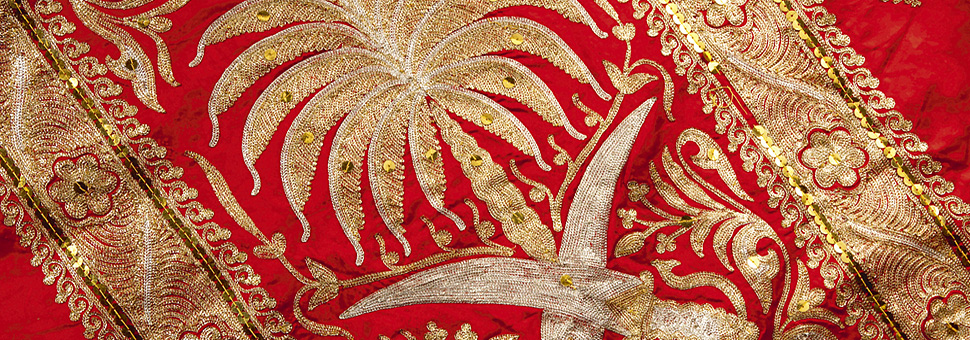
The Middle East has long been the home of a multitude of different embroidery styles, which in many cases hav a long history. Many of these forms have been influenced by techniques, motifs and materials from neighbouring lands and continents. Embroidery was widely used for the wardrobe of the Egyptian pharaoh, Tutankhamun. It was also an important feature of the Byzantine and early Christian courts and religious institutions.

Long cotton panel with a repeating and intricate geometric design in red on a white ground. Fes, Morocco, 20th century (TRC 2022.0956).Long cotton panel with a repeating and intricate geometric design in red on a white ground. Fes, Morocco, 20th century (TRC 2022.0956).

Embroidery was, and still is an important aspect of Palestinian dress, but also found throughout the Maghreb, especially in Morocco and Tunisia. Middle Eastern embroidery has had a significant impact on European styles and techniques, and vice versa, European forms, particularly from the mid-nineteenth century onwards, have deeply affected Middle Eastern decoration.

This study day looks at a wide variety of embroidery types associated with the Middle East. It will include urban, village and bedouin items from Morocco, Tunisia, Egypt, Palestine, Syria, as well as Saudi Arabia and Yemen. The workshop will look at the history, techniques and designs associated with this part of the world. During the day we will also look at developments beyond the Middle East that affected the embroidery in the Middle East, and vice versa.

The lecturer of this workshop is Dr Gillian Vogelsang-Eastwood, director of the TRC and the editor and principal author of the Encyclopedia of Embroidery from the Arab World (Bloomsbury 2016).

A previous partcipant has written about her experiences during a previous study day on this subject. Click here for the article.

  • Date: Friday, 12 June 2026.
  • Time: 10.00 - 16.00.
  • Venue: TRC Leiden, Boerhaavelaan 6, 2334 EN, Leiden.
  • Instructor: Dr. Gillian Vogelsang-Eastwood
  • Language: Dutch and English.
  • Costs: 85 euro. Coffee, tea and materials are provided. Please bring your own lunch
  • Maximum number of participants: 8. Minimum: 4. If the minimum number of participants is reached, confirmation and invoices shall be send.

 Please register in advance: This email address is being protected from spambots. You need JavaScript enabled to view it.

Khayamiya appliqué panel, Egypt, 2012 (TRC.2013.0314).Khayamiya appliqué panel, Egypt, 2012 (TRC.2013.0314).Khayamiya is a textile that is omnipresent in Egypt. The word itself is derived from the Arabic word for tent, namely khayma. Originally, this appliqué technique was mostly used for making hand-sewn tents. Nowadays, khayamiya can also be created using other techniques, such as machine sewing or (digitally) printing.

In addition to, for example, tents in (ritualistic) contexts such as weddings and funerals, khayamiya can be used in various shapes and variations. Especially before and during Ramadan, khayamiya tents and decorations are ubiquitous in the Egyptian streets. 

During this study day, we will discuss the historic and technical background of khayamiya. The participants will get a guided tour through the TRC exhibition on khayamiya, and learn the basic stitches of khayamiya. Participants do not have to bring materials. 

Khayamiya appliqué panel, Egypt, 2013 (TRC 2013.0615).Khayamiya appliqué panel, Egypt, 2013 (TRC 2013.0615).This workshop is given by visual artist and textile researcher Christina de Korte. She learned how to make khayamiya in the Street of the Tentmakers in Cairo whilst doing her research on the technique and the contemporary khayamiya usages before and during Ramadan.

Christina recently graduated from the research master’s programme in Religious Studies at Utrecht University and holds bachelor’s degrees in Fine Art from the HKU University of Arts Utrecht and Language and Culture Studies from Utrecht University. Christina gives a TRC Sunday lecture on 22 March on the same subject.

See also two TRC blogs by Christina de Korte:

There is also an online TRC exhibition: 


Column:

  • Date: Friday, 3 April 2026.
  • Time: 10.00 - 15.00.
  • Venue: TRC Leiden, Boerhaavelaan 6, 2334 EN, Leiden.
  • Instructor: Christina de Korte
  • Language: Dutch and English.
  • Costs: 85 euro. Coffee, tea and materials are provided. Please bring your own lunch
  • Maximum number of participants: 8. Minimum: 4. If the minimum number of participants is reached, confirmation and invoices shall be send.

 Please register in advance: This email address is being protected from spambots. You need JavaScript enabled to view it.

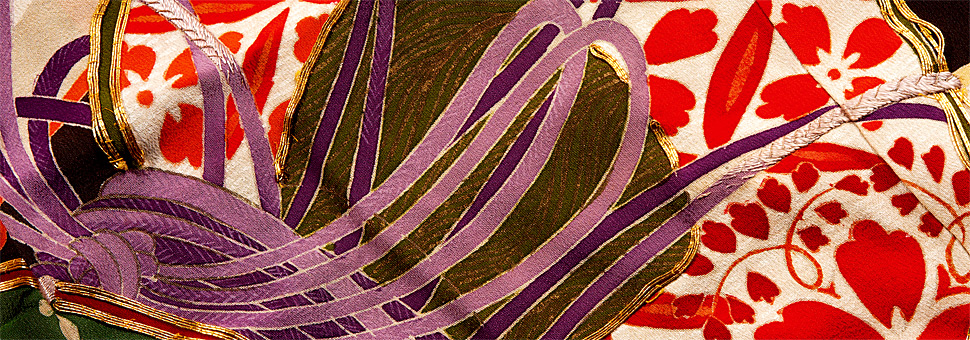
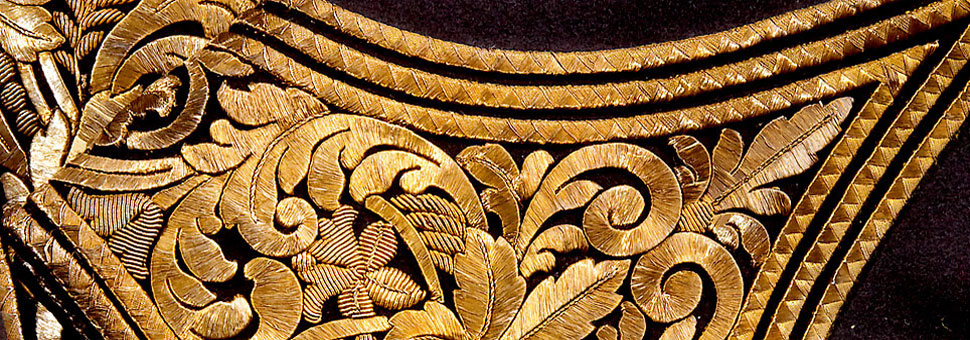
Sample of embroidered black cotton cloth with a square design enclosing various, interconnecting geometric shapes and applied mirrors. Factory woven cloth, hand embroidery (blanket stitch, stem stitch, chain stitch, couched herringbone stitch). India, late 20th century (TRC 2019.0286).Sample of embroidered black cotton cloth with a square design enclosing various, interconnecting geometric shapes and applied mirrors. Factory woven cloth, hand embroidery (blanket stitch, stem stitch, chain stitch, couched herringbone stitch). India, late 20th century (TRC 2019.0286).Embroidery is an ancient, diverse and important tradition for the decoration of garments and items around the home and public buildings. There are many forms of embroidery, literally hundreds, from the chain stitch examples found in the tomb of Tutankhamun (died c. 1323 BC) to the double sided embroideries of Han China, which are still being produced.

The aim of this interactive study day is for the participants to understand the main techniques, and to look and study the various tools and materials used during the process of making a piece of embroidery. Throughout the day, examples from the TRC’s extensive collection of embroideries from around the world will be examined to see how men and women over the centuries have made and used this decorative form of needlework.

The study day is given by Dr. Gillian Vogelsang-Eastwood, a specialist in the field of embroidery history and author of the series Encyclopedia of Embroidery from ..... (London: Bloomsbury 2016ff.). If you have a particular piece of embroidery you would like help in identifying, then you are welcome to bring it with you to the workshop.

  • Date: Friday, 8 May 2026.
  • Time: 10.00 - 16.00.
  • Venue: TRC Leiden, Boerhaavelaan 6, 2334 EN, Leiden.
  • Instructor: Dr. Gillian Vogelsang-Eastwood.
  • Language: Dutch and English, as required.
  • Costs: 85 euro. Coffee, tea and materials are provided. Please bring your own lunch.
  • Maximum number of participants: 8. Minimum: 4. If the minimum number of participants is reached, confirmation and invoices shall be send.

 Please register in advance: This email address is being protected from spambots. You need JavaScript enabled to view it.

Search in the TRC website

Contact

Boerhaavelaan 6
2334 EN Leiden.
Tel. +31 (0)6 28830428  
office@trcleiden.org 

facebook 2015 logo detail 

instagram vernieuwt uiterlijk en logo


Bank account number

NL39 INGB 0002 9823 59, in the name of the Stichting Textile Research Centre.

TRC closed until 4 May 2026

The TRC is closed to the public until Monday, 4 May 2026, due to our move to the Boerhaavelaan. The TRC remains in contact via the web, telephone and email. For direct contact and personal visits, please contact the TRC at office@trcleiden.org, or by mobile, 06-28830428.

Donations

The TRC is dependent on project support and individual donations. All of our work is being carried out by volunteers. To support the TRC activities, we therefore welcome your financial assistance: donations can be transferred to bank account number (IBAN) NL39 INGB 000 298 2359, in the name of the Stichting Textile Research Centre. BIC code is: INGBNL2A.

 You can also, very simply, if you have an iDEAL app, use the iDEAL button and fill in the amount of support you want to donate: 


Since the TRC is officially recognised as a non-profit making cultural institution (ANBI), donations are tax deductible for 125% for individuals, and 150% for commercial companies. For more information, click here