• F3
  • F4
  • F2
  • F1

Bethlehem jacket, early 20th century, TRC collection.Bethlehem jacket, early 20th century, TRC collection.TRC Gallery, Leiden; 10 March until 22 August, 2010


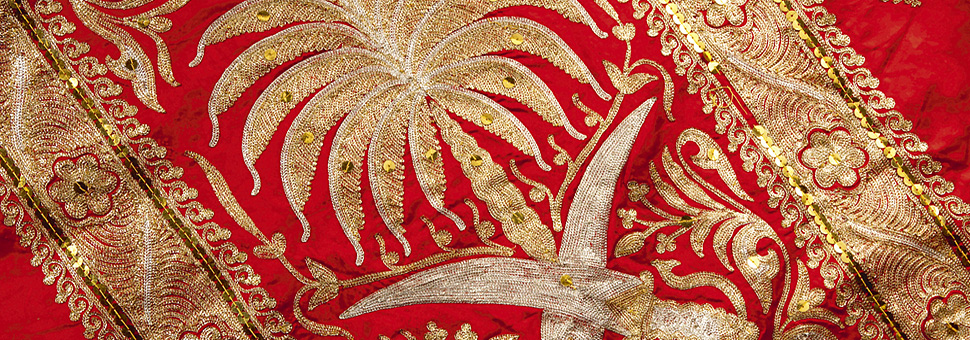
The world of Islamic and Arab art is well-known for its beautiful calligraphy, its manuscript miniatures, the exquisite geometric designs on wood, its pottery and silverware, but little has been said until now about another important aspect of Arab culture, namely its embroidery. For hundreds of years, embroidered textiles have decorated homes, public buildings, animals (especially horses), as well as the clothing of men, women and children. Embroidery has played a role in the social and cultural life of communities, as well as reflecting economic and political changes. This is the first time in The Netherlands that an exhibition has been dedicated to the various types of embroidery from the Arab world. On display are over 60 examples of embroidery, from various Arab countries including the Eastern Mediterranean, Egypt, Morocco, Oman, Saudi Arabia, Syria and Yemen.

The exhibition looks at various styles of embroidery and how this versatile textile technique is used to decorate men and women’s clothing in a wide variety of forms, colours and designs. The role of the French embroidery company of DMC is highlighted as it has influenced Arab embroidery, especially that from the Mediterranean region, for well over 100 years. The oldest embroideries on display are two fragments from children’s tunics, which date from about the 5th century A.D. These rare pieces come from Coptic Egypt. More recent items include an early 20th century dress and velvet jacket from Bethlehem; a late 20th century man’s cloak from the High Atlas mountains of Morocco, Bedouin dresses from the Northern Sinai; wedding dresses from Morocco, the Siwa Oasis (Egypt) and Saudi Arabia, as well as various types of indigo dresses from Yemen. Some of the embroideries on show are made out of silk, others of linen or wool. Some garments on display are decorated with large, abstract and colourful patterns, other examples are small, geometric and very precise. Many garments are further embellished with a wide range of beads, shells, coins and amulets. All objects derive from the collection of the TRC, Leiden.


Address: Hogewoerd 164, 2311 HW Leiden
Telephone: 071-5134144
Email: This email address is being protected from spambots. You need JavaScript enabled to view it.
Website: www.trc-leiden.nl
Opening times: Monday to Wednesdays from 10.00 until 16.00, other days by appointment only. From March 24-28, during the Leiden Textile Festival, the TRC is open every day.


Opening of the TRC exhibition on Arab embroidery, on 9th March, 2010.Opening of the TRC exhibition on Arab embroidery, on 9th March, 2010.


oya necklaceoya necklace For hundreds of years Turkey has been famous for the production of decorative textiles, including a wide range of gold and silk embroideries of the highest quality. But there is also a ‘minor’ textile art produced by Turkish women, which is not so well-known. This textile art is generally called oya or Turkish lace. The term oya includes a range of lace techniques that are used to decorate garments, especially women’s headscarves, and a wide variety of household textiles such as sheets, tablecloths and towels. The exhibition explores the different types, namely crochet, needle, hairpin and tatting techniques, which are used to make oya, and the different forms of two and three-dimensional oya lace.

  • Date of the exhibition: 1st December 2009 - 28th February 2010
  • Location: TRC Gallery, Hogewoerd 164, 2311 HW Leiden
  • Open: Monday - Wednesday 09.00 - 16.00 hrs, or upon appointment
  • Tel. 071-5134144 or 06-28830428

The TRC provides fourteen clothing outfits for large Oman exhibition in the Nieuwe Kerk, Amsterdam

For the large, international exhibition on Oman, which is shown in the Nieuwe Kerk, Amsterdam, the TRC has provided a set of fourteen outfits from various parts of Oman. The outfits for men, women and children come from various cities and regions of Oman and represent the wide range of dress styles worn in the country. The diversity of colours, patterns and forms reflects local and Bedouin origins as well as influences from neighbouring countries such as the Gulf States and Yemen, as well as more distant trading countries including India, Iran and East Africa, notably the island of Zanzibar.

TRC clothing at Oman Exhibition. Photograph by Joergen KoopmanschapTRC clothing at Oman Exhibition. Photograph by Joergen Koopmanschap

The exhibition was opened by Their Royal Highnesses The Prince of Orange and Princess Maxima, on 17 October 2009.

The exhibition will run until 18 April, 2010. For further information, click here.

Address:

De Nieuwe Kerk
Dam, 1012 JS Amsterdam
Tel. 020-6386909
Monday to Sunday 10.00-18.00 hrs; Thursday until 22.00 hrs.

KANGAS: An East African garment for women

A kanga is a large cotton cloth worn by women along the whole of the East African coast, especially in Kenya, Tanzania and the island of Zanzibar. Its characteristic feature is the short text printed on the cloth. Kangas are also worn by some women in Oman, due to long standing, historical connections between the various countries.

Kangas and similar garments have been part of the East African, Swahili dress code since the late 19th century. There they are still regarded as an essential item of a woman’s wardrobe. They are worn on a daily basis in and around the home, as well as for important occasions such as weddings and funerals. But their designs, colours and texts are not static. They are constantly being modified and adapted to the current political and economic situation and customer demands. Throughout the decades kangas have adopted textual and decorative elements from African, Arab, Indian and European sources. As a result, modern kangas reflect the international nature of Swahili culture.

Date of the exhibition: 3rd November 2009 - 28th February 2010. Location: TRC Gallery, Hogewoerd 164, 2311 HW Leiden Open: Monday - Wednesday 09.00 - 16.00 hrs, or upon appointment Tel. 071-5134144 or 06-28830428.

Page 3 of 3

Search in the TRC website

Contact

Boerhaavelaan 6
2334 EN Leiden.
Tel. +31 (0)6 28830428  
office@trcleiden.org 

facebook 2015 logo detail 

instagram vernieuwt uiterlijk en logo


Bank account number

NL39 INGB 0002 9823 59, in the name of the Stichting Textile Research Centre.

TRC closed until 4 May 2026

The TRC is closed to the public until Monday, 4 May 2026, due to our move to the Boerhaavelaan. The TRC remains in contact via the web, telephone and email. For direct contact and personal visits, please contact the TRC at office@trcleiden.org, or by mobile, 06-28830428.

Donations

The TRC is dependent on project support and individual donations. All of our work is being carried out by volunteers. To support the TRC activities, we therefore welcome your financial assistance: donations can be transferred to bank account number (IBAN) NL39 INGB 000 298 2359, in the name of the Stichting Textile Research Centre. BIC code is: INGBNL2A.

 You can also, very simply, if you have an iDEAL app, use the iDEAL button and fill in the amount of support you want to donate: 


Since the TRC is officially recognised as a non-profit making cultural institution (ANBI), donations are tax deductible for 125% for individuals, and 150% for commercial companies. For more information, click here