
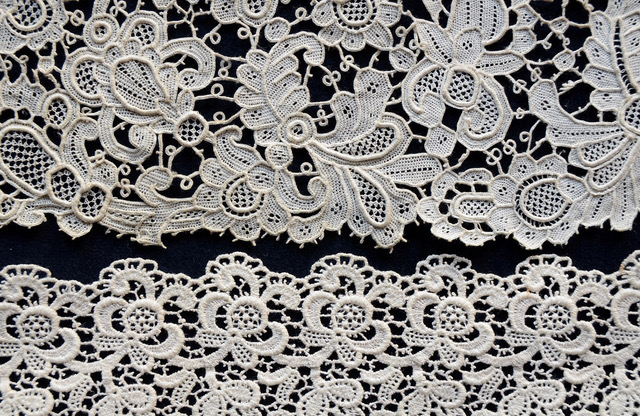
 Photorgaph showing two pieces of lace. The one on top (TRC 2007.0559) is handmade, the one below (TRC 2007.0595) is machine made.On Saturday 25th May, Lisa Dilitz wrote:
My name is Lisa Dilitz, and I am from Innsbruck, Austria. I am in Leiden for one year while I study for a Master's in Arts and Culture at the University of Leiden. As I am particularly interested in textiles I have been working as a volunteer at the Textile Research Centre since October 2018.
Initially my main work was to help digitalise the Iranian textile and dress collection. However, for my Master’s Thesis I wanted to focus on digital fashion and textile exhibitions, therefore my task at the TRC changed a bit. Digital or virtual exhibitions are a relatively new approach to curation, which is conducted in cyberspace.
New technology has the potential to make collections of cultural institutions accessible, visible, broadens the audience reach, expands the physical exhibition space and provides new learning opportunities. Digital exhibitions are a credible method for cultural institutions to reach out, present their collection and share knowledge.
The TRC began to publish online exhibitions in 2017 and uses this curatorial approach to interact on a global scale. I was given the chance to create a virtual exhibition myself, which helps me to develop my own research. I have teamed up with Olga Ieromina, a volunteer at the TRC and a lace specialist. We are working together on a digital lace exhibition for the TRC website.
How did we work? Olga and I have been meeting once a week at the TRC, starting from the beginning of February. The first question was: What do we want to exhibit? We decided on presenting a juxtaposition of handmade lace and their machine made imitations. We went through the TRC collection and found some suitable matches. For multiple sessions we were narrowing down the examples to seven pairs and carried out the necessary research. Thereafter we wrote the text labels.
I discovered that after writing the labels, the processes of implementing a physical or digital exhibition take a different path, and we started on the digitalisation process. Olga and her husband took high quality photographs of the laces. The images of the objects were uploaded on a computer, named and ordered into categories corresponding to the examples. We adjusted the images if necessary and balanced out the light and colour. Currently we are deciding on the best layout for the exhibition and doing some last refinements. The digital lace exhibition will go online in June.