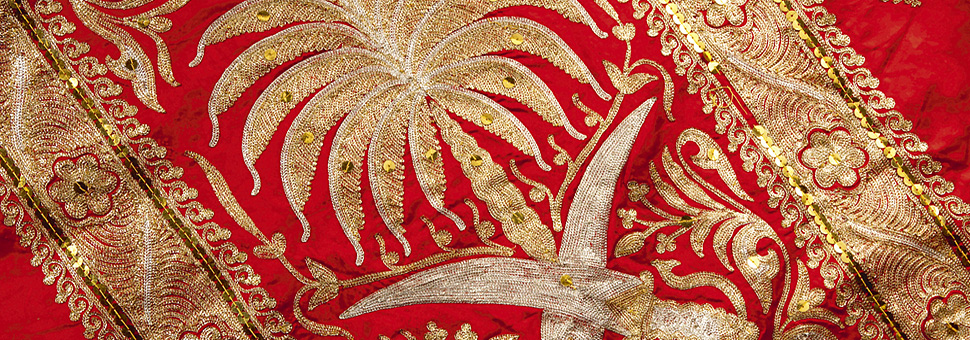

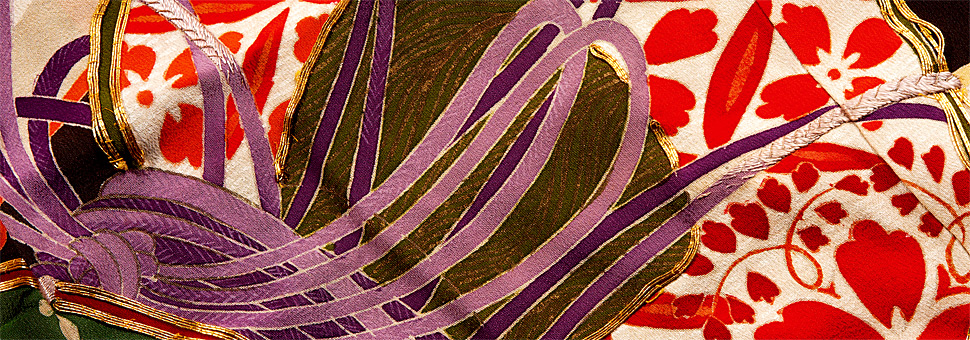
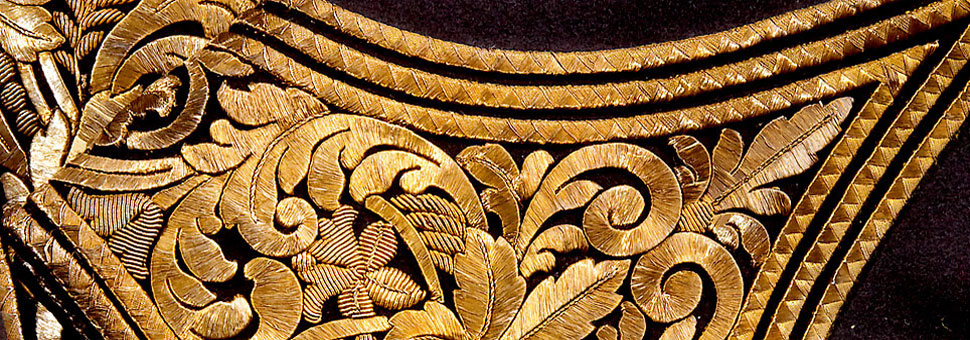
Publishing an on-line digital record of a collection allows the public greater access. That’s why the TRC has its entire collection of over 14,000 textiles, garments, accessories (headgear, footwear, jewellery, walking sticks, etc.), plus textile tools involved in hand spinning and weaving, on-line. While not every item has a detailed description or photograph yet, it does allow the interested public, including researchers and collectors, access to our international collection. This includes fragile items that might be damaged by light or moisture if put on public display.
Twelve Dutch museums for these same reasons joined hands in 2015 to share their collections via the on-line platform www.Modemuze.nl. A small but interesting display of real-time textiles and fashion accessories from this collaboration can be seen in Amsterdam’s Central Public Library (OBA). The handful of dresses chosen for display range from the traditional to the futuristic. The ‘traditional’ includes an evening gown of Queen Juliana (1909-2004), made in 1948 by the Swiss designer Erwin Dolder. It was worn on several occasions by the Queen, including during her first official visit to France in 1950. What intrigued me was that Princess Margaret wore the same gown in 1983, during a visit to Canada.
A more futuristic dress was made in 2015/2016 for the ‘Velero’ collection by designer Jef Montes, in cooperation with the Textielmuseum Tilburg. This was a floor-length, voluminous garment made with a mix of gold metallic thread, carbon and glass fibres. My favourite is a dress designed in 2002 by Dutch textile artist Claudy Jongstra. This is an elegant, strapless floor-length dress, made of felted wool and silk. It was commissioned by a Japanese woman for her wedding dress. It’s an off-white colour, which makes the vivid red phoenix stitched on the back even more striking. The large felted bow on the back is reminiscent of the obi on a traditional kimono. Interspersed between the dresses are displays of purses and hats—and lap tops where the visitor can access thousands of more textiles.
The exhibit is on until May 31. A series of lectures has also been organized: see www.oba.nl for more information. And don’t forget to look at some of the textiles in the TRC’s on-line collection at www.trc-leiden.nl/collection/. Every week new information is added to the database by a team of dedicated colleagues.
Shelley Anderson, 4th April 2017