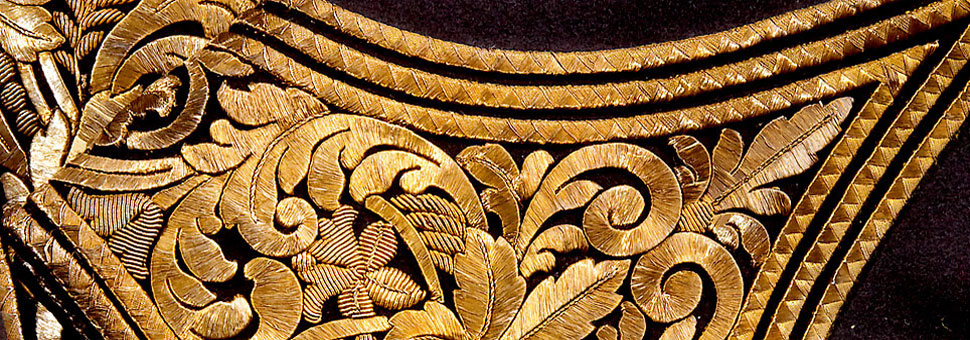

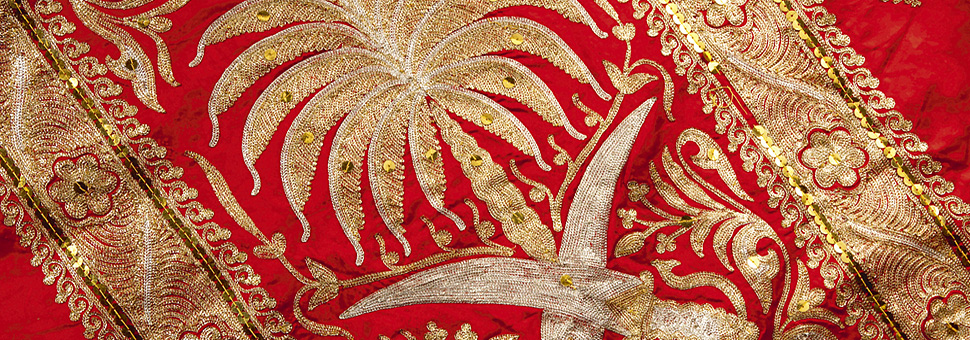
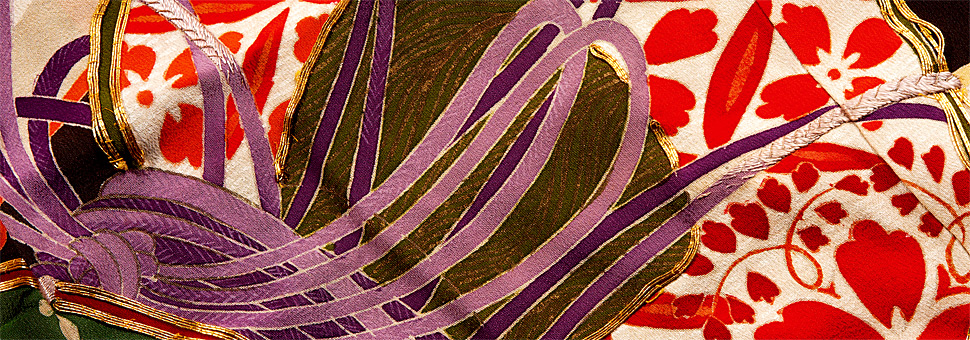
 Petal crown of Bogd Khaan, with gold, silver, pearl, Indian gyasar gold-thread brocade, velvet, early 20th century, Bogd Khaan Palace Museum, Ulaan Baatar, Mongolia.Well, while Karakorum did not provide much in the field of textiles and dress (see below), a visit to the Bogd Khaan Palace Museum in the Mongolian capital, this morning, was really amazing. The complex, which dates to the late 19th and early 20th centuries, includes a summer and winter palace. While the Summer Palace (being a complex of buildings erected in traditional style) contains mainly religious objects, including appliqués and paintings, the Winter Palace (built in European/Russian style) houses a wealth of other objects, including a large number of gorgeous, and above all very intriguing garments, and not to mention Bogd Khan's personal collection of stuffed animals and some of his coaches (made in England, thank you). The Winter Palace is one of these buildings, rather like Huis Doorn in The Netherlands, where Kaiser Wilhelm spent the last twenty years of his life, or his former palace in Potsdam, where you get the feeling that nothing has changed since the royal occupants left the premises (together with the servants and the maid, who quite surely also took the vacuum cleaner).
Bearing in mind the rumours that the royal occupant of the Winter Palace led a rather debaucherous life (for good religious reasons, of course), this only adds to the atmosphere. The Winter Palace in Ulaan Baatar was occupied by Bogd Khaan until his death in 1924. He was the last of the secular/religious leaders of Mongolia (I will spare you the details). He was actually born in Tibet, and at the young age of four or five taken to Mongolia. Some of the clothes he was wearing when he was taken on this long journey can acually be seen in the museum, together with many of his toys. Most fascinating however are the ceremonious robes and other garments (including hats, boots, jackets etc.) that he wore on various occasions. The museum also contains many of the garments worn by his wife, the Queen Dondogdulam. Much of the original furniture is also there, including a chair on which the Queen used to sit. There is actually a photograph showing the Queen on that chair. Furthermore, rather amusing, two real musical chairs for the royal couple (they actually produced music when people sat down on them), a gift from the Russian tsar.
Willem Vogelsang, 20 September 2015