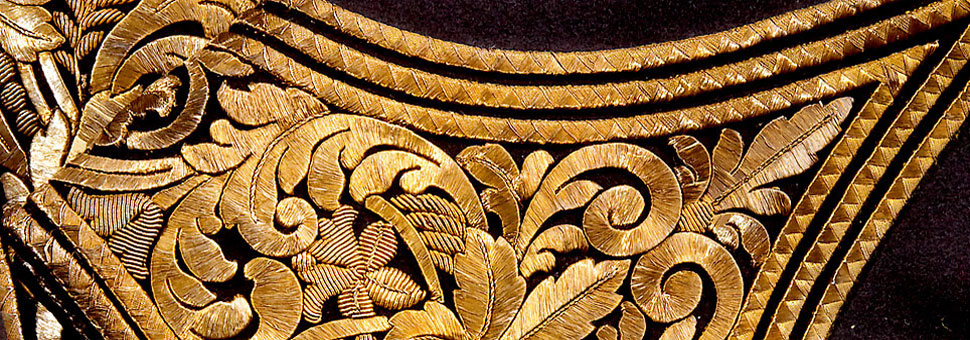
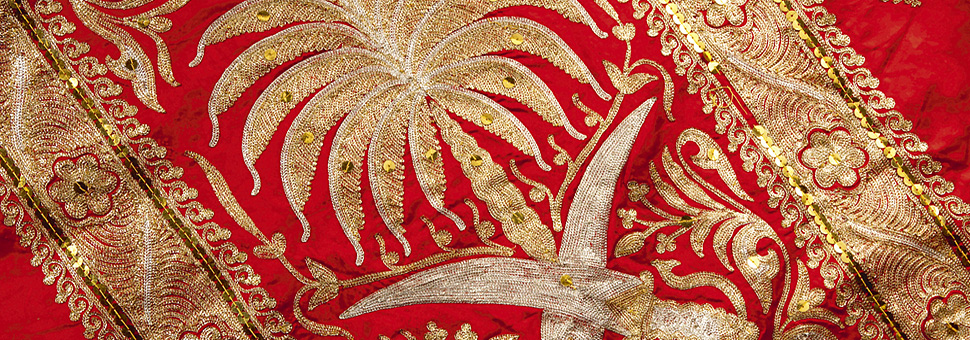

 A new TRC donation: white cotton nanduti lace dolly, c. 2010, Paraguay (TRC 2026.0646).The TRC has two recent donations of a very special type of lace from the South American country of Paraguay. This lace has its own National Nanduti Day, celebrated on the second Sunday in October. On that day the city of Itaugua, considered the home of nanduti lace, organises a festival whereby women wear traditional blouses and skirts decorated with nanduti lace.
Nanduti means “spider web” in Paraguay’s indigenous language, Guarani. There are many folktales about nanduti’s origins. These usually involve a young woman who discovers her dead lover’s body, covered in a shimmering cloth. Looking more closely, she realises the cloth is actually made of spider webs, and she vows to make him an equally beautiful shroud.
Less poetically, it’s believed that 17th-century Spanish colonisers brought the technique of lace making to Paraguay, where the indigenous population made it their own. Jesuit missionaries, who prized lace for their ecclesiastical textiles, are believed to have spread lace making via their missions. Indeed, one of the earliest references to indigenous Paraguayan women’s skill in needlework is from a 1610 Jesuit document, which mentions decorated towels.
Technically, nanduti lace is related to Tenerife lace (sometimes spelled Teneriffe, and known as Sol lace, or Roseta Canario or Calado Canario), which originated in the Canary Islands. It is a type of needle lace known for its round, medallion-shaped motifs, comparable to nanduti lace forms. The TRC has several examples in its collecion, including a stunning, late 19th-century lace collar (see below; TRC 2020.0462).
 Four blue and white nanduti lace coasters, cotton, 2025, Paraguay (TRC 2026.0647a-d).
In Tenerife lace, the medallions are made separately, on circular cards or wheels with pins stuck in around the edges. Threads are stitched across the circle around the pins. These are called the radial threads. Once they are in place, a needle weaves in the rest of the pattern. When the medallions are finished, the pins are removed and the rounds are decoratively stitched together.
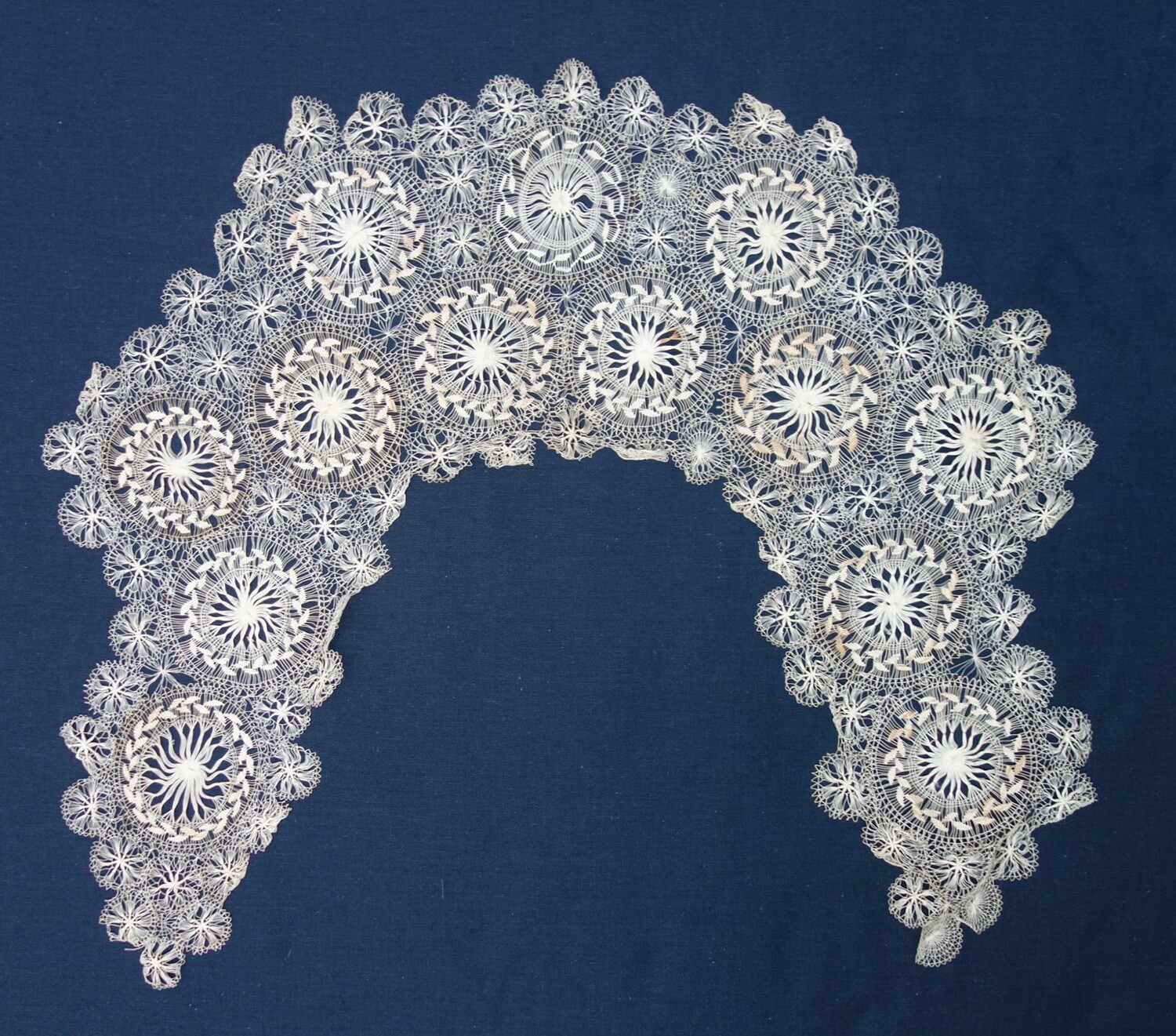 Tenerife lace colar, late 19th century (TRC 2020.0462).
The TRC also has several of these Tenerife lace-making wheels in its collection (see a separate TRC blog of 16 December 2023 by Gillian Vogelsang). There was a fad for making Tenerife lace in the early 20th century, and a lot of ingenious patents were issued for various tools to make the medallions, like the American “crazy daisy winder” (TRC 2020.4400a) or the British “Vicars’ Lace Tablet” (TRC 2015.0632). There were also oval-shaped tools, and square-shaped ones, such as TRC 2023.2319.
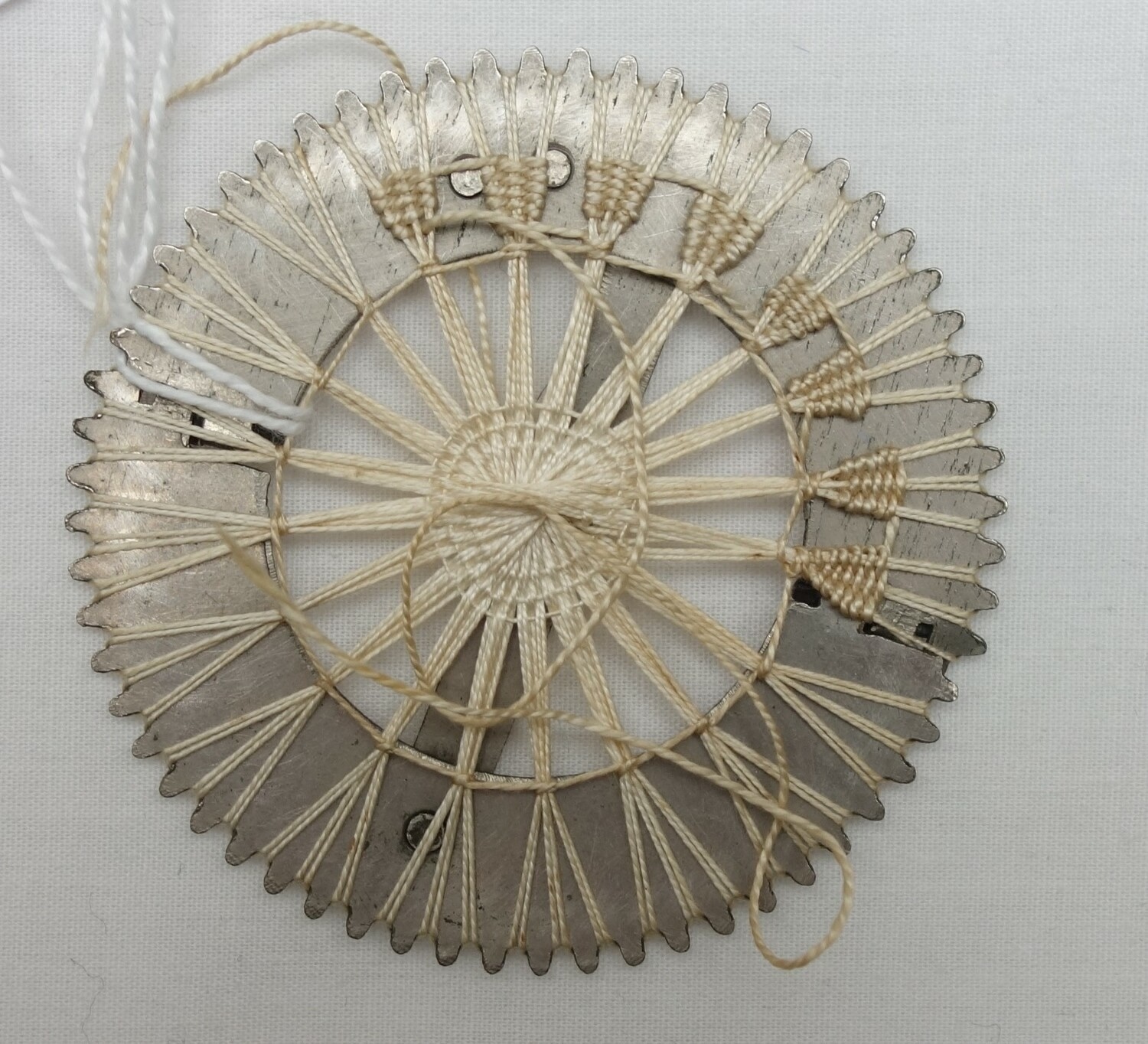 Tenerife lace loom, early 20th century (TRC 2023.2316c).While nanduti lace is related to Tenerife lace (some would even say it descended from Tenerife lace making), there are differences in how it is made. Both types are needle laces, and both feature the characteristic round, medallion-shaped motifs. There are three stages in nanduti lace making, each named after the principal tool used.
The first, or “pencil” stage, involves tightly stretching a background cloth across a frame. The entire pattern is then drawn with a pencil on the background cloth. In the next, or “needle” stage, radial threads are made in all the medallions, using either a running stitch, or by stitching directly through the background cloth. Fine cotton or silk thread is used. Traditionally, white or cream coloured thread was used, but many lacemakers today use different colors.
Once the medallions are completed, they are woven together, the needle no longer piercing the background cloth. When the entire pattern is finished, the “scissor” stage begins, and the background cloth is carefully cut away. The lace is washed and dried, and then starched, using cassava starch.
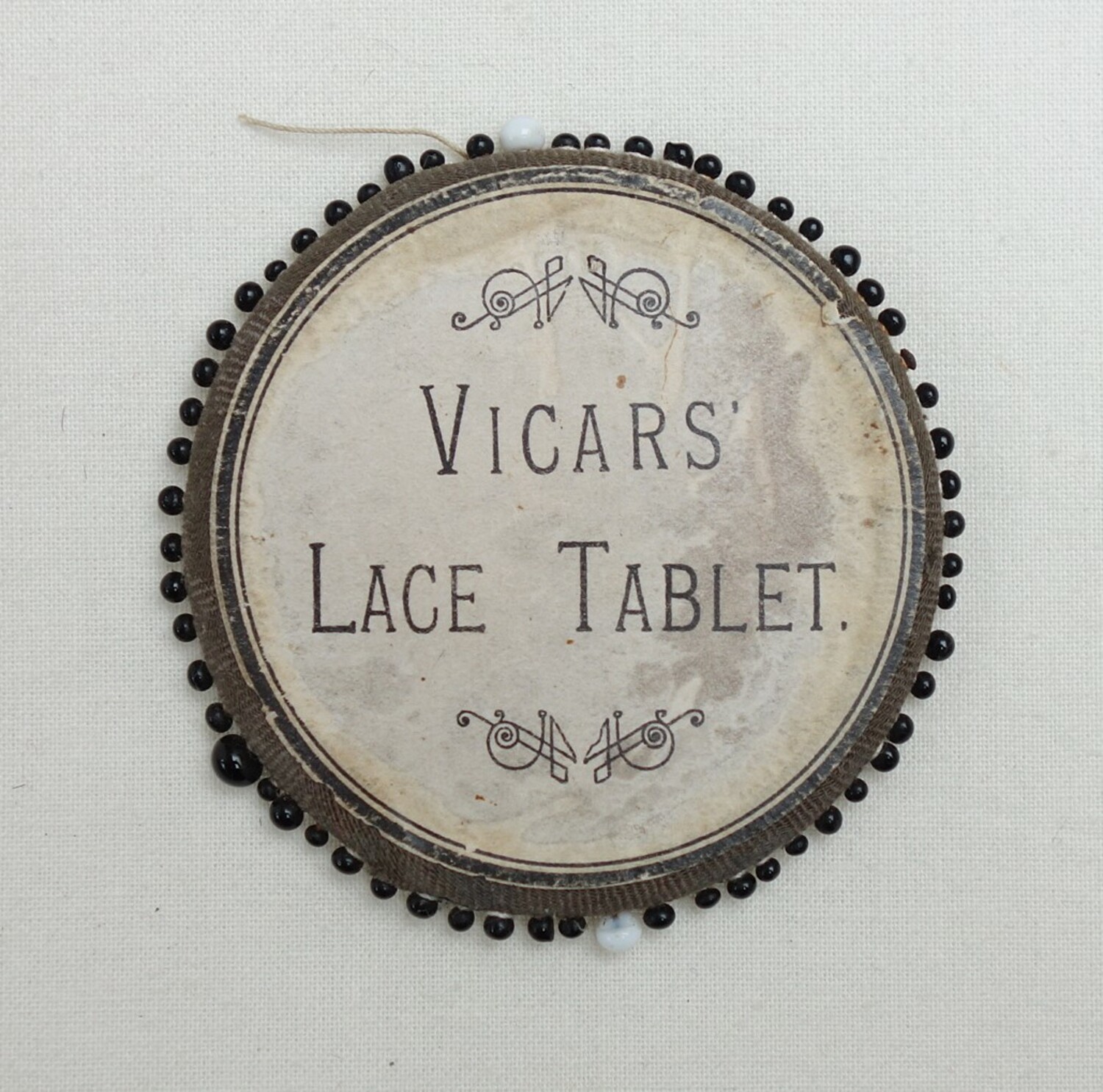 Vicar's lace tablet from the UK, late 19th century (TRC 2015.0632).Paraguay has many rich, textile traditions, which include nanduti lace, ao po’i embroidery (a counted thread technique, which also uses drawn thread work) and the unique poncho para’i de 60 listas (poncho of 60 stripes, which was added to UNESCO’s Intangible Heritage list in 2023). All these skills are labour intensive and in danger of disappearing.
But today is not the first time nanduti lacemaking has come under threat. From 1864 to 1870, Paraguay suffered a devastating war, considered the deadliest in Latin American history. By the time the war ended, over half of the population had been killed. The story goes that only one lace maker in the town of Itaugua survived. She quickly resumed nanduti lacemaking in order to support herself and her children. She taught other women, who were soon producing lace for clothing, tablecloths, fans, and parasols, for an influx of wealthier immigrants.
We can hope that the pride in and skills of Paraguay’s incredible textile tradition continue.
By Shelley Anderson, 13 March 2026.
- For more on nanduti lace, two websites are pertinent: click here or here.
- For a video on nanduti lacemaking, click here.
- For a UNESCO video about another endangered Paraguayan textile, the poncho para’i de 60 listas, click here.