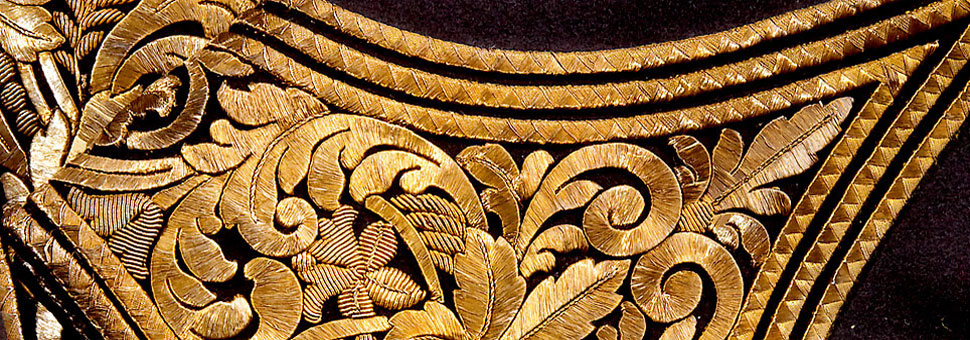

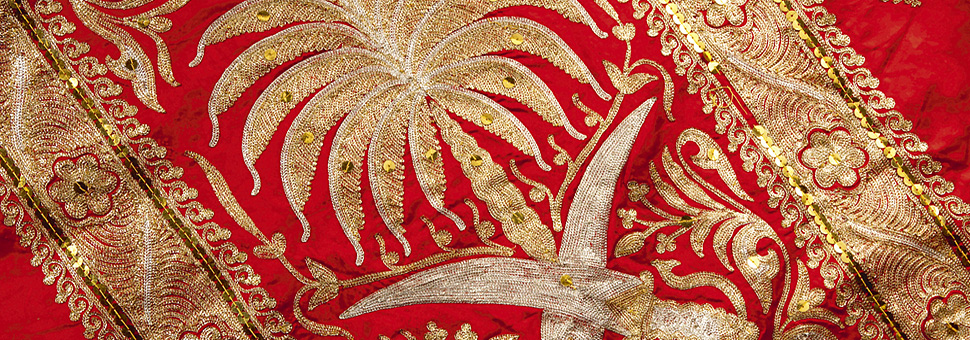
 Jacket made of reed and cotton, China, 20th century (TRC 2023.2071).It's been an incredibly busy time at the TRC! So what's new, you may ask, it is often busy at the TRC, but this is more so than normal!
A few weeks ago, Quirina Vreeburg, from Haarlem, emailed saying she had two more boxes of Chinese textiles and garments for us. Quirina is slowly giving the TRC her collection of Chinese items that formed a small, private museum and lecturing collection (see earlier blog).
There are 67 items in the current selection, including gowns (Han and Manchu), single wrap-around skirts and double skirts, some amazingly embroidered jackets, as well as a jacket made up of small pieces of reed strung together to form a diamond net (TRC 2023.2071). There are also various embroidered panels from jackets, skirts, etc. The donation includes a pair of mourning lotus shoes in white, and two pairs of nineteenth century glasses with articulated side arms. There is a lovely headband decorated with panels of kingfisher feathers (TRC 2023.2074). And let us not forget an embroidered panel that looks like a stylised owl (TRC 2023.2078), but is it actually an owl?
 Black satin headband, China, 20th century (TRC 2023.2074).
All of these pieces have now been catalogued and are in the process of being photographed. They will all be online next week. I am very curious what will come in the next two boxes!
Thanks to the help of Kris Schiermeier, director of the SieboldHuis, Leiden, on Saturday 21st October a group of Japanese items were delivered to the TRC that have been donated by Keiko Okamoto. These are part of her family’s collection of items produced by her grandfather’s kimono company in Kyoto and items worn by her grandmother, mother and by Keiko herself (see earlier blog).
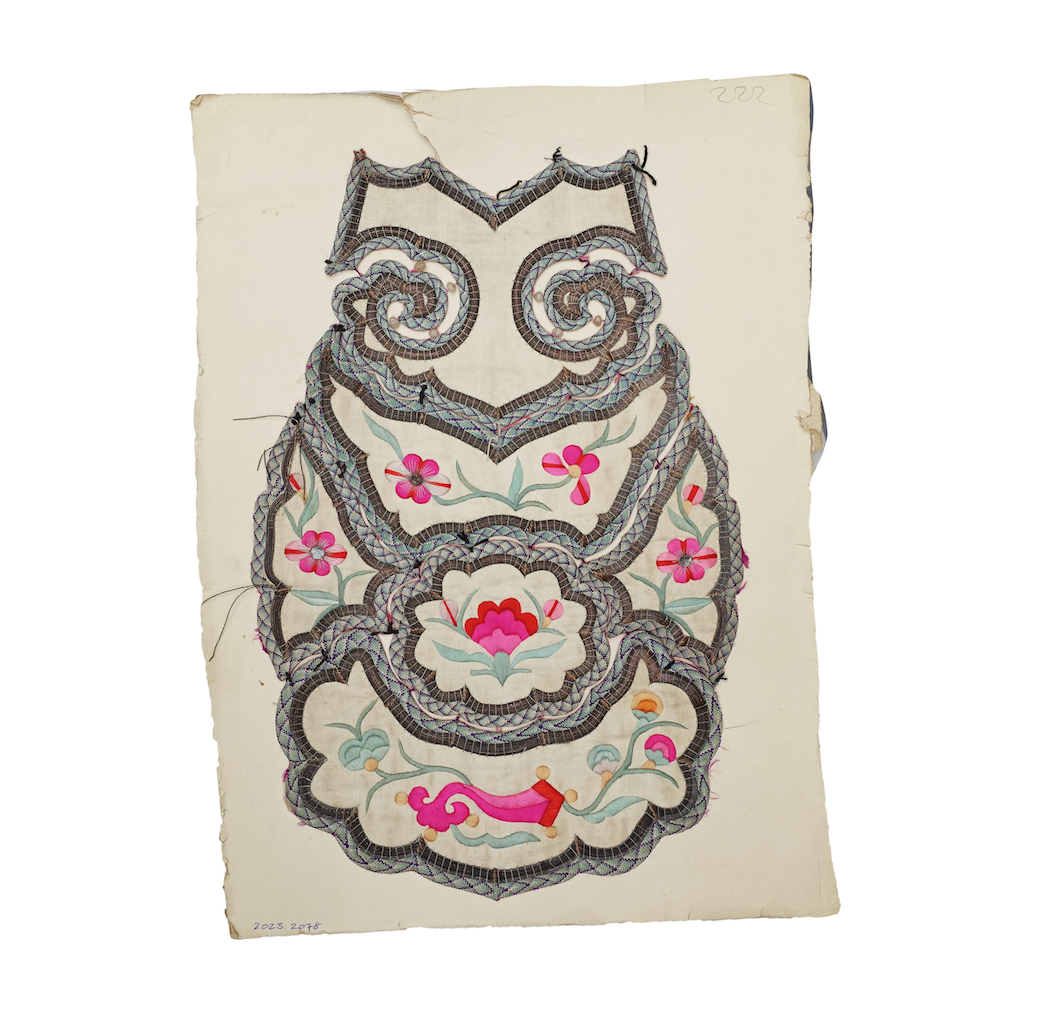 Embroidered panel, China, early 20th century (TRC 2023.2078).The current donation consists of over 100 accessories and kimono swatches, including some lovely beaded bags, a range of sandals (including a beaded example, which raised the question how comfortable are these to walk in?). I fell for some samples of painted kimono material with swimming ducks on them….
In a few days time I will be starting to catalogue a group of over 60 woollen ikats for winter kimono. All of these items should be online within the next few weeks. These and other items are going to be used in various online and actual exhibitions, including one planned with The Japanese Museum, SieboldHuis, Leiden.
In between these donations, we also had the October Intensive Textile Course with people from England, Italy, the Netherlands and the Philippines. We had great fun (sorry, that should read deep academic questioning of), spinning, weaving, natural dyeing, learning to read printed textiles, as well as having the chance to talk about textiles, people's research questions, and in general the important role textiles have and continue to play in the lives of everyone around the world. I am not sure where the week went, neither did the participants. But I do know everyone was very tired by 15.30 on Friday. The next intensive textile course is being held on the 27th November – 1st December 2023.
But there was not much time to recover from the October course! Because on the Sunday, Willem and I went to pick up a new and huge donation of needlework and lace, as well as related samples, needlework albums, pronkrollen, tools, patterns, advertisements, etc. from Hennie Steven-Bathoorn and Sjoerd Stevan. They used to run a small needlework museum (Naaldkunst Museum, Winschoten), but due to various reasons they closed it a few years ago. Various pieces were donated to other museums, such as a collection of samplers, but the TRC was more interested in the ephemera and small tools. Initially we had not realized this would mean c. 6,500 items!
We have started to sort out the c. 60 boxes, and we have already found they include some really interesting items, including a 19th century fichu, detachable sleeves, lace caps for women and children, samplers (marking, letters, darning, general), etc. There are boxes of pattern books, transfers, charts, etc., many of which we will scan and put online. We reckon it will take about a year to work our way through all the boxes and sort out what the TRC needs, objects for other institutes, and items for the TRC shop.
One of the questions we get is why accept all of these pieces when the TRC is acutely short of space? Well, mainly because these types of donations are only offered once and we want to add depth to the unique and diverse nature of the TRC Collection. And yes, we are very aware we need more space and we are actively working with various groups to resolve this situation!
In the meantime we are looking for volunteers to help with the storage depot, photography, cataloguing, and the library…..
Gillian Vogelsang-Eastwood, 1 November 2023