I have just come back (10th – 16th May 2023) from an intense, yet relaxing time spent in Estonia looking at embroidered textiles for information and inclusion in Vol 5 of the Bloomsbury World Encyclopedia of Embroidery.
In addition, Willem and I were able to see and hear about a far wider range of textiles, dress and their uses, both in Estonia and in neighbouring countries. We also came away very impressed with the country, its museums and indeed, its food and countryside.
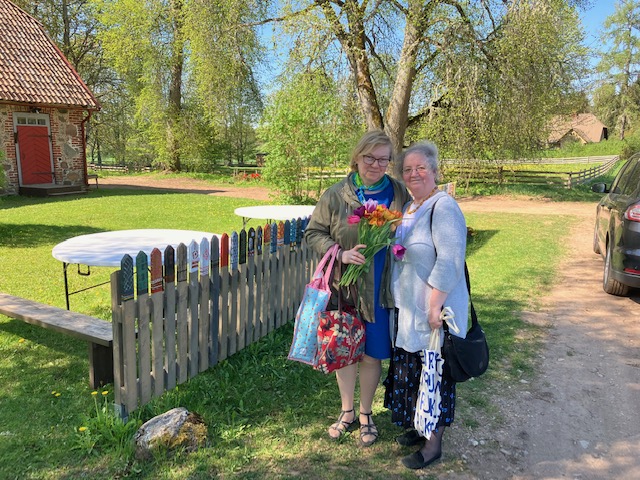 Merle Ernits and Gillian Vogelsang at the Heimtali Museum, Estonia; in the background a garden fence painted with knitted socks
The early morning of our first full day in Tartu, the second city of Estonia, we went with friend and guide, Merle Ernits (who lives in the Netherlands and is a regular visitor to the TRC) to visit part of the University of Tartu where a group of volunteers are making camouflage nets for the Ukrainian army. This visit is discussed in an earlier blog.
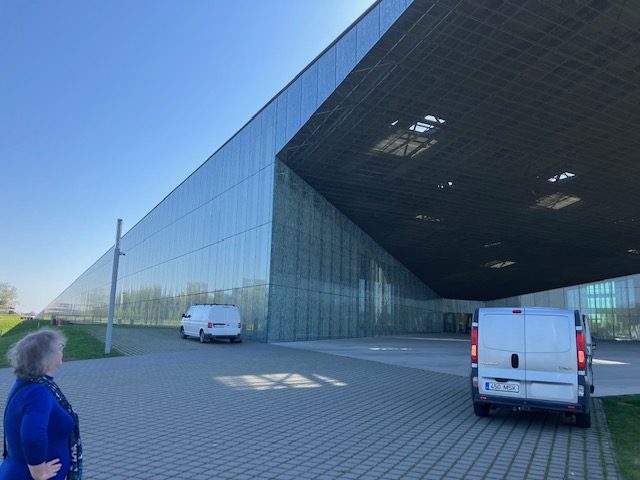 National Museum of Estonia (Eesti Rahva Muuseum), Tartu. Photograph by Willem Vogelsang.The anger felt by many people at the Russian invasion of Ukraine is very clear when talking with them. And given the history of Estonia, being invaded by various countries including Germany, Sweden and in particular, Russia, it is not really so surprising.
We then went on to our appointment at the Eesti Rahva Muuseum (National Museum of Estonia, ERM). The museum was founded in 1909 and looks at the history, life, culture and traditions of the Estonian people and other Finnic ethnicities, as well as minority groups in Estonia (such as German and Russian). The museum has a large and comprehensive collection of regional textiles and dress.
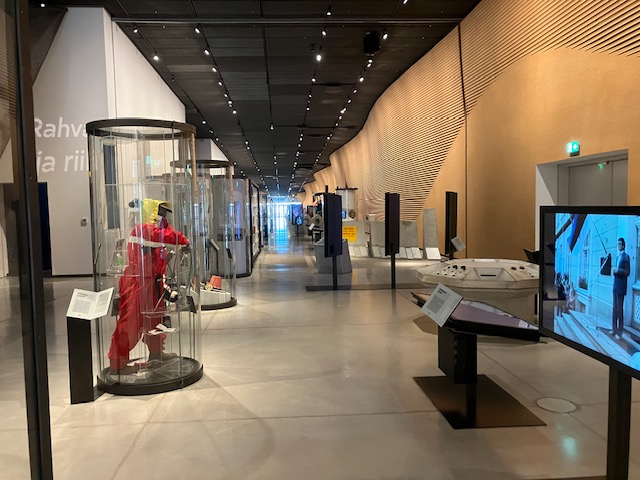 Inside the National Museum of Estonia (Eesti Rahva Muuseum), Tartu. Photograph by Willem Vogelsang.The current museum consists of an amazing building that was opened in 2016 and shaped like a very long runway. It is used as a cultural centre with a theatre and concert hall at one end and a museum at the other. The building is huge, with large open spaces for different functions.
There was an annual festival of the elderly on the first day I was there with folk dance groups in regional dress, as well as numerous stalls with goods and services from companies, political groups, clothing groups, even a honey seller, all geared towards the 65+ community.
I had sent the museum one week in advance a list of the embroideries I wanted to see based upon a book by Elle Vunder called Eesti rahvapärane tailmornament tikandis (2022), which includes many items from the museum collection. It was a long list, but nobody muttered, in fact they added extra items they thought I should see! What a difference from some museums where you have to book a place months in advance, and you get to see a maximum of three items for one hour in total.
 Inside the National Museum of Estonia (Eesti Rahva Muuseum), Tartu. Photograph by Willem Vogelsang.I was able to sit down for two days in the spacious museum research room (good lighting, plenty of table space, quiet, well organised facilities). I simply sat down and looked, and looked, and looked at embroidery from different regions of Estonia. Bliss.
The embroidered textiles I was researching ranged in date from the 18th to the mid-20th century, and included garments, especially blouses and shirts, headdresses, caps, sash ends, shoes, hand knitted socks with embroidered details, as well as various panels in a variety of techniques, including some lovely (and complicated) panels of seto embroidery (from southeastern Estonia) that uses double running stitch (Holbein stitch) and satin stitch in a wide variety of geometric patterns.
I was also able to look at some very different forms of embroidery using woollen yarns on a wool ground from the Karuse and Märjamaa parishes which are decorated with stylised flowers. The whitework examples from Muhu are amazing, using darning stitch, satin stitch and laidwork. What I found particularly intriguing was the variety of laidwork and interwoven fillings used for the centre of various, embroidered stylised flowers.
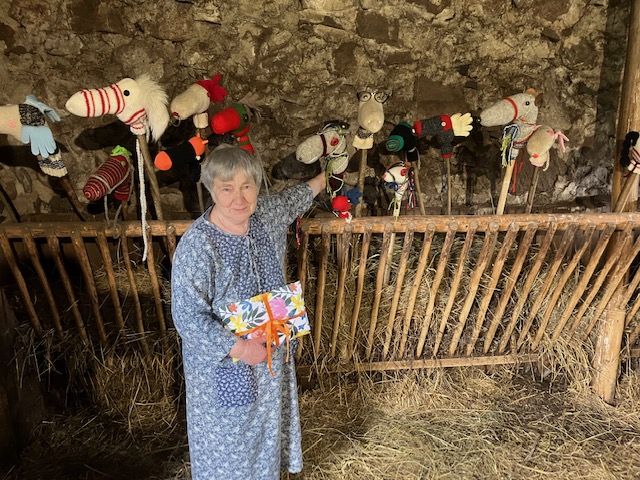 Anu Raud at her farm house at Heimtali, Estonia. Photograph by Willem Vogelsang.Then came a small surprise! Merle had talked with some of the folk dancers appearing in the festival and two came to the research room and kindly explained the embroidery on their garments and how each family had their own patterns. Some of the embroidery was over 100 years old. There were also modern elements such as the headdresses, but as they explained their traditions were developing, not rigid and moribund, as happens in some places where detailed rules are established about what can and cannot be worn. A feature that often kills any natural development of regional dress.
The second day at the museum was a continuation of the first, plus a chance to see some of the permanent exhibition spaces. I was shown around by Reet Piiri, the curator of textiles at ERM and we looked at the displays on regional dress, embroidered blankets, Finnish-Uralic life and an open storage area for a wide range of bags, many made out of re-used embroidery and other textiles. Lots to think about and well worth another trip to the museum to look at the displays.
 Cloth embroidered by Leida Kibuvits, an Estonian artist, while detained in the Siberian kulag from 1950-1954.I should add that the museum does not believe in dumbing-down, but emphasises the story behind. Texts are on small screens and if you put your ticket with its special QR code to the machine, then the language changes, in my case to English. I went away with the feeling of having seen and leant something very interesting!
I also had a quick lunch with Kertu Saks, the very busy director of ERM and we briefly discussed the important and underestimated role of textiles and dress and how we could work together in the future. The museum is going to help and support, for example, writing and illustrating the various chapters of the embroidery encyclopaedia.
The weekend was spent in Tallinn, the capital of Estonia, two hours away by train. A medieval town with lots of hills, cobbles, setts and flags, and well worth visiting. There are many craft shops selling locally produced woollen, knitted, leather, and felt goods, as well as jewellery.
 Leida Kibuvits. KIREV. Saatus ja loomingThen on the last full day in Estonia we went to the Heimtali Museum of Daily Life, which is a branch of the Estonian National Museum. This is a textile centre in the midst of the countryside housed in an old village school. It contains a small collection, and is mainly used for teaching purposes.
The collection includes objects made by, and related to Leida Kibuvits (1907-1976), an Estonian writer and artist. In 1950 she was deported to Siberia on the accusation of anti-Soviet ctivities; she returned four years later. She made various textile items, including embroidered garments.
At the centre I talked with the very helpful and knowledgeable curator, Tuuli Tubin McGinley, and met Anu Raud, who is an Estonian grand dame of textiles! She is a weaver of tapestry floor coverings and embroiderer who started in 1991 her own collection of regional textiles and dress. Later, the collection was included in that of the National Museum of Estonia, but teaching remains an important aspect being taught at Heimtali to a wide variety of age and interest groups, including the students from the nearby Viljandi Culture Academy of Tartu University.
The next day we travelled back to Leiden and had time to stop and think about the embroideries, encyclopaedia chapters, and equally important, how we can work with the ERM in order to make textiles and dress, especially Finnish-Uralic, Central and Eastern European forms, more well known in other parts of Europe and indeed the world. The museum’s holdings of textiles and how they approach, and support textile studies are impressive and thought provoking. It is amazing what can be achieved with plenty of space, as well as suitable financial and political support.
The rich textile crafts of Estonia, in general, are also something I want to explore further. It is very clear that in Estonia textiles are taken seriously. How textiles are still being taught as an important aspect of craft/artisan teaching is something I would like to know more about and explore in order to help support the ‘serious’ training of crafts people here in the Netherlands. We have a lot to (re)learn here!
Finally, I would like to thank everyone who made our trip to Estonia so interesting and useful (especially with respect to embroidery). It was and is greatly appreciated. We look forward to a return visit to discuss further possibilities.
Gillian Vogelsang-Eastwood, 22 May 2023