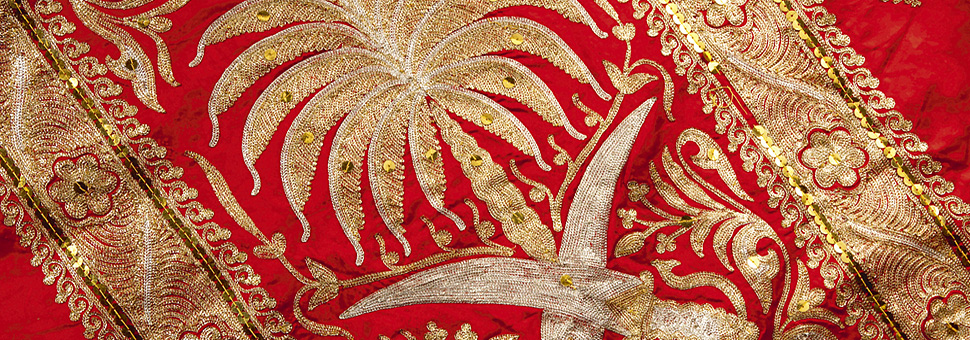
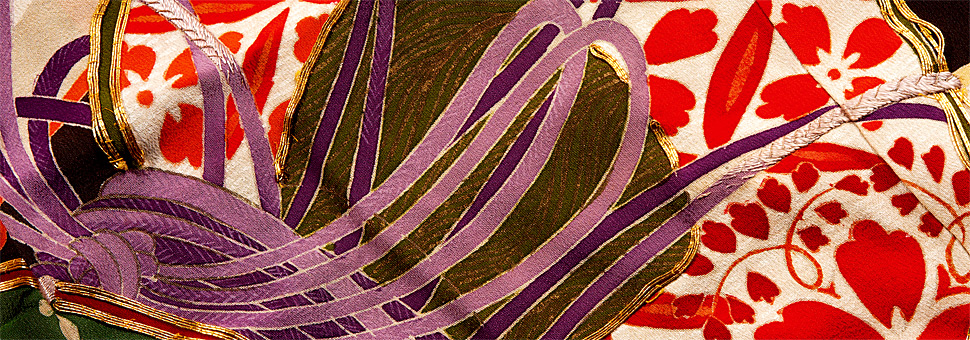

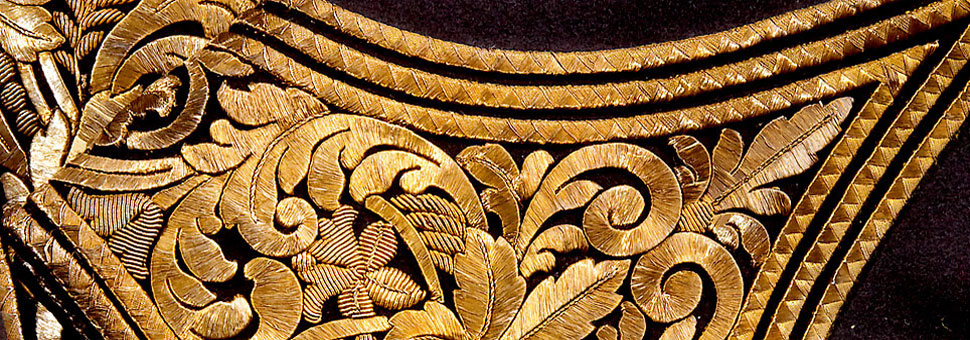
 Title page of Olfert Dapper's Naukeurige beschrijving ... (Amsterdam 1672).Last weekend I was browsing through a 17th century Dutch encyclopedia about Mughal India (as one does in the weekends), and to my surprise I came across a rather detailed account of the production and use of Kashmir shawls. Having a closer look at the text and doing some Googling I found out that the Dutch text was almost a verbatim translation of information contained in the work of a French physician and traveller, François Bernier (1620-1688).
I had known about the French record, and ploughed through it a long time ago, but the passage about Kashmir shawls had obviously escaped me. It often amazes me how much information and knowledge about Asia was available in Europe, and in particular in the Netherlands in the 17th century. In this case, his information about the Kashmir shawls I had missed completely; I am sure others writing about Indian textiles or Kashmir shawls in particular, will know about it, but still, many seem to have missed it as well. It remains fascinating, for me, to read these early details in a Dutch publication of the 17th century.
Bernier visited Kashmir in 1664-1665, and his report, Histoire de la dernière Revolution des États du Grand Mogol .... appeared in 1670 and 1671, while a more complete version, in 2 volumes, called Voyages dans les États du Grand Mogol was published in 1699, in Amsterdam, and abain in 1724. Other editions in various languages were published for many years.
The Dutch book I am referring to is called Asia, of naukeurige beschryving van het Rijk des Grooten Mogols, en een groot gedeelte van Indien: …. (‘Asia, or a detailed description of the Great Mughals, and a large part of India: …..’). The book was written by Olfert Dapper (1636-1689) and published in Amsterdam in 1672. It is a sort of encyclopedia, composed in the same vein as most of his other books, including his equally monumental Naukeurige beschrijvinge der Afrikaensche gewesten … (Amsterdam, 1668), or the Naukeurige beschryving van Asie : behelsende de gewesten Mesopotamie, Babylonie, Assyrie, Anatolie of Klein Asie : beneffens eene volkome beschrijving van gansch ... Arabie (Amsterdam, 1680). For all of his books (and he also published extensively about East and Southeast Asia, and yes, also about Amsterdam) he freely used information he copied from other books published in Holland or elsewhere in Europe, including in this case François Bernier's work. Plagiarism and copyright infringement had not yet developed into a mortal sin.
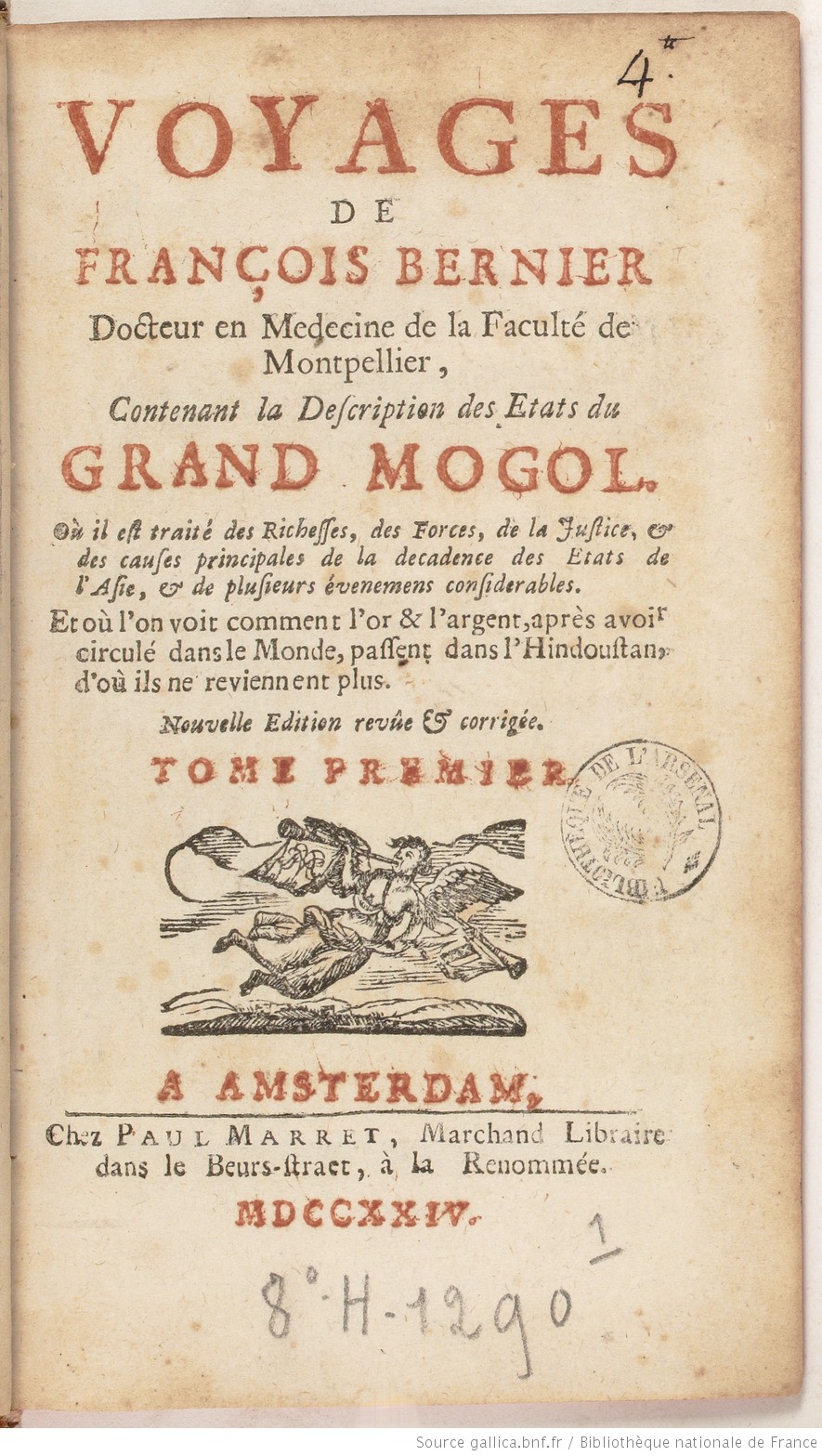 Title page of the Voyages ..... by François Bernier, published in Amsterdam in 1724.Anyhow, back to Kashmir. I will first present the Dutch text (sorry for that, but I like my own language), followed by a summary in English and some general comments. I used the original French text to elucidate certain matters. The Dutch text is taken from Dapper’s chapter on the kingdom of Kashmir (Het Koninkrijk of Landschap van Kaximir), pp. 274-283 of the original edition, esp. p. 282.
Dutch text:
“Maer hetgeen d’inwoonders byzonder en merkwaerdig hebben, en den koophandel en gelt in hun landt brengt, is die onuitsprekelijke groote menigte van sluiers of Chales, die zy daer maken, en de kleine kinderen daer aen zetten te werken.
Deze Chales zijn zekere stukken van stof, van ontrent anderhalve elle lang, en ontrent een elle breet, geborduurt aen beide einden met een zeker slag van borduursel, tot de brete ontrent van een voet.
De Mogols en Indianen, beide mannen en vrouwen, dragen dezelve des winters op het hoofd, met een slag over de linker schouder, als een mantel. Men maektze op tweederlei wijze: eenige van inlandsche wol, die veel fijnder en zachter, als de Spaensche is; en een ander van een zekere wol of liever van een zekere hair, Touz genoemt; welk groeit op de borste van zekere wilde geiten van groot Tibet.
Deze laetste zijn veel dierder, ten aenzien van d’andere: ja is geen hair van een bever zoo zacht noch fijn: hoewel zy [the cloths] de mot of wurm zeer onderwarig zijn, ten zy men daer wel op past, met dezelve dikwils uit te slaen, en te verluchten. Zy worden veel bij de grooten en Omrahs gedragen, en kosten eenige hondert en vijftig Ropias, (een Ropia gerekent op vierentwintig stuivers:) daer die van inlandsche wolle, niet boven vijftig te staen komen.”
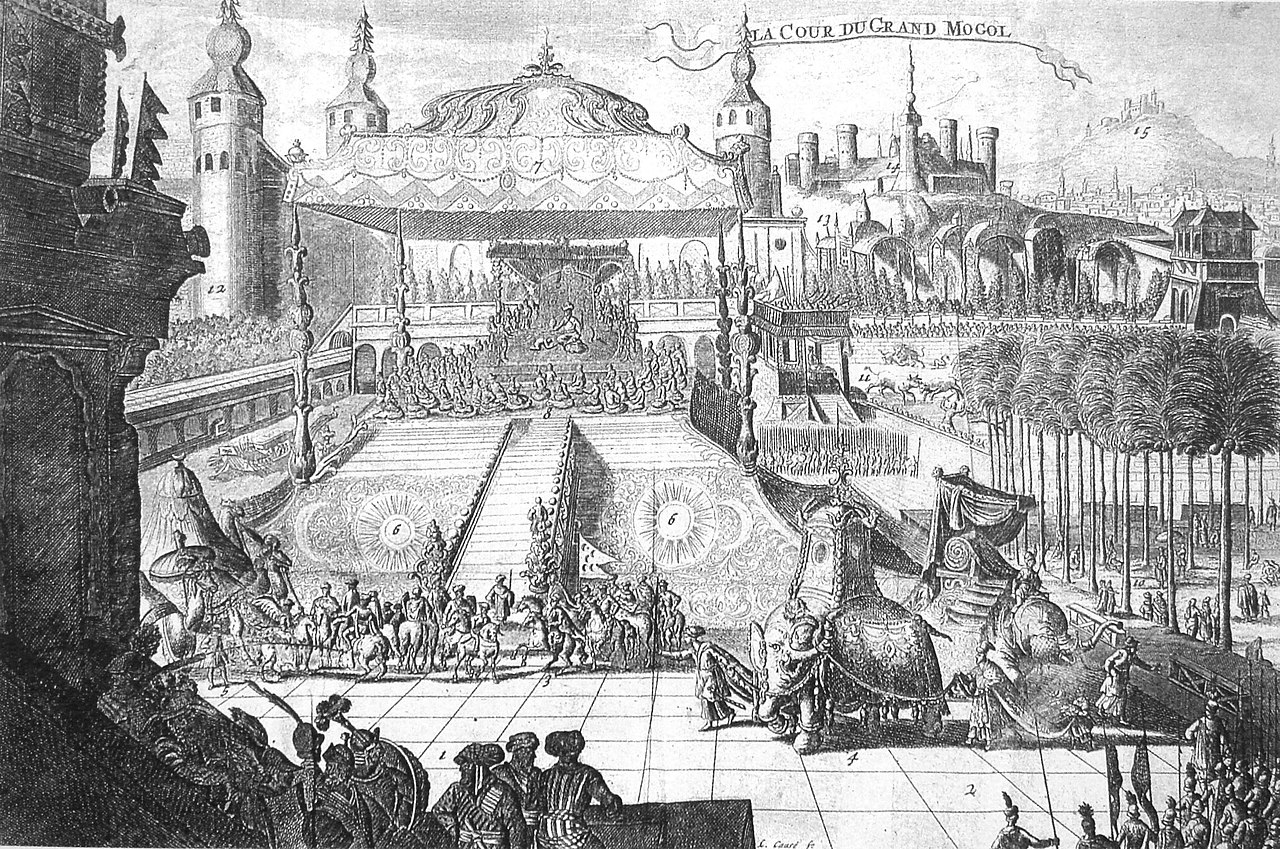 Illustration from the Voyages .... by François Bernier, edition 1710. 'La court du Grand Mogol.'English summary:
The most profitable product of Kashmir are the veils or shawls (châles), made by young children, and produced in large quantities. These shawls are about one and a half el long and one el wide. They are embroidered along both transverse edges with bands of about one foot. The Mughals and Indians, both men and women, wear the shawl around the head in the winter, and leave one end of it hanging down the left shoulder. The shawls are made in two manners: from local wool, which is much finer and softer than Spanish wool, or from the wool, or better: hair, called Touz, from wild goats in Tibet. The latter type is much more expensive than the first, for there is not even the hair of a beaver which is so soft and fine, although the animals can be afflicted by worms or moths. Such shawls are worn by ‘the Great” and Umlahs, and cost some 150 rupiahs, while the shawls made from local wool do not cost more than fifty.
Comments:
Various points can be stressed. Firstly, the Kashmir production of the famous shawls was already well-developed by at least the mid-17th century. This is not altogether surprising, since some written Indian documentation from the sixteenth century already refers to Kashmir shawls, but very little is known about their production until the late eighteenth and early nineteenth century, when Kashmir shawls become a dominant feature in European wardrobes for women and when Kashmir shawls were used as currency in Iran, the Afghan borderlands and India. Secondly, the shawls were called Châles, also in the original French text. I assume this is a plural form for Châl, which is of course nowadays the common word for these products. It likely originates from Persian shâl, شال.
What is also a significant feature Is the distinction made between the Mughals and the Indians. The Mughals were the descendants of Babur and his followers, from Central Asia, who in the early sixteenth century conquered northern India. Francois Bernier, and almost certainly also his Indian/Mughal informers, still separated them from the Indians themselves and regarded them, correctly, as foreign invaders.
Also, the shawls were worn by both men and women. Travelogues from Afghanistan in the early nineteenth century abound with references to Kashmir shawls being given by, and worn by elite Afghan men.
The weaving of the cloths was, according to Dapper/Bernier, carried out by “kleine kinderen” (young children). It is also important to realise that the measurrements given by Dapper (1.5 x 1 el) are not based on the Dutch el, which was about 70 cm, but the French el, which was about 120 cm. The Kashmir shawls correspondingly measured some 180 x 120 cm.
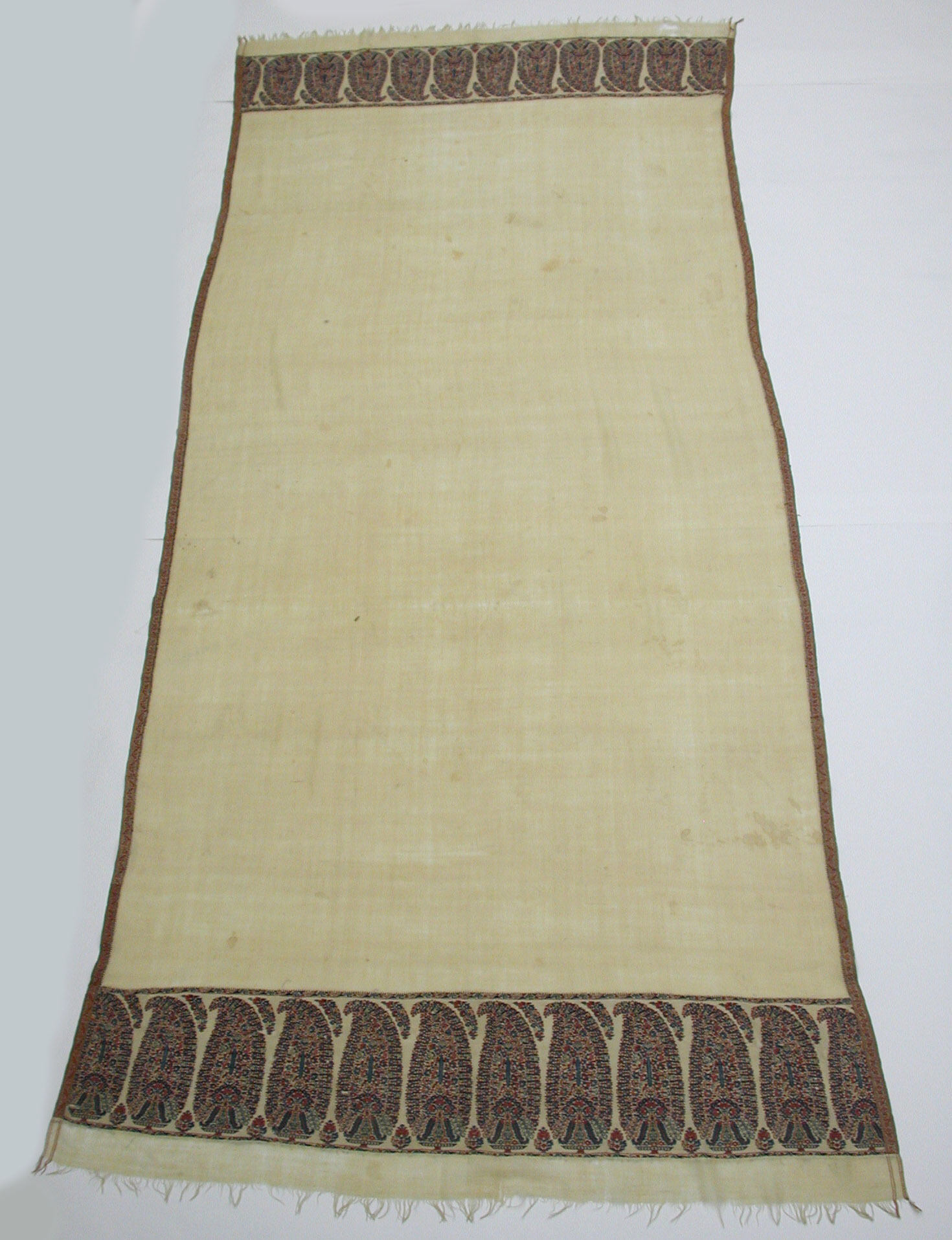 Kashmir shawl made up of various sections sewn together, with woven decoration, late eighteenth century (Courtesy Metropolitan Museum of Art, New York, MMA 1997.319).Furthermore, the Dutch text tells that the decoration of the cloth was embroidered; however, the French text tells the embroidery was worked on the loom, which would mean that it was woven, probably, as with many extant Kashmir shawls, with tapestry weave. Embroidered Kashmir shawls do occur in the nineteenth century, but these may have been imitations and/or cheaper versions of shawls with woven decoration.
The decoration of the 17th century shawls described by Bernier was worked along both transverse edges, and not all over the cloth. We can recognise this subtle use of decoration from an early nineteenth century shawl now in the Metropolitan Museum of Art with woven bands of buteh/paisley motifs (MMA 1975.348.3).
Dapper/Bernier also refers to the locally produced wool, which he says was much finer than Spanish wool. That will be a reference to the wool of the Merino sheep, which for a long time, until the eighteenth century, was a Spanish monopoly.
But there was also the Touz hair. Dapper/Bernier refers in this context specifically to hair, rather than wool. Wool, it should be noted, is the 'underhair' of goats and sheep, and sheep are specifically bred for their underhair/wool. Goats on the other hand are generally bred for their 'top hair', and their top hair and underhair are generally classed as 'hair'. In the case of the ultra-fine Touz 'hair', it was more likely the underhair or wool.
The word Touz is furthermore found in the word Shahtush (‘king’s tuz), which is nowadays the term for the finest quality of Kashmir wool, and indeed, the Chiru antilopes (not goats!) that produce this type of wool, roam, or at least used to roam, the mountains of Tibet and neighbouring Ladakh (between Kashmir and Tibet).
The textiles produced with the wool of this animal have become known as ‘ring shawls’, because the shawls were so fine that they could be drawn through a ring. Dapper/Bernier tells that the shawls made from Touz were worn by the Mughal leaders and the Umlah. The last mentioned word was used to indicate the courtiers and governors in Iran, India an Central Asia, thus also indicating their high quality, their prestige and their huge cost.
Finally, a Kashmir cloth of the finest quality, according to Dapper/Bernier, cost about 150 rupiahs, which in Holland, according to Dapper, by that time equalled (150 x 24 stuivers) 3600 stuivers. By the mid-17th cenury, a stuiver was 1/20 of a guilder. A Kashmir cloth would thus cost 180 guilders. In comparison, a normal day's wages by that time was about one guilder, and a ferry from Harwich to Hellevoetsluis, near Rotterdam, cost 6 guilders. The Touz Kashmir cloth was certainly not cheap!
Again, I am sure this information has been used before, but many of us, including myself, missed it. I will carry on reading Olfert Dapper and see what else he comes up with!
PS: An English translation of Bernier's 1699 edition of 'Travels' was published in London in 1826, with some fascinating footnotes about Kashmir, collected from the travelogue of George Forster, who from 1782 travelled overland from India, via Kashmir and Afghanistan, to Britain.
Willem Vogelsang, 14 January 2022