
On Saturday we were the venue for a meeting of OIDFA (Organisation Internationale de la Dentelle au Fuseau et à l'Aiguille) the Netherlands, an international lace making group. People came from various parts of the Netherlands, including Groningen, Schagen, Amsterdam and indeed the Leiden region.
 Early 20th century example of linen bobbin lace (TRC 2021.2961).
Tea, coffee, biscuits and chocolate cake were waiting for our guests. The day started with a welcome by Gon Homburg who had organised the day. She gave a short introduction about the TRC and OIDFA. This was the followed by a longer talk about the TRC Leiden by Gillian Vogelsang and a visit to the depot. Emphasis was placed on the general work of the TRC.
There was then a guided tour of the TRC’s current exhibition about the Buteh/Paisley motif. Lots of questions and inspiration! Several of the lace makers were wearing paisley shawls, while one of them had brought a sample book of lace she had made, and all the pieces were paisley motifs in various sizes and degrees of complexity!
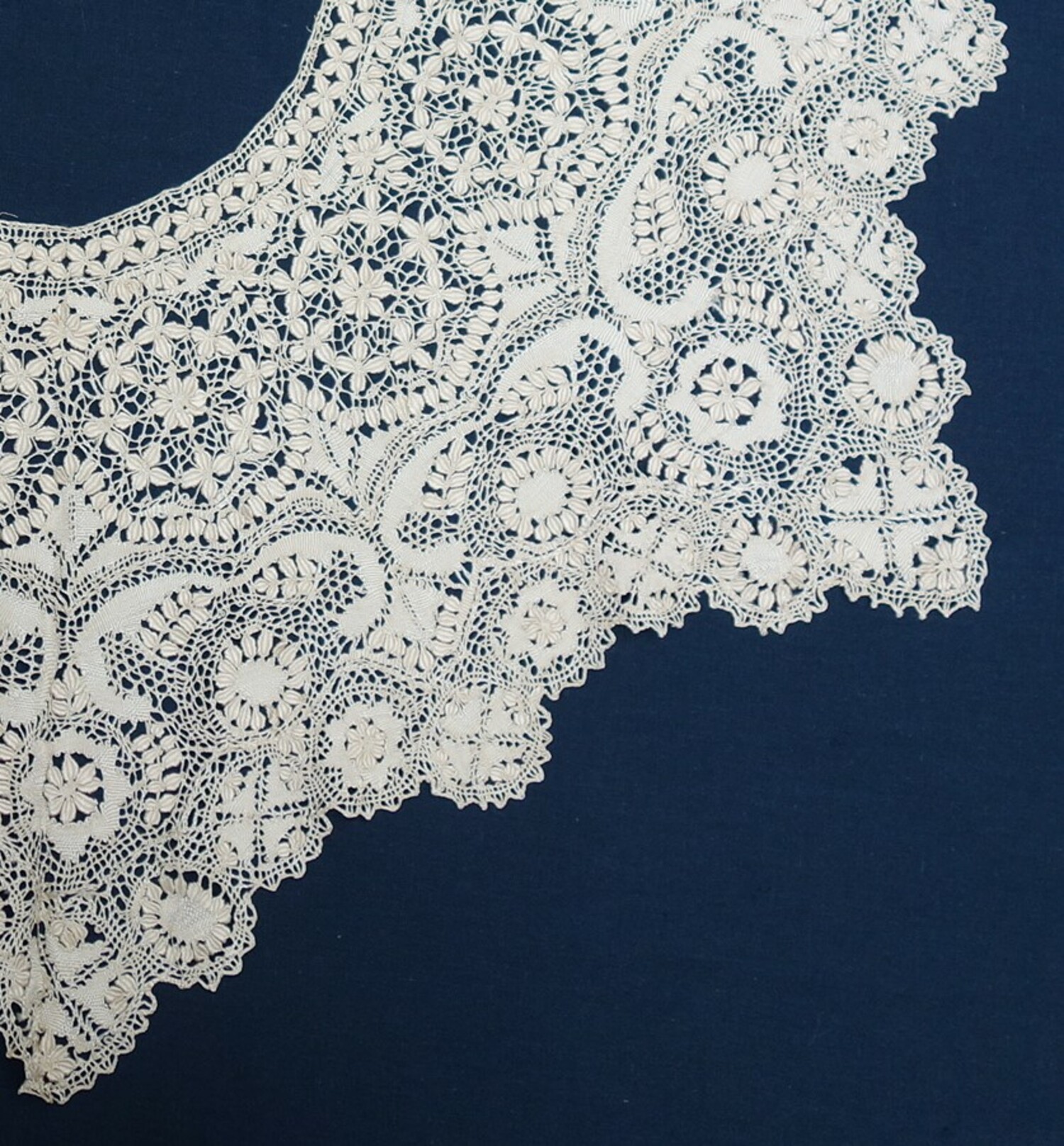 Detail of a bobbin lace collar, Maltese lace in silk, early 20th century (TRC 2020.4423).
After lunch there was a presentation by Olga Ierimina, a TRC volunteer and specialist in bobbin laces. She has given several courses and workshops on the theme of lace identification and the difference between hand-made and machine made forms that resulted in an online exhibition.
Her talk was about her life as a lace maker, how she became involved with lace while in Ukraine and Russia. Later when she came to the Netherlands, lace making was an important method of getting in contact with people. The corona period meant lace was even more important for her, although she missed direct contact with other lace makers. The second half of her talk was about the TRC’s collection of lace, what it consists of, and the diverse nature of the collection (bobbin, needle, knitted, crocheted, tatted, and netted forms).
There then followed a short break during which people visited the TRC Shop and found various ‘treasures’!
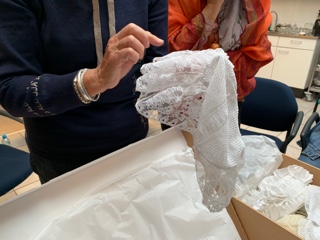 Inspecting a lace cap from the TRC collection.Afterwards we moved the chairs from straight lines to a circle, and had an enthusiastic brainstorming session to discuss how we can work together to improve the TRC lace collection and in particular how to build up an extensive reference collection of both hand and machine forms, and more significantly, how we can work together to make more people aware of lace and to increase the chance of learning about diverse forms of lace making techniques.
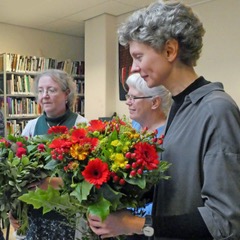 From left to right: Gillian Vogelsang, Gon Homburg and Olga Ierimina.Various people made suggestions about workshops and courses, such as courses on non-West European forms, a workshop on knitted laces, and more lace identification study days. We also want a study day on the identification of the lace used for Dutch lace caps, and lace caps in general.
We have offered the TRC as an easily accessible venue for various meetings, always within a few metres from the TRC depot and its huge textile collection, including many forms of lace from all over the world. Lots to think about – perhaps even a national lace centre in Leiden?
Gillian Vogelsang, 25 October 2021