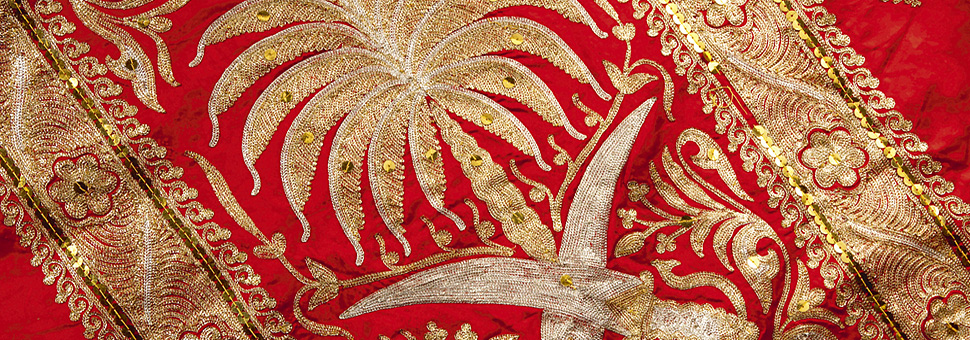
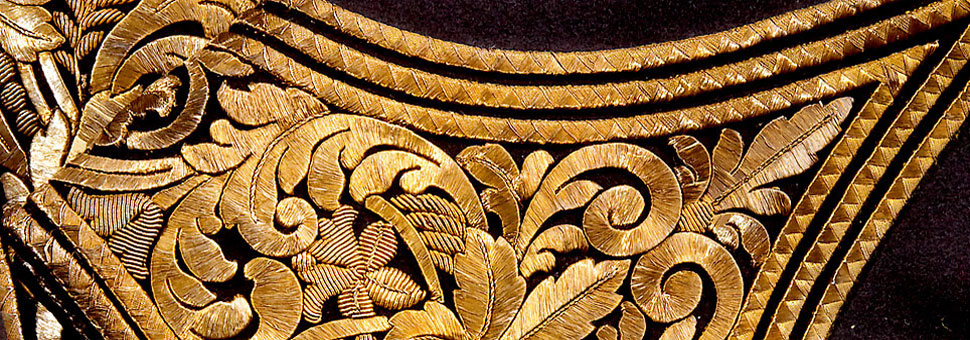
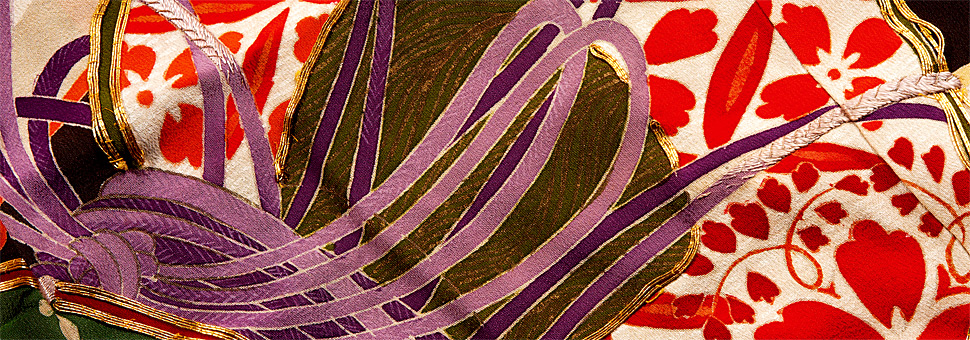
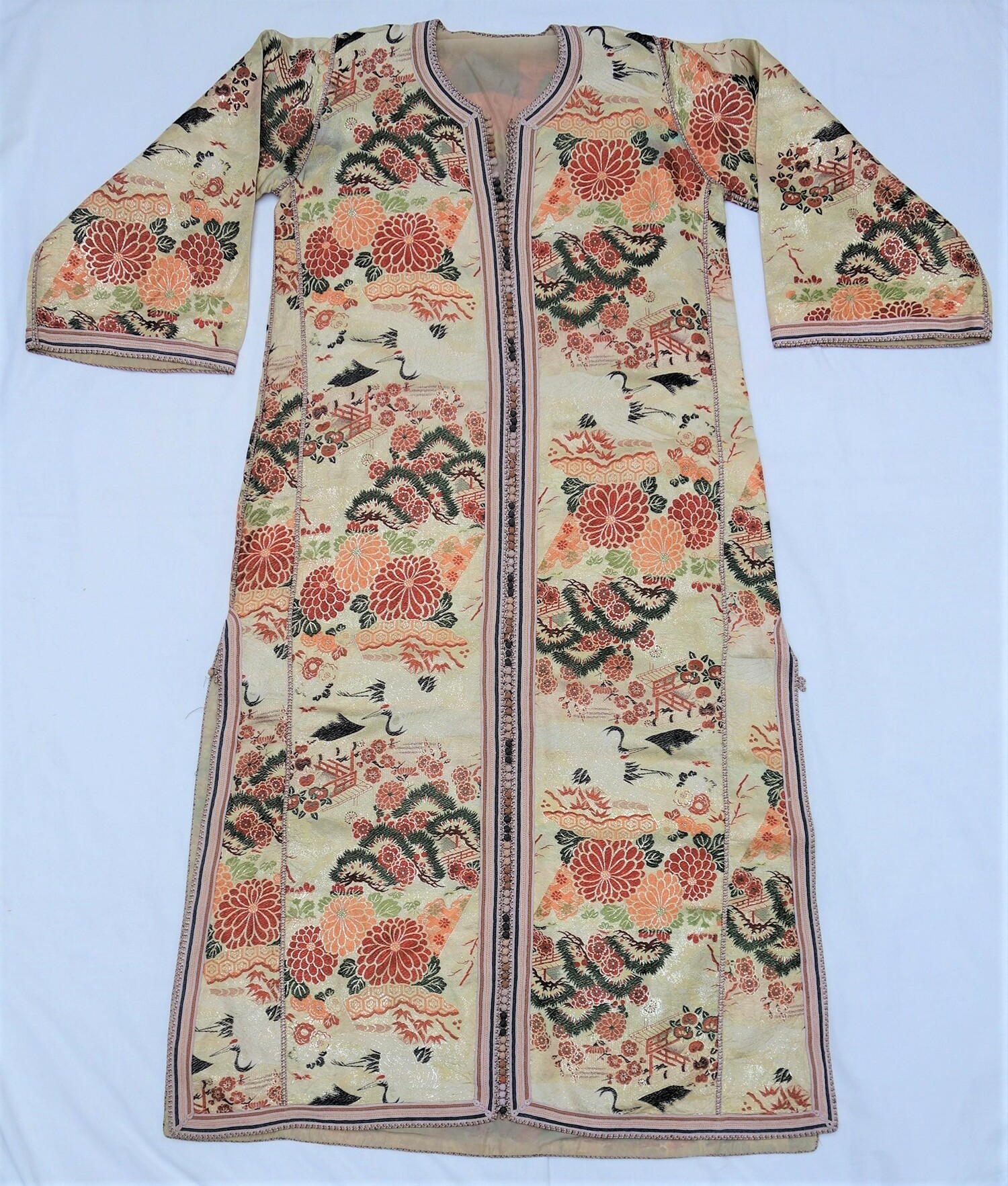
 Traditional Moroccan woman’s kaftan made from Japanese material intended for a kimono sash (second half 20th century). Courtesy Textile Research Centre, Leiden (TRC 2001.0074).The International Institute for Asian Studies (IIAS), Leiden, has just published its Newsletter (summer 2021). It has a special focus section that contains a number of articles based on an international online conference in 2020 about textile and dress traditions that developed through time and space, and thereby often changed their role and meaning.
The conference was organised by the IIAS with the support of Sandra Sardjono of the Tracing Patterns Foundation in Los Angeles, Gillian Vogelsang-Eastwood of the Textile Research Centre in Leiden, and Chris Buckley in Oxford.
The Newsletter can be read here; the focus section covers pp. 29-45. It contains the following contributions:
- pp. 29-30: Textiles on the move, through time and space, Willem Vogelsang
- p. 31: When motion blurs boundaries: made in Vienna, made in Japan, by Marie-Eve Celio-Scheurer
- pp. 32-33: Ancient and medieval Chinese textiles in the Cotsen textile traces study collection, Washington, D.C., Lee Talbot
- pp. 34-35: From buteh to paisley: the story of a global motif, Gillian Vogelsang-Eastwood
- p. 36: A tale of two silks, Anna Jackson
- p. 37 Shōchikubai on the Coromandel: textiles, techniques and trends in transit, Ariane Fennetaux
- pp. 38-39 Unexpected consequences: The Javanese batik collection of Thailand’s King Rama V (r. 1868-1910), Dale Carolyn Gluckman
- pp. 40-41 Kantha forms and transformations, Niaz Zaman and Cathy Stevulak
- p. 42: The Batik Kompeni from Indonesia, Nuning Y Damayanti Adisasmito
- p. 43: Sukajan: crossing cultures, Francesco Montuori
- pp. 44-45: Textiles with a dual heritage, Caroline Stone
Willem Vogelsang, 25 August 2021